PrizePicks review: the payout table against the true odds
PrizePicks turns player props into multiplier entries from $5. We worked out what each Power Play and Flex payout implies, and what a coin-flip pick is really worth.
Our score
6.3/10Rated 6.3 out of 10
Verdict
PrizePicks is easy to use and pays out on a published table, but that table is the story. On picks that are true coin flips, a 6-pick Flex entry returns about 67 cents per dollar and a 6-pick Power Play about 59 cents. You need to beat the line consistently by several points a pick to profit, and most players will not.
Best for
Casual prop fans who treat entries as paid entertainment
Payout multipliers are published in full on the help center
Flex Play gives partial payouts when one or two picks miss
Simple more/less format with no odds to read
Withdrawal options include bank, PayPal, Venmo and debit card
What held it back
At 50 percent per pick, expected return runs from 59 to 75 cents per dollar
Reverted lineups reduce the multiplier when a player is marked DNP
Availability and age rules differ by state and by game type
The app now leans on card packs, which are a separate spending temptation
Pick-em apps sell a feeling: choose more or less on a few players, hit them all, and a $5 entry becomes $187.50. The multipliers are real. So is the arithmetic behind them, and it is published on the help center for anyone who reads it. We read it, then did the sums.
Turning the payout table into a hit rate
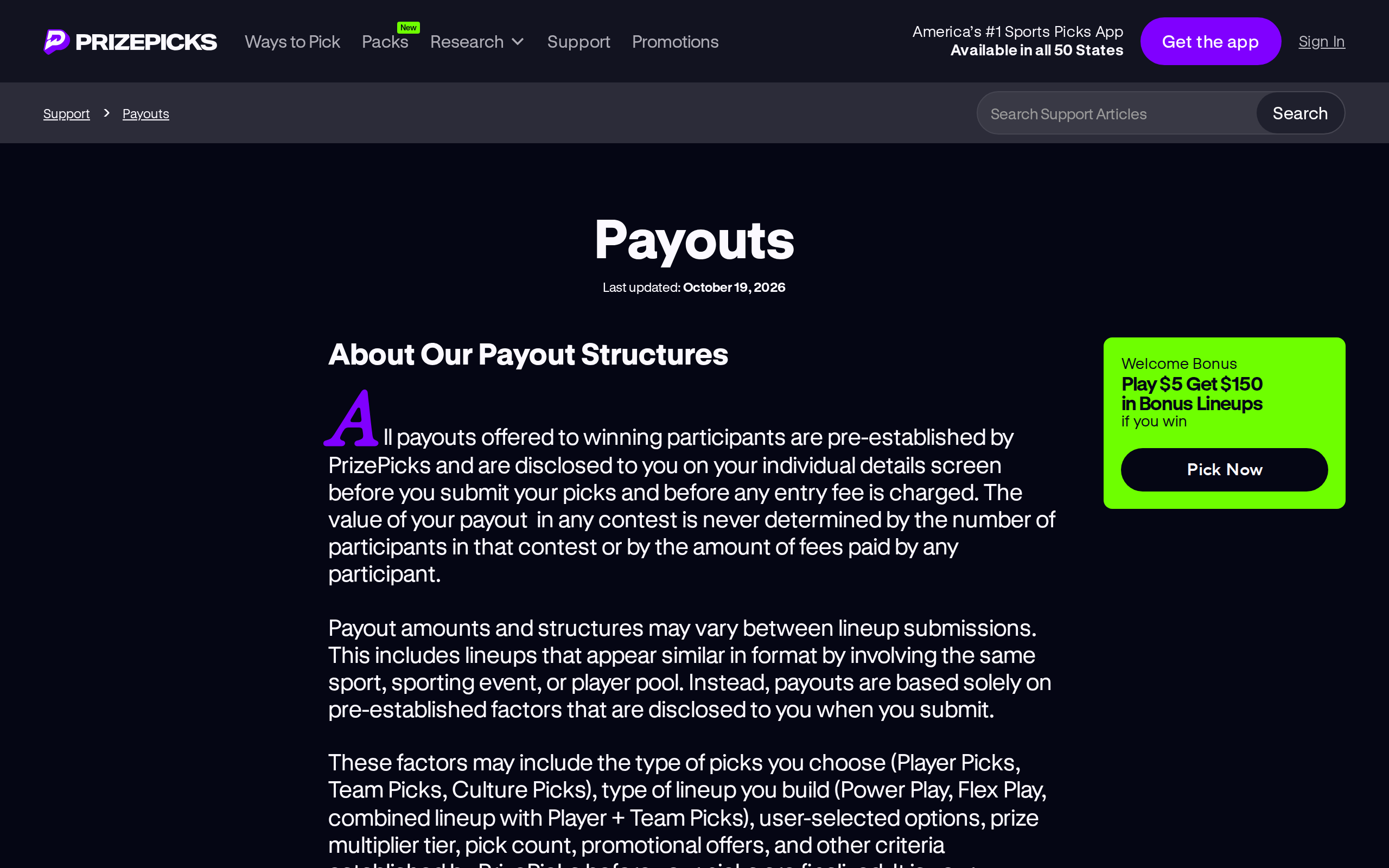
PrizePicks lists two entry types for Player Picks. In Power Play every pick must win. In Flex Play you can miss one or two and still collect something smaller. According to the payouts page, updated October 19, 2026, a Power Play pays 3x on 2 picks, 6x on 3, 10x on 4, 20x on 5 and 37.5x on 6.
The PrizePicks Payouts help page, headed About Our Payout Structures, with the standard rates for Power Play and Flex lineups
Assume each pick is a true 50/50, which is what a fair line aims for. A 2-pick Power Play then wins one time in four, so a fair multiplier would be 4x and PrizePicks pays 3x: expected return of 75 cents per dollar. Run it up the ladder: 3 picks pays 6x against a fair 8x (75 cents), 4 picks pays 10x against 16x (62.5 cents), 5 picks pays 20x against 32x (62.5 cents), and 6 picks pays 37.5x against 64x (about 58.6 cents).
Flex is gentler but not generous. On 6 picks the table pays 25x for a perfect card, 2x for 5 of 6 and 0.4x for 4 of 6. At 50 percent per pick that works out to 43 divided by 64, or about 67 cents per dollar. On 3 picks (3x, 1x for 2 of 3) it is 75 cents. In plain terms, you give up a quarter to two-fifths of every dollar before skill enters.
To break even on a 6-pick Power Play you need each pick to win about 54.7 percent of the time. A 2-pick card needs about 57.7 percent. Those are demanding numbers over hundreds of entries, though not impossible for a bettor who finds lines that are genuinely soft. The point is that the product does not hide the cost, it just does not advertise it.
The reverted lineup rule
One rule changes the maths and is easy to miss. If a player you picked is marked DNP or rebooted, the lineup still counts but the multiplier drops. A 6-pick Power Play becomes a 5-pick one, 5 becomes 4, and so on, and a 2-pick Power Play with a DNP becomes a refund. That is better than a loss, but notice the direction: your payout shrinks while the odds against you on the remaining picks stay the same.
Where you can play, and at what age
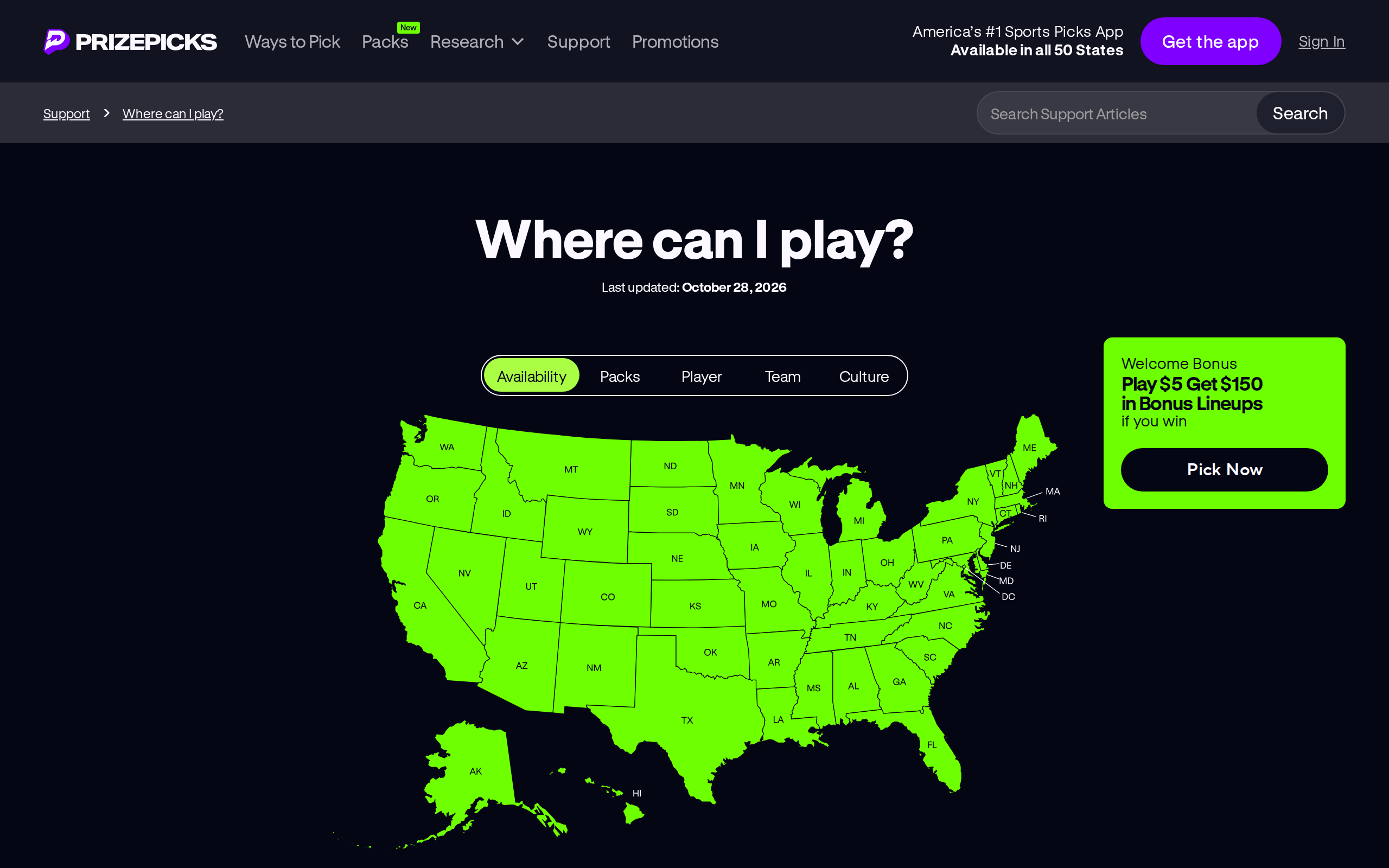
The Where can I play? help page, last updated October 28, 2026, which lists the states and age limits for each game type
Eligibility is the second thing to check. The help center says Player Picks, described there as a daily fantasy sports game, are available in 36 states plus Washington D.C. The age floor is 18 in most states, 19 in Alabama and Colorado, and 21 in Arizona, Illinois, Massachusetts and Virginia. Team Picks and Culture Picks are different: they are event contracts through PrizePicks Predict, need a separate account, and have their own state lists. Rules change, so read the page for your state before you deposit.
Getting your money out
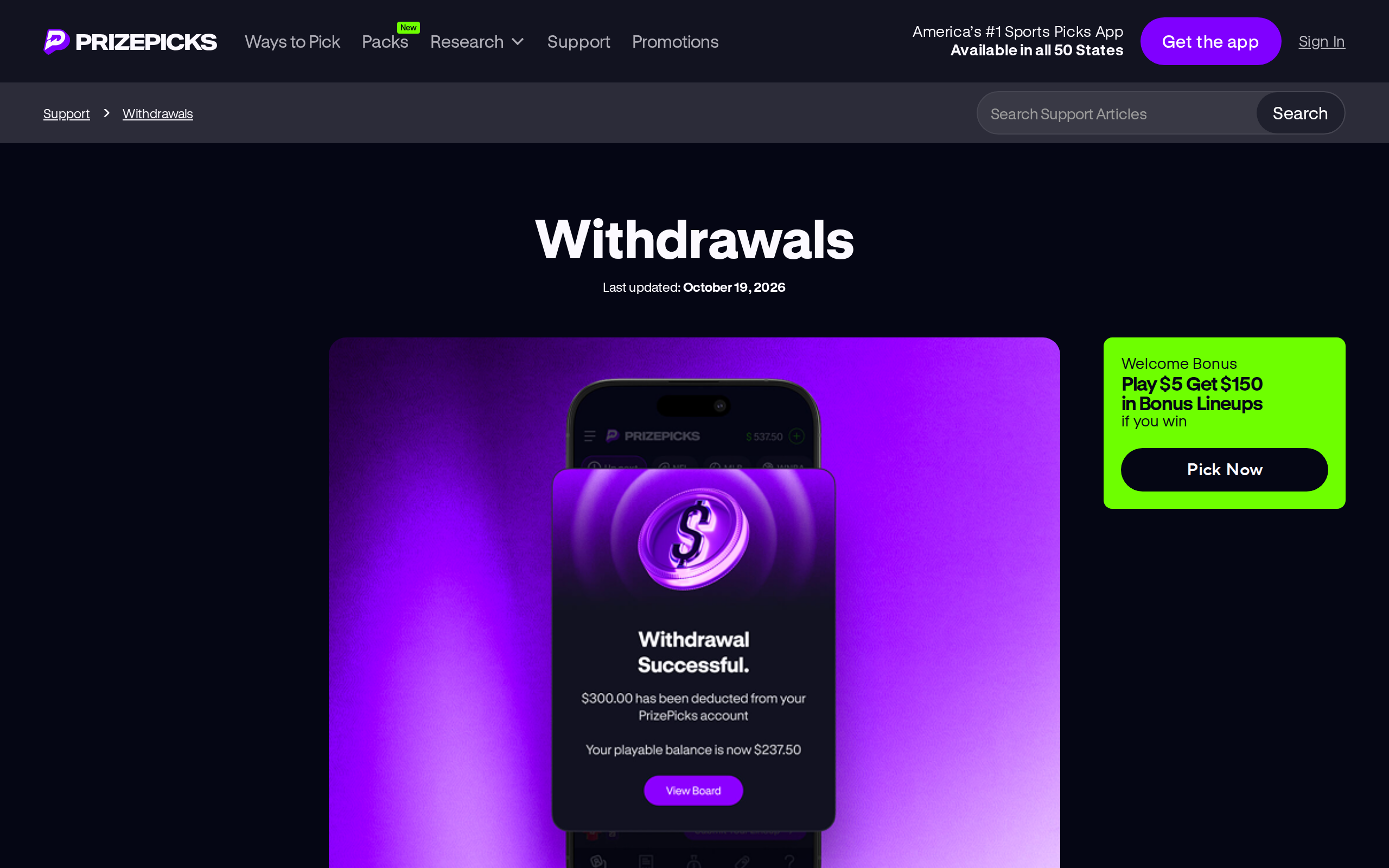
The Withdrawals page, which says a verified bank account is the default method and explains how to add PayPal, Venmo, Apple Pay or a debit card
Withdrawals default to a verified bank account, and you can add PayPal, Venmo, Apple Pay or a debit card by depositing with that method. Some cards, such as Discover, are deposit-only. A one-time passcode by email confirms each request. We did not time a payout ourselves, so we cannot give you a speed figure, and you should treat any quoted timeline as the company's, not ours.
What the app is turning into
The homepage no longer leads with player props. Its headline pushes card packs, "Pull million-dollar cards" with packs from $1, alongside $5 and $25 price points. That is a separate product with its own pull of chance, and it is easy to drift into. A budget you set for props should cover everything in the app.
A PrizePicks Playbook article, a Trail Blazers vs Lakers NBA Cup prediction with a featured articles list
The Playbook section offers free previews and picks. They are useful for context, but they come from a company that earns when you enter, so weigh them as you would any tout.
Who this suits
PrizePicks suits someone who enjoys the player-prop format, sizes entries like a night out, and likes Flex's cushion. It does not suit anyone hoping a $5 habit becomes income: the structure takes a clear slice, and the best-case number is a long shot by design. If you want to bet props with a visible price, a sportsbook's prop market lets you shop lines, though it carries its own margin. Betting carries real risk of loss and none of this is financial advice.