Polymarket Review 2026: Sports Fees, Liquidity and Kalshi
Polymarket Review: Cheap Sports Contracts, Thinner US Depth Than Kalshi
Polymarket charges takers 5% of p x (1-p) on sports and nothing on makers. We ran the fee maths against Kalshi and a standard -110 sportsbook line to see who really pays less.
Our score
7.3/10Rated 7.3 out of 10
Verdict
Polymarket is the cheapest place we found to take a position on a game, because its sports taker fee peaks at 1.25 cents per share and makers pay nothing. The catch is depth: outside headline events the order book is thin, and US users face a separate, narrower app than the global site.
Best for
Cost-aware traders who can make limit orders and read an order book
Sports taker fee tops out at 1.25 cents a share, under Kalshi's 1.75
Makers are never charged and earn a daily rebate of the fees collected
Geopolitical and world events markets carry no fee at all
Free USDC deposits and withdrawals, with only third-party costs
Public accuracy page and full documentation for the fee formula
What held it back
Fees are charged on top of the spread, which is wide on small markets
US access runs through a separate regulated app with a narrower list
Prices are probabilities in cents, an adjustment for sportsbook bettors
Some state regulators dispute that game-outcome contracts are legal
Start with the arithmetic, because that is where Polymarket wins or loses the argument. A sportsbook that posts -110 on both sides of a game keeps about 4.5% of the money in the market. Polymarket sells you a share of "Yes" at a price in cents, and the sports fee on top of that price is written down in one line of its documentation. We worked it through for the sports markets most US bettors care about.
The fee formula, in dollars
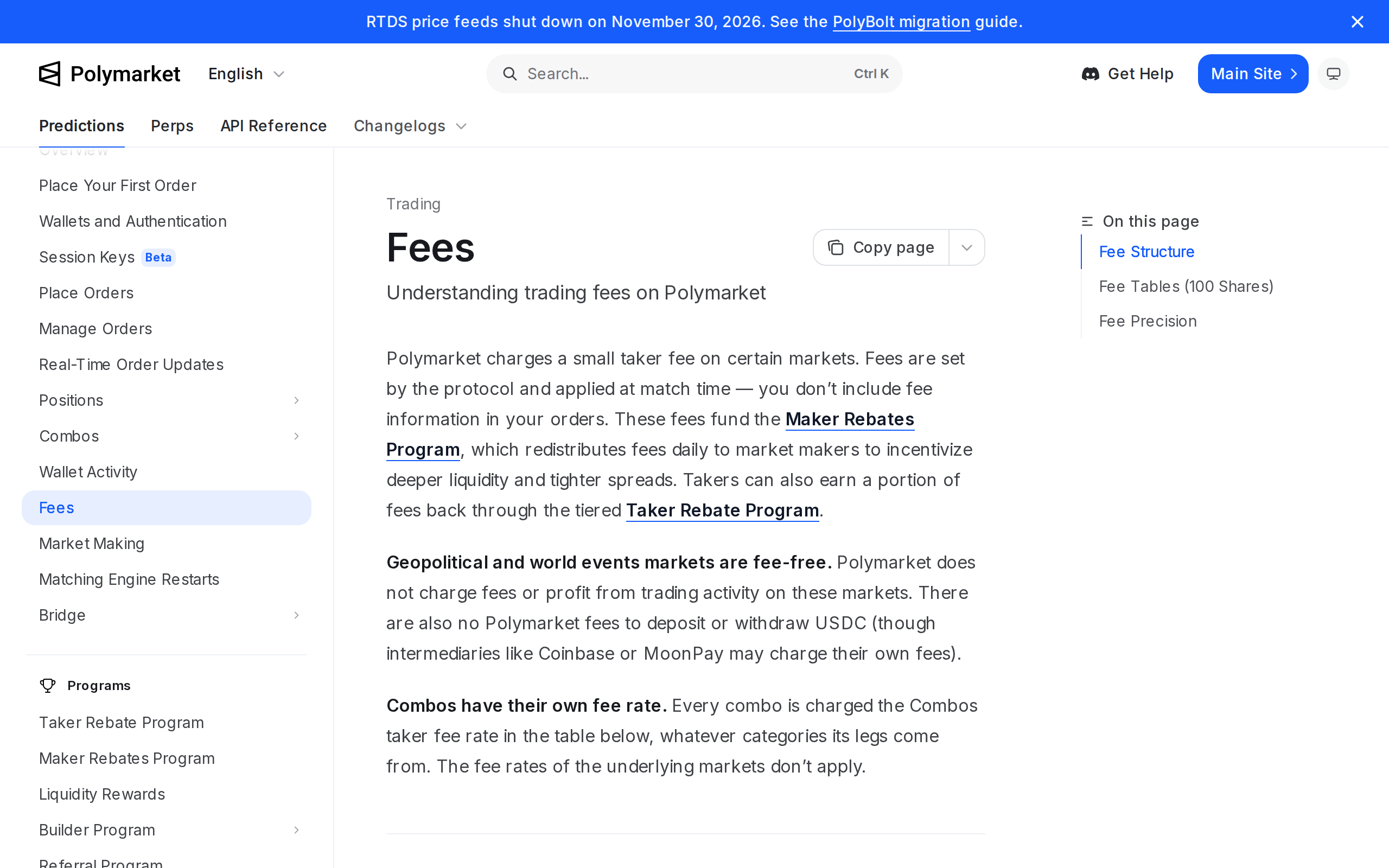
The fees page gives the rule: fee = shares x feeRate x p x (1 - p), where p is the share price between 0 and 1. For sports the feeRate in the table is 0.05. Crypto is 0.07 and finance is 0.04. Only takers pay it, and the docs say makers are never charged.
The Fees page of the Polymarket documentation, with the taker fee formula and the category table.
What that means for 100 shares:
At 50 cents ($50 staked), the fee is 100 x 0.05 x 0.25 = $1.25, or 2.5% of the stake.
At 80 cents ($80 staked), it falls to $0.80, or 1% of the stake.
At 20 cents ($20 staked), it is also $0.80, which is 4% of the stake.
The fee is symmetric around 50 cents and peaks there, so a heavy favourite is cheap to back and a longshot is the expensive end. Compare that with a secondary guide's account of Kalshi's rule, 0.07 x contracts x p x (1 - p) with a cap: the same 50-cent trade costs $1.75. On our numbers Polymarket's sports taker fee is about 29% lower than that. Treat the Kalshi side as a secondary figure and check Kalshi's own schedule before you trade.
Two further details matter. Geopolitical and world events markets are fee-free, and Polymarket says it does not profit from trading there. And deposits and withdrawals in USDC carry no Polymarket charge, although a card on-ramp or exchange may add its own.
The cost the fee table does not show
A low fee is not the same as a low cost. You also pay the spread, the gap between the price you can buy at and the price you can sell at. On a marquee event the book is tight and the spread is a cent or less. On a smaller market it can be several cents, and then it swamps the fee.
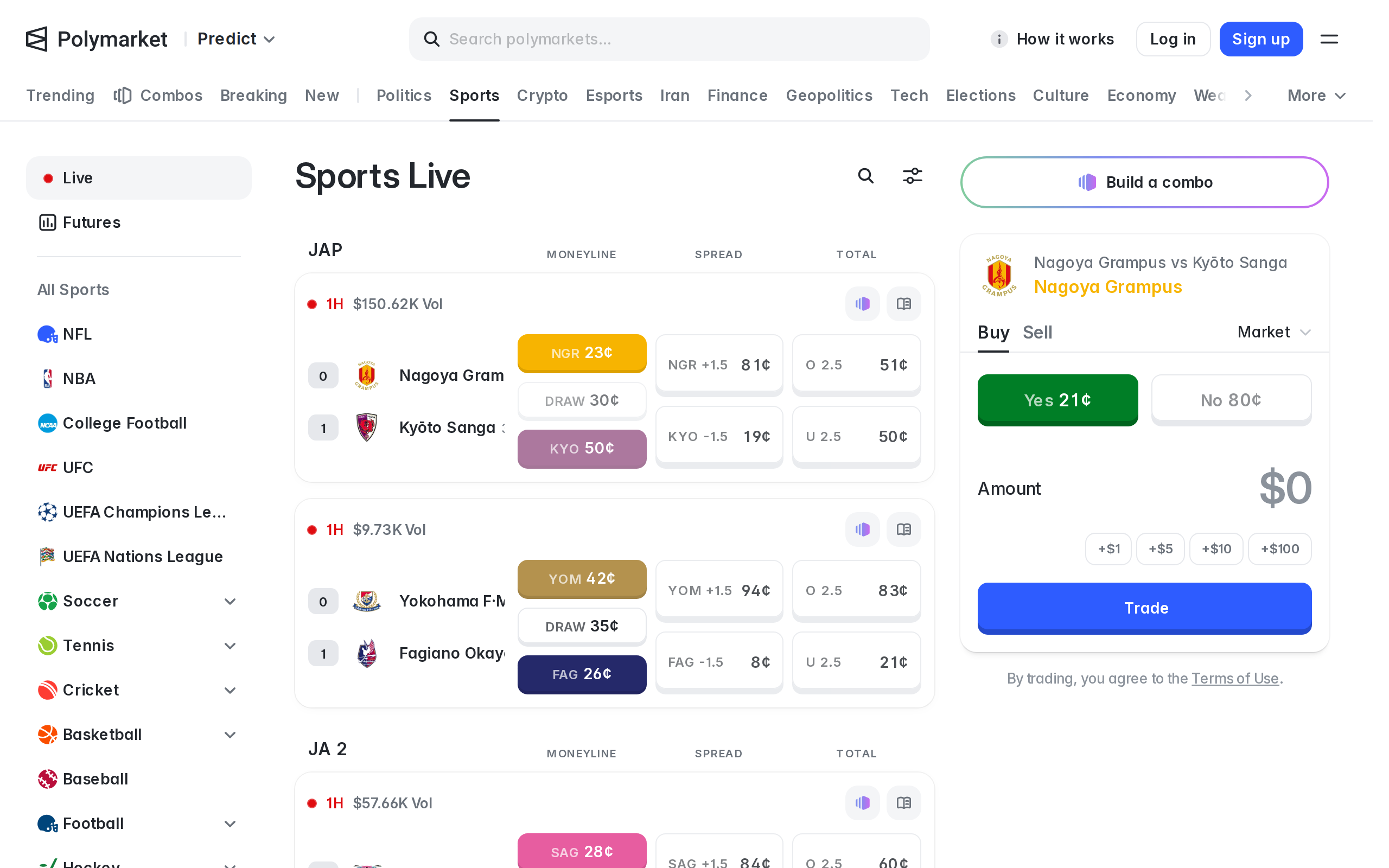
The Sports hub: live games with outcome prices quoted in cents, so the spread is visible before you trade.
The sports hub shows live games with each outcome priced in cents, and that display is honest about the thing a sportsbook hides: the two sides of a game here should add to about 100 cents, and the shortfall or excess is your real margin. We looked at it the way we look at any book, by adding both sides before anything else. Where the two prices sum to 101 or 102, you are paying for the privilege.
The practical rule we would give any reader is simple. Use limit orders. A maker pays no fee and picks up a rebate (the table lists 15% for sports), while a market order crosses the spread and pays the taker fee as well. The platform is built for people who will wait for a fill, and a bettor used to tapping a price and getting it instantly is paying for that habit.
Liquidity: deep in headlines, thin elsewhere
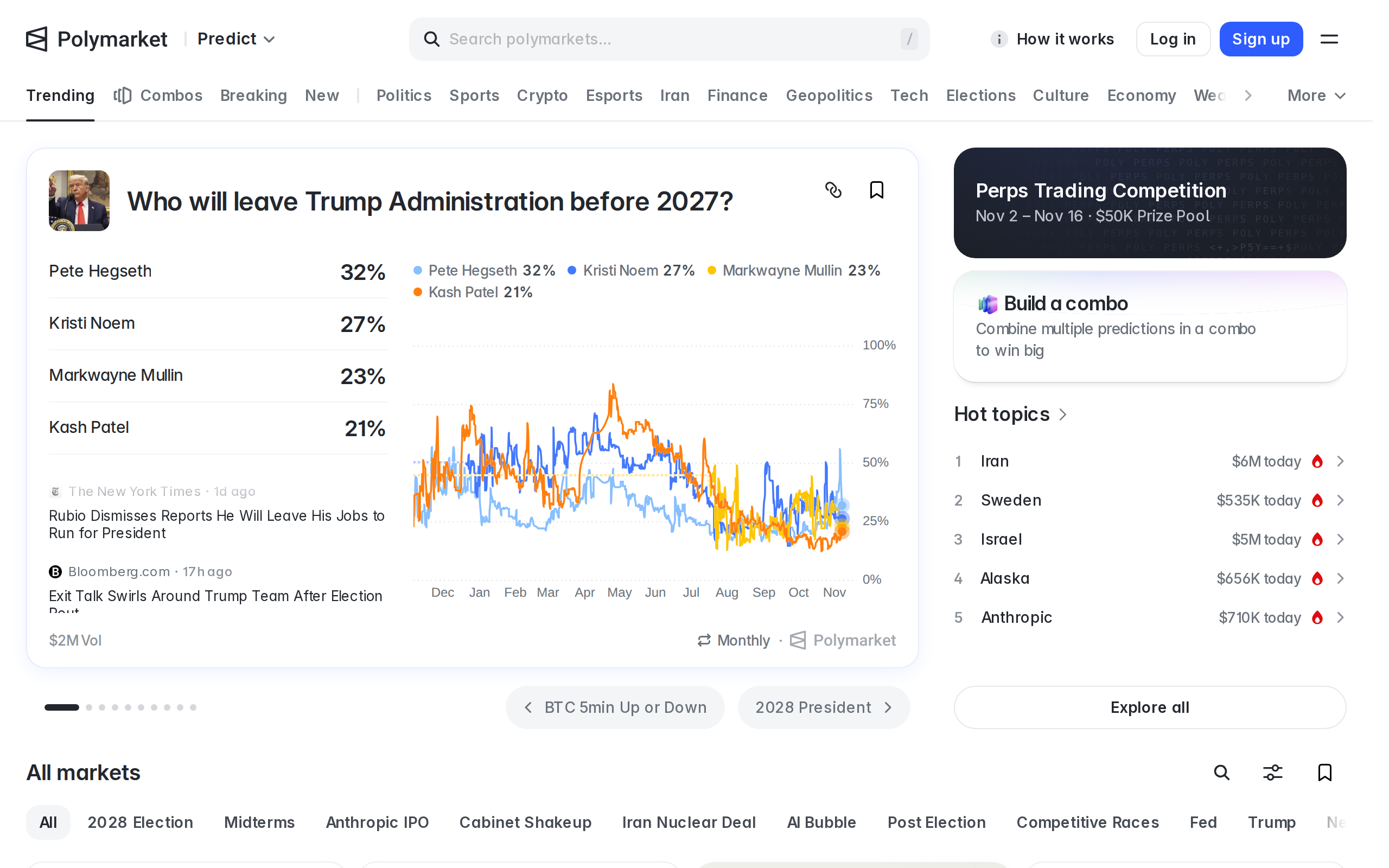
Polymarket's strength is the long tail of questions a sportsbook will never price: who leaves an administration, who wins an election in 2028, whether a team wins a conference. The homepage is a mix of politics, news and sport, and the Build a combo section lets you chain legs.
On US sports specifically, independent write-ups we found say Kalshi has the deeper lineup across the NFL, NBA, MLB, NHL and college sports, while Polymarket US has a narrower selection and tighter liquidity outside the biggest events. That matches how we would expect a newer entrant to look. We could not confirm current order-book depth for individual games from the public pages alone, so we will not quote one.
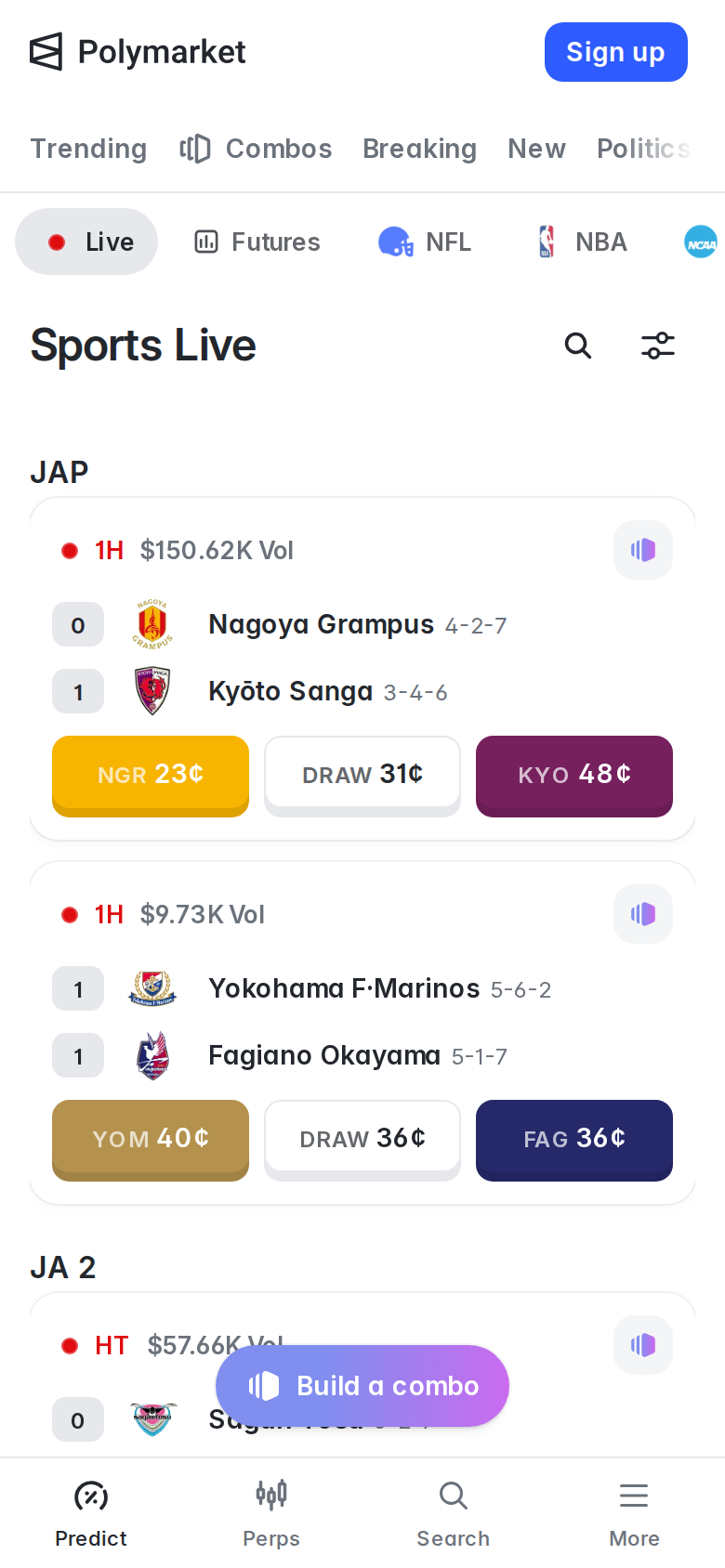
The same Sports hub at phone width, which is how most US users reach the platform.
US access: read this part twice
The global site and the US product are not the same thing. Reporting from late 2025 describes a US relaunch through a CFTC-regulated structure, opening first to waitlisted users with sports contracts and a mobile-only experience. Coverage also notes that several states argue game-outcome contracts are really sports betting under state jurisdiction. State availability has shifted over time, so check the current list in the app or on Polymarket's US help pages before you assume you can use it.
If you can reach the global site, the capture above is what it looks like. If you are in the US, expect fewer markets than the screenshots suggest.
Accuracy and the developer angle
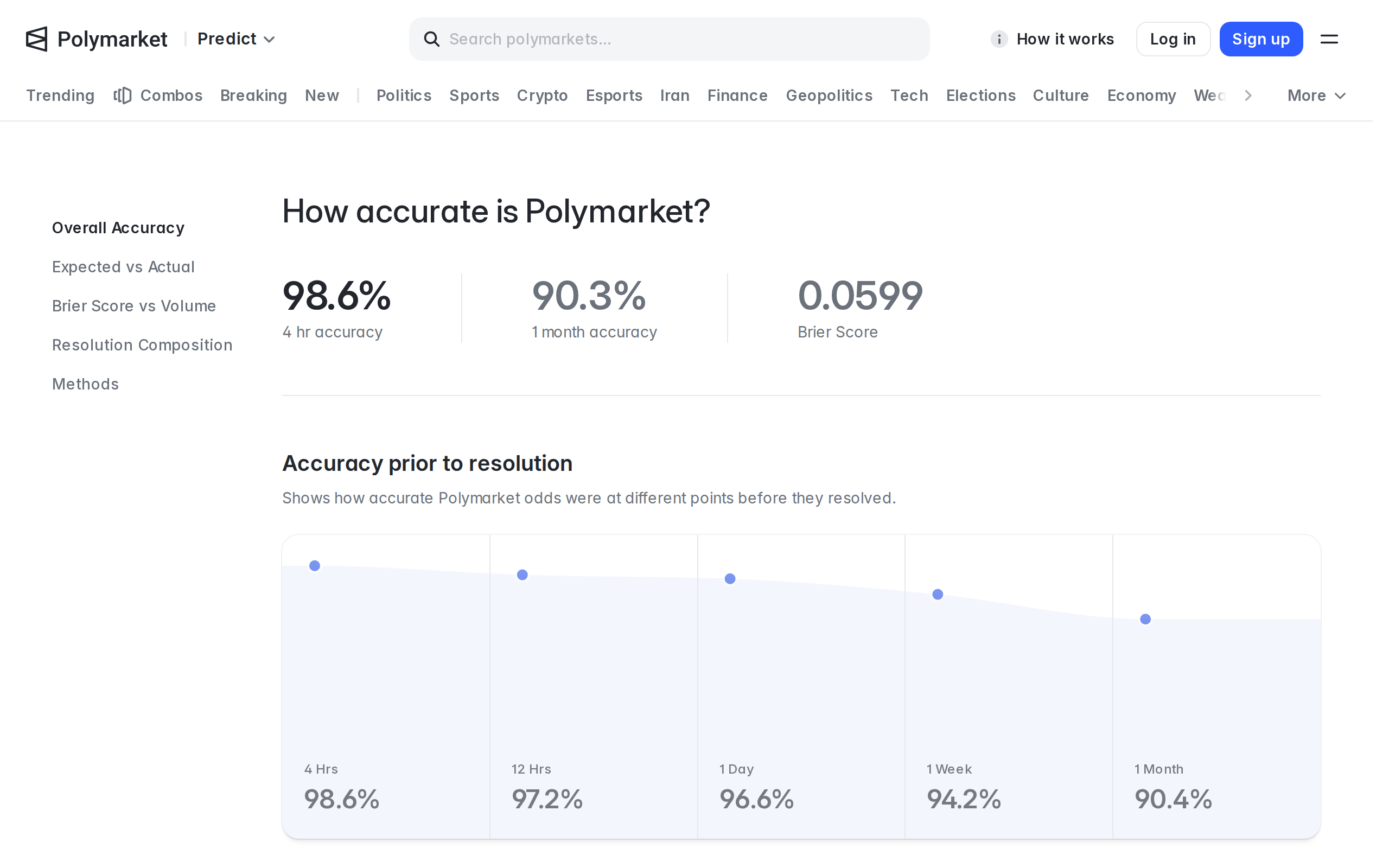
Polymarket publishes an accuracy page that charts how close its odds were to outcomes at different points before resolution. It is marketing, but it is verifiable marketing, which is more than most books offer.
The accuracy page, with its chart of how well Polymarket odds predicted outcomes at different times before resolution.
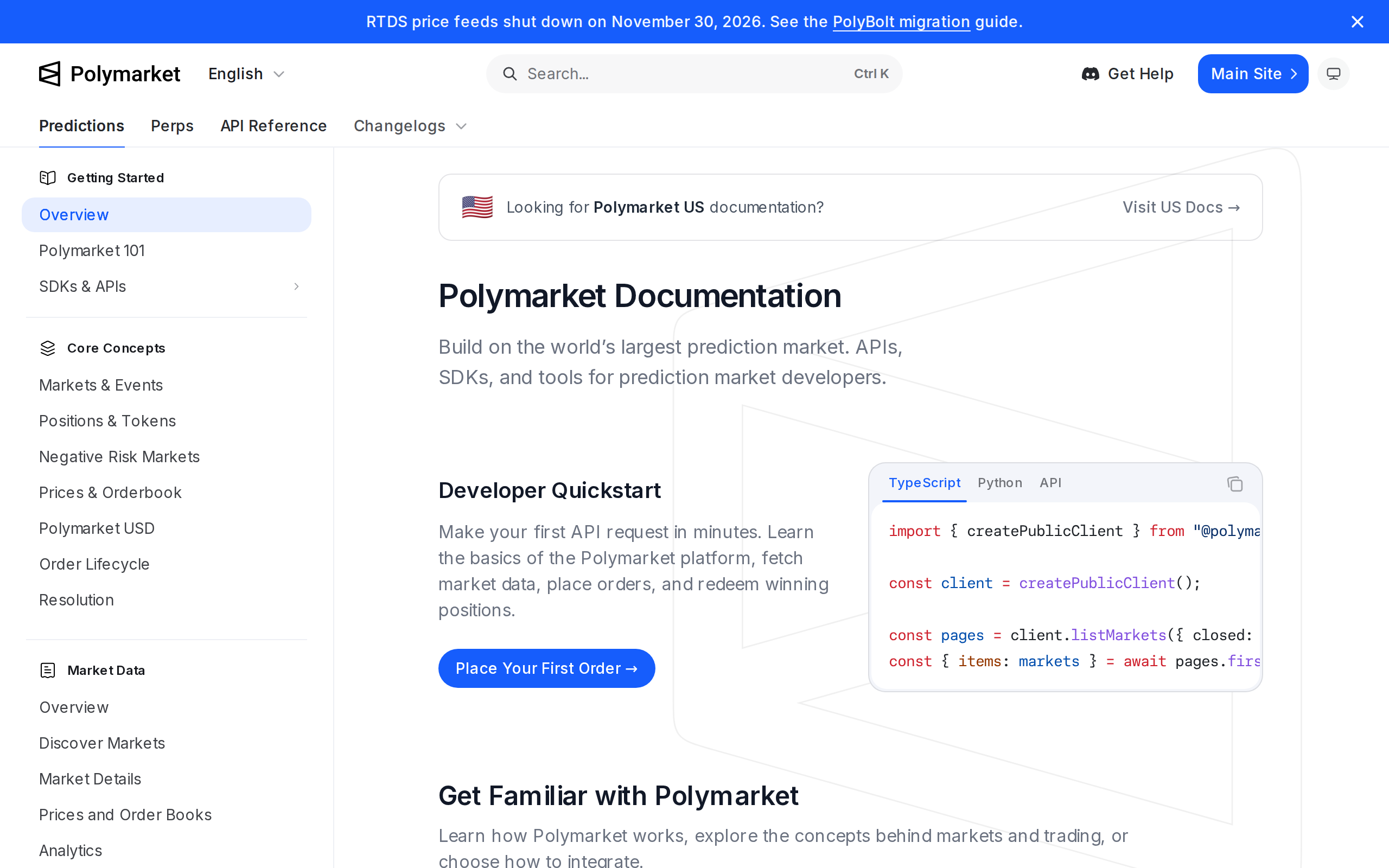
The documentation is thorough too, with sections on getting started, core concepts and market data. Anyone who wants to automate limit orders can read how.
The documentation overview, with Getting Started, Core Concepts and Market Data sections.
Verdict
Polymarket is the cheaper way to hold a view on a game if you are patient, use limit orders and live somewhere it operates. It is a worse fit if you want a sportsbook's instant fills, player props and same-game parlays on every fixture. We rate it 7.3: low and transparent costs, held back by thin depth outside headlines and an unsettled US legal picture.
Prediction market trading carries a real risk of loss, and you can lose your whole stake. Nothing here is financial advice: it is a comparison of published fees, and your own limits should decide how much you trade.