Pinnacle Review: Low Margins, Limits And Where It Works
Pinnacle Review: Low Margins Still Set The Benchmark, But Access Is The Catch
Pinnacle built its name on thin margins and a welcome for sharp bettors. We check what that reputation rests on, what it costs to withdraw, and where you cannot use it.
Our score
8.2/10Rated 8.2 out of 10
Verdict
Pinnacle is still the cleanest price on most major markets, and its history of taking sharp action is the reason the rest of the industry copies its lines. Where it is licensed and legal for you, it deserves a place in a serious bettor's rotation. Where it is not, there is nothing to review, and the withdrawal fee reports we found are inconsistent enough that you should read the cashier page before depositing.
Best for
Bettors who price lines and want the lowest margin
Reduced-margin pricing since launch, about -105 or -104 on spreads and sides instead of the usual -110
Reviewers put typical margins at about 2 to 3 percent against roughly 5 percent elsewhere
Its lines are the market reference that other books and tools compare themselves to
Free betting tools: margin, arbitrage, bet and odds calculators plus a deep articles library
Broad soccer and esports coverage, with a separate API product for developers
What held it back
Not available to US residents: it left the US market on January 11, 2007
Sources disagree on withdrawal fees, from about $5 to $12, and one reports a rule tied to deposit turnover
Licensed from Curacao with a Maltese Class II sports licence, not a UK or US regulator
Bare-bones interface with few of the promotions and boosts that mainstream books use
Most sportsbook reviews talk about bonuses. Pinnacle does not need to, and that is the point. The question that matters here is whether the old promise still holds: a small margin on every market and no fuss when you win.
The margin is the product
A standard US-style spread is priced at -110 on both sides. Add the two implied probabilities and the book keeps about 4.5 percent. Pinnacle launched in 1998 pricing the same markets at -105 and -104, and Wikipedia's account of the company says it makes its money on lower margins and higher turnover. Independent reviewers still put its typical margin at about 2 to 3 percent, against roughly 5 percent at many rivals.
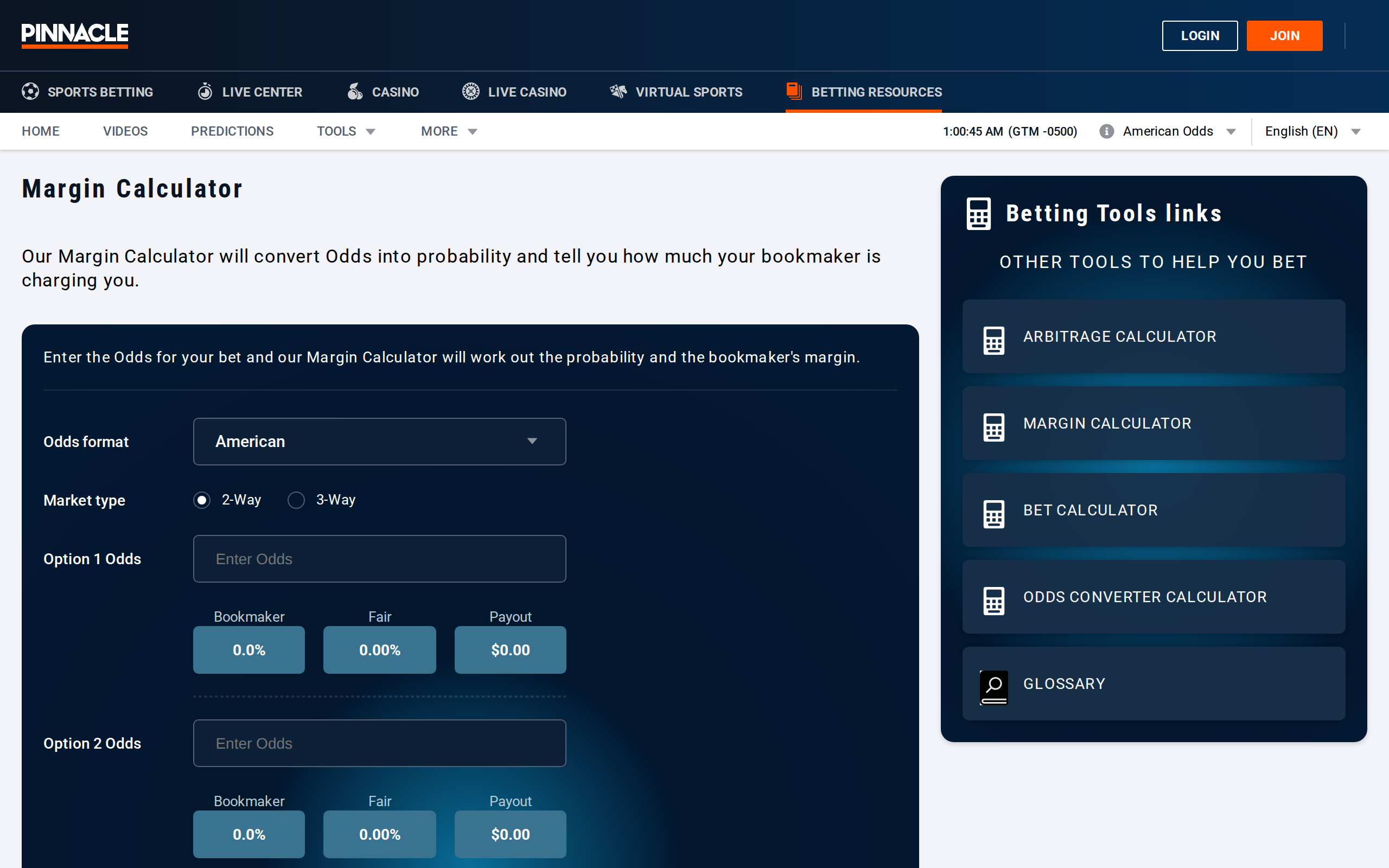
The site gives you the tool to check this yourself. Its Margin Calculator takes the odds you enter, converts them to probability and tells you how much the bookmaker is charging.
The Margin Calculator turns your odds into implied probability and shows the margin.
We would encourage you to run the same three-way soccer market through this calculator at Pinnacle and at your current book. The difference is rarely dramatic on a single bet. Over a few hundred bets at even stakes, it decides whether you can break even.
What the soccer board looks like
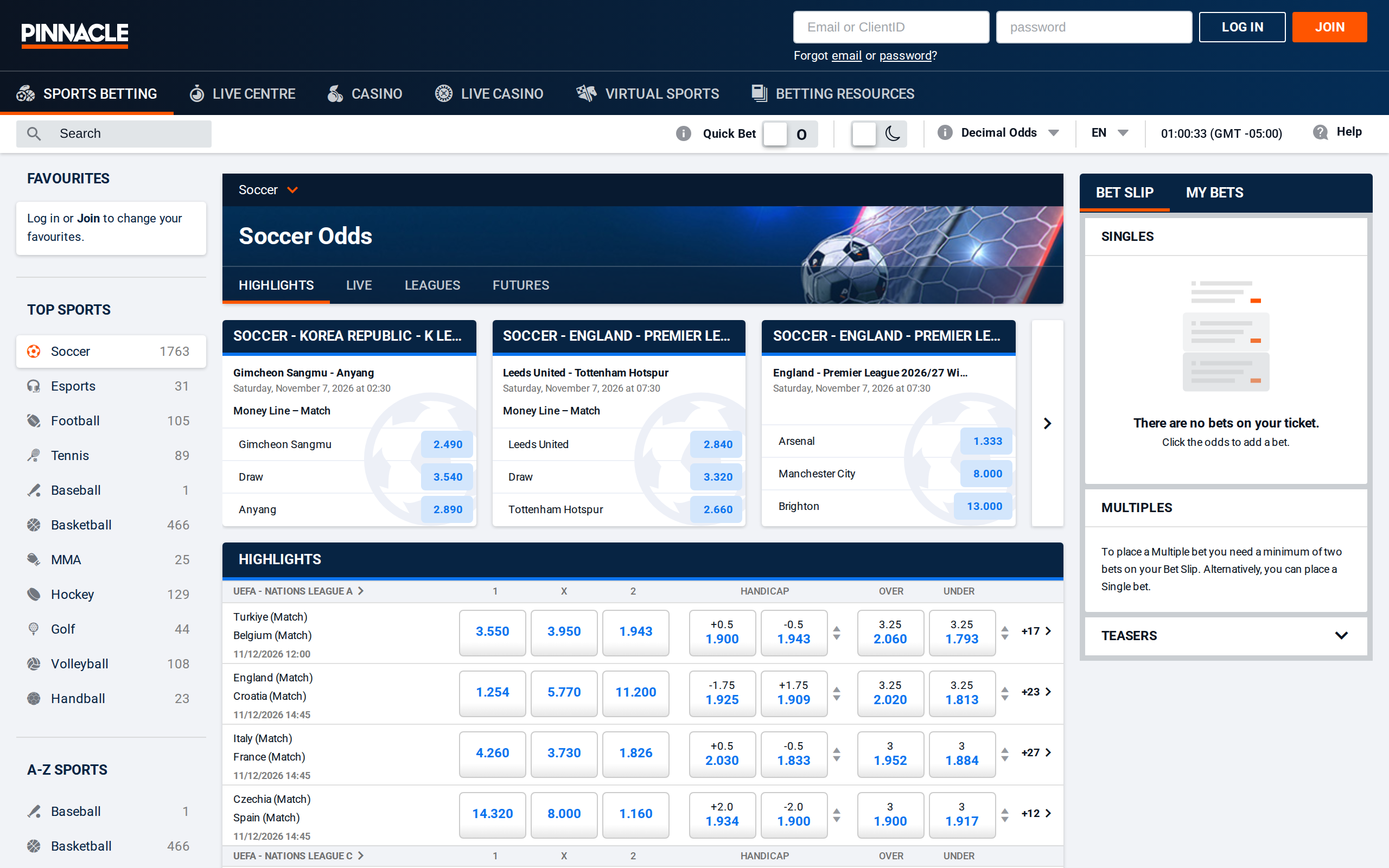
Soccer is where the thin margin helps most, because the three-way market hides a lot of vig at ordinary books.
The soccer odds page, with highlights and a menu of favourites and top sports.
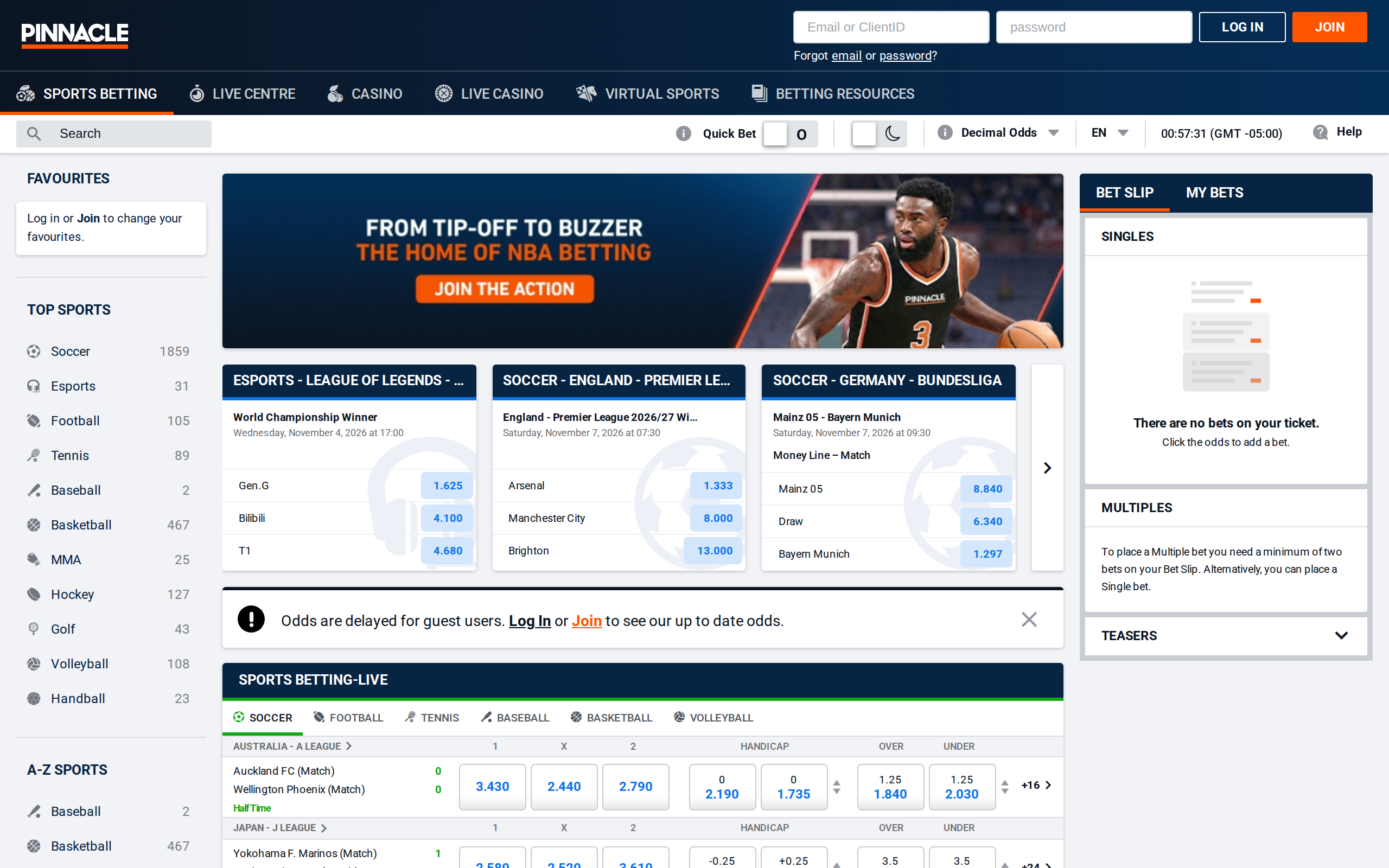
The layout is plain. You get a sports list, a matchups board and a slip. There are no flashy boosts, and the home page carries only banners for the NBA, a CS2 event and casino games. If you want parlay insurance and profit boosts, you will be bored. If you want to know what the true price is, you will be fine.
A library that teaches you to bet
The betting resources section is worth bookmarking even if you never deposit. It holds a glossary, tools, predictions, videos and long articles such as one on golf odds and probabilities, and another that uses the Poisson distribution to predict scores at the 2026 World Cup.
The Betting Resources home page: articles on golf odds, side bets and a Poisson score model.
This is the nearest thing to a house philosophy on show. It treats the customer as someone who can do the arithmetic. That attitude is also why the bookmaker has a reputation for tolerating winners, though we found no written policy on limits and Wikipedia describes none. What it does describe is the book moving its opening lines based on early low-limit bets from sharp players. Read that as: your action helps set the price, which is a different thing from being left alone.
Arbitrage and the bettor's tool belt
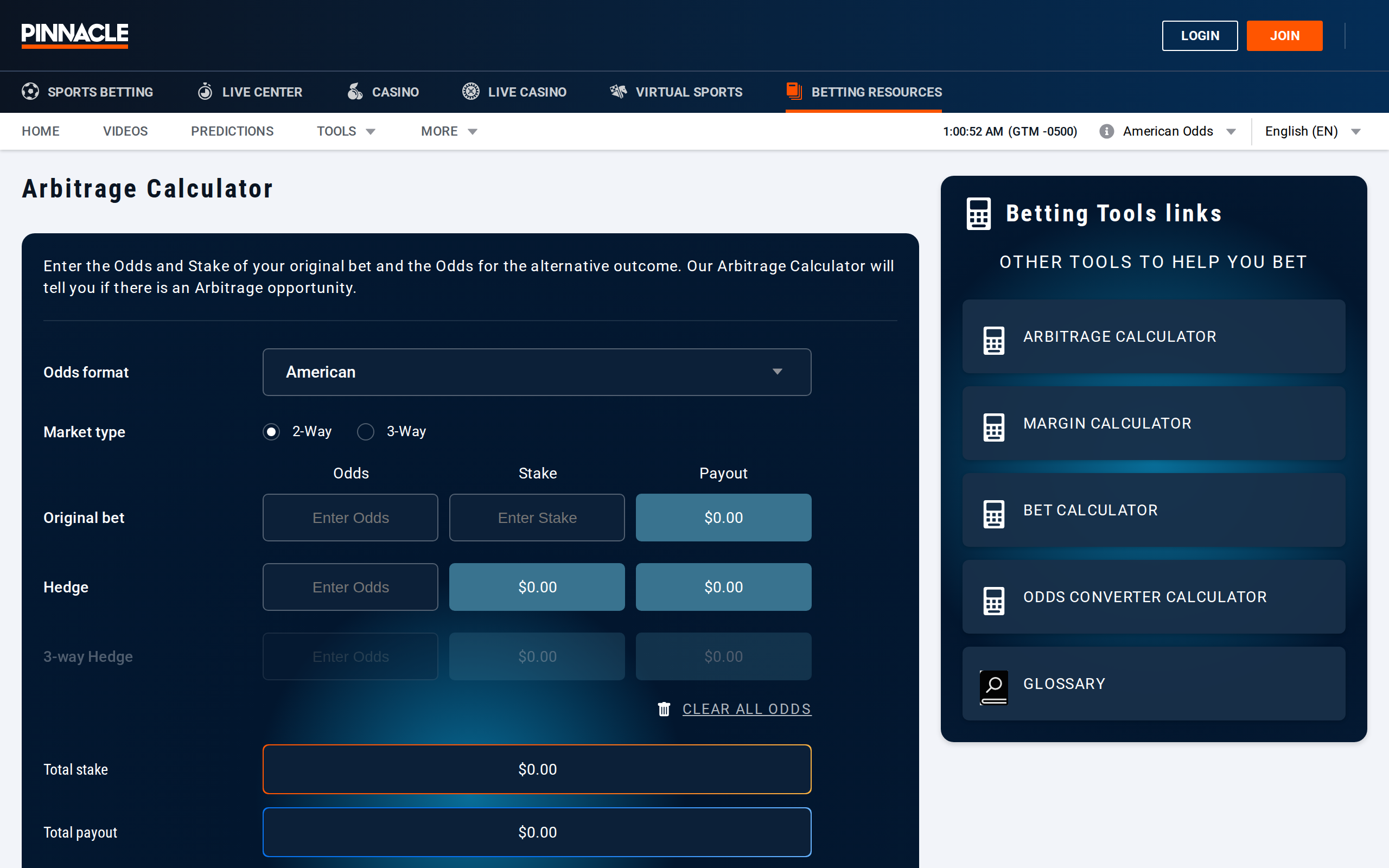
There is also an Arbitrage Calculator, which compares your original stake and odds with the opposite outcome at another book.
The Arbitrage Calculator asks for your original odds and stake and the odds of the opposite outcome.
Pinnacle's own odds are usually the sharp side of any arbitrage, which is why price comparison sites and tools such as Unabated use it as a reference. Using it as a reference is easier than using it as a place to bet, because of access.
Where it works, and where it does not
Pinnacle left the US on January 11, 2007, citing the Unlawful Internet Gambling Enforcement Act, and remaining balances were moved to World Sports Exchange accounts on request. It is headquartered in Curacao, with a Maltese Class II remote gaming licence granted in March 2015. Wikipedia also reports that it began winding down in Sweden in October 2026. Availability is decided country by country, so check the sign-up page and your local law before anything else. We cannot confirm it is lawful for you.
Withdrawal costs are the part we could not pin down. Reviews we found quote about $5 to $10 depending on method, one flat $12 charge, a single free payout a month, and a 10 percent charge if you withdraw before turning over your deposit three times. They cannot all be right. Read the cashier terms on your own account before you fund it.
Verdict
We give Pinnacle an 8.2. The pricing and the free education are the best of any book we looked at, and a bettor who prices markets will get the most out of it. It loses marks for the fee confusion, the offshore licensing and the lack of any US access at all.
Who should use it: a bettor in a country where it is licensed, comparing prices on soccer, tennis or esports. Who should skip it: anyone who wants bonuses, anyone in the United States, and anyone who needs a UK Gambling Commission licence behind their account. Betting carries real risk of loss and nothing here is financial advice.