OddsJam Review: +EV, Arbitrage and the Cost of Edge
OddsJam review: does a +EV and arbitrage scanner pay for itself?
OddsJam scans sportsbook prices for positive-EV bets, arbitrage and middles. We looked at what it promises, where its pricing is hidden, and the break-even maths for a small bankroll.
Our score
6.8/10Rated 6.8 out of 10
Verdict
OddsJam does what it says: it surfaces bets priced above the market's fair value, and arbitrage pairs, quickly. Whether that earns back a subscription depends almost entirely on your bankroll and discipline. With a small bankroll, a monthly fee is a heavy hurdle, and the site's own marketing headline about weekly earnings is not a promise we would plan around.
Best for
Disciplined bettors with enough bankroll to cover a monthly fee
Scans many sportsbooks and prediction markets for pricing gaps
Covers +EV, arbitrage and middle bets in one subscription
Homepage carries an honest line that no edge is passive income
7-day free trial advertised on the homepage
What held it back
Pricing is not shown without signing up, and several pages sit behind a bot check
Marketing leads with 'Make $500-$1000+ weekly', a claim that depends on bankroll
Arbitrage and +EV play can get accounts limited by sportsbooks
Every bet still carries variance, and +EV is not the same as winning
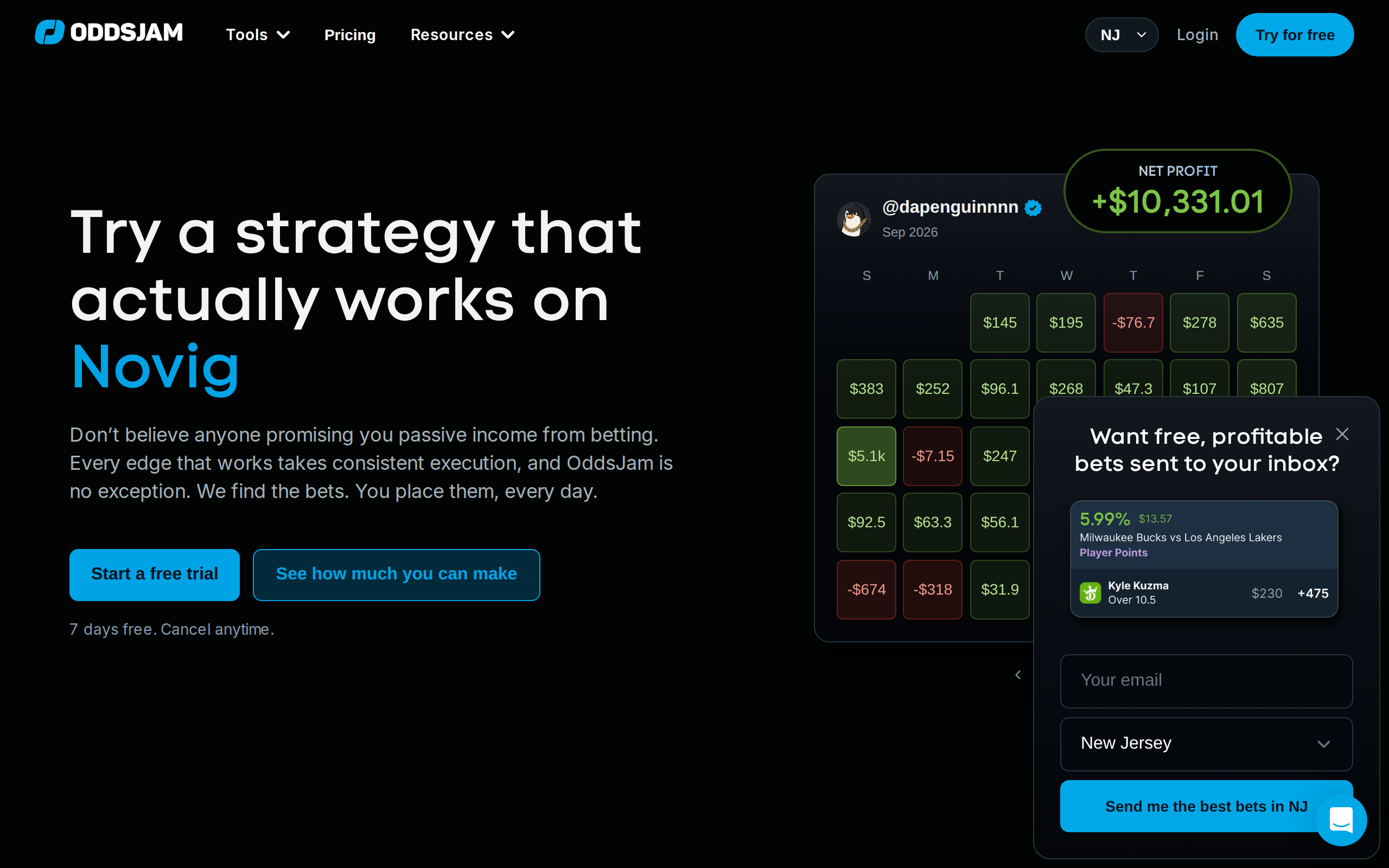
The first thing OddsJam's homepage said to us was "Make $500-$1000+ weekly. Use math, not luck." The same site, in another version of its front page, carries a more sober line: do not believe anyone promising passive income from betting, because every edge that works takes consistent execution. We trust the second sentence more. This review is about the distance between them.
What the tools actually do
OddsJam compares prices across sportsbooks and flags three kinds of opportunity. A positive-EV bet is one priced better than a sharp market's fair value. An arbitrage is a pair of bets on opposite sides, at different books, that locks in a profit whatever happens. A middle is a pair where you can win both if the result lands in a window.
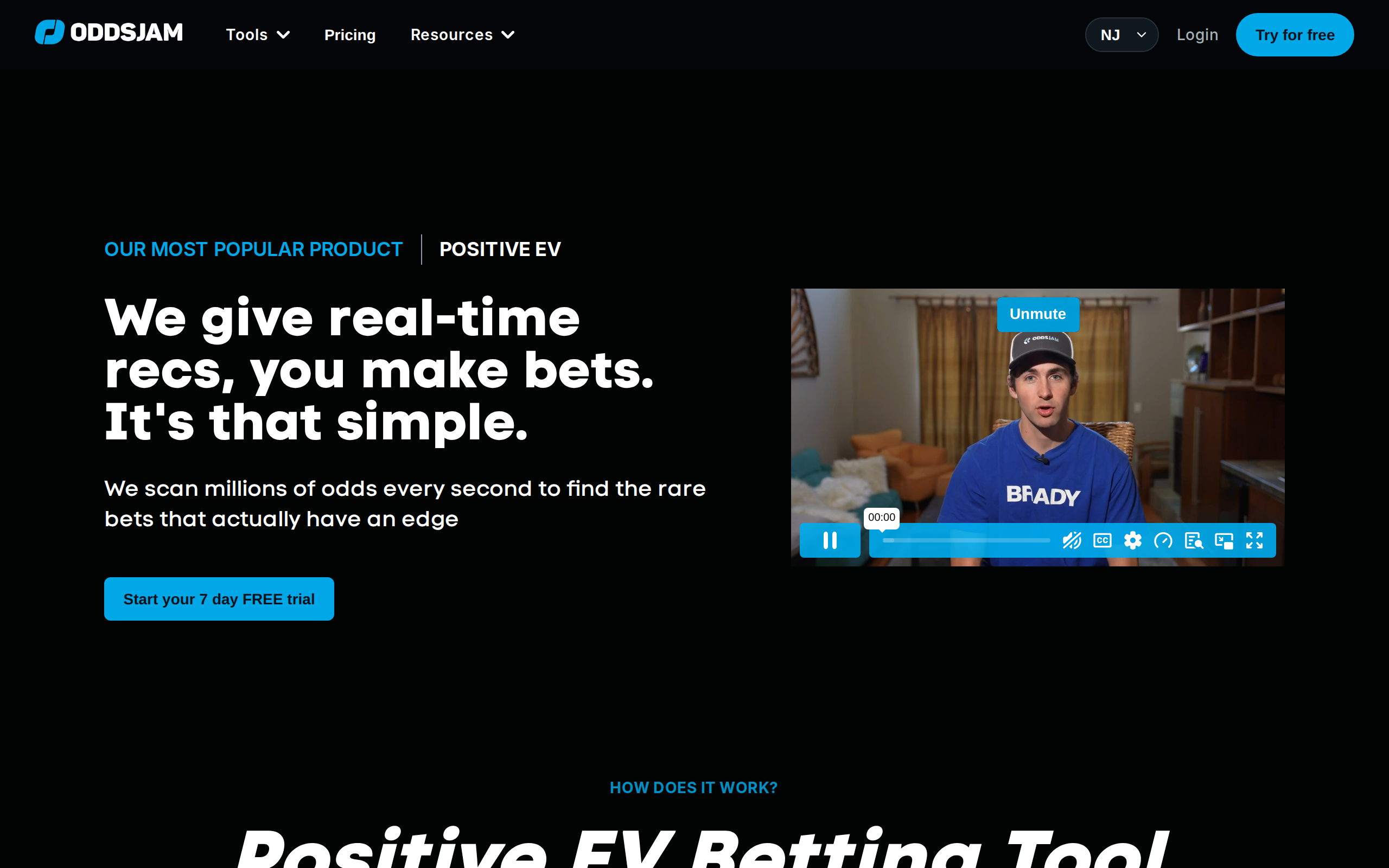
The Positive EV Betting Tool page, which says OddsJam gives real-time recommendations and scans millions of odds every second
The positive-EV pitch is plain: the tool scans, you place the bets. That framing is honest about the division of labour. The software finds the price; you still have to be able to place the bet before it moves, at a book that will take it.
Arbitrage is a small-margin business
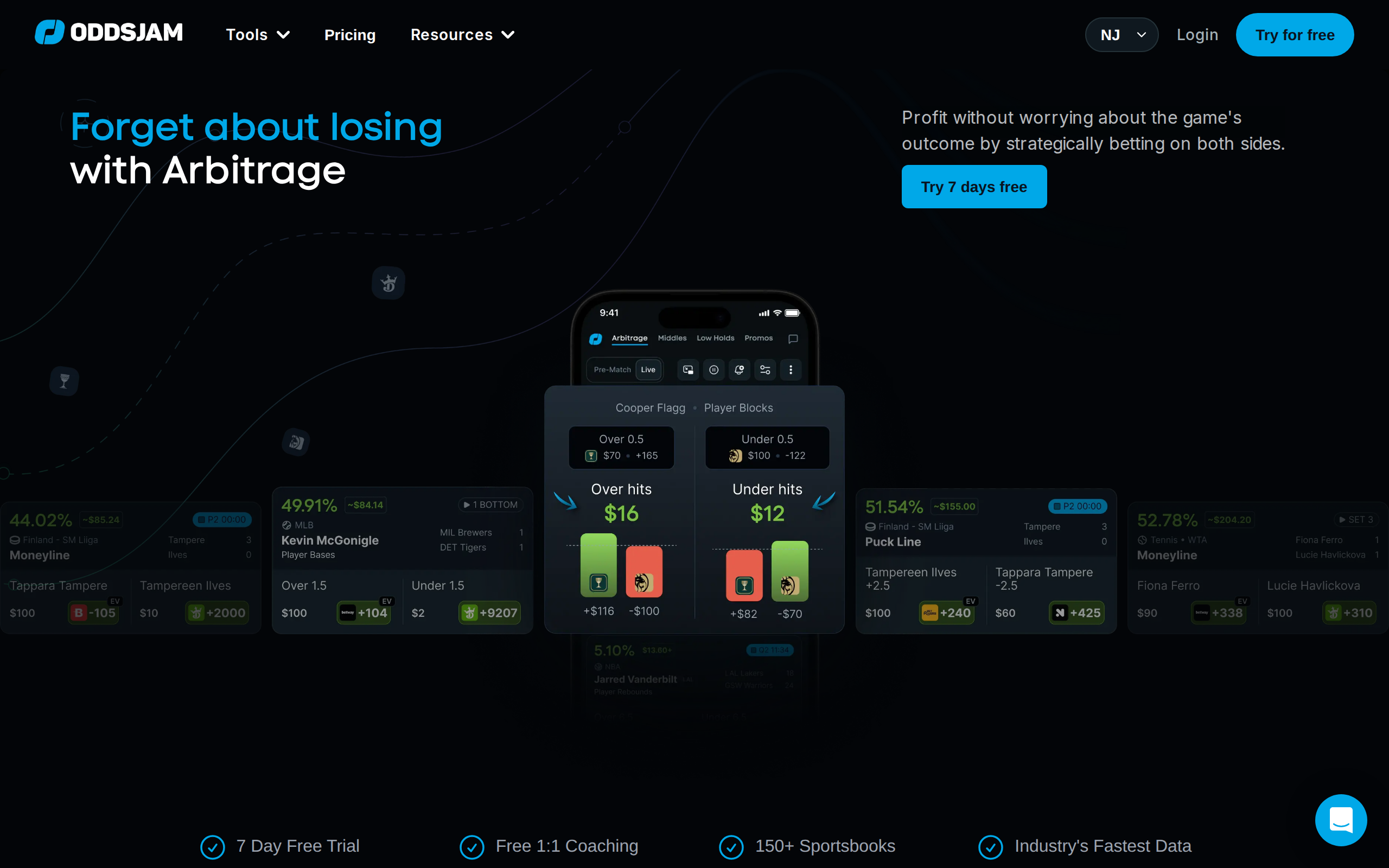
The Arbitrage page, headed Forget about losing with Arbitrage, showing an example pair of opposing bets
Arbitrage margins are thin. As a rule of thumb, retail arbs sit in the low single digits of percent, and they close quickly. Our illustration, not OddsJam's: if you cycle $2,000 through arbs at an average 2 percent edge, that is $40 gross. Run it ten times a month and you have $400, before the time spent, the stake you have tied up at each book, and any bet that is voided or mismatched. The point is not that the sum is small. It is that it scales with capital and speed, both of which a modest bankroll lacks.
Speed is the hidden input. A posted arb can vanish in the time it takes to log into a second book, leaving you holding one leg with no hedge. The sensible habit is to place the harder-to-fill side first, then the easier one, and to skip any pair where either book has a history of voiding bets.
Middles tell the same story with more variance: the pair costs a little when it misses and pays well when both legs land.
The Middle Bets page, with the line that these bet pairs are picked so your risk is reduced and you have a chance of hitting both
The price of the subscription
Here we hit a wall we should be upfront about. OddsJam's pricing page and several others returned a security verification screen to our capture tool, and the plan prices were not on the pages we could read. Third-party aggregators list figures that disagree with one another, so we are not going to quote a number. What the homepage does confirm is a 7-day free trial and a cancel-anytime line. Use the trial to see the actual price before you hand over a card.
You can still do the break-even yourself. If a plan costs F dollars a month and your realised edge on +EV bets is e (say 3 percent of the amount staked), you need to stake F divided by e just to cover it. At a $100 fee and a 3 percent edge, that is $3,333 in stakes before the first dollar of profit. With a $1,000 bankroll you would have to turn it over more than three times a month, with every bet landing at the posted price. That is the real hurdle, and it is why bankroll matters more than the software.
The costs OddsJam cannot take away
Sportsbooks limit accounts that win through pricing gaps. If your arb and +EV play works, expect stake limits at some books, and that shrinks the pool of opportunities over time. Variance does not go away either: a bet with a 4 percent edge still loses most of the time at even odds, and a bad run of 20 bets proves nothing about the model.
The marketing deserves a mention. The hero headline and a "trusted by 100k+ bettors" line are claims from the vendor. Neither tells you what the median subscriber earns. Treat dollar figures on a landing page as the best-case illustration it is.
Who should pay for it
Subscribe if you already bet regularly across several books, keep clean records, and can stake enough that a monthly fee is a small fraction of expected profit. Try the free week first and log every bet.
Skip it if your bankroll is a few hundred dollars, if you cannot watch the screen when the best prices appear, or if you are hoping the tool replaces judgment. A scanner finds prices, not guarantees. Betting always risks real money, and nothing here is personal financial advice.