Dabble Review: A Social Pick'em Feed, Weighed Against A 25% House Edge
Dabble pairs over/under pick'em with a copy-entry feed, live chat and a $0.05 Copy Cash payout. We checked whether the social layer adds value, then ran the payout table against a fair coin flip.
Our score
6.4/10Rated 6.4 out of 10
Verdict
Dabble is a workable second pick'em app with low $5 minimums and a feed that helps beginners see how entries are built. The feed shows popular entries, not proven ones, and Copy Cash pays authors a nickel per copy win or lose. On a coin-flip basis a two-pick entry carries a 25% house edge, and longer entries cost more.
Best for
Casual pick'em players who want low minimums and a chat room
$5 minimum deposit and $5 minimum withdrawal, per RotoWire's comparison
Hedge option pays a reduced multiple when one or two picks miss
One-tap copying of public entries helps newcomers see how entries are built
Real-money play in 31 states, with social features open nationwide
Instant deposits by card or Apple Pay
What held it back
On a coin-flip basis a two-pick entry at 3x leaves the house a 25% edge
Feed ranks popular entries, with no verified win rates for authors
Withdrawals by bank transfer only, quoted at 1 to 3 days
Reported top multiplier differs between sources (20,000x and 5,000x)
App-first product, with no browser version per ESTNN
A pick'em app that sells a social feed is making a claim worth testing: that watching other people's entries helps you make your own. We read what Dabble publishes, set it beside two independent write-ups, and ran the arithmetic. The feed is a nice room to sit in. It is not an edge, and the payout table is where the money is decided.
What you are actually buying
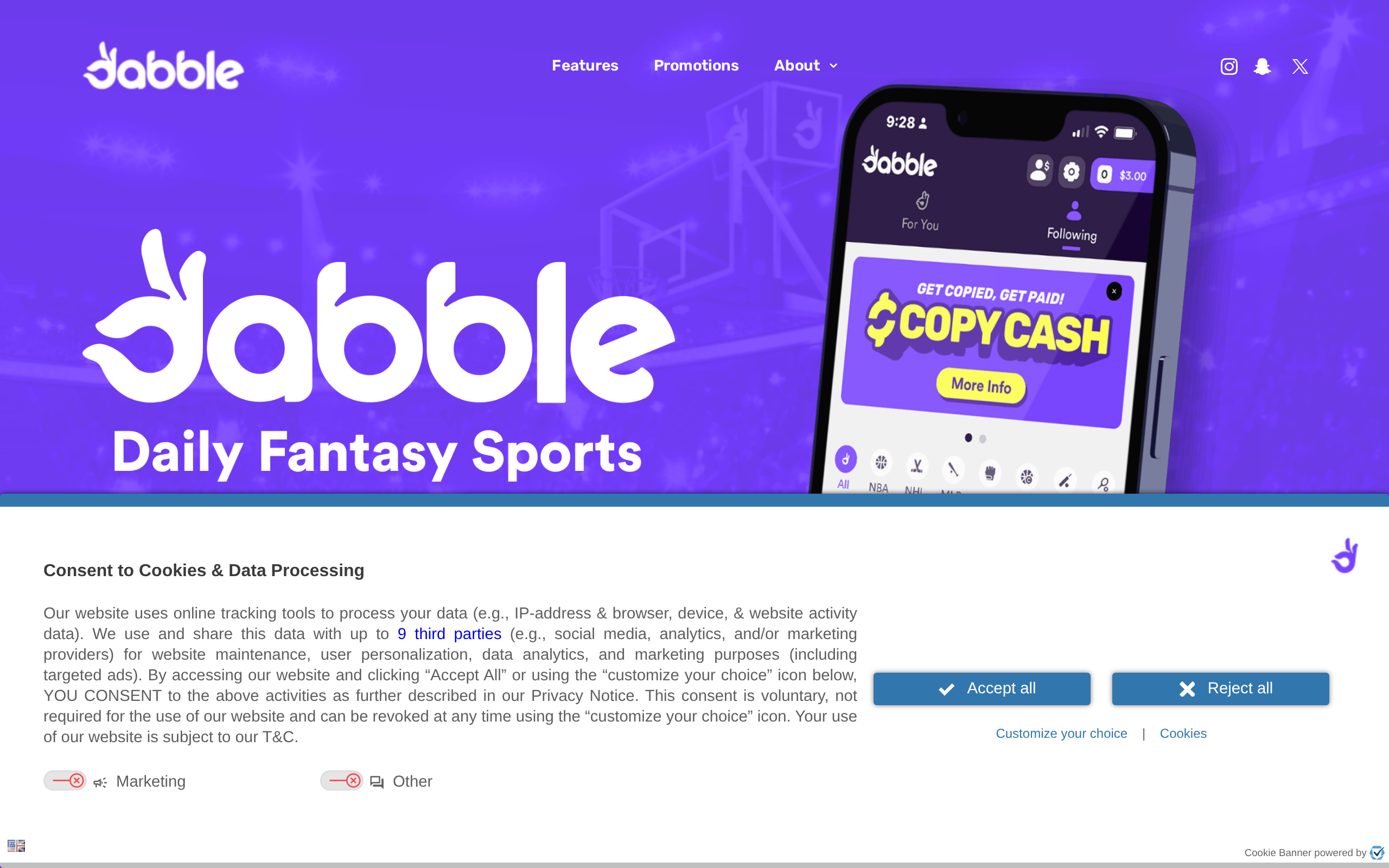
Dabble is a player-versus-house pick'em app. You choose over or under on player stats, stack two or more picks into an entry, and win a fixed multiple of your stake if every pick lands. Its home page leads with a sign-up banner ("Play $10, Get $20", code P2026 on the day we looked), and its terms reference a separate "Play $5, Get $50" offer that Oddschecker was running under its own code. Promotions move weekly; read the playthrough terms before you deposit.
The company says real-money play is open in 31 states, and the state list on its own page runs to 32 entries including DC. Age floors differ: 21 in Arizona, Illinois, Iowa, Louisiana, Massachusetts and Virginia, 19 in Alabama and Nebraska, 18 elsewhere. The social features are open to everyone in the US, which tells you where the company thinks its stickiness lies.
The feed: copy, chat, and a nickel
Three pieces make up the social layer. A "For You" feed lists trending entries that you can copy with one tap. Banter is a live chat room that fills up on big game days. And Copy Cash pays the original author $0.05 each time someone copies their entry, per Dabble's own page.
Think about what that last one does. A feed ranked by popularity shows you entries that were easy to copy, not entries that were good. The author earns a nickel per copy whether the entry wins or not, so the incentive is to post the obvious. Dabble publishes no verified win rate for feed authors, and we found none from anyone else. Copying a popular entry is a way to save time, nothing more.
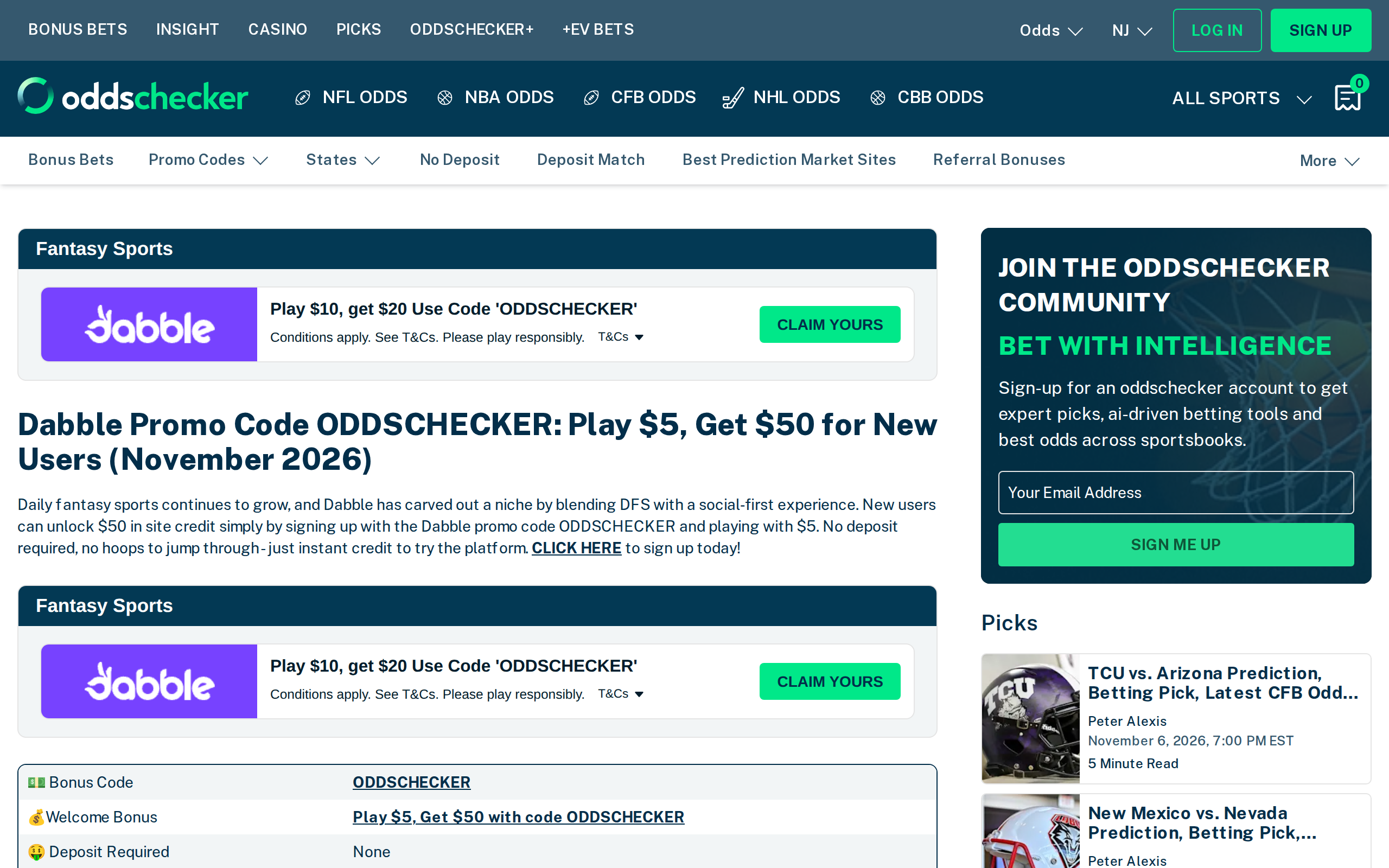
An affiliate page covering Dabble's offer, which describes the app as daily fantasy blended with a social-first experience.
That does not make the feed worthless. For a newcomer, seeing how others build a three-pick entry beats staring at a blank sheet, and the chat is a decent way to catch a late injury. Judge it as a learning tool, not an alpha source.
Payouts: where the house takes its cut
Multipliers are the real product. The sources disagree about the top end: Dabble's own page claims up to 20,000x on some entries, while RotoWire lists a ceiling of 5,000x on the largest entries. A separate review (ESTNN) puts the "All In" ladder at 3x for two picks and 100x for eight, which is the figure we used below. Check the in-app table before relying on any of these.
Take a coin-flip pick, which is the generous assumption because projections are set to be close to 50/50. Two picks win 25% of the time, so the fair price is 4x and a 3x payout returns 75 cents per dollar: a 25% house edge. Eight picks win 1 time in 256, a fair price of 256x, so 100x returns about 39 cents per dollar. The longer the entry, the larger the cut. Anyone who thinks they can beat a 25% edge on a two-pick entry needs to be right on about 58% of individual picks, and that is a hard record to hold.
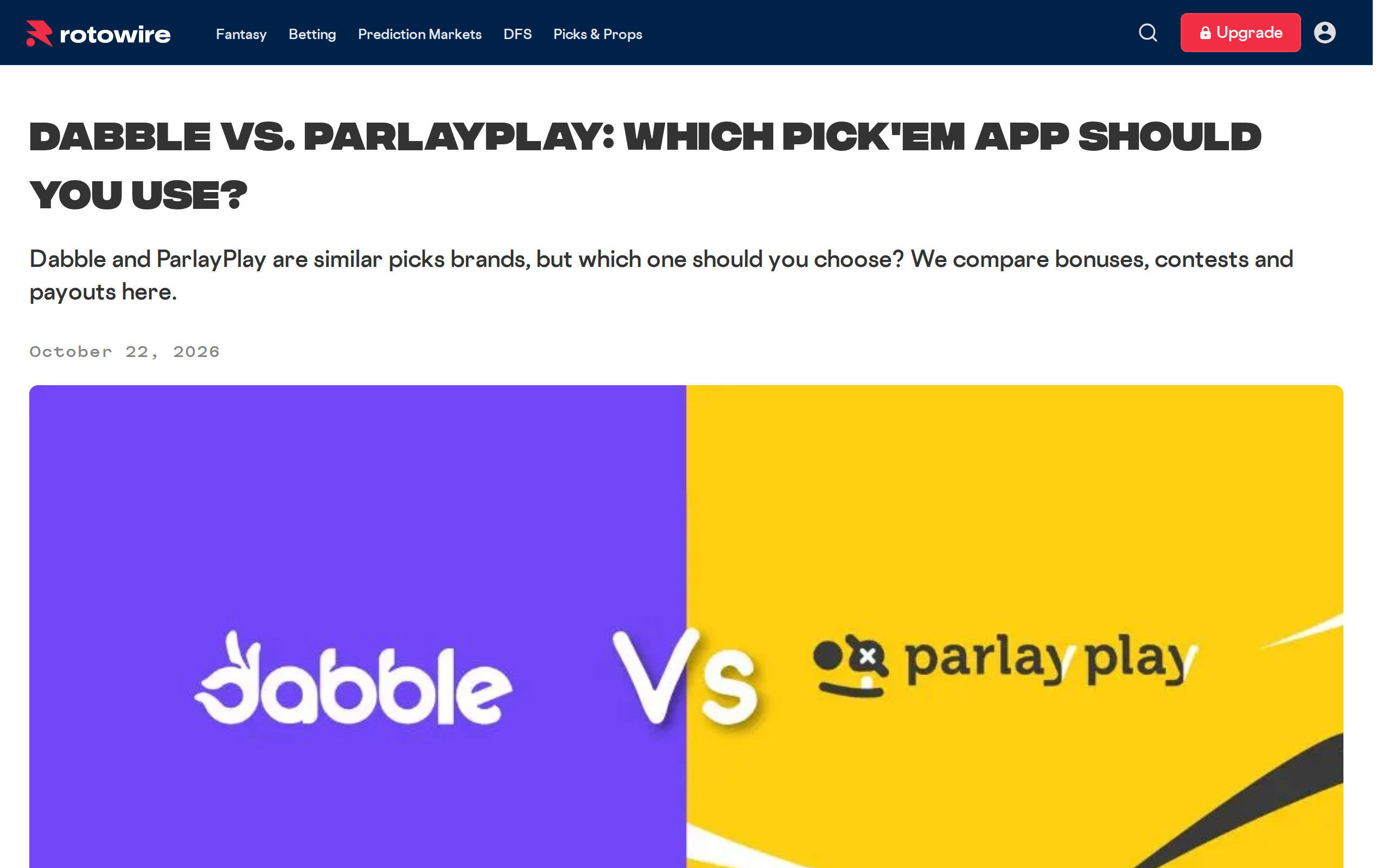
RotoWire's head-to-head of Dabble and ParlayPlay, the main independent source for Dabble's minimums and payout ceiling.
Dabble's Hedge option pays a reduced multiple if one or two picks miss. It softens variance but the multiples are lower, so the edge to the house does not vanish; it just gets spread across more outcomes.
Money in, money out
Deposits are instant by card or Apple Pay with a $5 minimum, and the same $5 floor applies to withdrawals, which is friendlier than ParlayPlay's $30, per RotoWire. Withdrawals go by bank transfer only, and the sources quote 1 to 3 days. The app is mobile-first, and ESTNN notes it has no browser version and can load slowly.
The same page at phone width, which is how most Dabble players will see it.
Verdict
Dabble is a reasonable second app for a pick'em player who wants lower minimums and a chat to hang out in, and a poor first reason to start playing. The feed adds a little context and no proven edge. Entries cost real money, the payout table is set against you, and betting carries a real risk of loss. Nothing here is financial advice: set a monthly limit before you open the app and treat every entry as spent.