Upbit review: Korea's biggest exchange, and who can use it
Upbit is South Korea's flagship exchange, run by Dunamu, with a 0.05% KRW fee and a licence under local law. We explain who outside Korea can open an account and who is locked out.
Best forSouth Korean residents with a real-name bank account
Full fee ledger
- Price
- Free to join; trading fees vary by market
- Operator
- Dunamu
- Operator
- Dunamu Inc., Seoul
- Launched
- 24 October 2017
- KRW market fee
- 0.05% maker and taker
- BTC and USDT market fee
- 0.25%
- Fiat
- Korean won only on the main site
- Overseas sites
- Singapore (2018), Indonesia (2019), Thailand (2021)
- Ownership news
- Naver Financial announced a plan to acquire Dunamu in November 2025
Our verdict
For a Korean resident with a real-name bank account, Upbit is the safe default: licensed, large and cheap at 0.05% in won. For nearly everyone else, it is closed, and the overseas sites are separate, smaller products. Check access before you plan around it.
What works
- Flat 0.05% fee on KRW markets for makers and takers
- First exchange licensed under Korea's virtual asset rules in 2021
- ISO 27001, 27017 and 27018 certifications since December 2018
- Separate sites for Singapore, Thailand and Indonesia
What does not
- Real-name Korean bank account needed for the main site
- BTC and USDT markets cost 0.25%, five times the KRW rate
- Lost about $48.5 million in ETH in a 2019 hack
- Overseas sites are smaller and run on different rules
Most exchange reviews ask whether a platform is good. For Upbit the first question is whether you are allowed in. If you have a South Korean bank account in your own name, Upbit is probably the exchange you should use. If you do not, the main site is closed to you, and what remains are three overseas siblings that are smaller and different. Nothing here is personal financial advice.
Why a Korean exchange matters
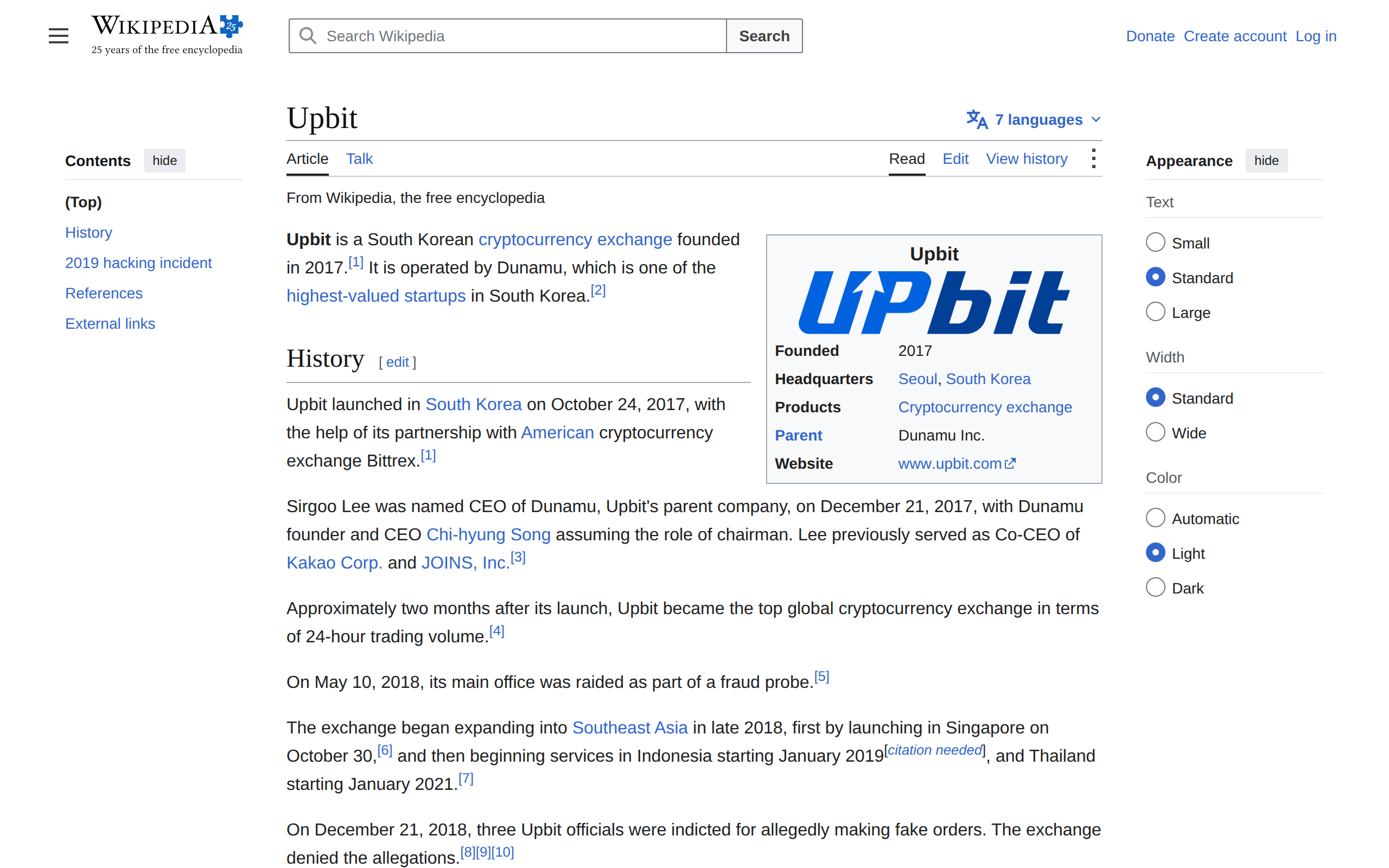
Upbit opened on 24 October 2017, built with the help of the American exchange Bittrex, and Wikipedia records that it became the world's top exchange by 24-hour volume within two months. It is run by Dunamu, one of South Korea's most highly valued startups. In November 2025 Naver Financial announced a plan to acquire Dunamu, which would tie the exchange to the country's largest search and portal company.
For Koreans the appeal is plain. It trades in won, it operates under Korean regulation, and in September 2021 it was the first exchange licensed under the country's new virtual asset rules. That licence is a stronger protection than most offshore rivals can show.
The fee: one number for won, another for everything else
On the KRW market, CryptoWinRate's review lists a flat 0.05% for makers and takers. On the BTC and USDT markets the fee is 0.25%. That gap matters: moving $10,000 through a USDT pair costs $25, against $5 in won.
So the cheap way to use Upbit is the won pair, and that is exactly the pair you cannot reach without a Korean bank account. The fiat rail is won only, and the deposits come from and go back to a Korean account in your name.
What "real-name" means in practice
Korean rules tie exchange accounts to a verified bank account at the same name. CoinCodeCap's review describes the requirement as one that cannot be worked around, and Upbit's main site backs this up: its pages are Korean-first and the notices are in Korean. A visitor with only a foreign bank account has no way in.
If you are abroad, do not search for a trick. Using a borrowed identity breaks the rules and can freeze funds.
The overseas sites
Upbit runs separate sites for other markets, and these are the answer to "who outside Korea can use it". Wikipedia dates the Singapore launch to October 2018, Indonesia to January 2019 and Thailand to January 2021.
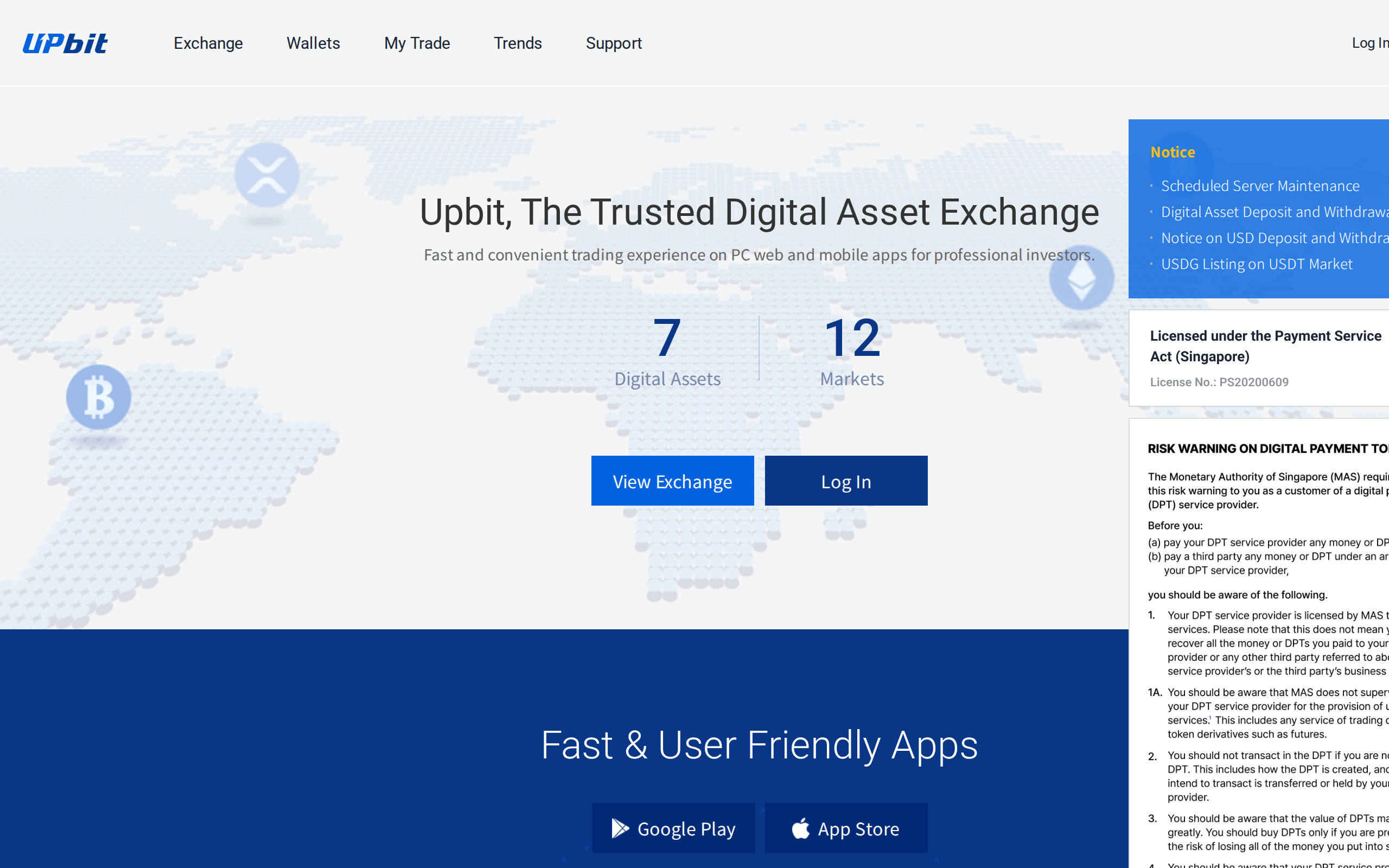
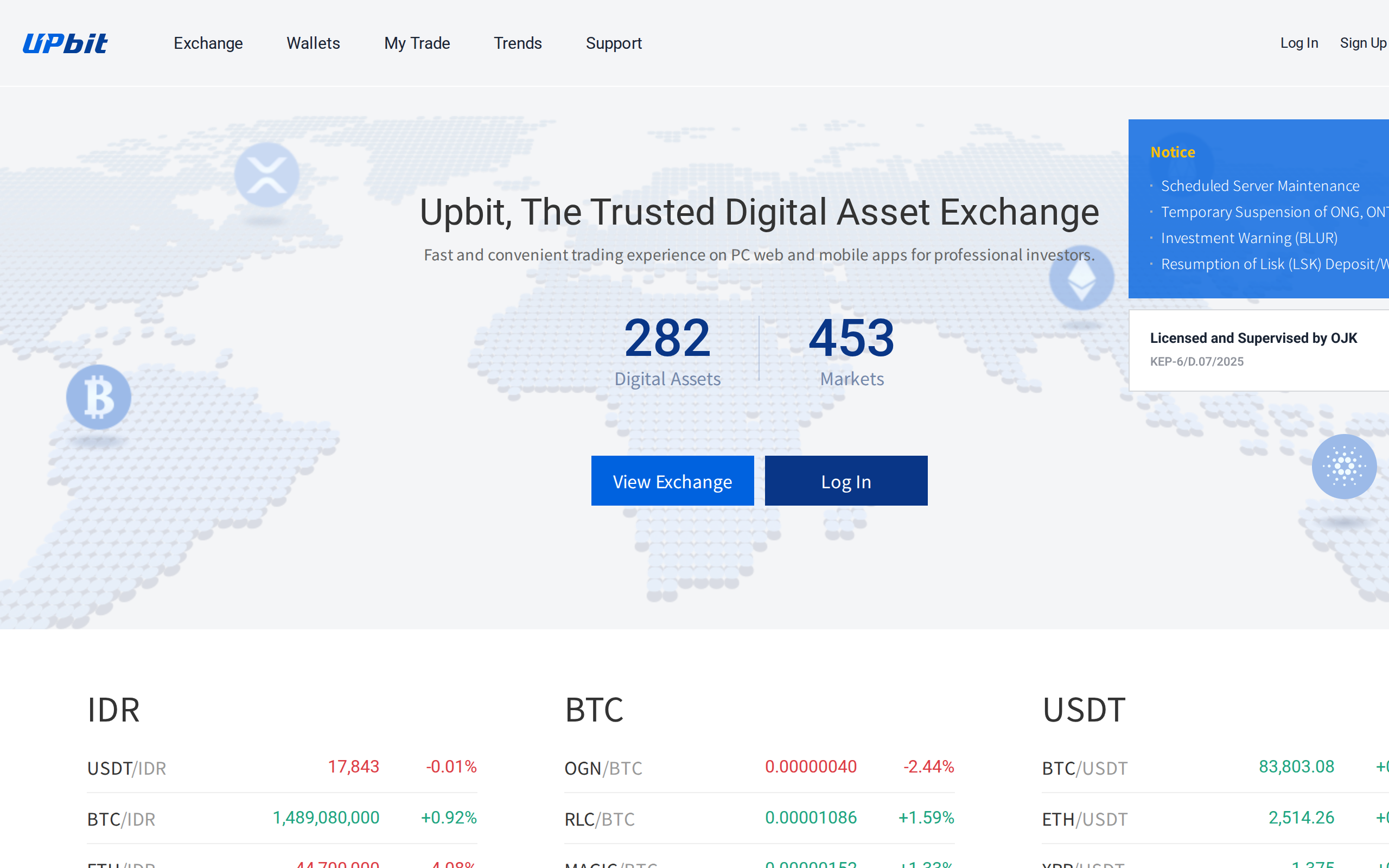
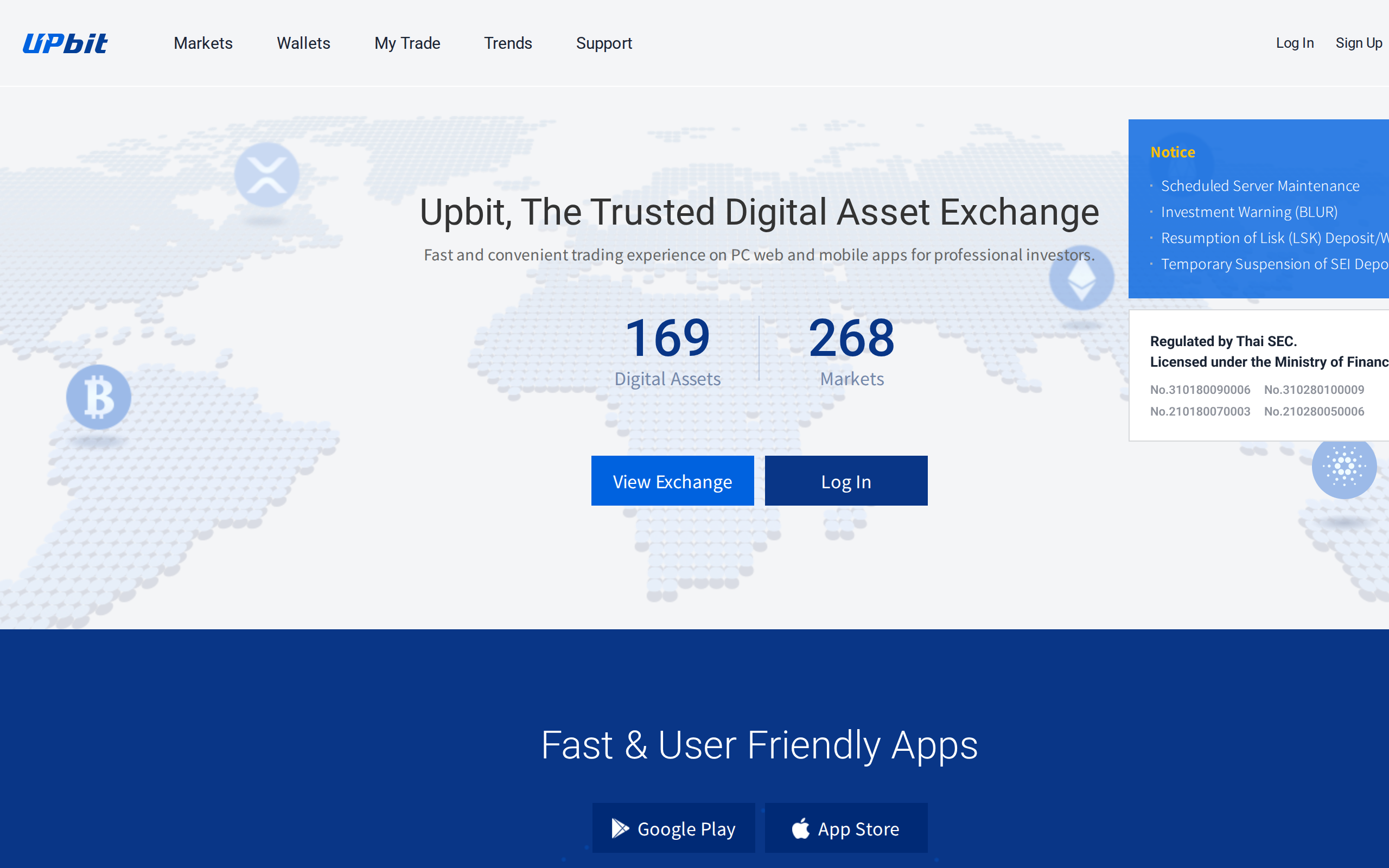
They are not the Korean exchange with a different flag. Each is a separate entity with its own licence, user base and token list. The Thailand page shows a licence notice image, and its announcements cover token-level events such as a deposit and withdrawal resumption for Lisk.
Check which site accepts residents of your country, and what it lets you do. Availability and fiat support change, so read the current terms.
Support and language
The English pages on the overseas sites are readable and carry the same trading screens as the Korean one. Notices on maintenance and investment warnings appear on the front page of each, so scan them before you deposit, since a suspended token cannot be moved until it resumes.
Security record
Upbit lost about $48.5 million in Ethereum (342,000 ETH) in November 2019. A November 2024 investigation attributed the attack to North Korean groups Lazarus and Andariel. It had been certified to ISO 27001, 27017 and 27018 since December 2018, which shows that certificates are not a shield.
Since then the company has operated for years without a comparable incident that we found. That is a good record, but a single event of that size is the benchmark.
Compared with the alternatives
A Korean resident choosing between Upbit and a rival local exchange is mostly choosing on liquidity and token list. Upbit's size means tighter spreads on the major won pairs, though smaller rivals may list newer tokens sooner. Outside Korea, the comparison is with the regulated exchange in your own country, which will usually offer your own currency.
Who should use it
Use Upbit if you are a Korean resident or hold the right visa and bank account. It is cheap, large and licensed at home. Use an overseas site if your country is on its list and the local product suits you. Skip it, and use a regulated exchange in your own country, if you only want to buy Bitcoin from abroad.
We rate Upbit 7.2. It would score higher with open access, and the score reflects the fact that most readers cannot use it.