Pionex review: free grid and DCA bots, a 0.05% fee and a thin regulatory record
Pionex bots cost nothing to run, but each fill pays 0.05%, and its own guide says grids lose in trending markets. We read the bot docs, the fee reports and the regulator warnings.
Best forBeginners who want automated DCA and accept offshore regulatory risk
Full fee ledger
- Price
- 0.05% trading fee; bots free
- Operator
- Pionex
- Spot fee
- 0.05% maker and taker (third-party reviews)
- Bot fee
- None; 16+ built-in bots
- Bot types
- Grid, DCA, arbitrage, trailing buy and sell, leveraged variants
- Market maker programme
- 0% maker fee near 300,000 USDT volume (one review)
- Liquidity
- Aggregated from Binance and HTX (one review)
- US registration
- FinCEN money services business (Pionex Inc.)
- EU entity
- Irish entity reported authorised under MiCA (one review)
- France
- AMF blacklist entry, 10 April 2025
- Hack reserve
- SAFU reserve of about 50,000 USDT (one review)
Our verdict
Pionex does one job well: it lets a beginner run a grid or DCA plan in minutes, with no code and no bot fee. The 0.05% fee still applies to every fill, its own guide says grids lose when prices trend, and the platform is on France's AMF blacklist. Use DCA with money you can lose. This is reporting, not personal financial advice.
What works
- 16+ built-in bots with no subscription or separate bot fee
- Flat 0.05% maker and taker spot fee, per third-party reviews
- No API keys or coding needed to start a grid or DCA plan
- Pionex's own guide states grid risks plainly, including range breakouts
What does not
- Pionex's guide calls trending markets a weaker fit for grid bots
- Narrow grids lose a large share of gross profit to the 0.05% fee
- Listed on the French AMF crypto blacklist since 10 April 2025
- Reviews report a US consent order, a Philippine warning and a Malaysian alert
The bots are free. That is the whole product, and it is also where the question starts. Pionex charges 0.05% on every fill, so a bot that trades constantly produces a steady stream of fees for the platform whether or not it produces profit for you. We did not run capital through these bots, so we cannot give you a return figure. What we can do is read what Pionex says about when its own grid strategy loses, and look at the regulatory record. Reporting, not personal financial advice.
How a grid bot earns, and how it stops
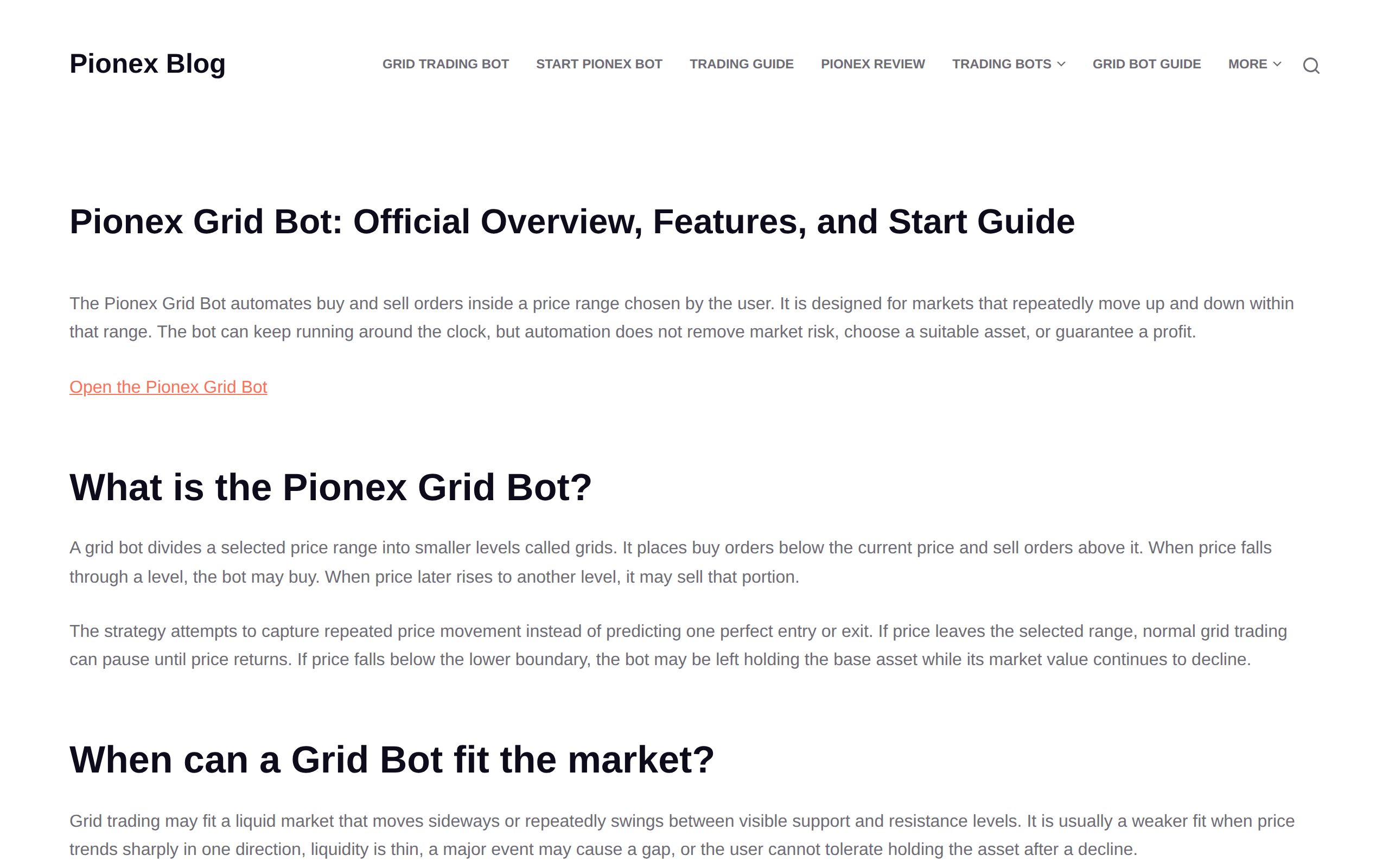
The Pionex grid guide describes the idea simply: you choose a price range, the bot splits it into levels, places buy orders below the current price and sell orders above, and repeats as the price moves up and down. The featured picture above is that guide as we captured it, with sections on what the bot is and when it fits the market.
The profit comes from small swings inside the range. The same guide is frank about the opposite case. A strong move above the upper limit can leave the bot having sold most or all of the asset, then paused. A strong move below the lower limit leaves it holding a full position in a falling coin. Pionex calls trending markets "usually a weaker fit". It adds that stop-loss execution "can differ during fast or illiquid markets" and that automation "does not remove market risk" or guarantee a profit.
That is the answer to the angle on the work order, in the maker's words: bots make money when a coin chops sideways and lose money when it trends. Ordinary traders rarely know in advance which kind of month they are in.
The fee arithmetic
Third-party reviews put spot fees at 0.05% for both maker and taker, with no extra charge for any of the 16 or more built-in bots (grid, DCA, arbitrage, trailing buy and sell, and leveraged variants). A market-maker programme cuts the maker side to zero at about 300,000 USDT of volume, per one review.
Do the sum on a grid. If a bot has set 50 levels across a range and each level is about 0.4% wide, each completed buy and sell cycle earns roughly 0.4% minus 0.1% in fees. A quarter of the gross profit goes to Pionex on every cycle. Narrow the grid and the fee share rises. Pionex's own guide tells you to compare "expected gross amount per grid with trading costs and spread", which is the right instinct. The illustration above is our arithmetic, not a measured result.
A DCA bot is different. It buys a fixed amount on a schedule, so the fee is a small one-off on each purchase. For a person who wants to accumulate Bitcoin monthly, that is cheap and honest, and it needs no judgment about ranges.
The tricky parts of the bot menu
Pionex sells several grid variants, and the Infinity Grid is the one it explains in a separate guide.
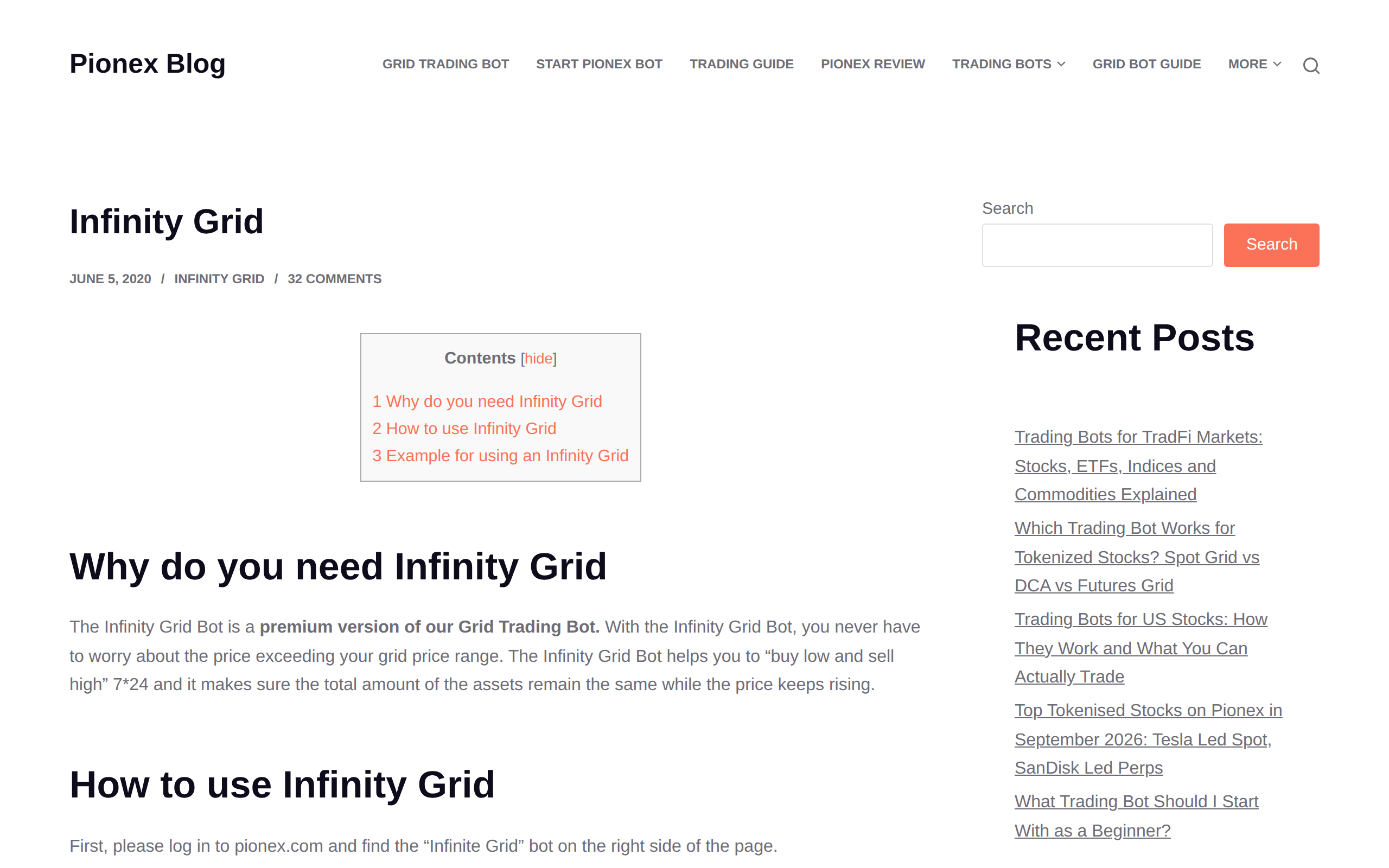
We read it for the framing: each variant is a different bet about the market, so choosing one still takes a view. None of them removes the range-breakout risk described above.
Minimum investment is also not fixed. Pionex says it is calculated from the pair, range, grid count and "current order requirements", and can change, so read the live order panel.
Licensing, which is the harder part
One review (Daytrading.com) lists mixed standing. Pionex Inc. is registered as a Money Services Business with FinCEN in the United States. A separate Irish entity is reported as authorised by the Central Bank of Ireland under MiCA. The global entity, Marketa Trading Inc., holds no regulator-backed licence in that review's account.
The warnings are public. France's market regulator, the AMF, added pionex.com to its crypto blacklist on 10 April 2025, as a site offering services without authorisation. The same review also reports a US consent order in May 2025, a Philippine SEC warning in August 2025 and a Malaysian investor alert in January 2026. We confirmed the French listing through its search results and treat the others as reported, not verified.
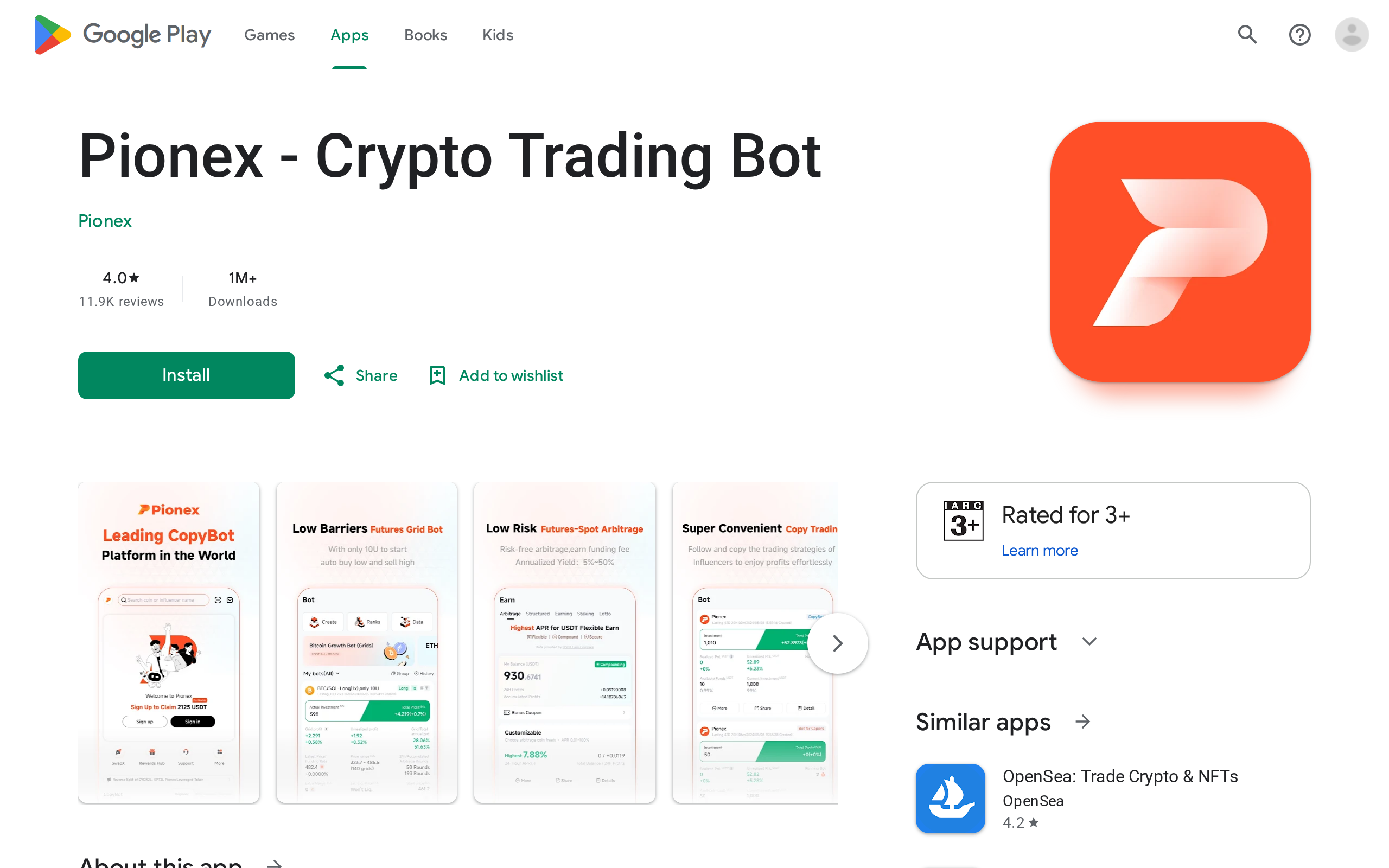
Funds sit with the exchange. The review mentions a SAFU reserve of about 50,000 USDT for hack losses, which is small beside the balances of a platform this size. US customers are routed to a separate service, with no FDIC or SIPC cover.
Verdict
Pionex is good at one thing: letting a beginner set up a grid or a DCA plan in minutes with no code and no monthly bill. For DCA, that is a clean use. For grids, expect the outcome to depend on the market's mood, and size the money to what you can lose. The bigger concern is where it can be used and under what protection. If you live in France, check the blacklist first. If you do not want a trading bot, there is little else here to recommend. We rate it as a useful tool with a regulatory cloud.