Kraken review: the regulated exchange that rewards you for leaving the simple app
Kraken's simple app adds a spread, while Kraken Pro charges maker and taker fees that fall with volume. We read the fee schedule, security page and staking offer, and weighed its 2023 SEC settlement.
Best forIntermediate traders wanting a regulated exchange with a fee ladder
Full fee ledger
- Price
- Free to join; Kraken Pro from 0.25% maker / 0.40% taker
- Operator
- Payward (Kraken)
- Kraken Pro entry fee
- 0.25% maker / 0.40% taker (third-party reviews)
- Fee schedule entry tier
- 0.40% maker / 0.80% taker in the cross-platform table
- Fee schedule Tier 6
- 0.12% maker / 0.25% taker above $40M 30-day volume
- Fee schedule Tier 9
- 0.04% maker, from $100M 30-day volume
- Instant Buy/Sell
- Spread included in the quoted price
- Staking
- Up to 21% a year, per Kraken, where available
- Reserves
- Quarterly Proof of Reserves
Our verdict
Kraken is the best-balanced regulated exchange we reviewed: a long track record, quarterly reserve proofs and a Pro tier that gets cheap with volume. The entry fees are still above the offshore giants, and the simple app hides a spread. This is reporting, not personal financial advice.
What works
- Published fee schedule with ten volume tiers, falling to 0.04% maker at the top
- Quarterly Proof of Reserves reported by independent reviewers
- Full EU access under a MiCA licence, per independent reviews
- Staking page offers rewards up to 21% a year in supported regions
What does not
- Entry fees are higher than Binance's flat 0.10%
- Instant Buy and Sell prices include a spread on top of any fee
- Not available in New York or Maine, and staking was shut down for US users in 2023
- Fee page layout mixes several tables, which confuses newcomers
Kraken has two prices, and the review is really about the gap between them. The simple app quotes you a price that already contains Kraken's spread. Kraken Pro, the order-book interface, charges visible maker and taker fees that fall as your volume rises. If you stay in the first, you pay for convenience. If you move to the second, Kraken becomes one of the more balanced regulated exchanges. Reporting only, not personal financial advice.
Two doors into one account
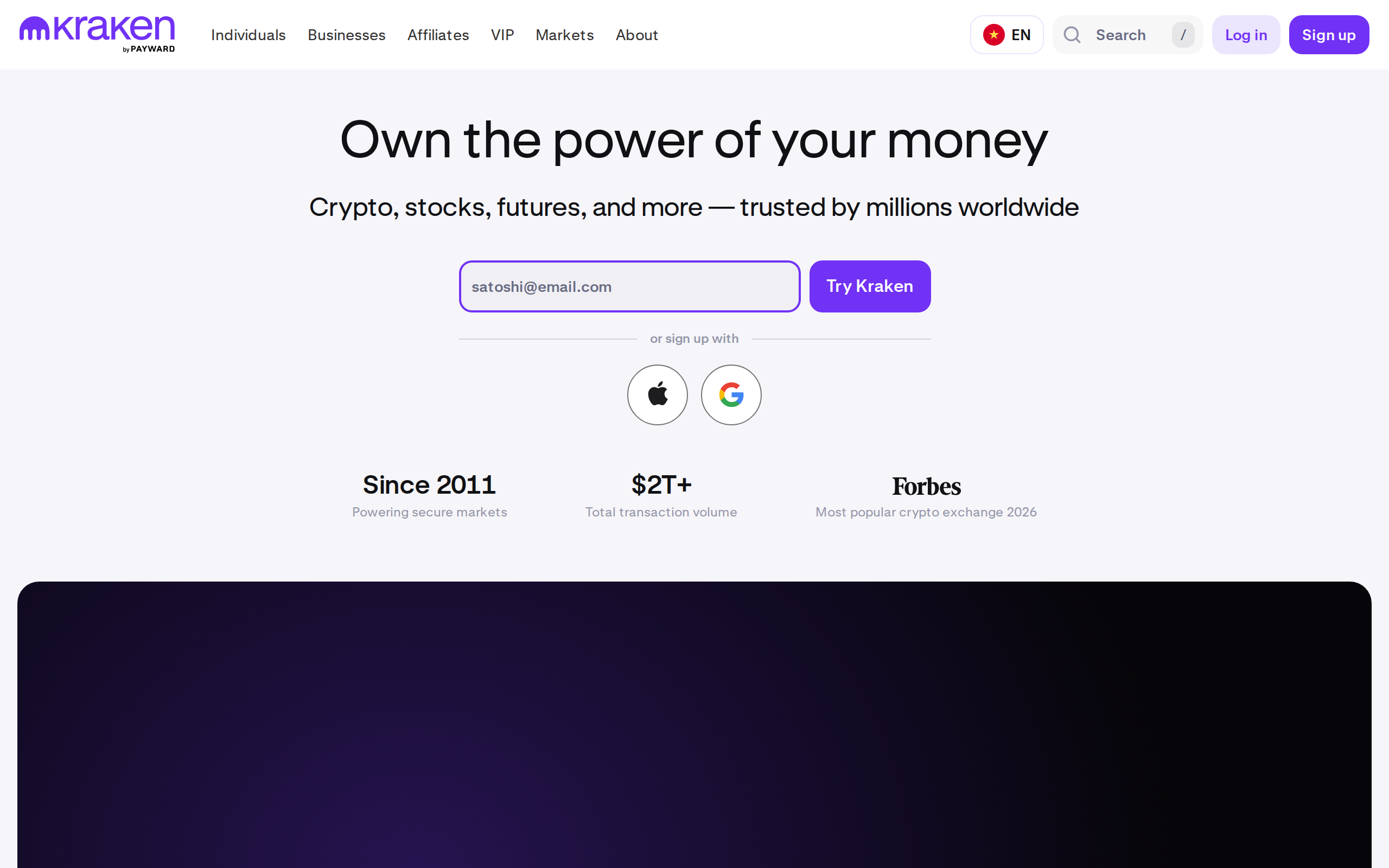
The Kraken homepage pitches "the command center for active traders" and calls itself the most popular crypto exchange of 2026, a ranking we could not trace to a source, so we ignore it.
What matters sits behind the headline. Instant Buy and Sell is the easy route, and the fee schedule says plainly that the price you see "includes a spread, the difference between the market rate and the rate you receive". Volume made through Instant Buy does not count toward your 30-day volume incentives, so the simple route also keeps you at the top of the ladder.
Reading the fee ladder honestly
Independent reviews such as Koinly's put Kraken Pro's starting spot fee at 0.25% maker and 0.40% taker, falling with 30-day volume. The schedule page we pulled shows something harsher in one table: an entry tier of 0.40% maker and 0.80% taker, then 0.30% and 0.60% from the second tier. The page holds several tables for different products, and we could not fully tie each to Kraken Pro, so check your own fee level before you trade.
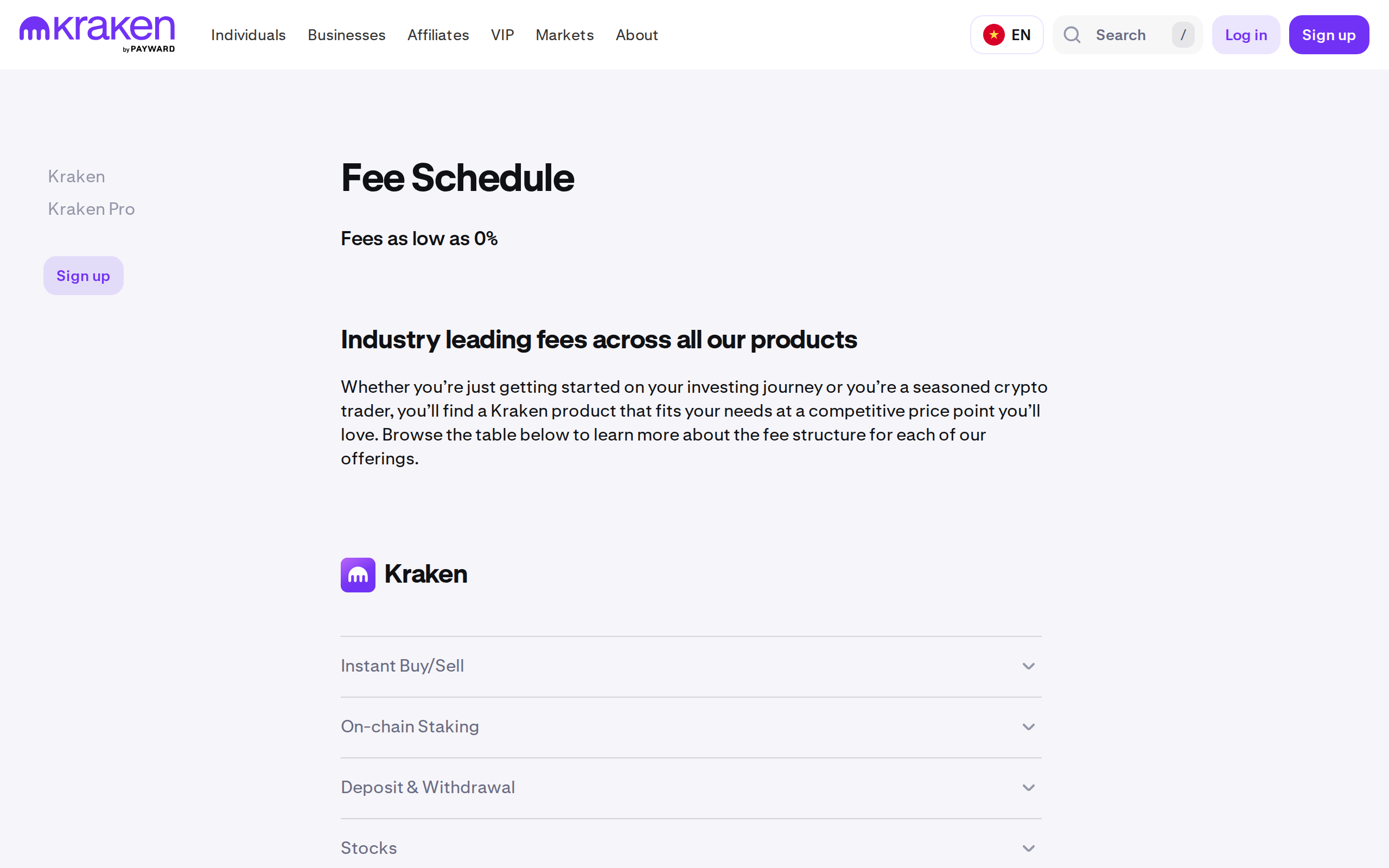
The lower tiers are clearer. The cross-platform table reaches 0.12% maker and 0.25% taker at Tier 6, which asks for 40 million USD of 30-day spot volume. At Tier 9, from 100 million USD, the maker fee is 0.04%. Those are institutional volumes. A person trading 5,000 USD a month never leaves the first rungs.
Here is what that means for a taker order of 1,000 USD:
At 0.40%, the fee is 4 USD, the same as Coinbase's maker rate.
At 0.80%, it is 8 USD, which is dearer than Coinbase's 0.60% taker fee.
At Binance's 0.10% base rate, it is 1 USD.
So Kraken does not win on price at entry level. It wins on what the price comes with.
What you get for the premium
Start with security. The security page says "protecting your funds and privacy is our number one objective" and describes a broad set of controls.
Marketing, again. The independent record is more useful. Coin Bureau credits Kraken with publishing Proof of Reserves audits before the practice became common, and reviewers describe them as quarterly, with about 95% of assets held in air-gapped cold storage. We could not open Kraken's own reserve page: the address we tried returned a 404, so these are reviewers' statements, not ours.
Kraken also holds a MiCA licence for EU access, according to Koinly, and is available in most countries apart from New York and Maine.
The staking caveat
Kraken advertises staking at "up to 21% yearly" and says over 1.35 million people use it.
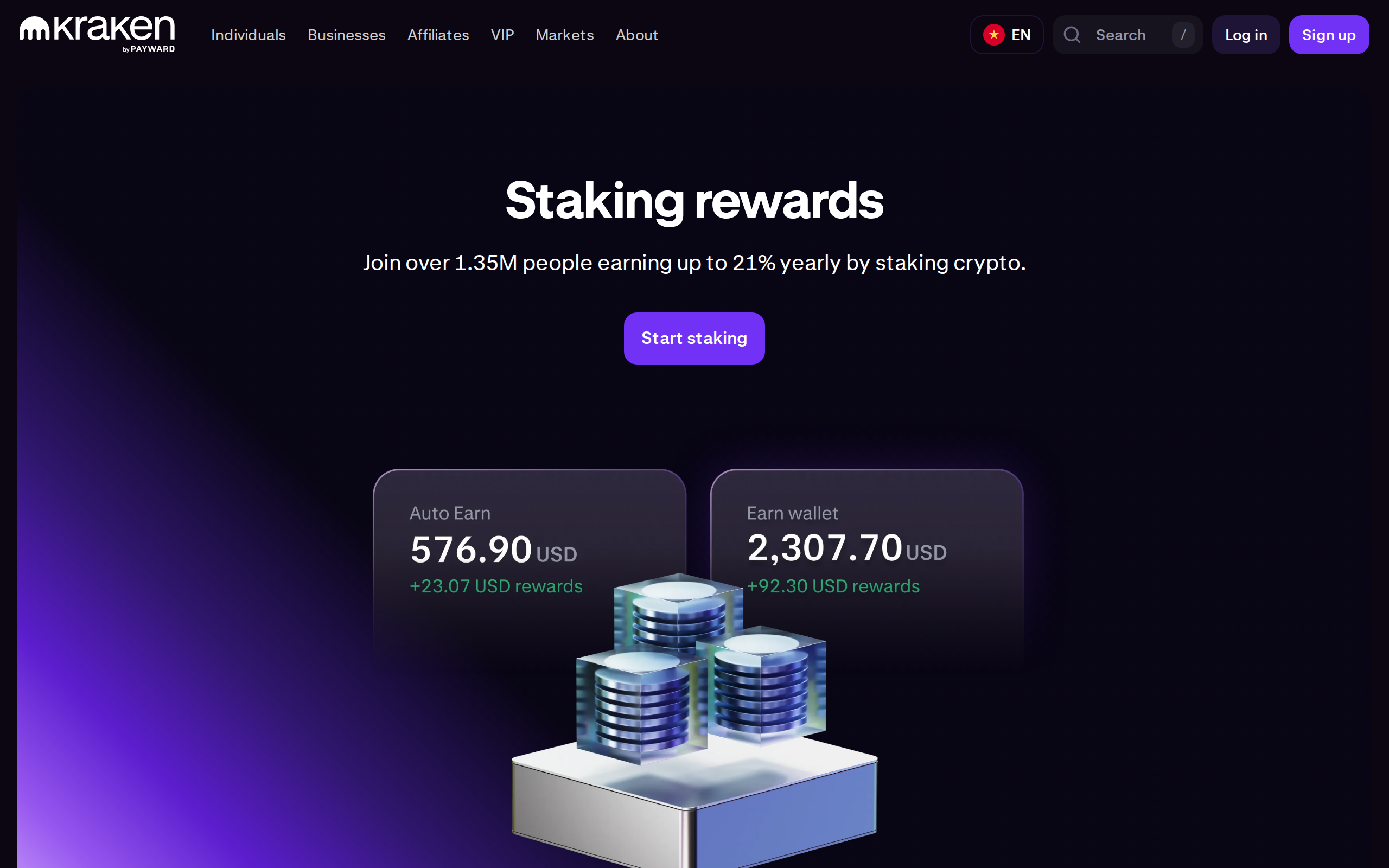
"Up to" does the work in that sentence. The top rate belongs to one asset, and a staking reward is paid in the asset that may fall. In February 2023 Kraken settled with the US SEC for 30 million USD over its staking programme and stopped offering it to US customers, according to BeInCrypto. That is a smaller and older blot than the guilty pleas at Binance and OKX, and it concerned a product, not the exchange's licensing.
A reading list that sits close to the product
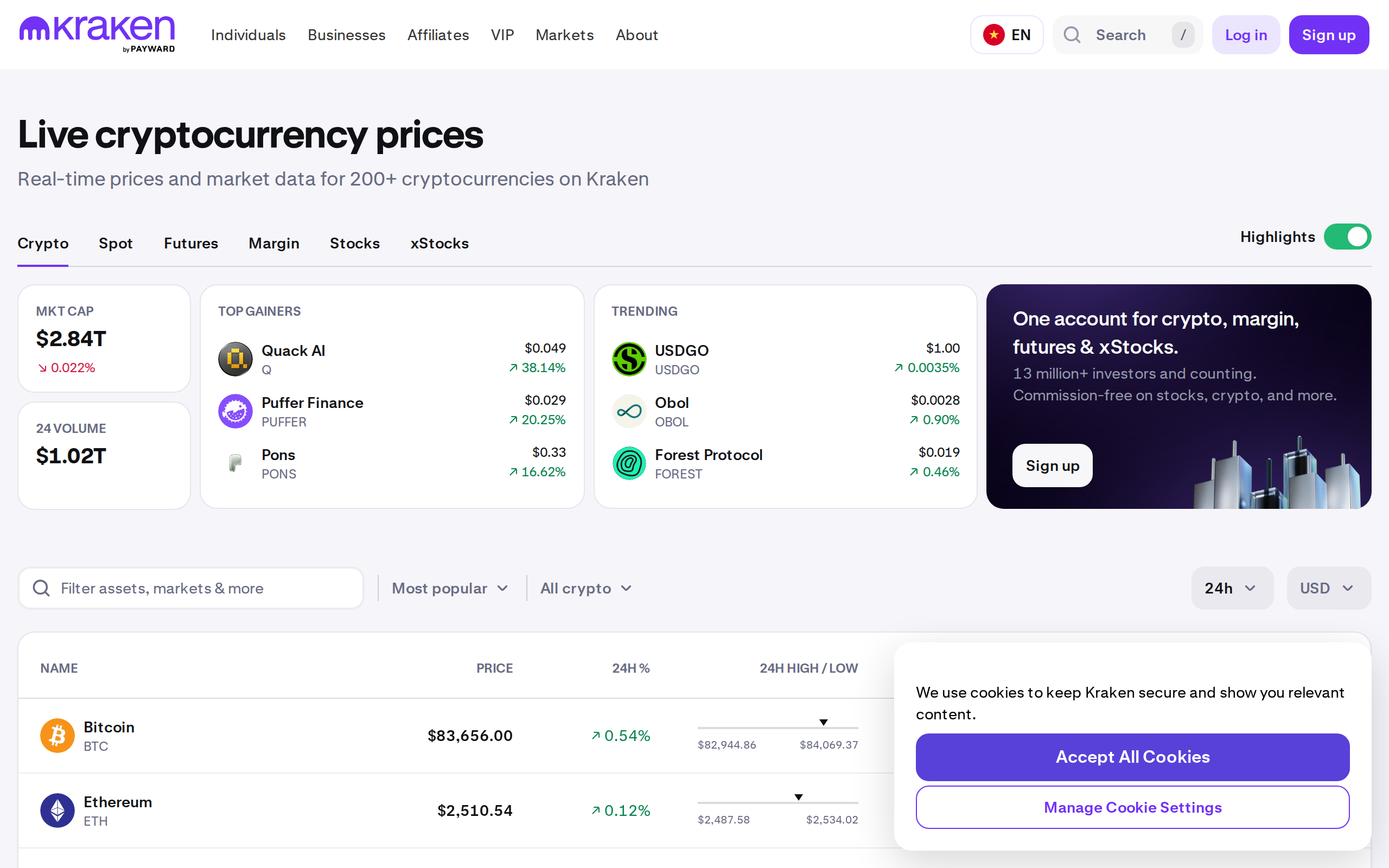
Kraken's Learn hub lists 385 results, including a guide to placing futures trades in Kraken Pro and a roundup of the best exchanges in 2026.

Guides written by the exchange will lean toward its own tools, so read them for how the interface works, not for which exchange to pick. They are useful for a first limit order, and the prices page covers 200+ cryptocurrencies if you want to see what is listed before opening an account.
Who should use it
Choose Kraken if you want a regulated venue, plan to trade enough to climb past the entry tier, and value having a named company with a paper trail. Learn Kraken Pro on small orders first and keep limit orders as your default.
Look elsewhere if the lowest fee at small size is your goal, or if you want yield you can rely on. Our score is 8.0 out of 10. The reserve record and the tier ladder earn it; the entry pricing and the spread in the simple app cost it.