Jupiter review: the best Solana swap router, but its perps are not cheaper than a CEX
Jupiter routes Solana swaps at 0 to 10 bps for most pairs, with no account to open. Its perps charge 0.06% to open and close plus hourly borrow fees, so the saving versus a CEX is custody, not cost.
Best forWallet-holding Solana users who want the best on-chain swap route
Full fee ledger
- Price
- Free to use; swap and network fees apply
- Operator
- Jupiter
- Ultra Swap, most pairs
- 10 bps (0.10%)
- Ultra Swap, SOL to stablecoin
- 2 bps (0.02%)
- Ultra Swap, new tokens (24 hours)
- 50 bps (0.50%)
- Perps base fee
- 0.06% on open and again on close
- Perps price impact
- Up to 0.44%
- Perps borrow fee
- Hourly, e.g. 0.0016% an hour (about $3.84 a day on $10,000)
- Perps leverage
- 1.1x to 250x
- JLP markets
- SOL, ETH, wBTC (JUP, HYPE, ZEC and others in beta)
- Account required
- None, wallet connection only
Our verdict
For swapping Solana tokens from your own wallet, Jupiter is the router we would use: fees are 0 to 10 bps on most pairs and there is no account. The perps cost more than a centralised futures account once borrow fees run, and everything is final if you err. This is reporting, not personal financial advice.
What works
- Ultra Swap fees are 0 bps on stable-to-stable and 2 bps SOL-to-stable, 10 bps for most other pairs
- No sign-up or identity check: you trade from a wallet you control
- Wide product set: swaps, limit orders, DCA, perps, lending and staking
- Fee breakdown is documented for perps, including the liquidation rule
What does not
- Brand-new tokens within 24 hours of launch carry a 50 bps fee, in the riskiest part of the market
- Perps charge 0.06% to open and close, up to 0.44% price impact and an hourly borrow fee
- Perps leverage up to 250x and a liquidation forfeits all remaining collateral
- No support recourse: wrong signatures, scams and lost keys are your loss
Jupiter is not an exchange you sign up to. It is a router: you connect a Solana wallet, pick two tokens, and it splits your order across the on-chain pools that quote the best price. For swapping Solana tokens we found nothing easier, and the fee is written down in bps. The harder claim is that its perpetuals save money against a centralised exchange. They do not, at least not on fees. Reporting, not personal financial advice.
One screen, no account
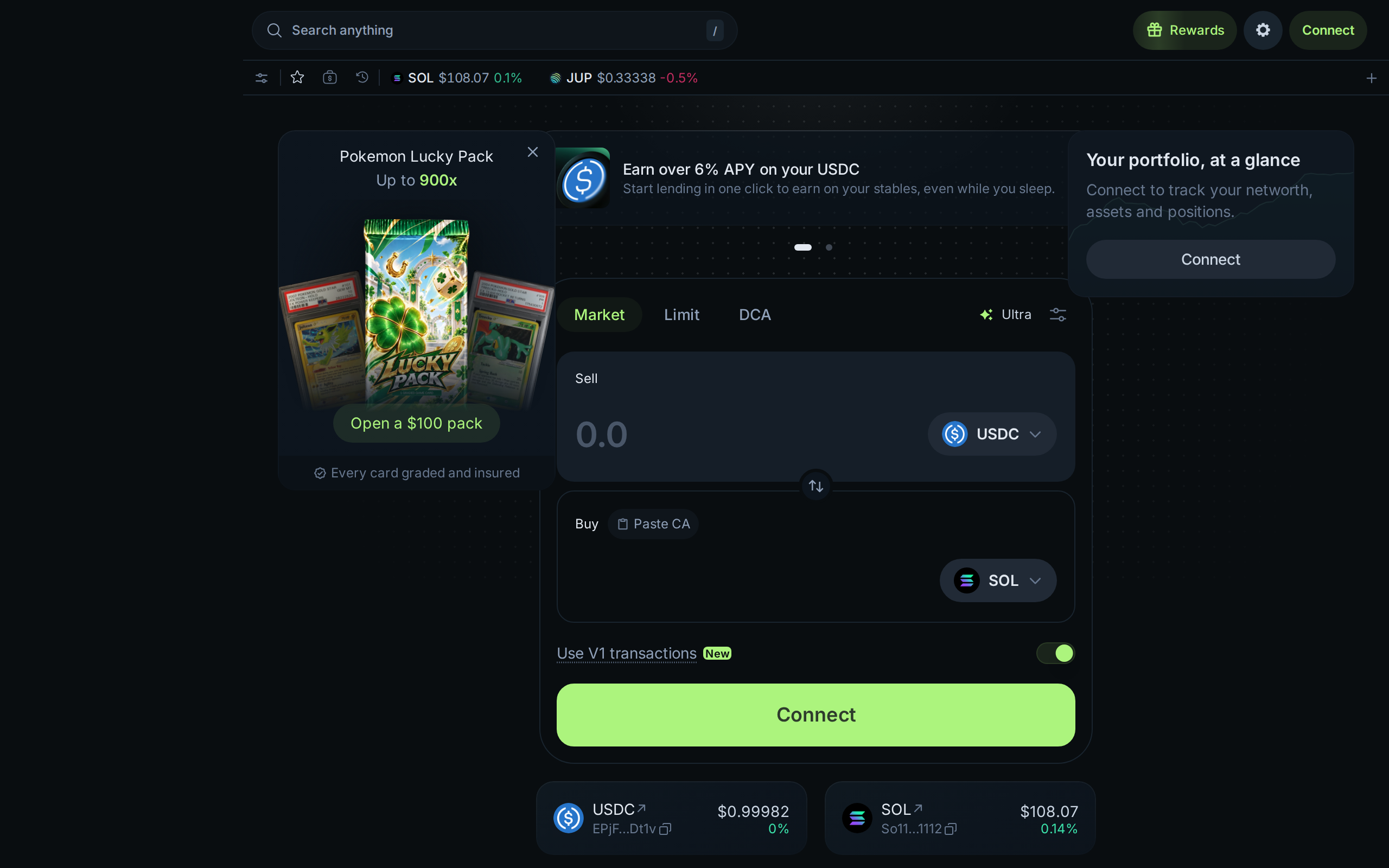
The front page opens straight onto a swap box, with Market, Limit and DCA tabs above it and an "Ultra" mode that handles routing for you. There is no registration, no identity check and no deposit step, because you never hand Jupiter your coins. Your wallet signs each trade.
That design is the point, and also the risk. Nobody can freeze your balance, and nobody will reverse a mistaken transfer or reimburse a bad signature. Support will not recover a lost seed phrase.
What a swap costs
Jupiter's developer documentation sets Ultra Swap fees by pair type:
SOL or stablecoin into JUP, JLP or jupSOL: 0 bps.
Stablecoin to stablecoin, or liquid staking token to liquid staking token: 0 bps.
SOL to a stablecoin: 2 bps (0.02%).
A liquid staking token to a stablecoin: 5 bps.
Everything else: 10 bps (0.10%).
Tokens launched in the last 24 hours: 50 bps (0.50%).
On top of that you pay the Solana network fee, plus the price impact of the pools you cross. A third-party guide claims aggregation typically offsets a 0.1% fee with 0.3% to 0.5% better pricing and puts Jupiter's share of aggregator-routed Solana swaps above 70%. Treat both numbers as claims. We cannot test every pool on every day.
Compare that with an exchange. On Bitstamp, a taker order at the entry tier costs 0.40%, and Uphold's published spread on bitcoin is more than two percent. A 0.10% fee on a Solana token swap is a fraction of either, and with no withdrawal step.
The 50 bps charge on brand-new tokens is the one to notice. Fresh launches are where scams cluster, and the fee does nothing to protect you from one.
Perps: cheaper to enter, not cheaper to hold
The perps page trades SOL, ETH and wBTC against a pooled liquidity token, and a banner at capture time said the staked-JUP requirement for the beta markets (JUP, HYPE, ZEC and others) had been removed. Docs list leverage from 1.1x to 250x.
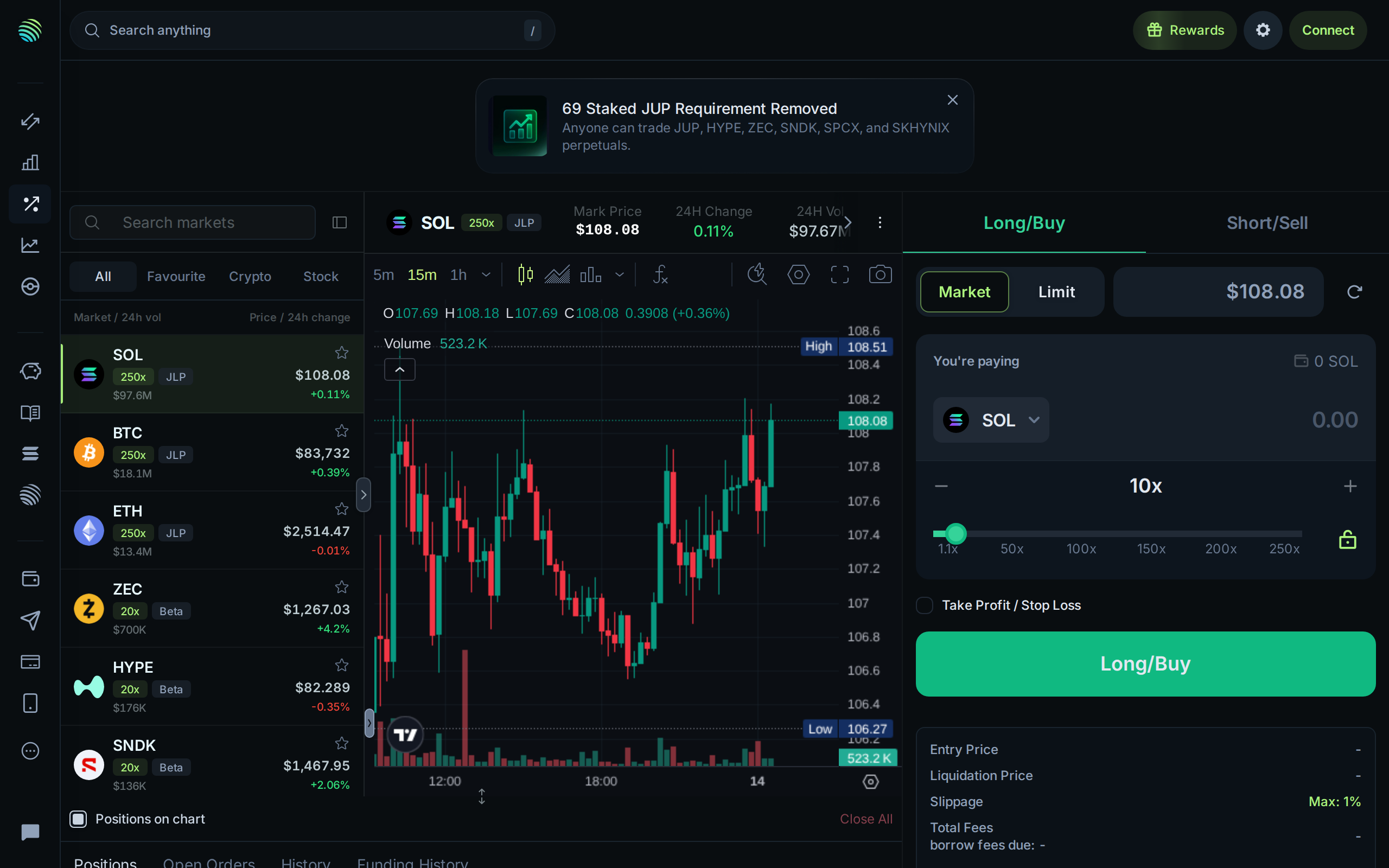
The fee documentation is where the comparison with a centralised exchange gets honest:
A 0.06% base fee on opening and again on closing.
A price impact fee of up to 0.44%.
An hourly borrow fee on the full position, for example 0.0016% an hour, about $3.84 a day on a $10,000 position.
On liquidation, all remaining collateral is forfeited, not just the loss.
Set that beside Phemex, whose standard futures account pays 0.01% to make and 0.06% to take. Over a day or a week, a Jupiter position with a borrow charge running costs more. What you buy with it is non-custodial trading and no identity check.
JLP, the pool token behind all this, earns most of the trading fees (75%, per the docs), but its holders are the counterparty to every trader. When traders win, JLP loses. That is yield with a catch, not a savings account.
Everything else on the menu
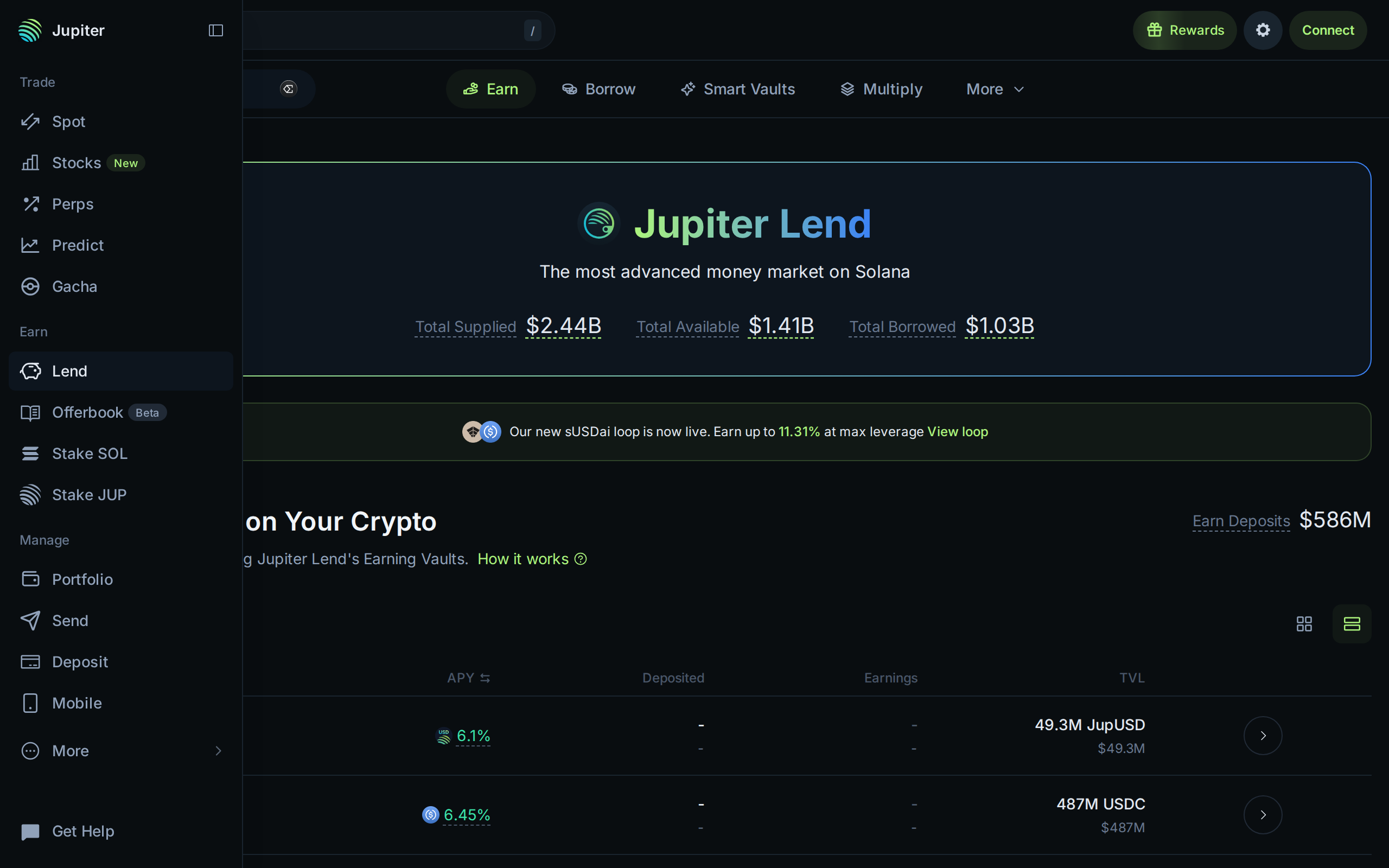
Jupiter has grown well beyond swaps. Jupiter Lend sells itself as "the most advanced money market on Solana", with earning vaults for passive yield.
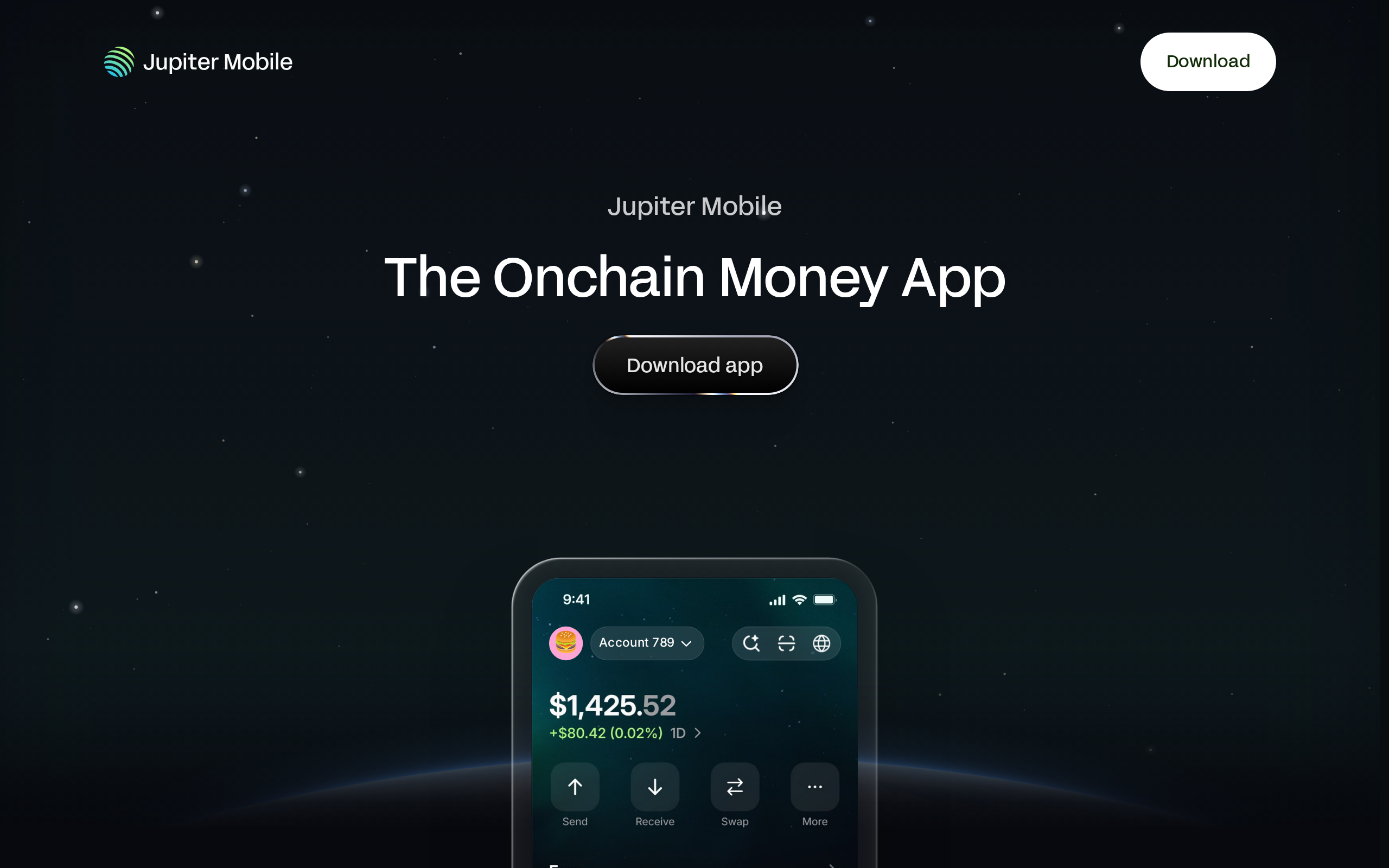
There is also a mobile app billed as "The Onchain Money App".
The homepage also pushes a Pokemon card "Lucky Pack" gacha. It is gambling dressed as collecting, and we ignored it.
Who should use it
Use Jupiter if you already hold SOL or Solana tokens in a wallet you control, you want the best on-chain route without opening an account, and you accept that mistakes are final. For that job it is our default.
Skip it if you are new to wallets, you want fiat on-ramps, a regulated counterparty or any recourse after a scam, or you plan to trade perps with high leverage: costs accrue by the hour and a liquidation takes the whole collateral. Beginners should start on a regulated exchange.