Hyperliquid review: a perps DEX that looks like an exchange, and its risks
Hyperliquid runs perpetual futures on its own chain from 0.045% taker, with no sign-up and your own wallet. We checked the fee docs, the trade screen and the 2025 JELLY incident.
Best forExperienced perps traders who want self-custody and low fees
Full fee ledger
- Price
- Free to use; perps from 0.045% taker
- Operator
- Hyperliquid Labs
- Perps base fee
- 0.015% maker / 0.045% taker
- Spot base fee
- 0.040% maker / 0.070% taker
- Fee tier basis
- Rolling 14-day volume, assessed daily in UTC
- Tier 1 volume
- Above $5M
- Top tier volume
- Above $7B (Tier 6)
- Custody
- Self-custody via your own wallet
- Markets
- Crypto, commodities, indices, FX and real-world assets
Our verdict
Hyperliquid is the first decentralized perps venue that matches a centralized futures account on cost and speed, and you keep your keys. The price is smart-contract and market-design risk, plus no support desk to call. It suits experienced derivatives traders only, and this is not personal financial advice.
What works
- Perps fees of 0.015% maker and 0.045% taker at the base tier
- No account sign-up: you trade from your own wallet
- Maker rebates are paid continuously on each trade
- Docs publish the full fee and tier schedule openly
What does not
- No customer support desk or chargebacks if you lose funds
- The March 2025 JELLY incident exposed risk in its liquidity vault
- Permissionless listings include thin, easily manipulated markets
- Spot fees of 0.040% maker and 0.070% taker are higher than perps
Hyperliquid answers a narrow question: can a perpetuals exchange on its own blockchain feel like a centralized futures account? On cost and speed the answer from our reading is close to yes. On protection when something breaks, the answer is no. There is no support line, no insurer to call and no account to freeze. Read this as reporting, not personal financial advice, and note that it is built for people who already understand liquidation.
What it is, in one paragraph
Hyperliquid is a trading venue that runs on its own layer-1 chain. You connect a wallet and trade; there is no sign-up form. The homepage describes it as "infrastructure to house all finance" and says you can trade crypto, commodities, indices, FX and real-world assets onchain, around the clock, "without intermediaries".
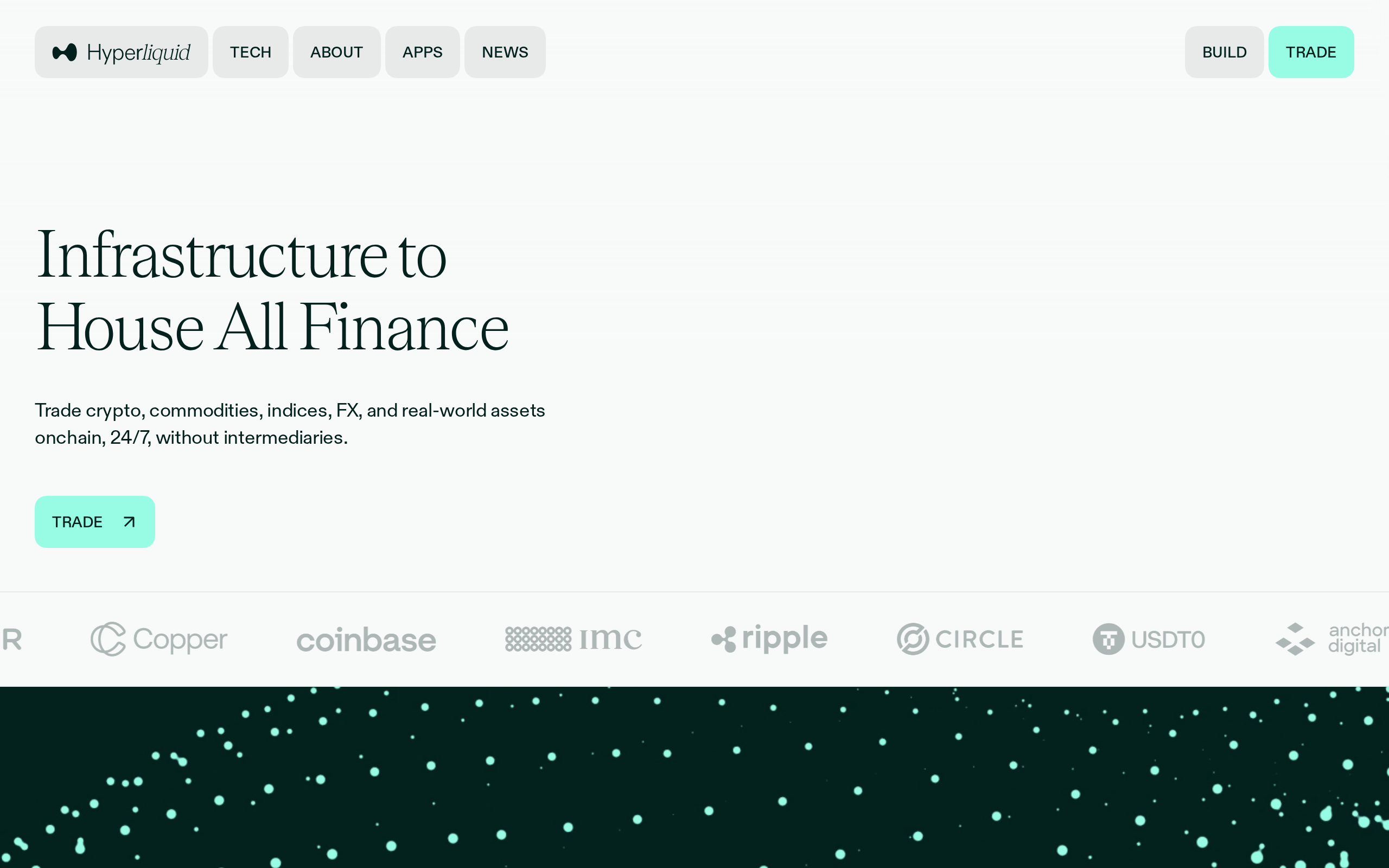
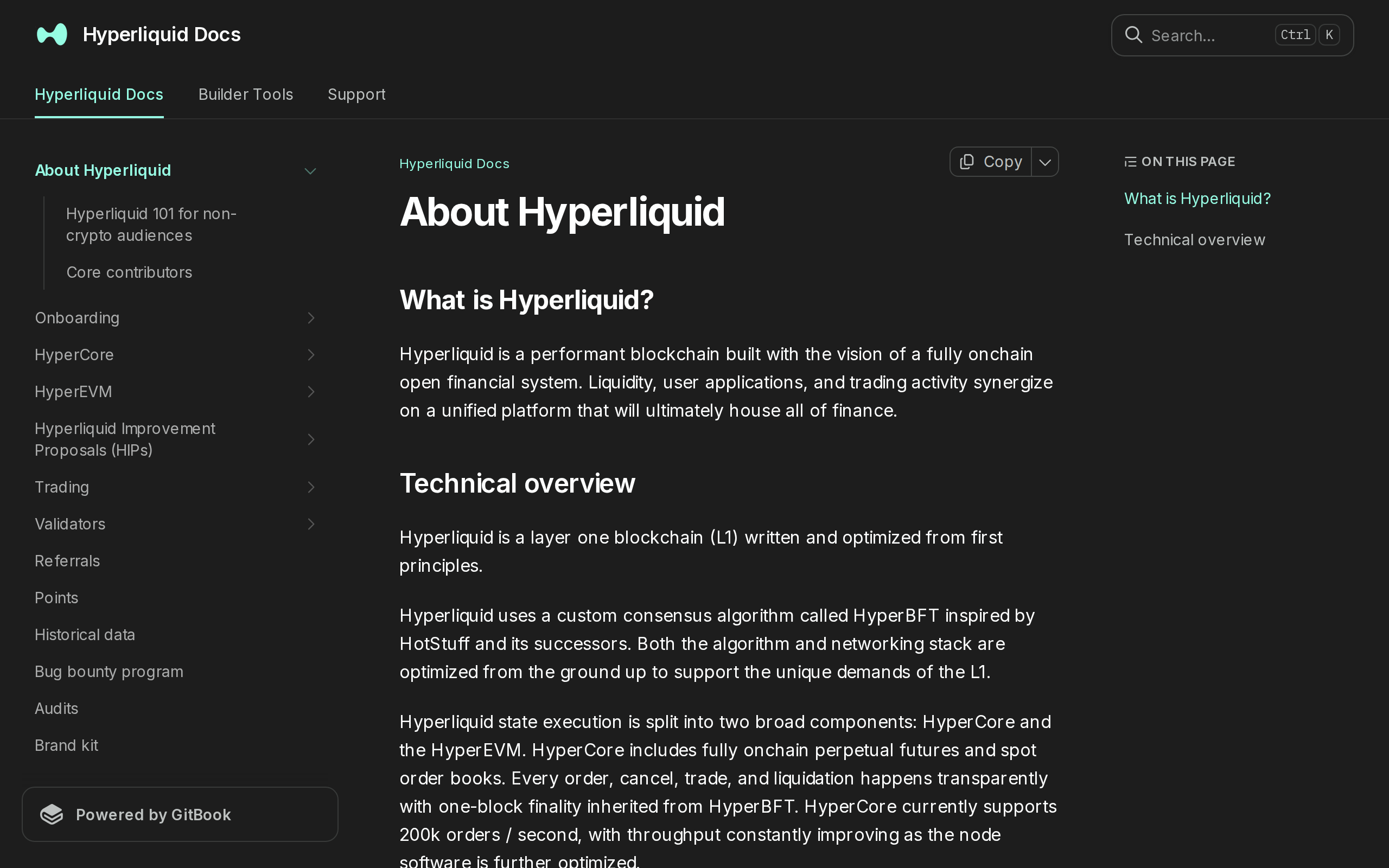
The documentation overview covers the technical design, and also a plain-language "Hyperliquid 101 for non-crypto audiences" page. That second page is a good sign: most DEX docs assume you already know.
The fee schedule is the draw
The fee page sets the base perps tier at 0.015% for makers and 0.045% for takers. Spot is higher: 0.040% maker and 0.070% taker. Fees follow your rolling 14-day volume and are assessed at the end of each UTC day. Spot volume counts double toward the tier.
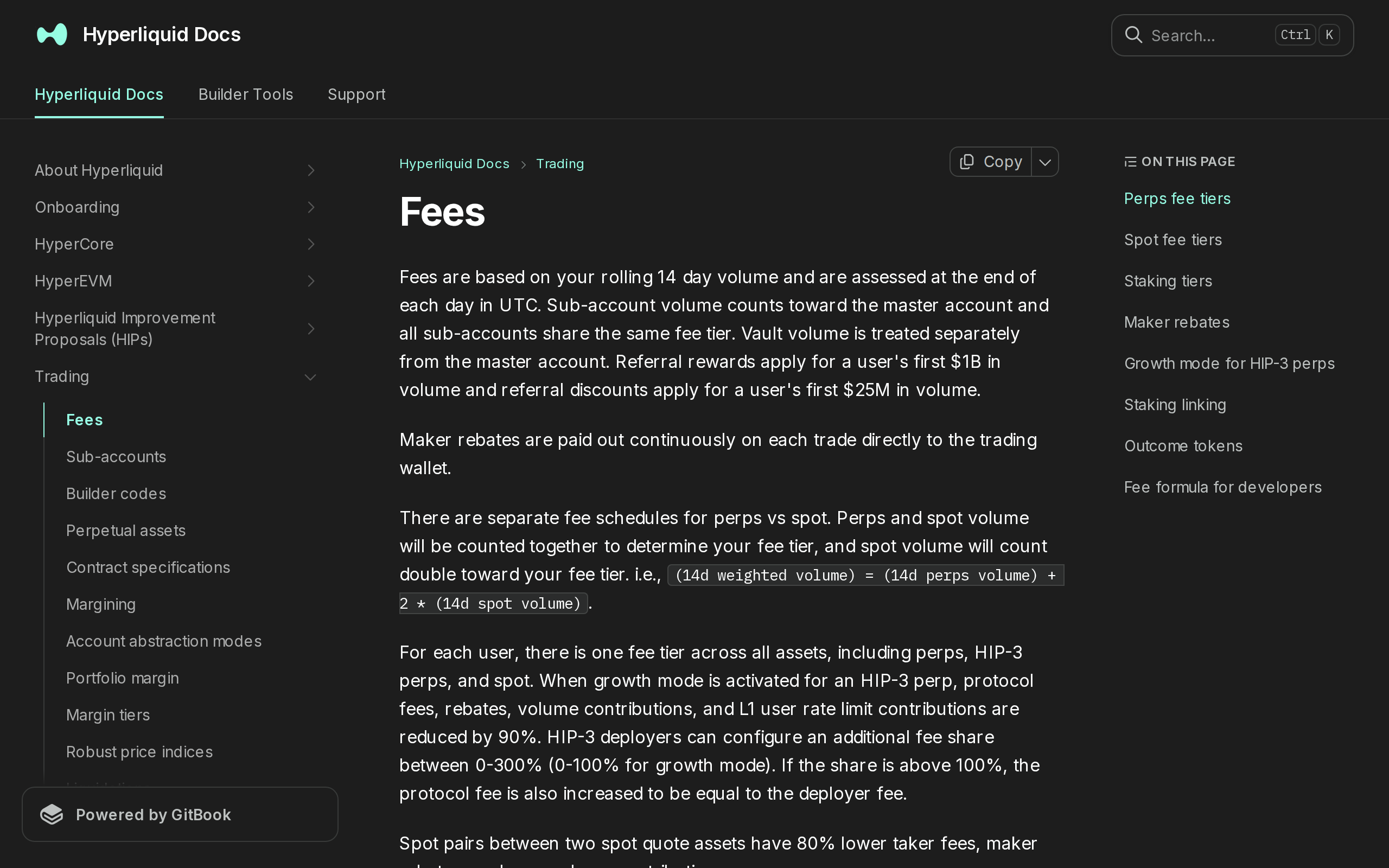
The volume steps are published: above 5 million USD for Tier 1, 25 million for Tier 2, 100 million for Tier 3, 500 million for Tier 4, 2 billion for Tier 5 and 7 billion for Tier 6. Maker rebates are paid out continuously, trade by trade, to the trading wallet.
On 10,000 USD of notional, a taker order costs 4.50 USD at the base tier. Against the 0.60% Coinbase charges its Advanced takers, that is a fraction of the cost, and the claim of DEX pricing at centralized-exchange levels holds up on paper. You still pay the network and market costs that apply to any perp: the funding rate, and slippage in thin books.
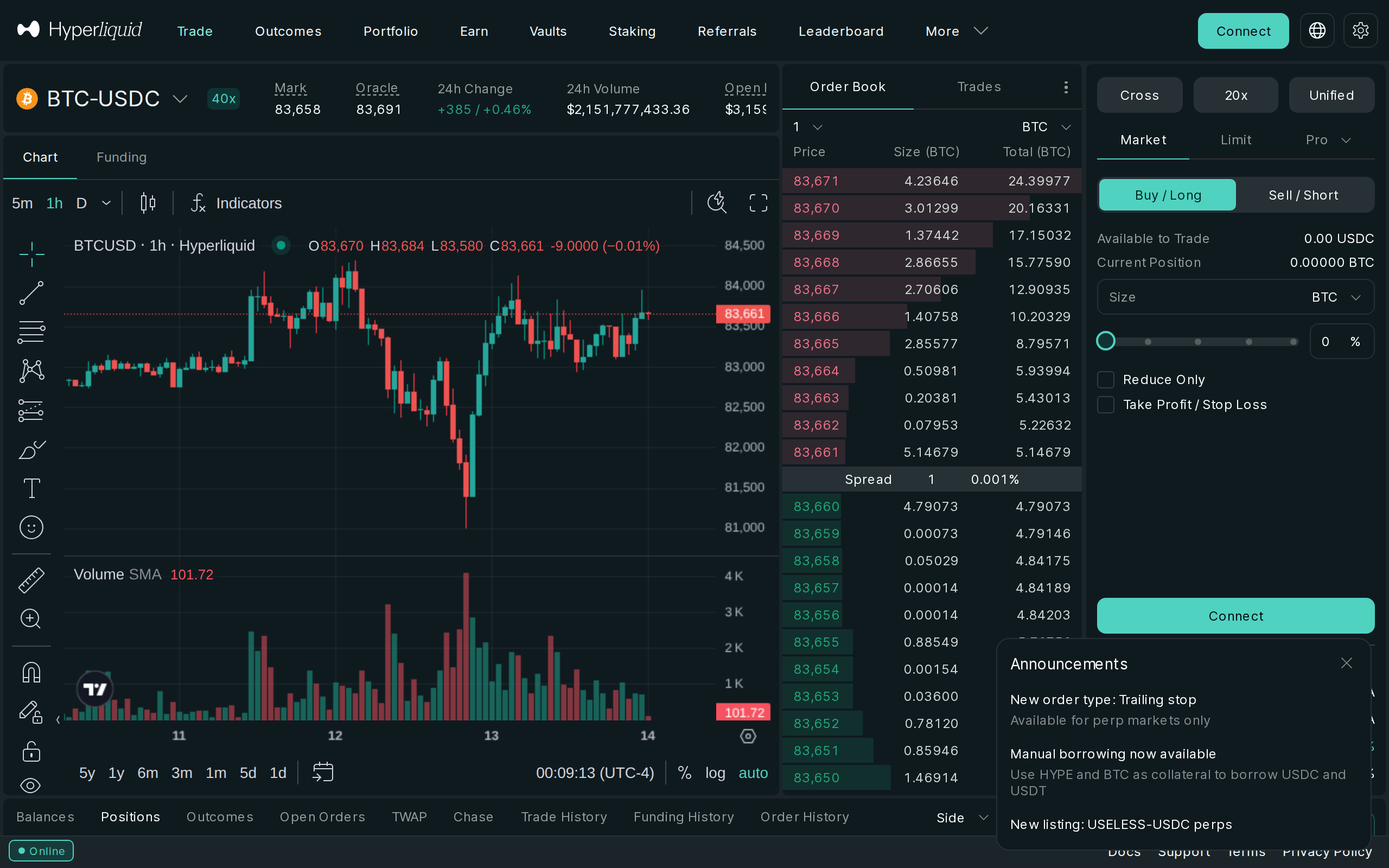
The trade screen
The trading app is a conventional layout: chart, order book, positions and a ticket. It showed hundreds of millions of dollars in headline volume figures when we loaded it.
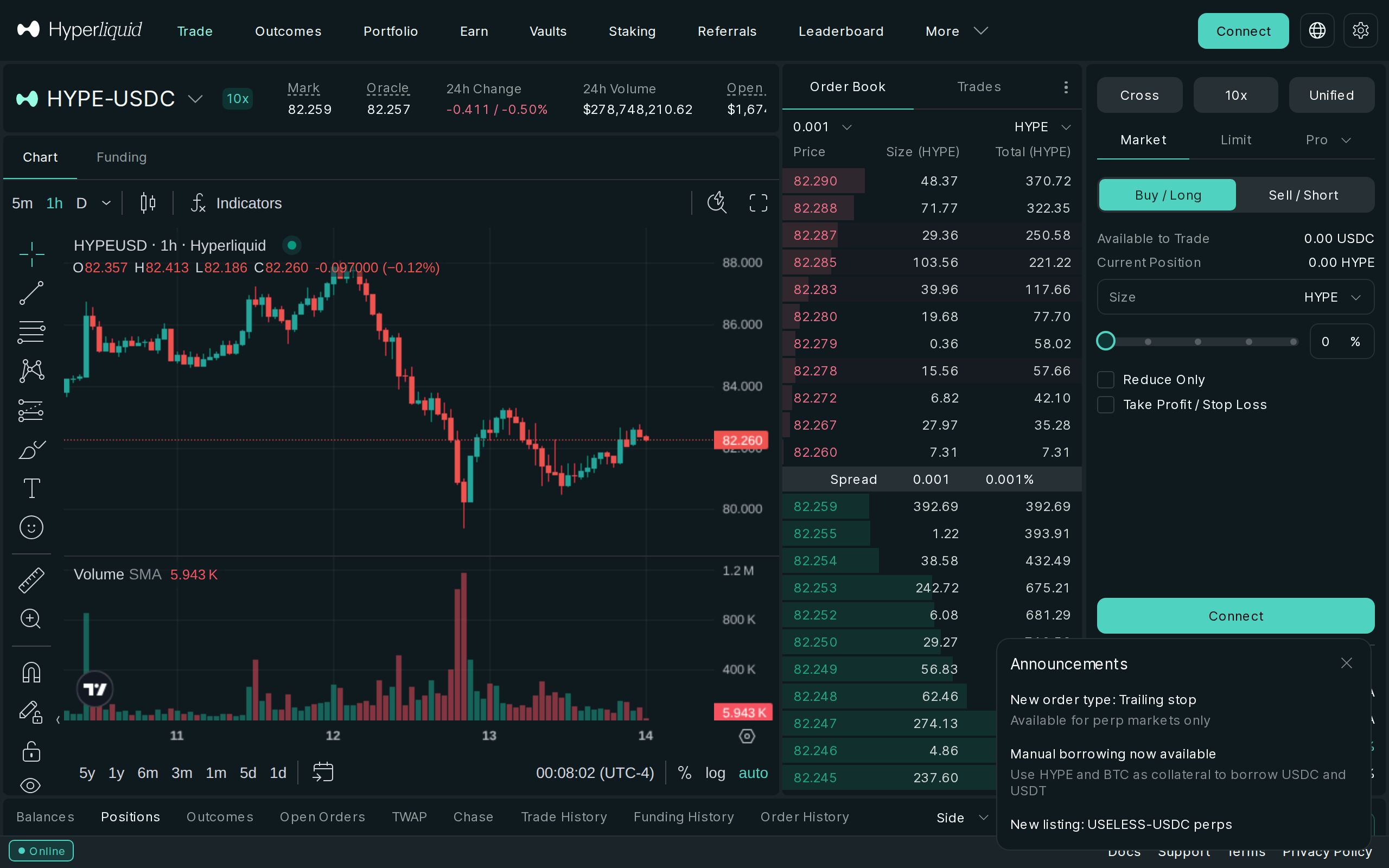
Orders settle on-chain without a broker in the loop, which is the product's real advantage. Nobody can freeze your withdrawal, because the funds sit under your wallet's rules. Equally, nobody can reverse a mistake. Send a wrong size and it stays sent.
The JELLY incident is the risk to understand
Hyperliquid's liquidity comes partly from a pooled vault. In March 2025 a trader opened a short of roughly 6 to 8 million USD on the JELLYJELLY perp, then bought the thinly traded token elsewhere to push its price up. According to the OneKey postmortem, the forced liquidations landed on the vault, with potential losses estimated at 12 to 20 million USD. Hyperliquid delisted the token. Reports say the vault's deposits fell from about 540 million USD to about 150 million USD afterwards.
The vaults page shows how visible that pool is. The Hyperliquidity Provider (HLP) vault sits at the top of a list of user-run strategy vaults, each with a dollar balance next to it.
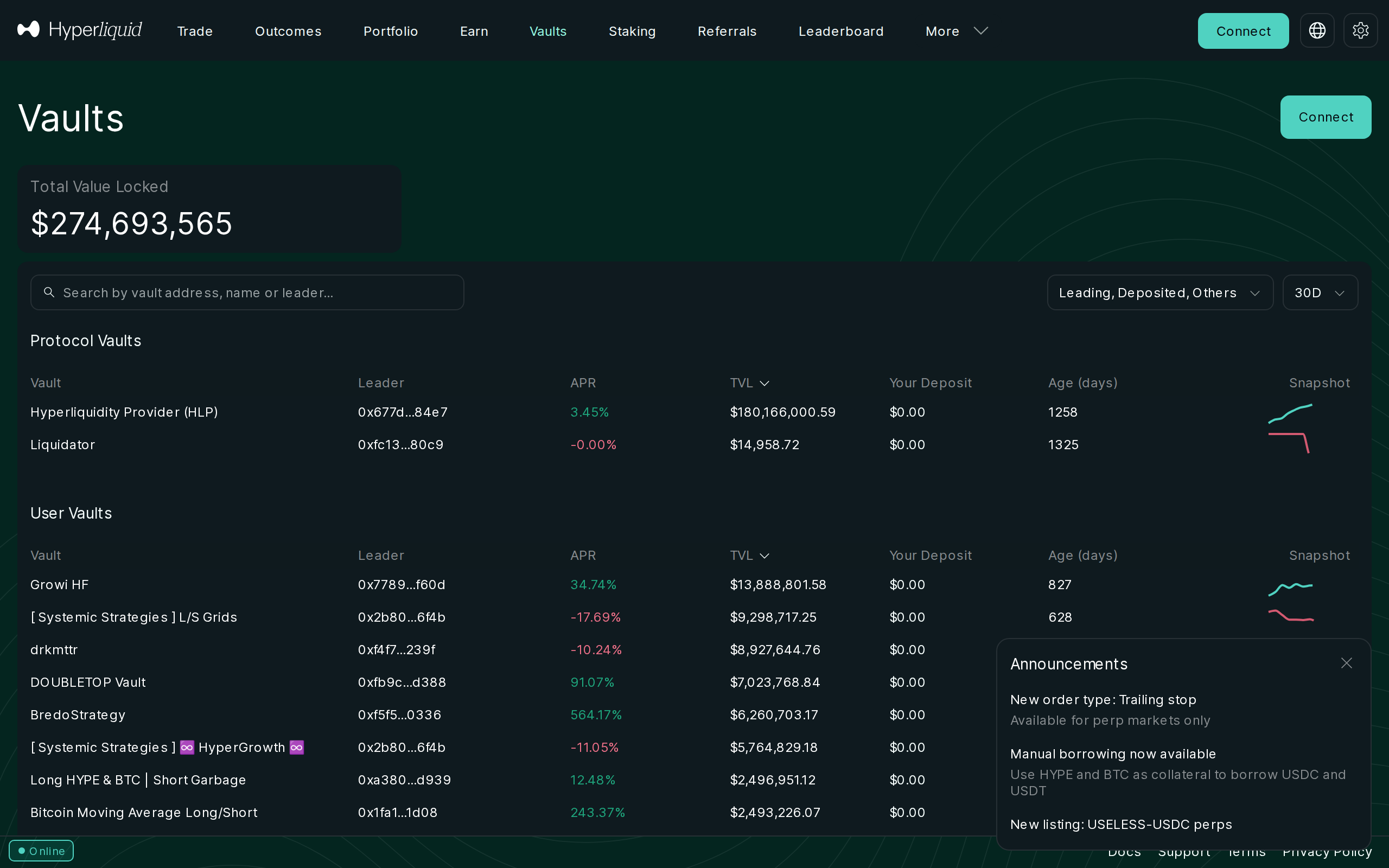
Two lessons follow:
Permissionless listings carry risk. A small token can be listed with open interest larger than its real market.
A pooled vault is a counterparty. If you deposit into it for yield, you may inherit those losses.
Volume is real
Third-party reviews such as this one put Hyperliquid's perps volume above 210 billion USD in the 30 days to 7 July 2026, and its share of decentralized perps near three quarters earlier in the year. We did not verify those totals ourselves, but depth is clearly not the weak point.
What the docs do not promise
Read the liquidations section before you fund a wallet. Margin rules, maintenance levels and what happens when a position cannot be closed at a fair price are written down there, and they differ by asset. A leveraged position can be closed for you without warning, and a self-custody wallet gives you no one to appeal to afterwards.
Who should use it
Use Hyperliquid if you already trade perps, keep your own keys, accept that mistakes are final, and size positions small enough that a wallet error is survivable. Do not use it as a first exchange, as a place to park savings, or if you need regulated recourse.
Rating: 8.1 out of 10. It earns the score on price and openness, and loses points for the missing safety net.