Gate review: 5,000+ coins and a reserves proof, but a patchwork of licences
Gate lists more coins than nearly any rival and publishes reserve proofs, but its fee table sits behind a login and its licences differ by entity. We read the listings, reviews and reserve figures.
Best forExperienced users hunting coins the regulated exchanges do not list
Full fee ledger
- Price
- Free to join; 0.10% spot trading fee
- Operator
- Gate
- Launched
- 2013 (as Bter, renamed Gate.io in 2017)
- Spot assets
- 5,100+ (Bitcoin.com); 5,200+ (CoinMarketCap)
- Spot fee
- 0.10% base per Gate help; 0.1% maker / 0.2% taker per Bitcoin.com
- Futures fee
- 0.02% maker / 0.05% taker (USDT perpetuals)
- Reserve ratio
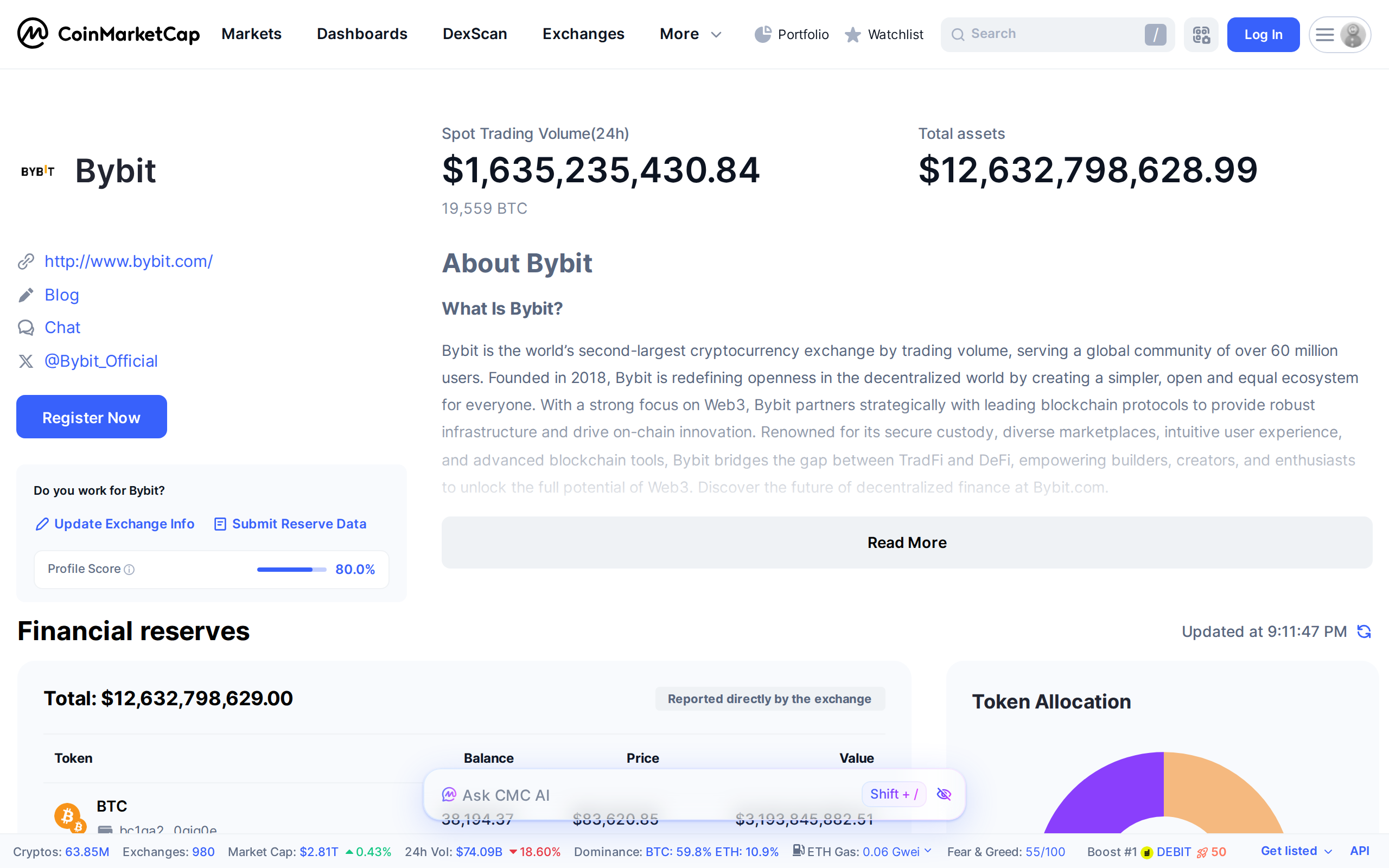
- 115%, $8.182 billion, as of 22 June 2026 (CoinMarketCap)
- EU licence
- Malta MiCA, dated 1 October 2025
- Other licences
- Dubai VARA, AUSTRAC registration, PSD2 payment institution
- US access
- Separate Gate US entity, spot only
- Claimed users
- 60 million+
Our verdict
Gate is worth using for coin selection and for the reserve proofs, not for a calm first exchange. The base spot fee is ordinary, the app is crowded, verification can loop, and the licence that protects you depends on which Gate entity serves your country. This is reporting, not personal financial advice.
What works
- More than 5,100 spot assets, per Bitcoin.com and CoinMarketCap
- Merkle-tree proof of reserves, reported at 115% coverage in June 2026
- Recent licences: Malta MiCA, Dubai VARA, Australia AUSTRAC
- Futures fees of 0.02% maker and 0.05% taker, per Bitcoin.com
What does not
- The live fee table sat behind a login, so we could not verify it
- Licences are held by separate entities, so protection varies by country
- Mandatory verification, document loops and 24-hour withdrawal holds are reported
- Predecessor Bter lost 7,170 BTC in a 2015 hack
Gate lists more coins than almost any exchange we looked at, and that is both the sales pitch and the warning. The reserves figure is good, the fee is ordinary, and the licensing is a patchwork that depends on which Gate company serves your country. Check that first. Nothing here is personal financial advice, and we did not place orders for this piece: the numbers come from Gate's own listings and from the third-party pages named in the text.
Five thousand coins is a feature and a risk
The pitch is breadth. Bitcoin.com's review counts 5,100+ digital assets for spot trading, and CoinMarketCap's Gate page says "over 5,200". On top of that sit tokenized stocks, indices, forex and metals, with the stock count given as 12,800+. Gate says it has served more than 60 million users since 2013, when it started life as Bter.
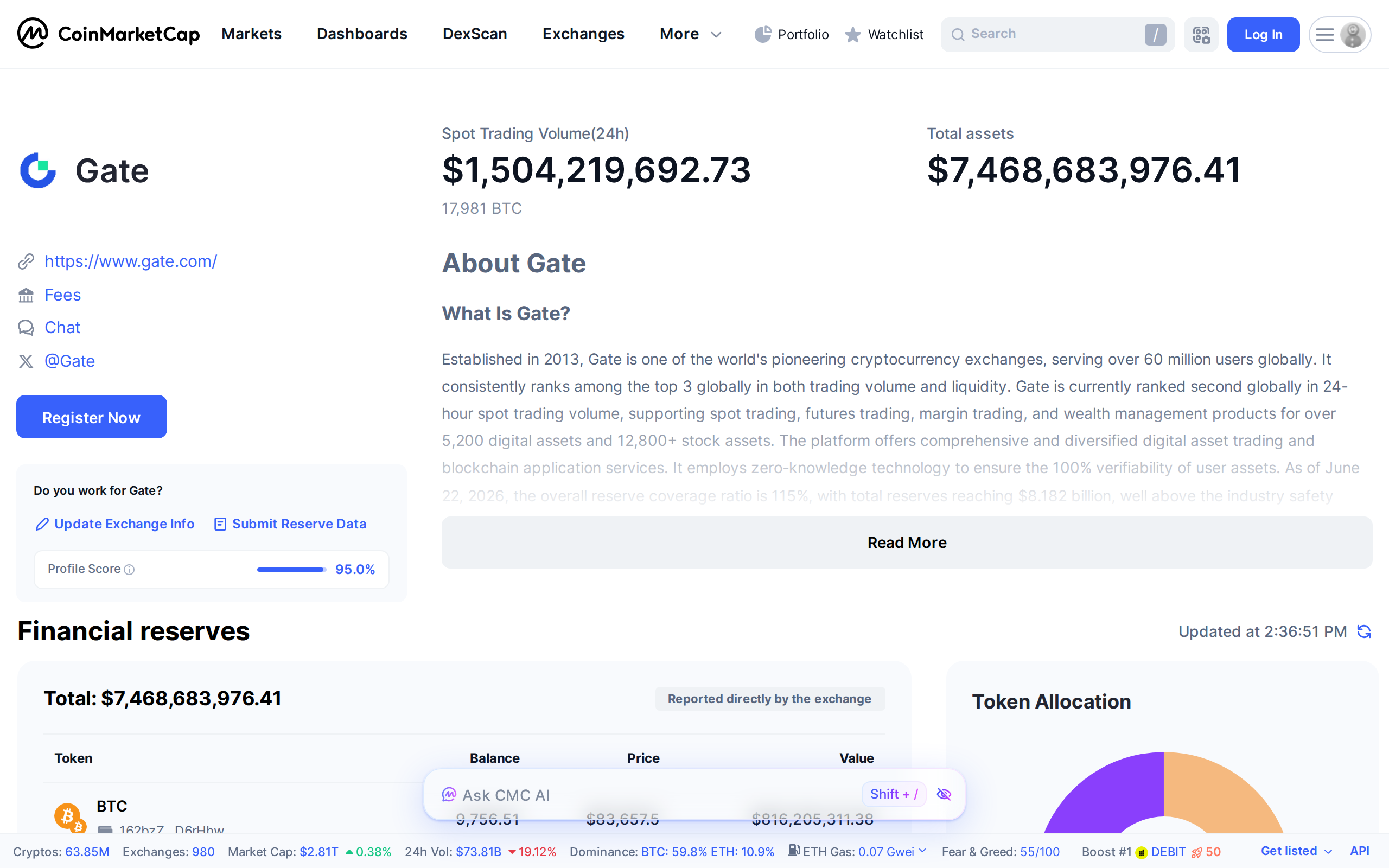
A long list matters when the coin you want is new and no regulated venue carries it. It matters much less if you hold Bitcoin and Ether. The same list means thousands of thin markets, and a thin market is where a market order costs you real money. If you stay with the top fifty coins, Gate's catalogue buys you nothing that Kraken or Coinbase does not already give you.
What it costs
Gate's help centre gives the spot formula as volume x 0.1% x tier discount, with VIP levels running from VIP 0 to VIP 16. That puts the base at 0.10%, the figure on the work order. Bitcoin.com reports the split as 0.1% maker and 0.2% taker, and says paying fees in the GT token lowers it. We could not open the live fee table: Gate's pages returned HTTP 403 to our capture machine, and the tool tells you to log in to see "your exclusive rates". Treat 0.10% to 0.20% as the range and check your own account page.
Futures are cheaper on paper: 0.02% maker and 0.05% taker on USDT perpetuals, per the same review. US stocks and ETFs are listed at zero fee.
There is no Gate subscription. Free to join, then you pay the trading fee and the network fee on withdrawal. The fee is not the story with Gate. Withdrawal friction is.
Proof of reserves, with the fine print
Gate was early to publish reserve attestations and uses a Merkle tree, so you can check that your own balance is counted. CoinMarketCap reports a 115% reserve coverage ratio with $8.182 billion in reserves as of 22 June 2026. A search summary of earlier reviews put the figure at 125% in January 2026, so the ratio moves.
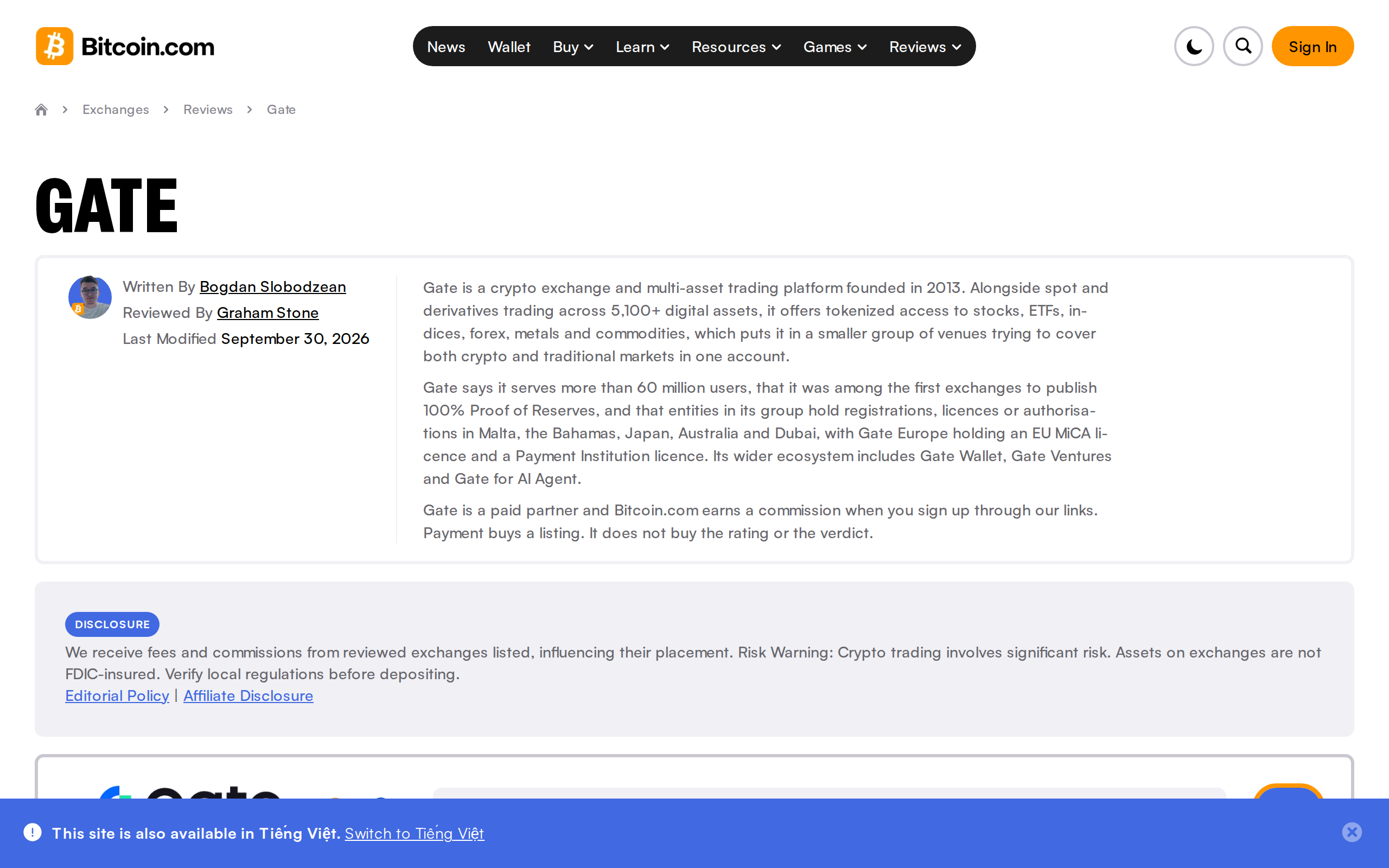
Read it for what it is. A reserves snapshot shows assets at one moment. It does not audit everything the exchange owes, and it cannot tell you whether you will be able to withdraw on a bad day. Bitcoin.com makes the same point. It is better than no proof, and better than several large rivals offer.
Licences: read your own country's line
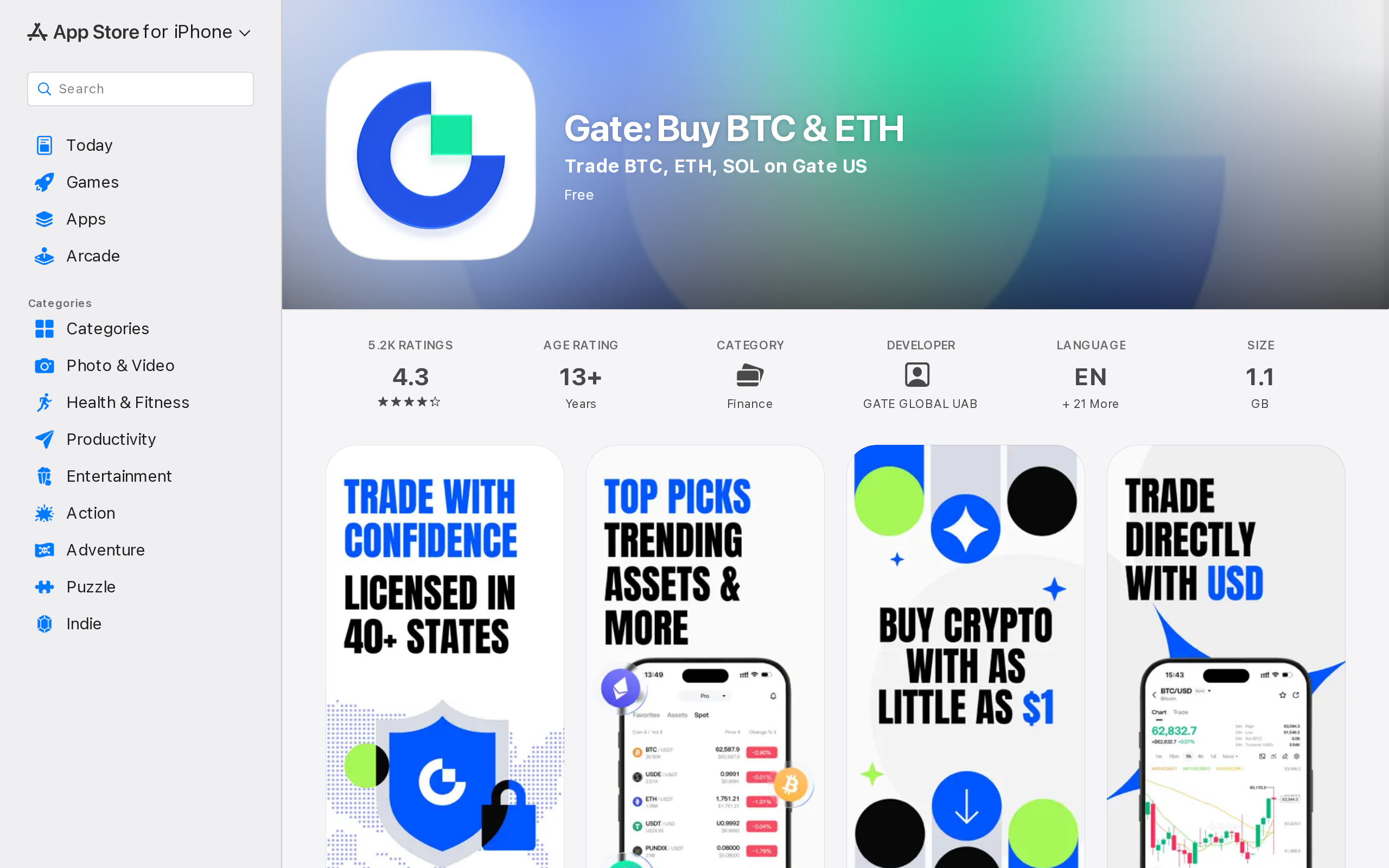
The App Store listing shows the problem, and it is our featured picture above: the headline reads 'Gate: Buy BTC & ETH', the tagline says 'Trade BTC, ETH, SOL on Gate US', and the developer is listed as GATE GLOBAL UAB. The app name, the US tagline and the developer entity do not match each other. CoinMarketCap lists a Malta MiCA licence (1 October 2025), a PSD2 payment institution licence (February 2026), a full VARA licence in Dubai (April 2025) and an AUSTRAC registration in Australia (November 2025). US residents are served by a separate Gate US entity that offers spot only.
Those are real approvals, and they arrived quickly. They are also entity-level. The company that serves a Singapore or Brazil user is not necessarily the Maltese one. Bitcoin.com notes that protections differ depending on which entity serves you, and that Gate's restricted-country list is non-exhaustive and can change without notice. If you are in the EU or Australia, the case is stronger. Elsewhere, you are on the offshore terms.
The interface and the friction
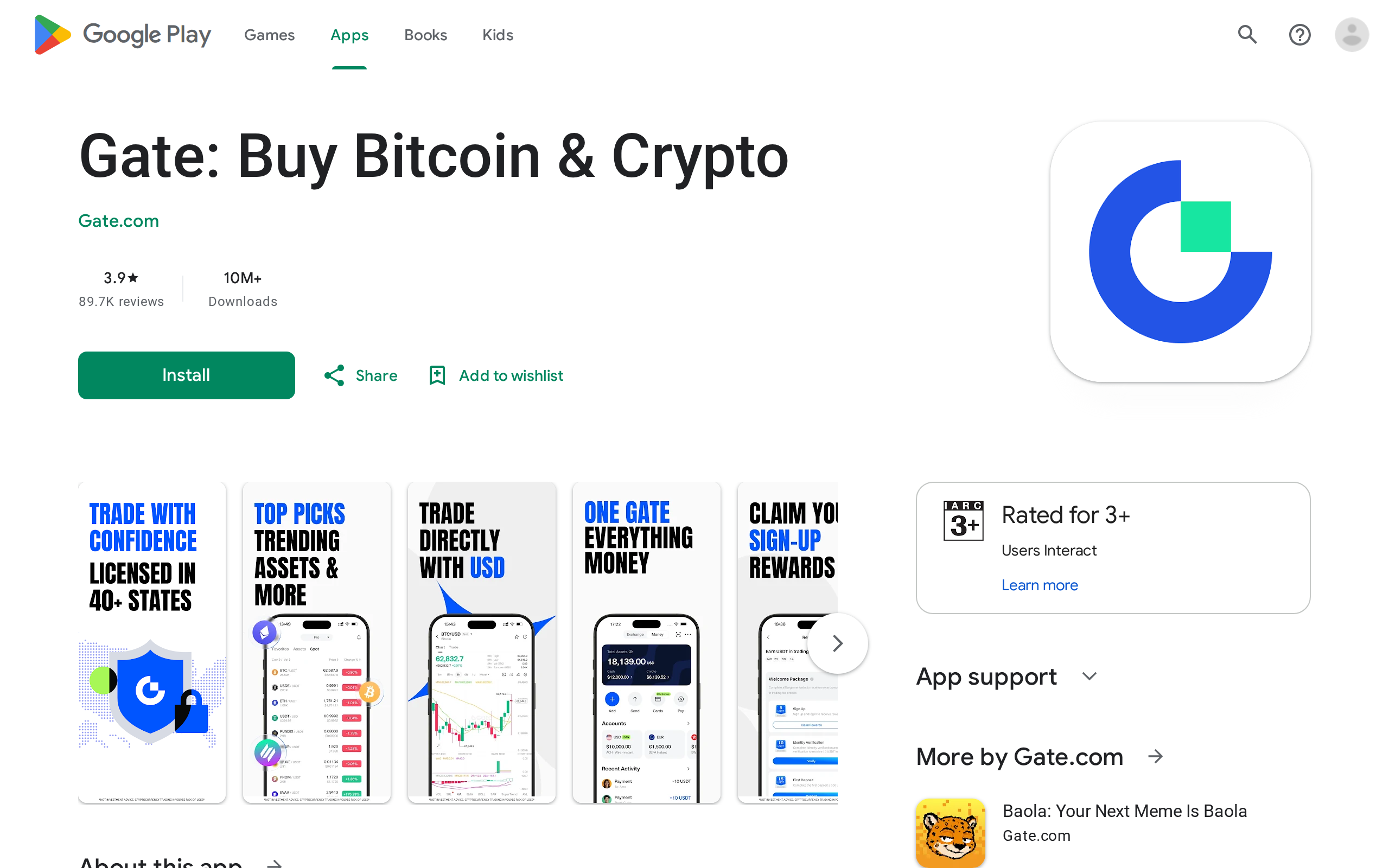
The app packs spot, margin, futures, options, copy trading, staking, NFTs and tokenized stocks into one place. Bitcoin.com's verdict is that complexity is the cost of the breadth, and we agree with the direction if not the tone. A beginner opening it will find a lot of menus.
Verification is mandatory before deposits and withdrawals, and reviewers report document loops. A 24-hour withdrawal hold can follow a security change, such as a new device or a changed password. That is a sensible control and a nuisance if you need the money quickly.
History
Bter lost 7,170 BTC in a 2015 hack, according to Bitcoin.com. In 2019 an attack on Ethereum Classic cost roughly $200,000, which Gate covered. Those events are old and the exchange survived them, but the Bter lineage is part of the record.
Who should use it
Use Gate if you need a coin that the regulated exchanges refuse to list, you are in a region where one of its licensed entities covers you, and you will withdraw to your own wallet rather than leave funds on the platform. Skip it if you want a calm first exchange, or if your holdings are Bitcoin and a few large coins. The fee does not beat Binance's flat rate, the interface is busier, and the licence story needs homework. We rate it as a capable tool with a heavy asterisk.