dYdX review: still a serious perps DEX, but Hyperliquid has most of the volume
dYdX publishes a seven-tier fee table from 0.05% taker, lists 118 markets and needs only a wallet. We weigh that against its smaller share of on-chain perps and the US block.
Best forSelf-custody perps traders who value a mature chain over top liquidity
Full fee ledger
- Price
- Free to use; fees from 0.05% taker / 0.01% maker
- Operator
- dYdX Trading
- Base fees (under $1M)
- 0.05% taker / 0.01% maker
- Top fee tier ($200M+)
- 0.025% taker / 0.011% maker rebate
- Staking discount
- 5% to 50% with bonded DYDX
- Markets listed
- 118 (as of capture)
- Architecture
- Cosmos-based app chain (dYdX Chain, v4)
- Custody
- Self-custody wallet, no account
- Listing model
- Permissionless since the Unlimited upgrade, 19 Nov 2025
- US access
- Perpetuals blocked; Solana spot reachable
Our verdict
dYdX is a well-engineered on-chain perps venue with an open fee table and no sign-up, now trading a small fraction of Hyperliquid's volume. Liquidity on minor markets is thinner, there is no support desk, and US users are blocked from perpetuals. A sound choice for experienced traders who want self-custody. Not personal financial advice.
What works
- Seven published fee tiers, from 0.05% taker to a maker rebate at top volume
- No sign-up: connect a wallet and trade
- 118 markets listed, including commodities, via permissionless listing
- Staking DYDX gives a 5% to 50% fee discount
What does not
- Volume is roughly a tenth of Hyperliquid's, so spreads can be wider
- No customer support or chargebacks if you make a mistake
- Perpetuals are blocked for US users and the terms bar US persons
- Permissionless listings mean some markets are thin and unvetted
dYdX still matters, but as the careful old-timer of on-chain perpetuals rather than the leader. Its volume is a fraction of Hyperliquid's, and the people who have stayed are mostly there for its fee schedule, its listing model and the fact that it never lost its footing. If you live in the United States you cannot trade its perpetuals at all. This is reporting on public pages and docs, not personal financial advice, and perpetual futures can wipe out a deposit in one bad move.
A chain built for one job
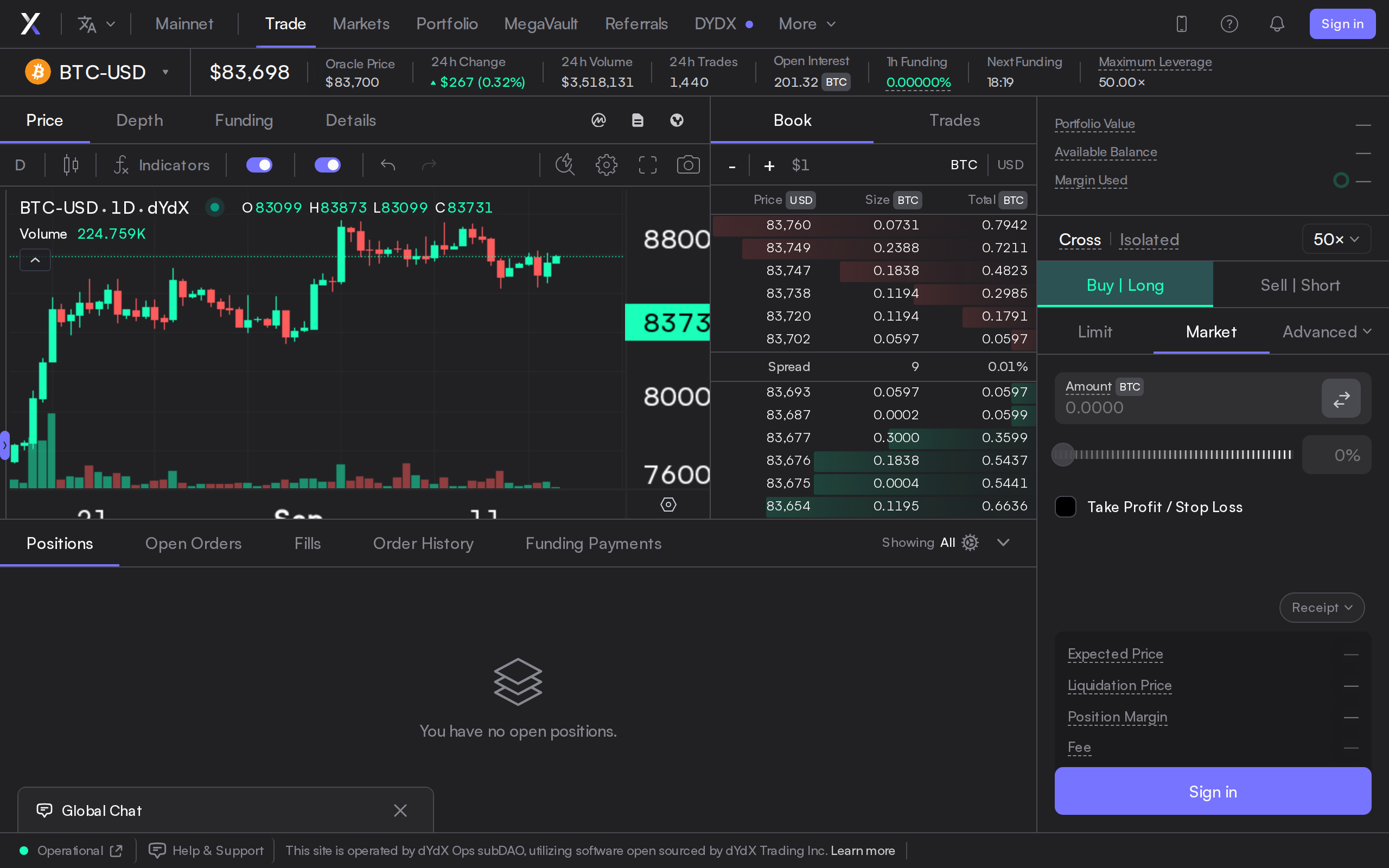
dYdX began as contracts on Ethereum and now runs as its own Cosmos-based chain, usually called dYdX Chain or v4. Validators run the order book and matching engine, and you trade from a self-custody wallet instead of an account held by a company. The trading screen opens on BTC-USD with the book, chart and order form in a dark layout familiar to anyone who has used a centralized futures site.
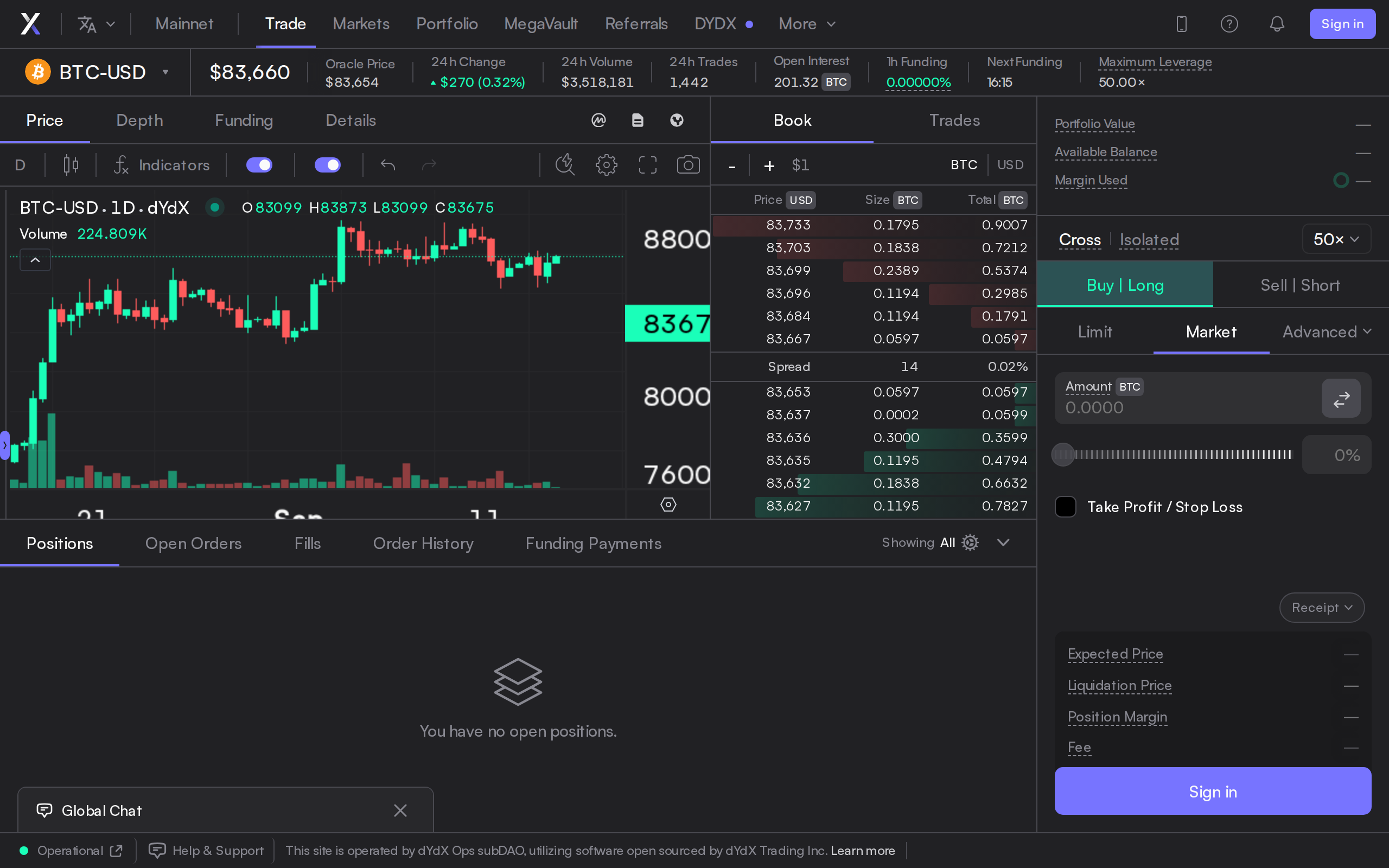
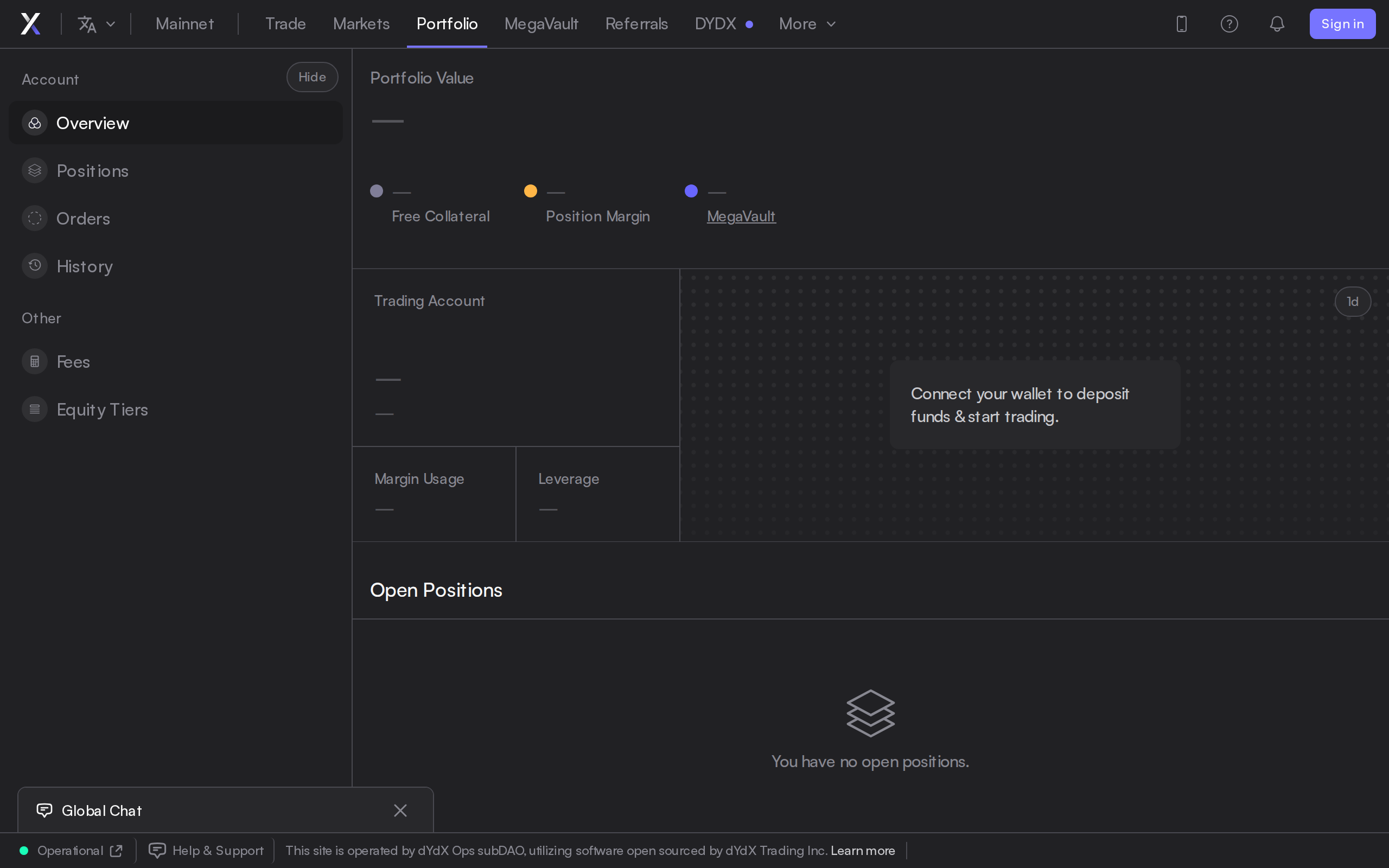
There is no sign-up. The portfolio page tells a new visitor to "connect your wallet to deposit funds and start trading". That is the whole onboarding, and it is also the whole safety net: no support ticket gets a mistaken transfer reversed.
What a trade costs
The fee documentation publishes a seven-tier table based on 30-day volume. Below $1 million you pay 0.05% taker and 0.01% maker. From $1 million the taker drops to 0.045%, from $5 million to 0.04% with a 0.005% maker, and at $25 million the maker fee reaches zero. The top two tiers, at $100 million and $200 million, pay makers a rebate of 0.007% and 0.011%, with takers at 0.025%.
Staking DYDX adds a discount of between 5% and 50% depending on the stake and your tier, and the docs state there is no community tax, so fees flow to validators and stakers. That matters if you hold the token anyway. If you do not, treat the discount as a footnote, not a plan.
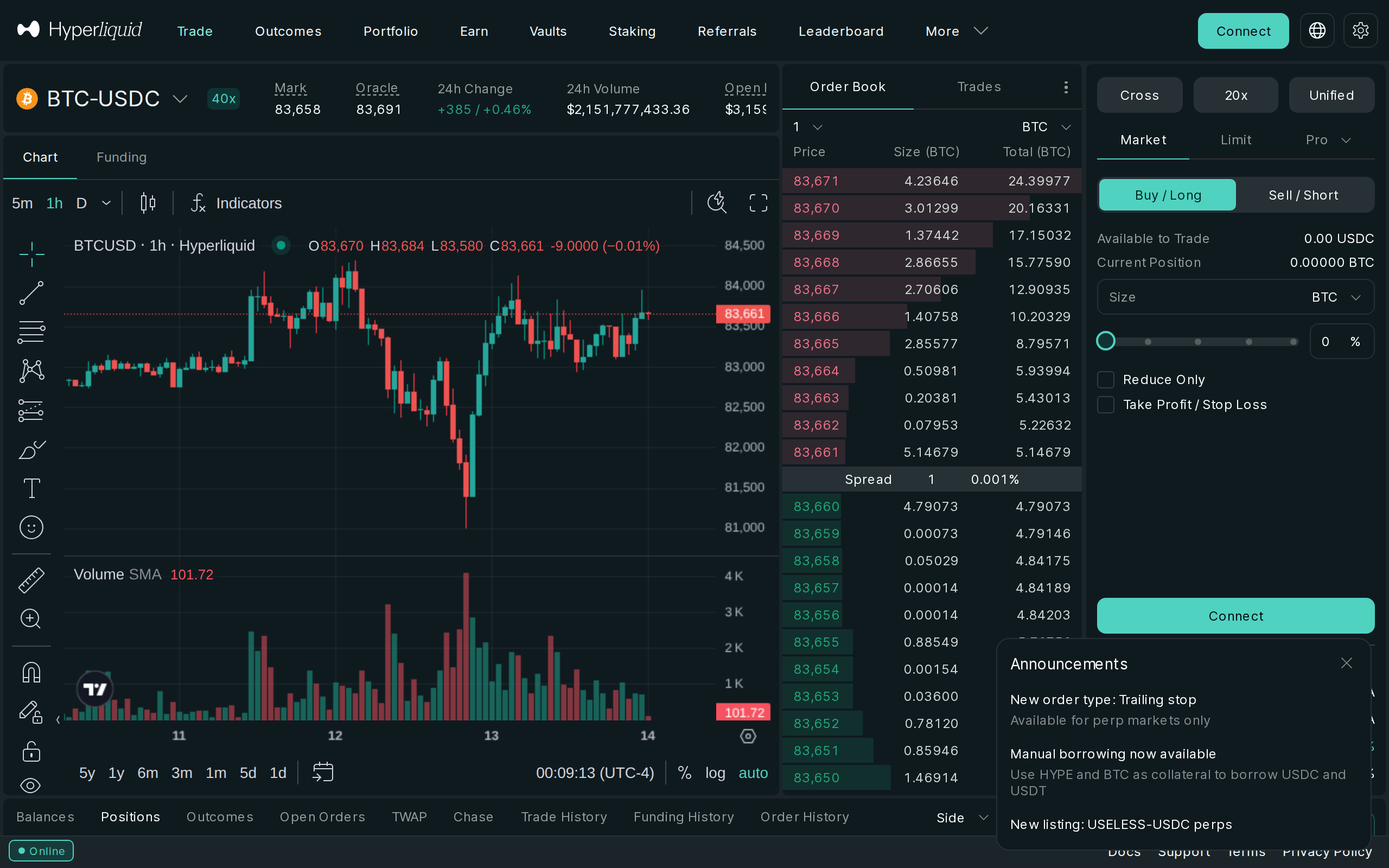
Compare that with a centralized futures venue such as Bitunix, which charges 0.06% taker at its entry tier. dYdX is cheaper for takers by a hair at the bottom tier and clearly cheaper for large makers. The honest comparison, though, is with Hyperliquid, whose base tier is 0.045% taker. At small sizes nothing here is a bargain. At institutional size the rebates start to pay.
Where the volume went
The more important number is market share. The dYdX Foundation's H1 2026 report is reported to put volume near $32 billion, with Q2 falling to about $10.8 billion. Outside trackers in April 2026 had Hyperliquid's 30-day perpetual volume above $180 billion, with dYdX running at roughly a tenth of that. Cumulative volume since the chain launch is cited at well over a trillion dollars, so this is not a ghost town. It is a smaller room.
For you as a trader, thin volume means wider spreads on lesser pairs and bigger slippage on big orders. Check the order book depth on the exact market you intend to trade before you deposit, not after.
Unlimited, and a very long market list
The upgrade called Unlimited went live on 19 November 2025. It lets anyone list a perpetual market without a governance vote, using a pooled liquidity vault named MegaVault to back new markets. Reports say more than 50 markets were added by the community within about six weeks. The markets page now shows 118 markets across three pages of 50, with listings that stretch to commodities such as West Texas Intermediate crude oil at 5x leverage.
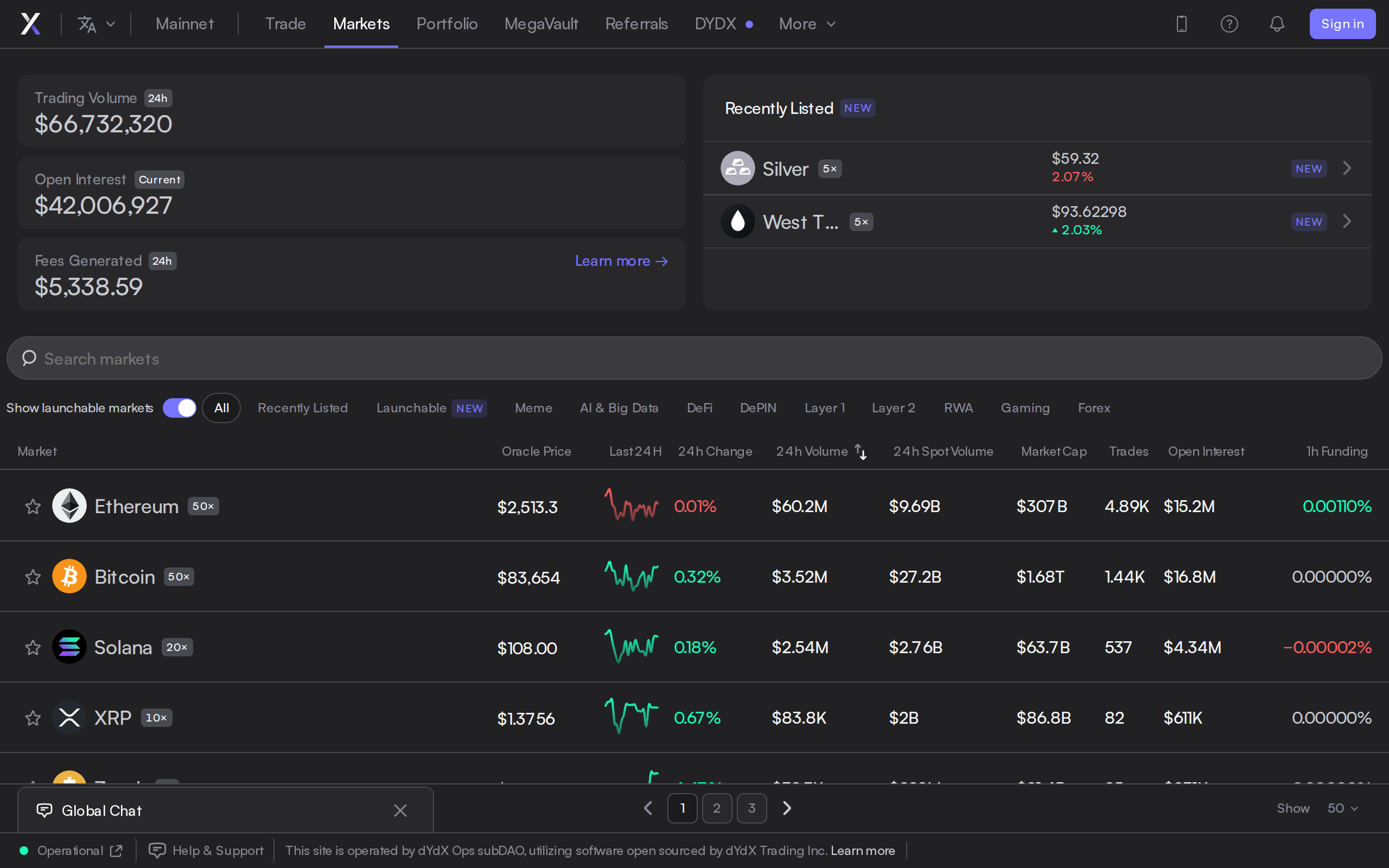
Permissionless listing is a feature and a hazard. A long list means you can find a market for almost anything. It also means some markets are thin, and a new one is not vetted by an exchange team. Lower leverage on the odd listings, such as the 5x on crude, is a sign the system leans on caps instead of curation.
Who can use it
The front end blocks United States IP addresses for perpetuals, and the terms bar US persons. In late 2025 dYdX added Solana spot trading that US users can reach, with trading fees waived for December. The perpetuals are still closed to them. Elsewhere, local rules are your own problem: a decentralized interface does not make a trade legal where you live.
Who should use it? Traders who want self-custody, a published fee table and a mature chain, and who accept that the best liquidity now sits elsewhere. Who should skip it? Anyone who needs a support line, anyone who trades small altcoin markets without checking depth, and anyone in the US.
We rate dYdX 6.8 out of 10: sound engineering, honest pricing, shrinking audience.