Bitso review: the practical exchange for Mexico and Latin America
Bitso lets you fund in pesos by SPEI, trade from 0.04% in USD markets and cash out to a local bank in seconds. We weigh that against MXN spreads of up to 0.60% and a footprint that stops at Latin America.
Best forMexican and Latin American users moving pesos, reais or pesos argentinos in and out
Full fee ledger
- Price
- Free to join; trading fees vary by volume
- Operator
- Bitso
- Founded
- 2014, Mexico City
- Countries served
- Mexico, Brazil, Argentina, Colombia, Chile, Peru
- Users
- About 9 million reported
- USD spot fee
- 0.04% maker, 0.05% taker
- MXN spot fee
- 0.36% to 0.60%
- Local deposits
- SPEI, PIX, COELSA: free
- Stocks and ETFs
- 5,000+ US stocks via Alpaca, commission-free
- Security audit
- CCSS Level II, reported late 2025
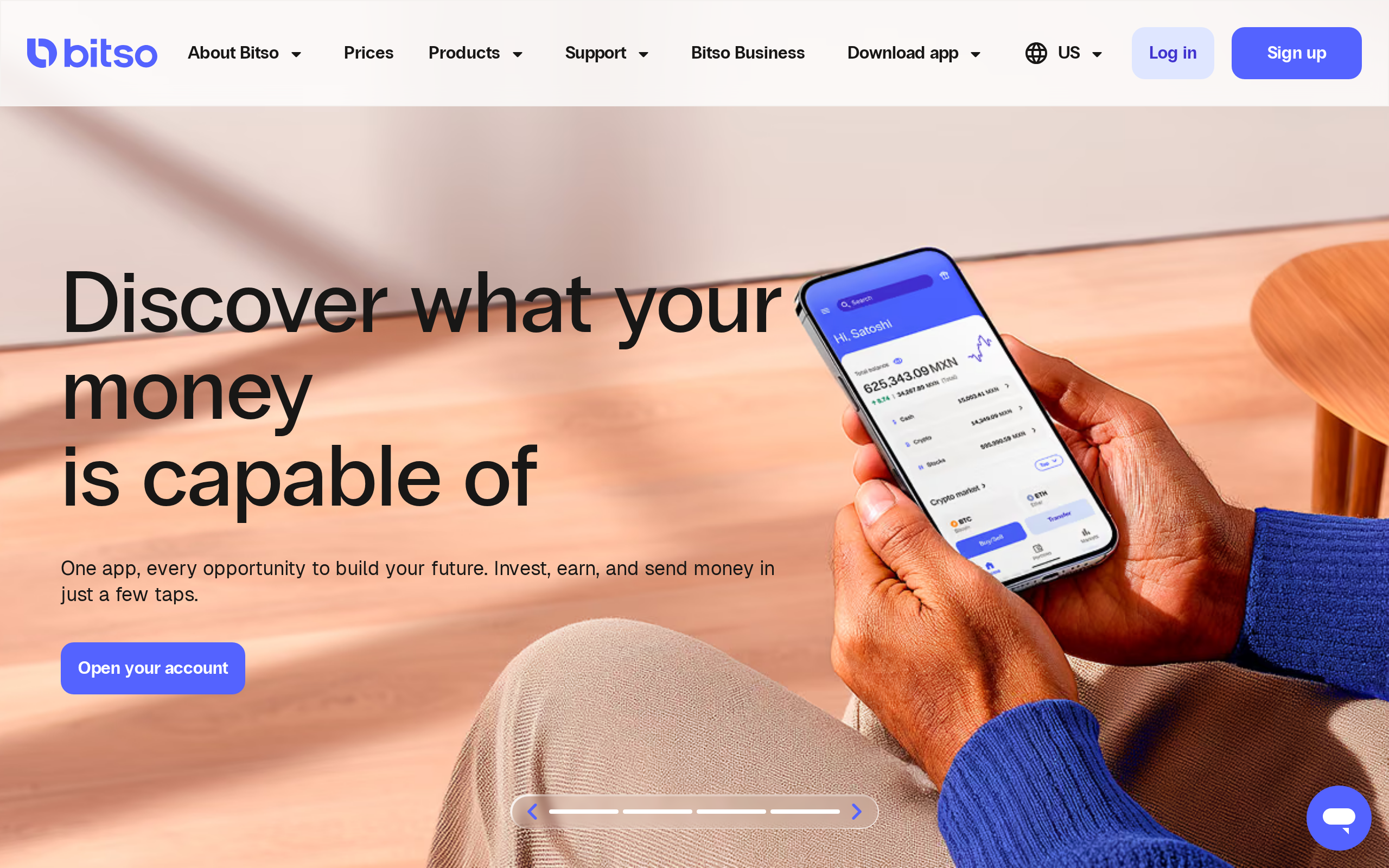
Our verdict
For someone in Mexico, Brazil, Argentina or Colombia, Bitso is the most practical place to turn local currency into crypto and back, because local rails are free and fast. Fees on peso markets are higher than the USD book, and the exchange is not open to US retail customers. For global altcoin range, look elsewhere. This is not personal financial advice.
What works
- Free local deposits by SPEI in Mexico, PIX in Brazil and COELSA in Argentina
- MXN withdrawals reach any Mexican bank via SPEI within seconds
- USD-market spot fees start at 0.04% maker and 0.05% taker
- Licensed with Mexico's CNBV, Gibraltar GFSC, and Brazil and Argentina registrations
- Never reported hacked since founding in 2014, per an independent review
What does not
- MXN market fees of 0.36% to 0.60% are well above the USD book
- Not available to US retail users and restricted in dozens of jurisdictions
- Fewer listed coins than global exchanges: roughly 50 to 100 depending on count
- Payoneer deposits carry a 2.9% fee
Anyone who has tried to move pesos into a global exchange knows the real problem is not the trade. It is the money route: card markups, peer-to-peer sellers, wire fees and days of waiting. Bitso was built to remove that problem. Founded in Mexico City in 2014, it plugs into local bank rails and says it now serves about 9 million users across Latin America. Our verdict is short: if you live there, it is the practical default. If you do not, it is irrelevant. We worked from Bitso's own pages and independent reviews, and this is not personal financial advice.
The reason to use it: local rails
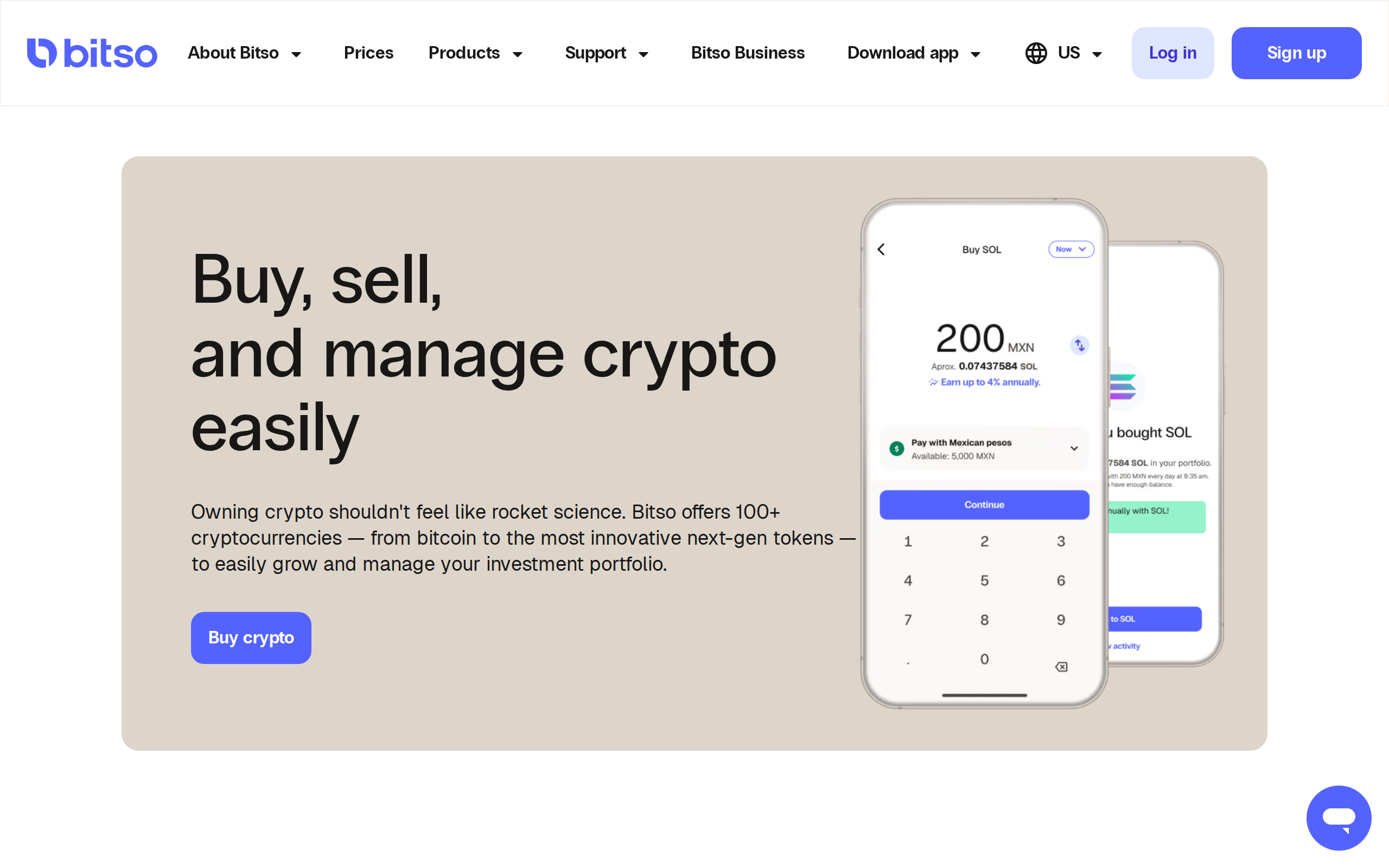
In Mexico, deposits arrive by SPEI, the national instant transfer system, and independent reviewers report they land in seconds and cost nothing. Brazil gets PIX and Argentina gets COELSA, also free. Withdrawals of pesos go back to any Mexican bank by SPEI, again reported as instant.
That is a bigger advantage than any fee table. A global exchange may quote a lower trading fee, but if you pay a card surcharge or a P2P premium to fund it, you have lost the saving before the first order. Bitso's one real exception is Payoneer funding, listed at 2.9%.
What trading costs
Fees depend on the market you pick, and the gap is wide:
USD markets: 0.04% maker and 0.05% taker.
MXN markets: 0.36% to 0.60%.
Volume discounts apply as your monthly trading grows.
Read that second line twice. If you trade in the peso book, you pay roughly seven to twelve times the USD taker fee. Many users do this without noticing because the interface makes it easy. A cheaper path for larger orders is to convert to a dollar stablecoin first and trade there, though you then take on the stablecoin's own risks.
A quick worked example makes the gap concrete. On a 10,000 peso purchase in the MXN book at the 0.60% top rate, the fee is 60 pesos. The same size at the 0.05% USD taker rate would be 5 pesos. Fifty-five pesos is not ruinous once, but it compounds if you trade weekly, and it is the first number to check on the order screen.
Beyond spot: transfers and stocks
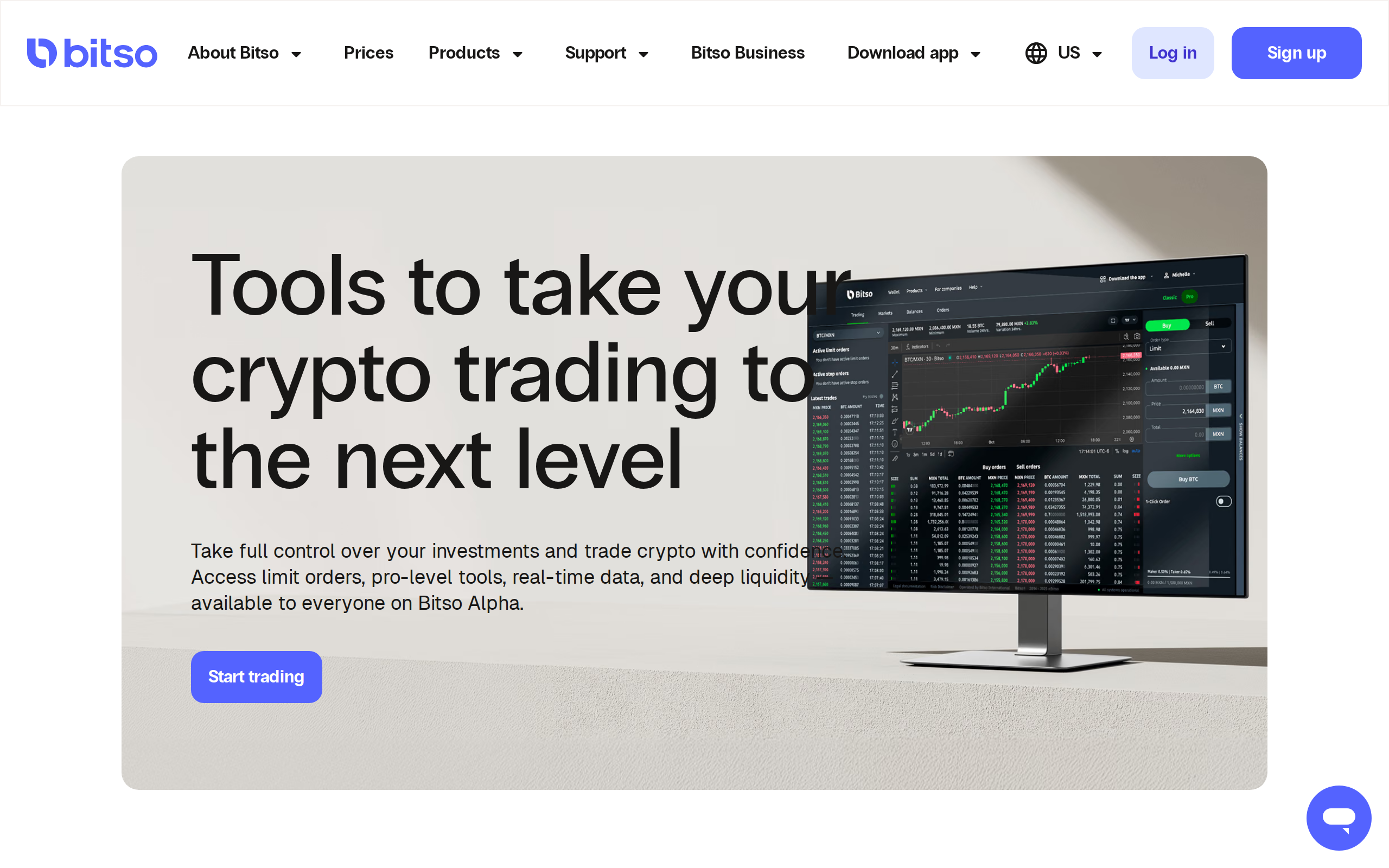
Bitso also sells money movement. Its transfer page pitches cross-border sending of crypto and Digital Dollars, which matters in corridors such as the United States to Mexico where remittance costs are high. Since early 2025 it has offered commission-free US stock and ETF trading through Alpaca, with a reported 5,000 plus securities. We did not test cross-border sends, so treat the pitch as the company's claim.
Licences and security
Regulation is the second reason to choose it. Bitso is reported to be licensed with Gibraltar's financial regulator and Mexico's CNBV as a fintech institution, with registrations in Brazil and Argentina. It reports a CCSS Level II audit and says customer funds are held in segregated accounts. One independent review notes it has never been hacked since 2014. That is a record, not a guarantee.
Where it falls short
The list is shorter than a global exchange. Bitso advertises 100 plus coins, while one independent reviewer counted around 50, and either way it will not carry the long tail of new tokens that Binance or MEXC list. It is not open to US retail customers and is restricted in 33 jurisdictions according to one review. And the peso-market fees above are not low.
Against the usual alternatives
Mexican users often ask whether Bitso beats Binance for local use. On the money route it does: SPEI funding is native, and a regulated Mexican entity sits behind it. On coin range and derivatives, Binance wins by a wide margin. Our suggestion is to treat them as different tools. Keep the pesos-to-crypto step on Bitso, then decide whether a second venue earns a place for the coins Bitso does not list. Before sending anything between venues, test with a small amount and confirm the network and address format, because a wrong-chain transfer is the one mistake no support team can reverse.
Who should use it
Use Bitso if you are in Mexico, Brazil, Argentina, Colombia, Chile or Peru and want fast fiat rails with a regulated counterparty. Use something else if you need rare altcoins, advanced derivatives or you live outside its countries.
We rate it 8.0 out of 10: the best-fitted exchange for its region, held back by peso-market fees and a modest listing count.