The short version
A fair place to buy a little Bitcoin or Ethereum if you already hold stocks in the app and want one screen. The 'no commission' line is true, but the cost sits in a spread that Robinhood does not itemise, and its own cost table is a company-commissioned study. Active traders, altcoin hunters and anyone who wants limit-order depth should use a dedicated exchange.
Best for: Existing Robinhood users making small, occasional crypto buys
Our score: 7.1 out of 10
Pros and cons
What works
- No commission and no deposit or withdrawal charge from Robinhood itself
- One app for stocks, ETFs and crypto, with a $1 minimum for staking
- Over 100 coins can be transferred in and out, with on-chain fees passed through
- Registered with FinCEN and holds a New York virtual currency licence
What does not
- The spread is not shown as a line item, so the true cost is hard to check
- The cost comparison table is Robinhood's own, built on three coins on one date
- Coin list and tools are thin next to Coinbase, Kraken or any global exchange
- Some coins and features vary by US state, and the product is US-led
The question a stock app has to answer
Most people reach Robinhood Crypto because the app is already on their phone. That convenience has a price tag, and the honest question is whether it is a bigger one than a dedicated exchange would charge. Our answer after going through the product and the fee material: it depends on the size of the order, and Robinhood makes the sum harder to do than it should be.
Here is how we frame it. A buyer weighs three costs: the visible fee, the hidden spread and the cost of leaving. Robinhood scores well on the first, poorly on visibility of the second, and acceptably on the third. The rest of this review works through each in turn.
Zero commission is not zero cost
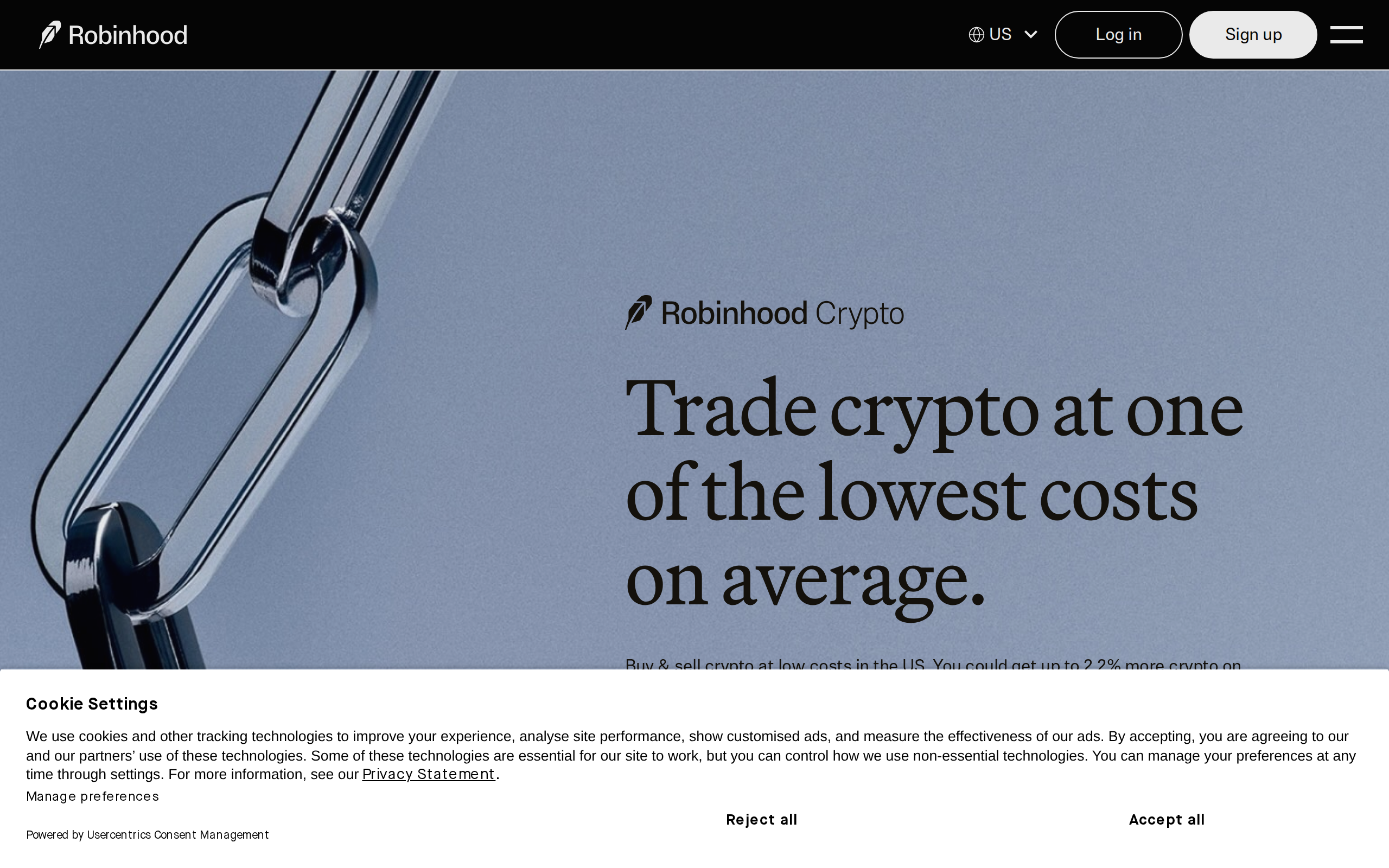
There is no trading commission. There is also no deposit or withdrawal fee charged by Robinhood. Both statements are accurate, and both skip the part that matters: the price you see already includes Robinhood's margin. Third-party writers who have measured it put the spread anywhere from 0.35% on the largest coins to as much as 2.5% when markets are busy. Robinhood does not publish a per-coin figure, so we cannot give you one that the company stands behind.
Compare that with the rival models. Coinbase Advanced and Kraken Pro show a maker and taker percentage you can read before you click. Kraken Pro starts at 0.25% maker and 0.40% taker. Coinbase's easy-buy screen is dearer than either on small orders, which is the fair comparison for a casual user.
Reading Robinhood's own cost table
The landing page carries a table dated 18 September 2026. For a $100 Ethereum purchase, Robinhood delivers 0.003842 ETH. The same hundred dollars buys 0.003770 ETH at Coinbase (1.86% less), 0.003780 at Kraken (1.61% less) and 0.003687 at Crypto.com (4.03% less). Coinbase Advanced trails by only 0.11%.
Two things to take from it. First, the gap to the two best-known retail rivals is real in this sample, about 1.6% to 1.9%. Second, the gap to Coinbase Advanced is a rounding error. The footnote says the figures come from a third-party study using quotes for Bitcoin, Ethereum and Dogecoin only. One coin, one date, a company-chosen basket: useful, not conclusive.
If you buy through the simple screens of any exchange, you pay the most. Robinhood is cheaper than most of those screens and about level with the pro ones.
Moving coins out
Older reviews say you cannot withdraw from Robinhood. That is out of date. The transfers help page lists more than 100 coins that can go in and out, adds no Robinhood fee on top of the network fee, and warns that sends are final. Confirmation counts differ: Bitcoin needs 3 (about an hour), Ethereum 30 (about five minutes), Solana 1.
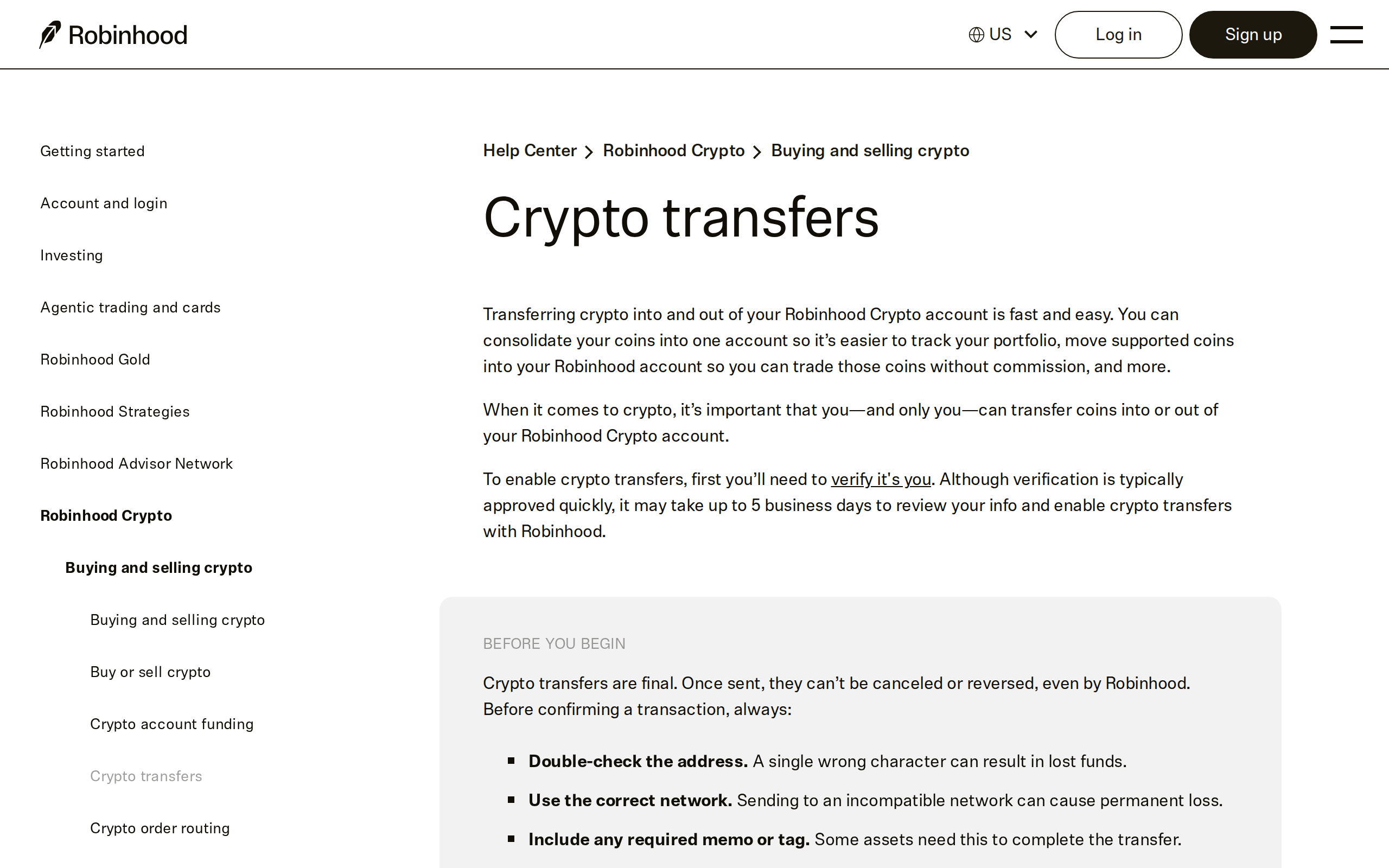
Limits depend on your verification level, history and payment methods, and the page names no figure. If you plan to move large sums, ask before you fund the account, not after.
Staking, lending and the wallet
Staking on ETH, SOL and ADA starts at $1. Separately, the Earn page advertises an estimated 7% APY on USDG lent onchain from a self-custody wallet. Both are variable, neither is a savings rate, and the lending product is not offered everywhere. Treat the 7% as a marketing estimate.
The wallet is a separate, non-custodial app run through Robinhood Non-Custodial, Ltd. That separation is good design, since a custodial account and a self-custody one should not share a screen, but it means you manage two products.
What a $500 monthly buyer should expect
Take someone who puts $500 into Bitcoin every month. At a spread near 0.5% they lose about $2.50 a month to the margin; at 1.5% it is $7.50. Neither figure is ruinous, and neither needs a pro terminal. Now take someone trading $20,000 a month in and out. At those sizes a 0.1% difference is $20 a month, and the lack of a published schedule becomes a real problem, because they cannot model it. That asymmetry is the whole product: cheap enough for small and rare, opaque for large and frequent.
Who should skip it
Robinhood is registered with FinCEN and holds a New York virtual currency licence (NMLS 1702840). That gives US users a regulated counterparty, though it does not insure you against price loss, and this is not advice to buy anything. The weak points are depth and transparency. There is no itemised spread, a short coin list against exchanges with hundreds, and fewer order tools than a pro terminal.
Skip it if you trade often, chase small-cap tokens, or want fee schedules you can audit. Use it if you hold stocks there already, buy now and then, and value having one place. Our score, 7.1, is for that narrow brief.
Specifications
- Maker
- Robinhood Markets
- Trading cost
- No commission; spread built into the price
- Deposit and withdrawal fees
- None from Robinhood; network fee applies
- Coins supported for transfer
- Over 100, some restricted by state
- Staking
- ETH, SOL and ADA from $1
- Onchain lending
- Estimated 7% APY on USDG, not in all regions
- Self-custody option
- Robinhood Wallet, via a separate entity
- Regulation
- NYDFS virtual currency licence; FinCEN MSB; NMLS 1702840
- Bitcoin confirmations on withdrawal
- 3 (about 1 hour)