The short version
Raydium is a solid, long-running Solana swap and liquidity venue: the default pool fee is 0.25%, concentrated pools go as low as 0.01%, and there is no account to open. The risk is not the engine but what flows through it. Fresh tokens on LaunchLab pay a 1% fee on a rising curve, and buyers arriving late tend to carry the loss. Good for experienced Solana users; poor for beginners chasing launches.
Best for: Experienced Solana users and liquidity providers
Our score: 6.8 out of 10
Pros and cons
What works
- No account or KYC: connect a wallet and swap directly
- Pool fees range from 0.005% up to 4%, with 0.25% as the default
- Concentrated and stable pools offer fees as low as 0.01% and 0.02%
- Docs publish fee splits, audits and attack-vector notes openly
- Deep liquidity on core Solana pairs, with roughly $1.2B in DefiLlama TVL
What does not
- LaunchLab charges 1% on each bonding-curve buy and sell
- New tokens carry scam, rug and sharp-drop risk that no fee table captures
- December 2022 and June 2026 exploits drained legacy pools
- Fee varies by pool type, so the cost of a swap is not one number
- Slippage, priority fees and wallet scams are all on you
Two different things share the name Raydium. One is a plain automated market maker on Solana, with published fees, audits and years of uptime. The other is a launch pad that feeds a stream of brand-new tokens into it. The first deserves a fair hearing. The second is where people lose money.
We read the swap interface, the pool and LaunchLab pages, Raydium's documentation and fee reference, and an independent review from Coin Bureau, and we checked its numbers on DefiLlama. We did not trade through a funded wallet, so costs below come from the published schedules.
The swap box is simple
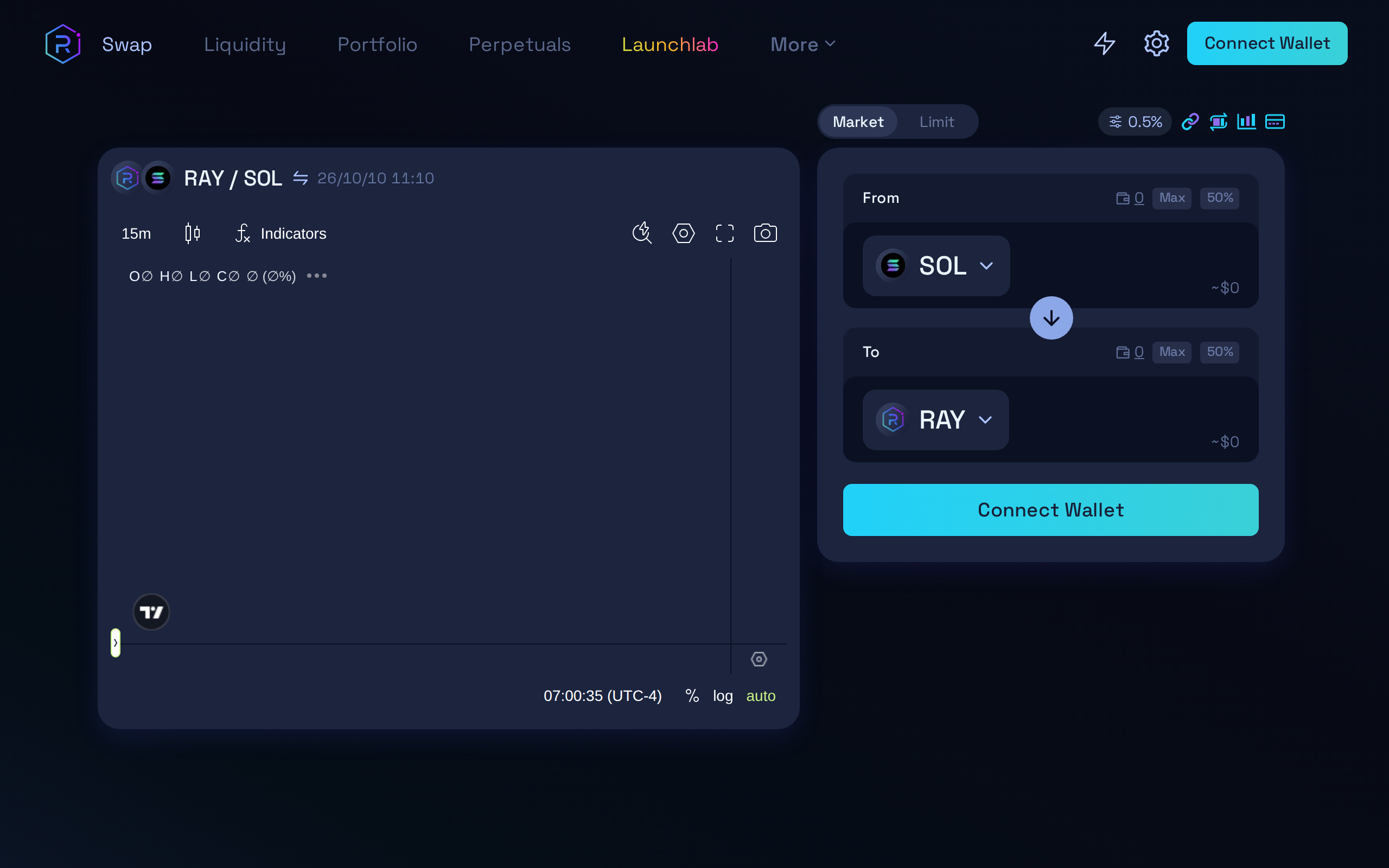
Open the swap page and you see a chart on the left and a panel on the right. Pick the two tokens, press the button and connect a wallet. There is no account, no email and no identity check, which is the point of a DEX and also the reason nobody can reverse a mistake for you.
In the capture we took, the panel shows a 0.5% setting near the top, which is the default slippage tolerance. That figure matters on thin tokens. A swap will go through at up to 0.5% worse than the quote, and in a volatile pool that can be a real cost. Lower it for stable pairs, and think hard before raising it for anything new.
What a swap costs
The fee depends on the pool, which is why Coin Bureau warns that swap fees are not one fixed number. Raydium's fee reference gives these figures:
AMM v4 pools charge a flat 0.25%.
CPMM pools have 21 published tiers from 0.005% to 4%, defaulting to 0.25%.
CLMM pools range from 0.01% to 4%, with 0.25% as the default.
Stable pools charge 0.02%.
For the CPMM and CLMM types, 84% of the fee goes to liquidity providers, 12% to the protocol and 4% to a fund. On top of that you pay the Solana network fee, about 0.000005 SOL plus any priority fee. On a well-known pair, a 0.25% fee is competitive with centralized exchanges' entry tiers.
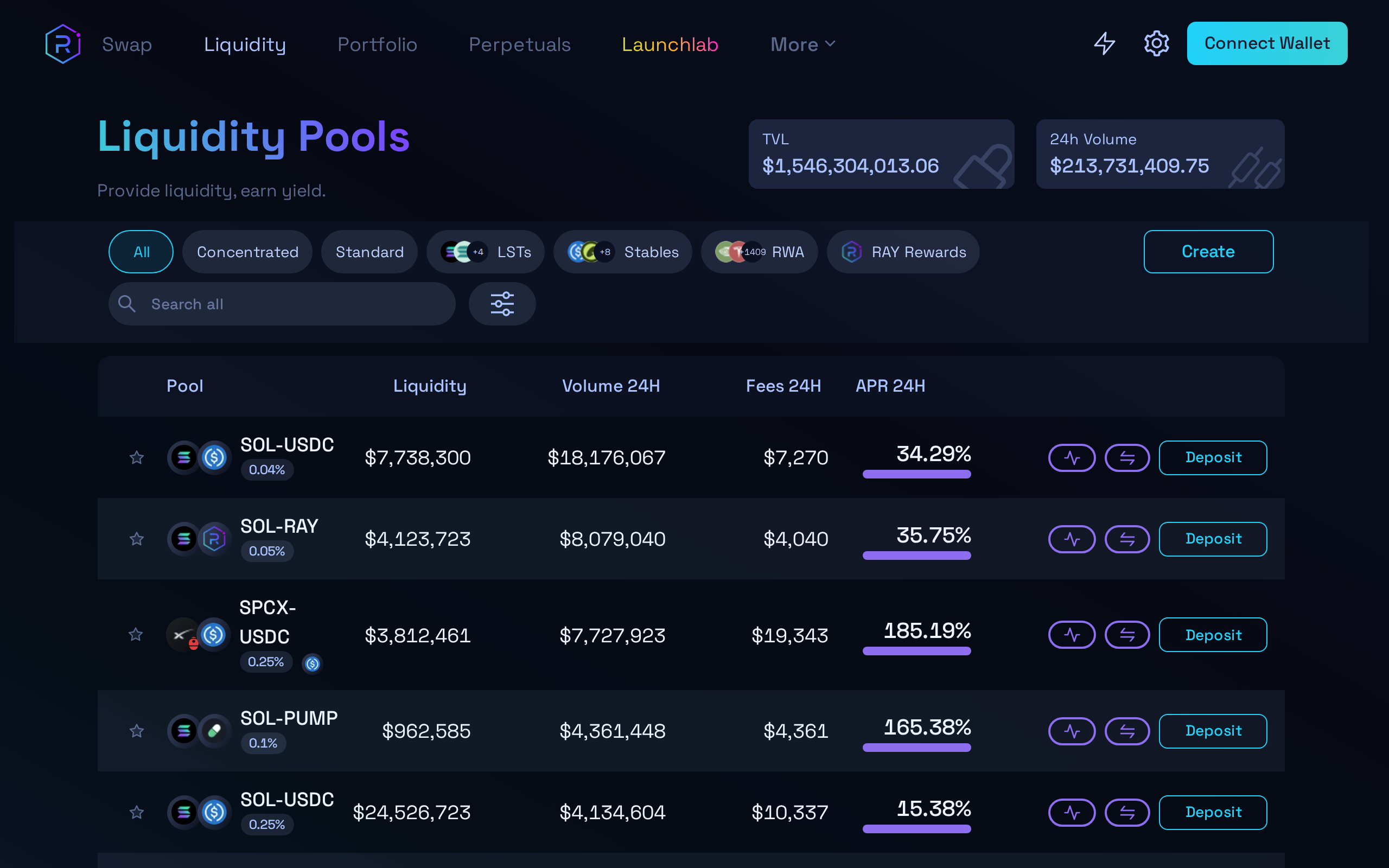
Liquidity providers face their own bill
The pools page invites you to provide liquidity and earn yield. The yield is real, but impermanent loss and, in CLMM pools, range drift can wipe it out. Creating a pool costs about 0.19 SOL for CPMM and 0.075 SOL for CLMM, according to Coin Bureau. We would not put in money we cannot watch.
LaunchLab: the part to be wary of
LaunchLab lets anyone create a token that trades on a bonding curve. The docs describe a 1% fee on buys and sells before the token graduates, split between the pool and the treasury, then ordinary 0.25% CPMM fees afterwards.
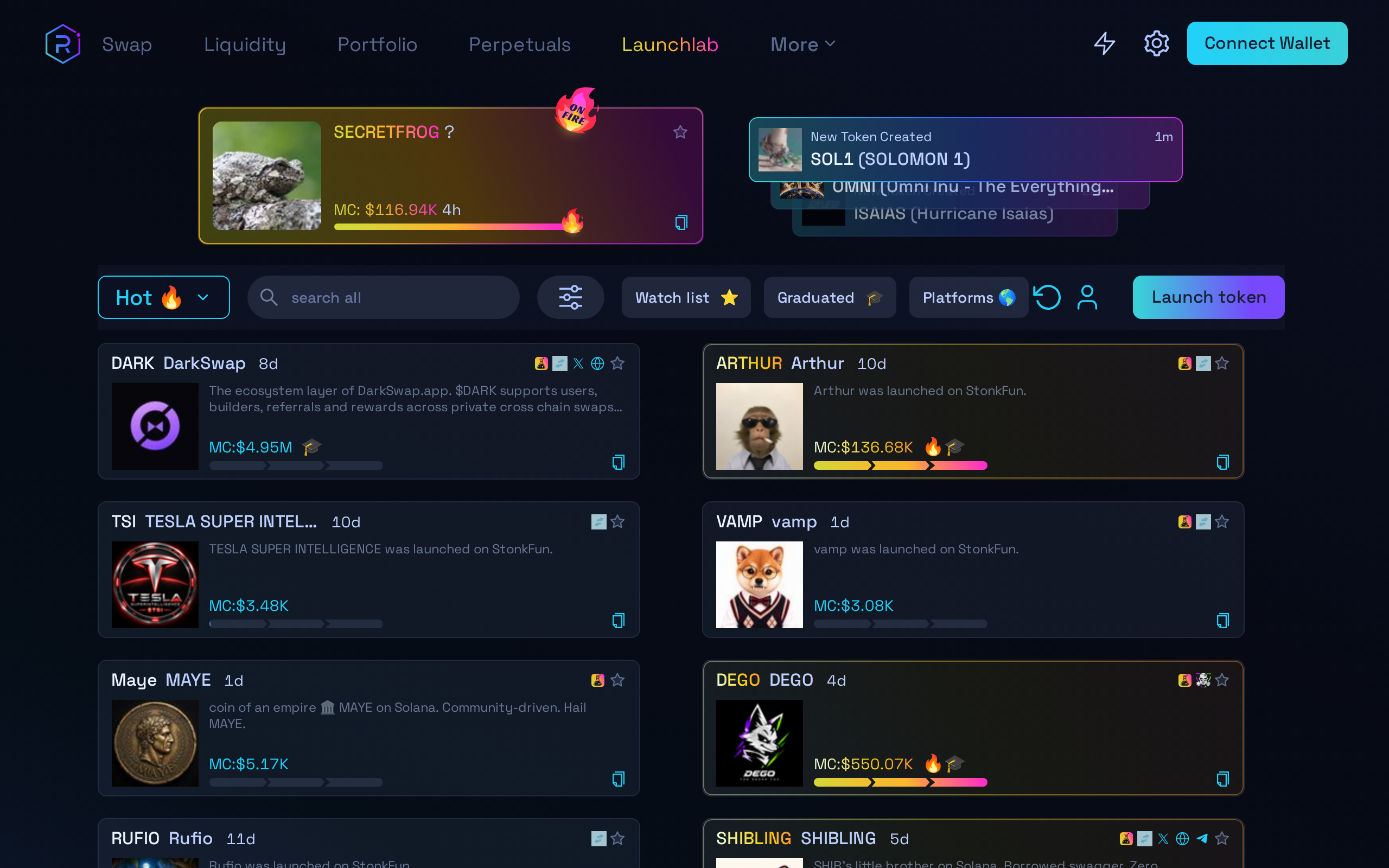
The 1% is not the real price. On a bonding curve, each buy pushes the price higher, so late buyers pay the most and sit on the largest paper loss if momentum fades. Many tokens in that feed have tiny market caps and no product. There is nothing in the fee table about creators dumping or about copycat names. If you use it, treat each purchase as a lottery ticket you have already written off.
Security record
The record is mixed. Coin Bureau reports that a December 2022 exploit of AMM v4 pool authority cost about $4.4 million, and that in June 2026 legacy AMM pools lost roughly $1.3 million, with Raydium pledging to reimburse from its treasury. Concentrated pools were not hit in 2022. The docs have pages on audits, admin keys and attack vectors, which is more openness than many rivals show.
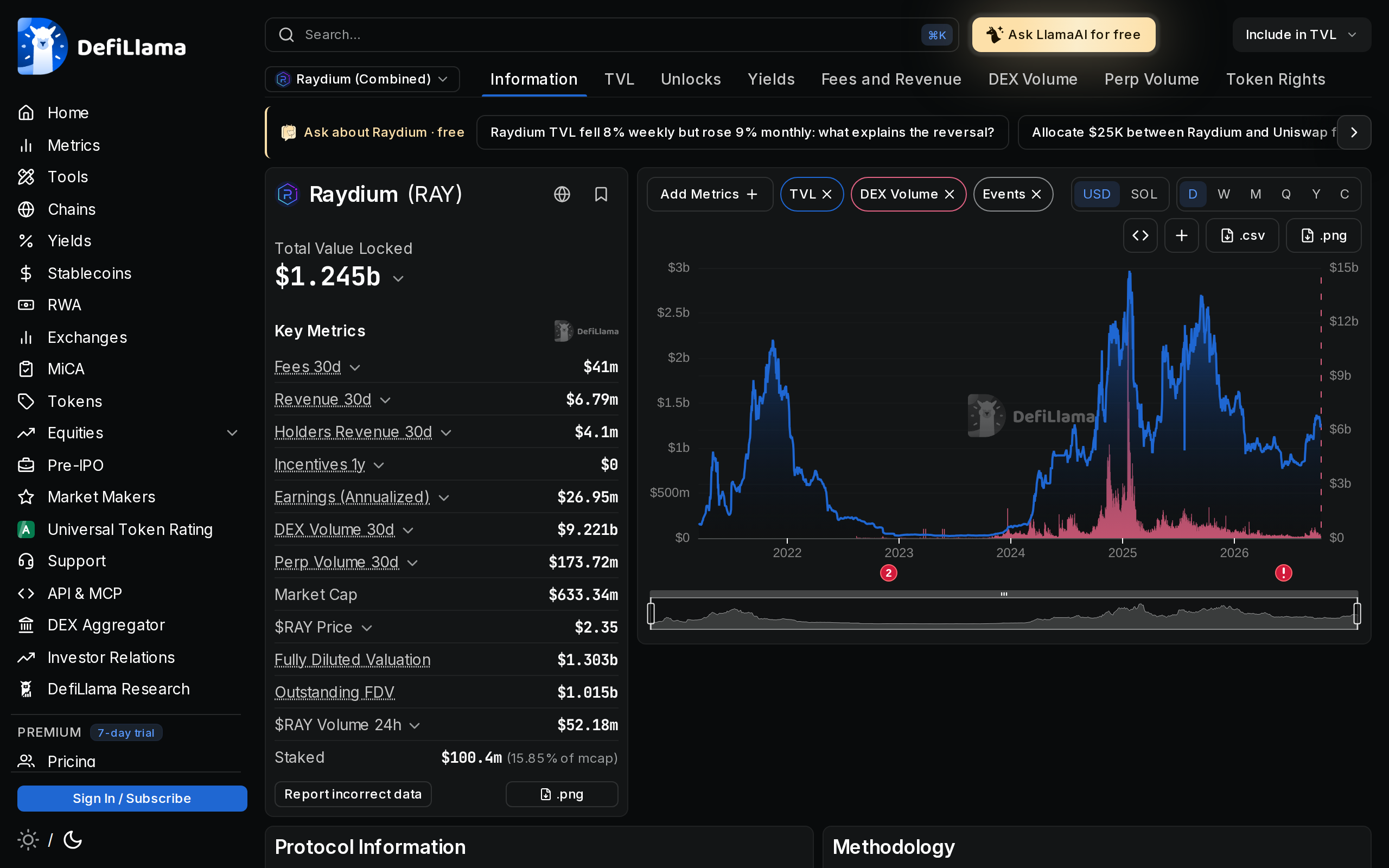
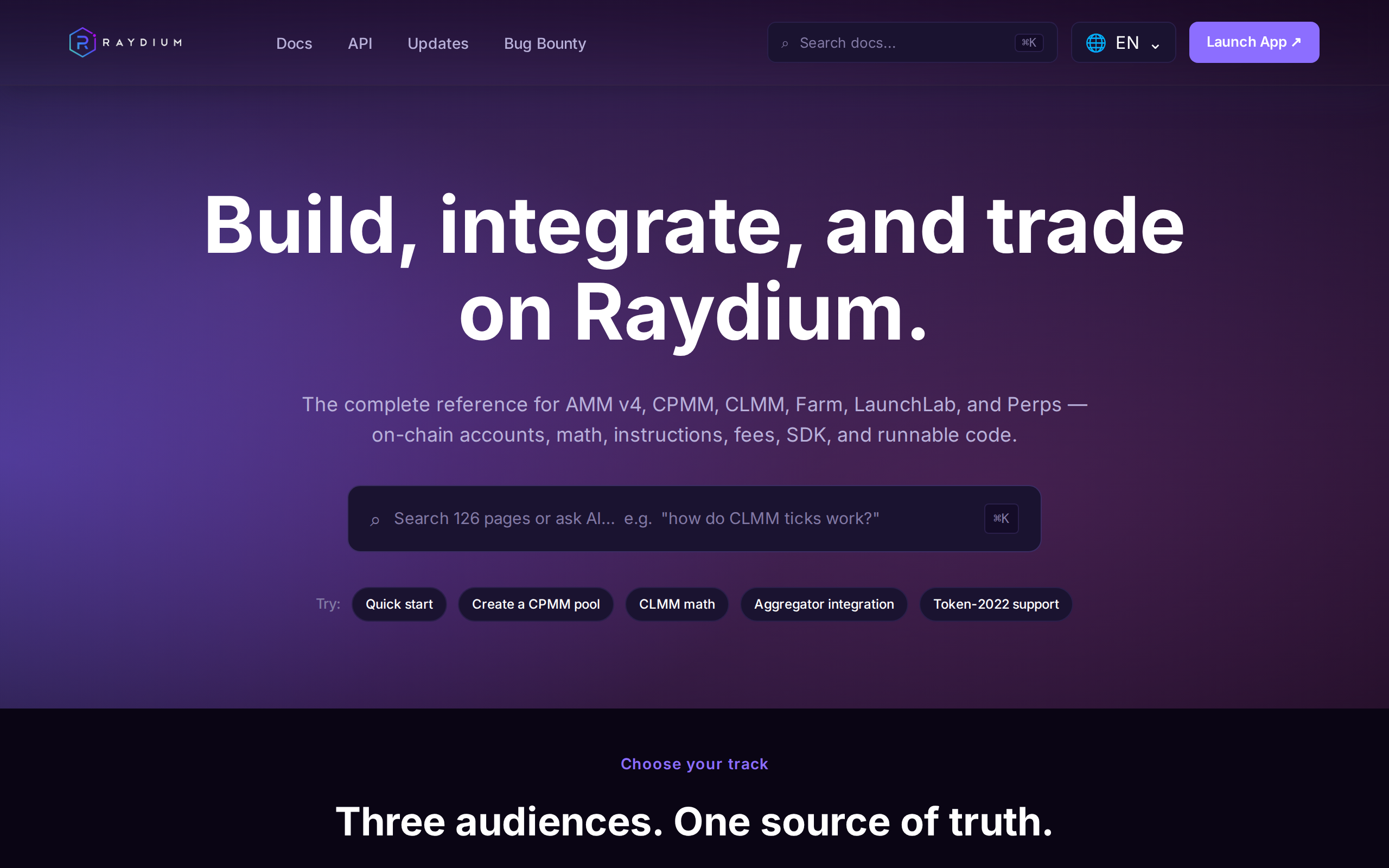
The docs are worth a read before you add liquidity or create a pool, since the fee splits and risk notes sit there. DefiLlama puts Raydium's liquidity at around $1.2 billion in October 2026, which is large for Solana.
Verdict
Raydium suits experienced Solana users who want a no-account swap, concentrated liquidity or a pool they can read the rules of. It does not suit beginners, or anyone using it mainly to buy tokens that launched yesterday. Coin Bureau scored it 4.15 out of 5 and called it unsuitable for risk-averse beginners; we agree with the second half. None of this is a recommendation to buy any token.
Specifications
- Network
- Solana
- Pool types
- AMM v4, CPMM, CLMM, stable, LaunchLab, perps
- Default swap fee
- 0.25% for AMM v4, CPMM and CLMM
- Fee range
- 0.005% to 4% across CPMM and CLMM tiers
- Fee split (CPMM, CLMM)
- 84% liquidity providers, 12% protocol, 4% fund
- LaunchLab fee
- 1% pre-graduation, then 0.25% in CPMM
- Pool creation
- About 0.19 SOL (CPMM), 0.075 SOL (CLMM)
- Default slippage
- 0.5% in the swap panel
- Token
- RAY, about $1.3B fully diluted on DefiLlama