The short version
OKX Wallet is one of the broadest free self-custody wallets: 130+ native chains, an in-app swap, token approval checks and Ledger, Trezor and Keystone support. The catches are an interface fee of up to 0.5% on swaps, a closed-source client, and a parent exchange with a criminal plea. Use it with a hardware key and modest balances, or pick Rabby for EVM-only signing.
Best for: Multichain DeFi users who want one free wallet and a hardware key
Our score: 7.4 out of 10
Pros and cons
What works
- Covers 130+ native chains, including Bitcoin, Solana, Tron and Cosmos networks
- Supports Ledger, Trezor and Keystone 3 devices over USB or QR codes
- Built-in phishing alerts, plain-language approvals and a revoke tool
- Free to use, with security reviews published by CertiK and SlowMist
What does not
- Swap interface fee runs from 0% to 0.5% on top of pool fees and slippage
- Client code is mostly closed, so the app cannot be fully audited by users
- Parent exchange OKX pleaded guilty to running an unlicensed money business in the US
- The keyless MPC wallet is closed to new users; new wallets use a seed phrase
Wallets that come from exchanges carry a question that wallets from pure software teams do not: who is really in charge of what happens next? OKX Wallet is non-custodial, so the keys sit on your device. But the company behind it has a compliance history, and the app itself is not fully open to inspection. Both facts belong in the same paragraph as the feature list.
The pitch: one wallet, a lot of chains
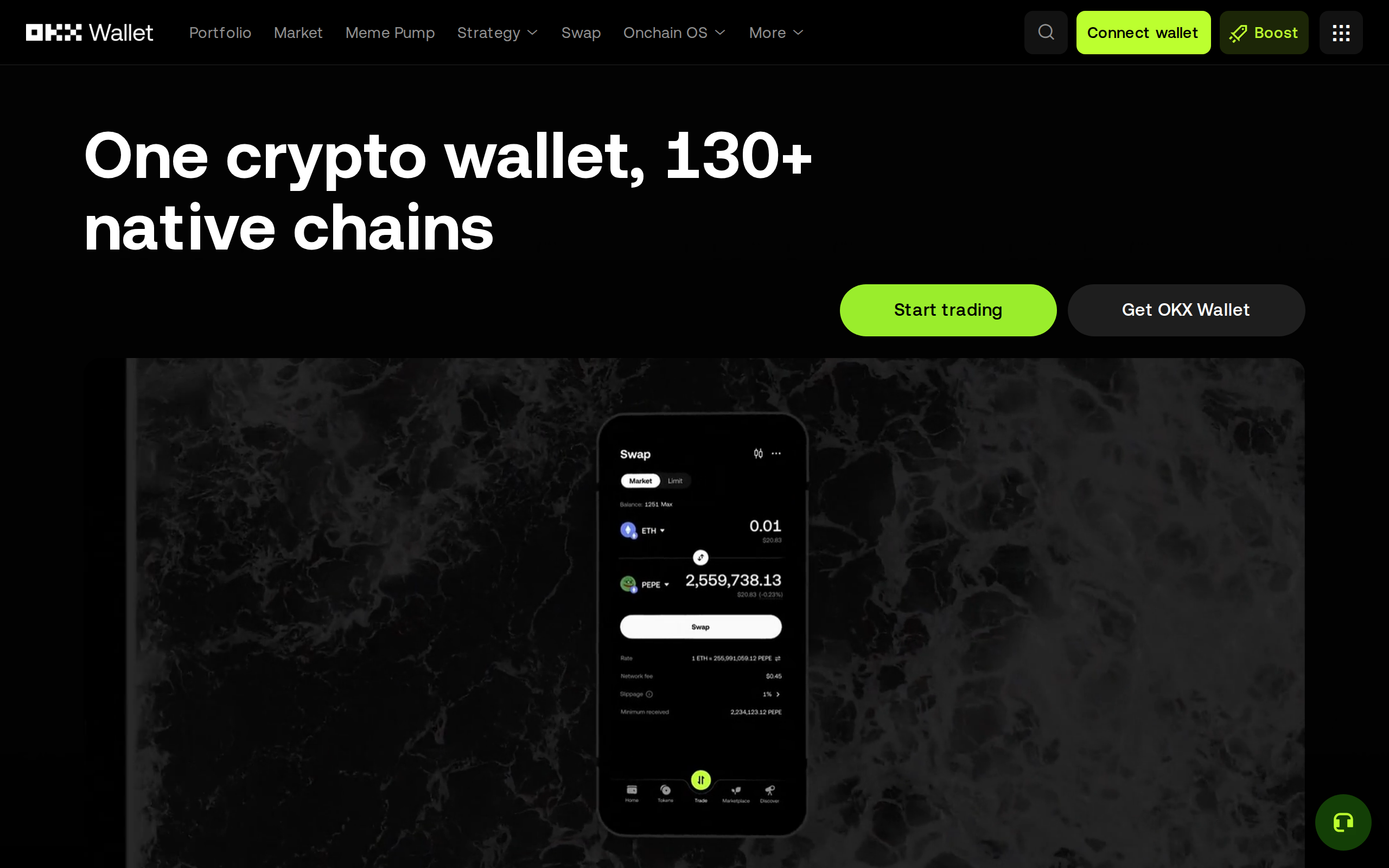
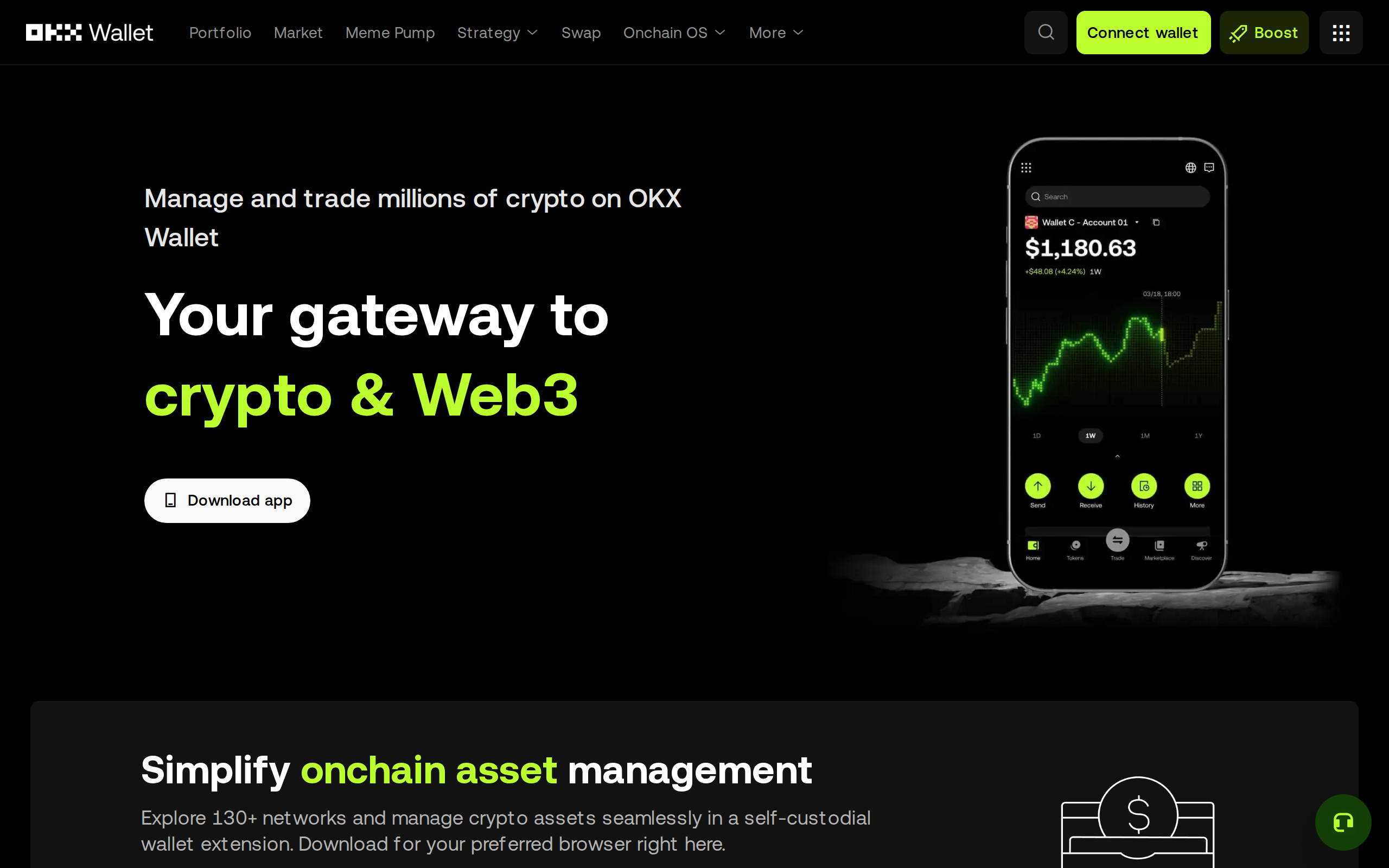
OKX's own page leads with a plain claim, "One crypto wallet, 130+ native chains". Support spans Bitcoin, Ethereum, BNB Smart Chain, Solana, Arbitrum, Optimism, Polygon, Avalanche, Tron and Cosmos networks, per CryptoSlate's review.
For a multichain user that breadth is the point. MetaMask spreads you across add-on networks, and Phantom is best on Solana. OKX Wallet puts Bitcoin, EVM chains, Solana and Tron in one list, with a portfolio view over the top.
The same navigation shows what kind of wallet this is: Market, Meme Pump and Strategy tabs, a "follow top traders" feature. It is a trading terminal wearing a wallet's clothes, which suits active users and sits awkwardly with a buy-and-forget saver.
What a first week looks like
Install the browser extension or the phone app, create a wallet, and write down the seed phrase offline before anything else. Then do the dull checks in order: send a small test amount, make one small swap and read the fee line, and open the approvals list to confirm you can revoke a permission. If you plan to use a hardware key, pair it before you fund the account, so the hot wallet never holds more than a spending balance. Those steps take less than an hour and tell you more about the app than any feature list.
Where the money leaks
The wallet is free to install. Swaps are not free. CryptoSlate puts the interface fee at 0% to 0.5%, on top of pool fees and slippage, with bridges charging extra and fiat on-ramps priced by third parties. Compare that with Rabby, which we cover separately as a signing-focused EVM wallet, and with the 1inch and Uniswap reviews on this site, where routing costs are laid out in detail.
Before you swap, read the quote for the fee line. A 0.5% cut on a $10,000 swap is $50. That is small next to a bad approval, and large compared with a wallet that charges nothing.
Security: decent tooling, one honest caveat
On the protective side, the wallet ships phishing and malicious URL alerts, plain-language contract approval prompts, and a built-in token-approval revoke tool. It lists CertiK and SlowMist assessments (the latest, a March 2026 SlowMist report, centred on key management) and a HackenProof bug bounty. It also works with Ledger, Trezor and Keystone 3 and 3 Pro over USB or QR codes. Pairing a hardware key is the setup we would pick for any balance you would hate to lose.
OKX built its name on a 2023 launch of MPC wallets that split a key three ways. That keyless mode is now closed to new users, and the CryptoSlate review says new creation ended on 23 May 2025. New wallets use a seed phrase or a private key, the standard model.
The parent company problem
Two facts weigh on trust. OKX pleaded guilty in the United States to operating an unlicensed money-transmitting business and, per the review, remains under a compliance consultant through February 2027. And in March 2025 the OKX DEX aggregator was suspended after roughly $100 million of Bybit hack proceeds passed through it.
Neither fact means the wallet will take your funds. But the client is largely closed-source, with only select smart-contract and SDK repositories open, so you cannot inspect the app the way you can inspect an open one. The company can also block access by region. Self-custody means they cannot move your coins; it does not mean they cannot change or withdraw the interface.
Who it suits
Use it if you move across Bitcoin, Solana, Tron and EVM chains and want one free wallet, ideally with a hardware key behind it and a small hot balance. Skip it if you want a fully open-source client, if you only use Ethereum-compatible apps and value a cleaner signing screen, or if an exchange parent's legal record is a deal-breaker.
We score it on features and tooling, then mark it down for fees and provenance. Nothing here is advice about how to split or secure your own funds.
Specifications
- Price
- Free
- Maker
- OKX
- Chains
- 130+ native chains
- Custody
- Self-custody, seed phrase or private key
- Hardware wallets
- Ledger, Trezor, Keystone 3 and 3 Pro
- Swap fee
- 0% to 0.5% interface fee, plus pool fees
- Audits
- CertiK and SlowMist; HackenProof bug bounty
- Source
- Mostly closed; select contract and SDK repos open
- Platforms
- Browser extension, mobile app, web