The short version
dYdX is a credible decentralised perpetuals exchange with an order book, a wide market list and a fee schedule close to its rivals. It has lost the liquidity race: third-party comparisons put Hyperliquid at around twenty times its daily volume, and a taker pays slightly more at base. Good for traders who want a mature, open-source venue and the DYDX staking discount. Skip it if tight spreads on large orders are your priority.
Best for: Perp traders who want a mature on-chain order book
Our score: 6.9 out of 10
Pros and cons
What works
- Base fees of 0.02% maker and 0.05% taker, falling with 30-day volume
- Roughly 240 markets listed, a wide menu for an on-chain venue
- Open-source chain and a documented API for bots and integrations
- 75% of net protocol fees go to DYDX buybacks, per the Foundation
What does not
- Daily volume is a fraction of Hyperliquid's, so spreads can widen on size
- Base taker fee of 0.05% is above Hyperliquid's 0.045% at retail level
- On-chain TVL of about $108M on DefiLlama is small for a leading venue
- You need a wallet and bridged USDC, which is friction for beginners
dYdX was the venue that made on-chain perpetuals a real category, and the question for 2026 is whether being first still earns it a place on your screen. We read the docs, opened the trading interface, checked DefiLlama and set the fee schedule beside the venue that took its crowd.
What you are actually signing up to
dYdX runs its own application chain, so your trades are settled by validators rather than by a company's matching engine. You connect a wallet, bridge USDC in, and trade against an order book. There is no email sign-up and no deposit to a custodian.
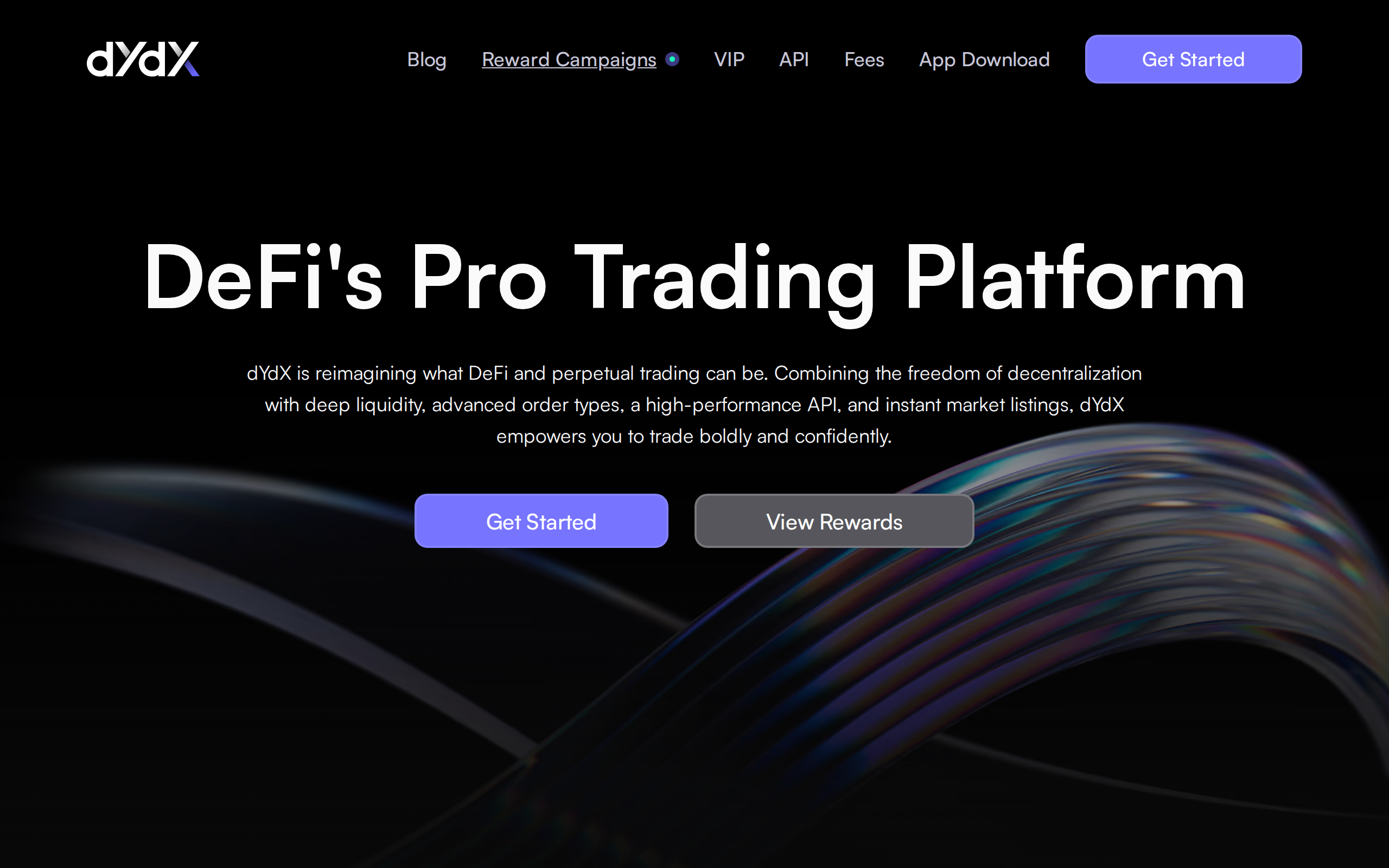
The pitch on the home page is plain: the freedom of decentralisation with deep liquidity, advanced order types and a high-performance engine. The first two promises are easy to check. The third is where the argument starts.
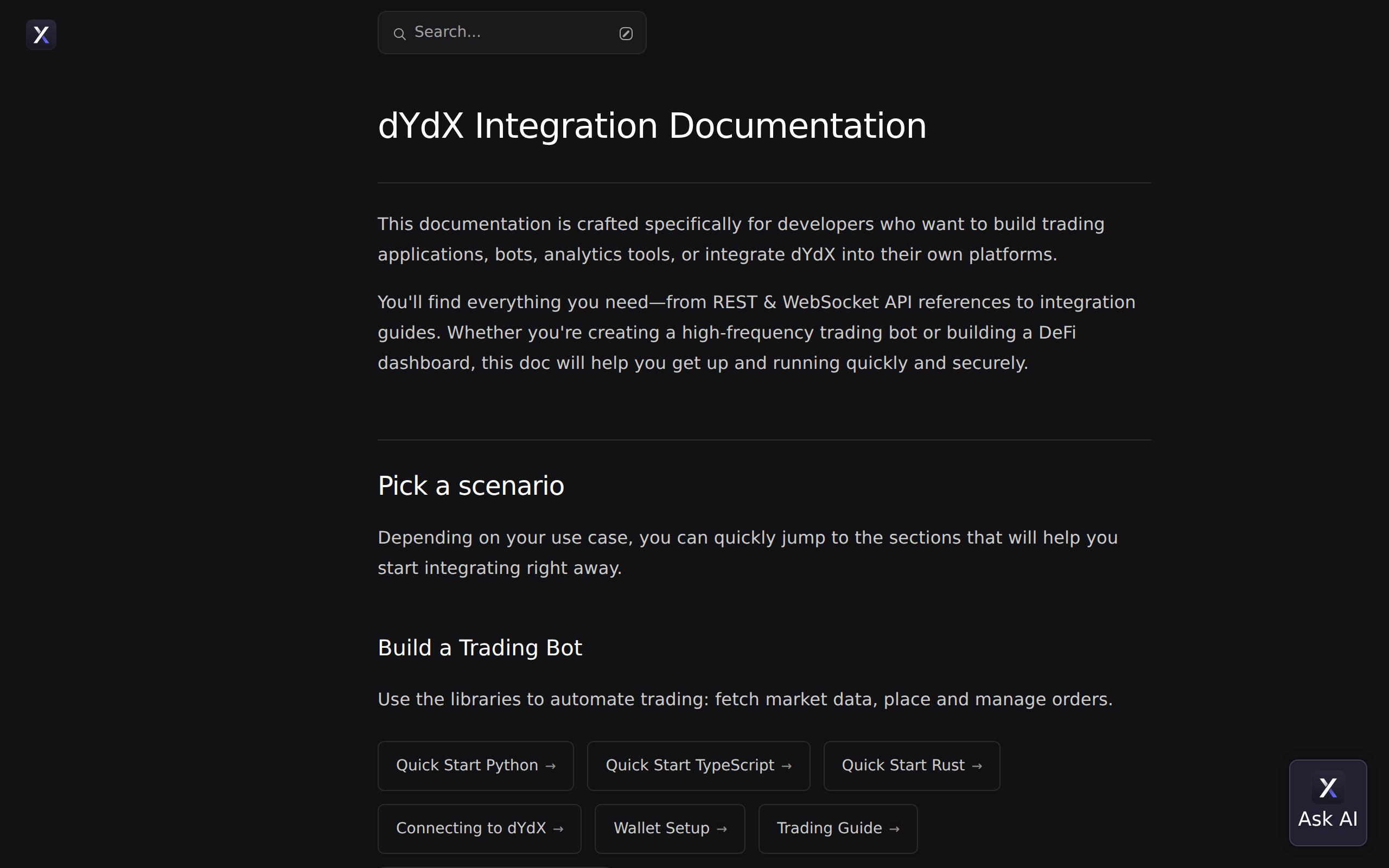
The documentation is a strength. It is organised by scenario, with a path for building a trading bot, and covers REST and WebSocket references. Teams that want to automate against a perp venue get an easier start here than on most competitors.
Fees: close, but not the cheapest
Third-party comparisons put the base tier at 0.02% maker and 0.05% taker, falling to about 0.025% taker at $1M of 30-day volume and about 0.018% at $25M. Hyperliquid's retail tier is 0.015% maker and 0.045% taker, so one $10,000 Bitcoin taker fill costs about $5.00 on dYdX against $4.50 there.
That is not a decisive gap. Fifty cents on a ten-thousand-dollar trade will not decide anything for most people. For a bot that fills thousands of orders a day, it adds up, and so does the difference in how far your order moves the price.
The token plays a part too. The Foundation's H1 2026 report describes a feature that lets users cut trading fees by staking DYDX, and says 75% of net protocol fees are directed to buybacks. Staking a volatile token to save a few basis points is the same trade-off we flagged on exchange tokens elsewhere: the discount is only worth it if you would hold the token anyway.
Liquidity is the problem
Here the numbers turn against it. One comparison puts Hyperliquid near $208 billion of 30-day volume in March 2026 against roughly $25 to $30 billion for dYdX, and another gives daily figures of $8 to $12 billion against $400 to $700 million. The Foundation, meanwhile, reports $406 billion of chain volume in the first half of 2026, which shows how much figures differ by source and period.
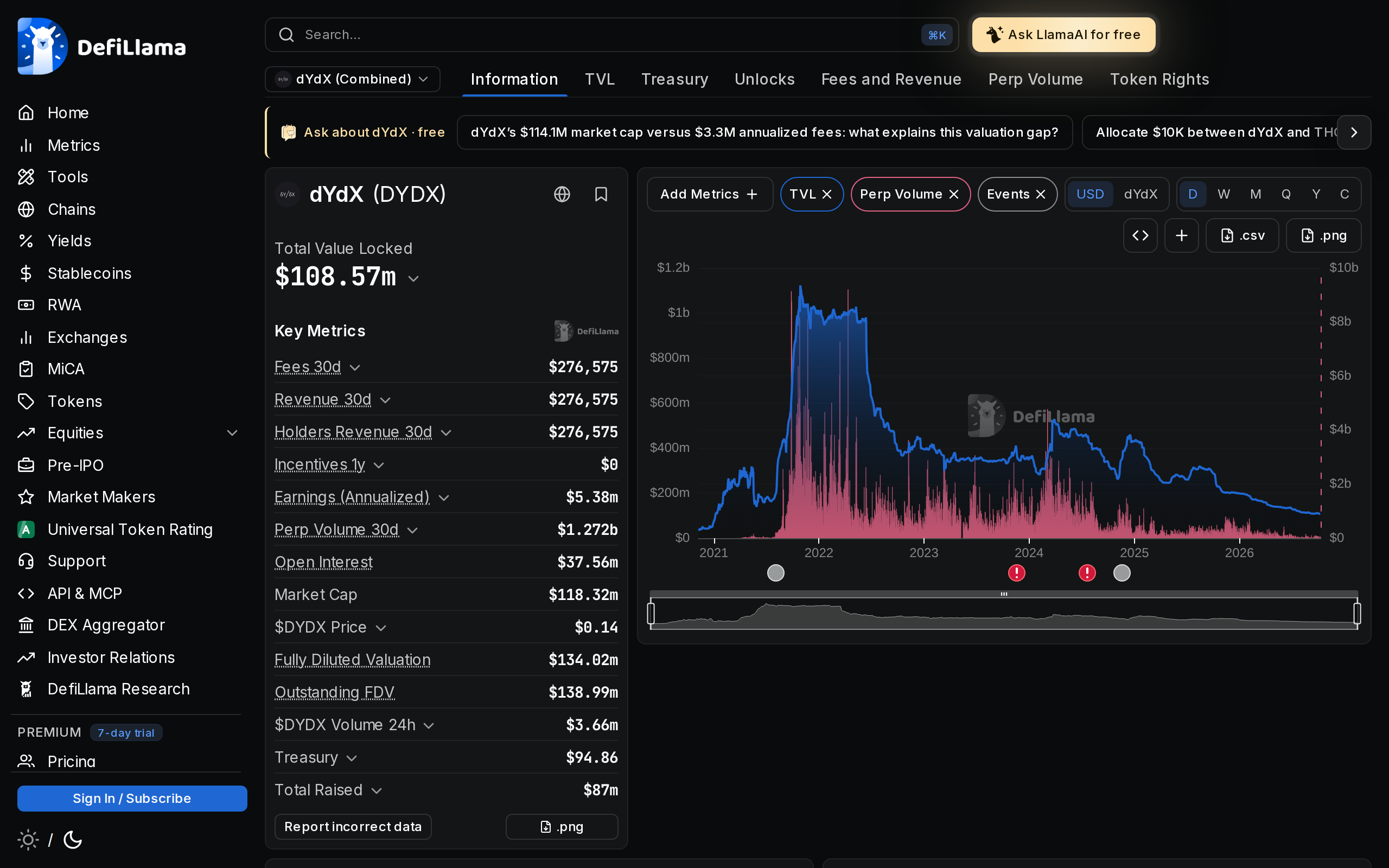
On the day we captured it, DefiLlama showed about $108.6 million of value locked and roughly $276,600 of 30-day fees. Those are modest numbers for a venue with this reputation. Treat any single figure with care, but the direction of every source we found is the same: dYdX is smaller than its main rival by a wide margin.
What that means for you is spread and slippage. On a liquid pair such as BTC or ETH, a small order will fill cleanly. On a long-tail market, or with a large order, thin books cost more than the fee schedule suggests.
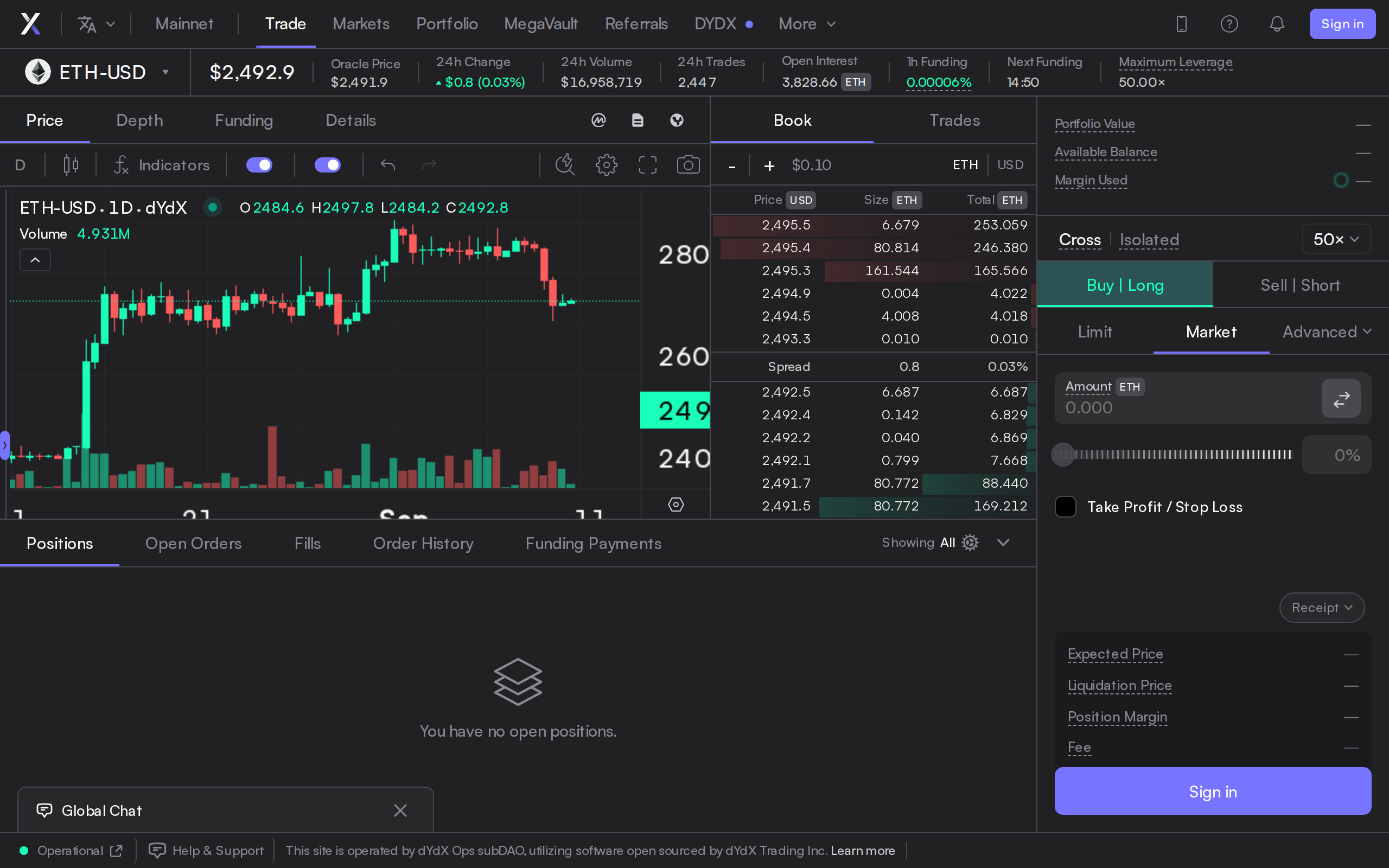
The practical friction
Self-custody trading means the setup is on you. You need a wallet, USDC on a chain the bridge supports, and a little patience while funds arrive. There is no support desk to reverse a mistaken transfer, and a wrong address is final. We would send a small test amount first, every time, and only then move the real balance.
The upside is that withdrawals do not depend on anyone approving them. For some traders, that single fact outweighs a half-cent of extra fee.
Who should use it
Choose dYdX if you value an open, mature chain, want its broad market list of about 240 contracts, or run an automated strategy against its API and have tested the fills yourself. It is also reasonable as a second venue to compare prices against.
Skip it if you are new to wallets and bridging, if you trade size and care most about depth, or if you want the busiest book. Perpetual futures use leverage and can liquidate a position fast; none of this is a recommendation to trade them. We would start with small positions, check the fill price against the displayed mid, and keep the funds you would be upset to lose somewhere else.
Specifications
- Maker
- dYdX Trading
- Type
- Decentralised perpetuals exchange, own app chain
- Base fees
- 0.02% maker, 0.05% taker (third-party comparison)
- Markets
- About 240, per the Foundation (Dec 2025)
- Token utility
- Stake DYDX to reduce trading fees
- TVL (DefiLlama)
- About $108.6M on the day of capture
- 30-day fees (DefiLlama)
- About $276,600 on the day of capture
- Developer access
- REST and WebSocket APIs, public docs