The short version
For swapping large amounts between stablecoins, or between a token and its staked version, Curve is still the pricing benchmark: pool fees start near 0.01% and the curve flattens slippage in a way a general-purpose pool cannot. Everything else on the site is a pool-by-pool lottery of liquidity and risk. You pay gas for every move, and the 2023 Vyper exploit showed that audited code can still fail. Use it for stable-to-stable size; use an aggregator for the rest.
Best for: Large stablecoin swaps and liquid staking pairs
Our score: 7.9 out of 10
Pros and cons
What works
- Stablecoin pool fees start around 0.01% to 0.04%, against 0.3% in classic Uniswap pools
- Stableswap math keeps slippage tiny when pegged assets trade near parity
- No account, no custody and no platform fee on top of the pool fee
- Deep stablecoin liquidity: weekly volumes of over $1B on its pools in 2026
- Plain pool pages list the composition, fees and your position
What does not
- Gas is a cost on every swap and approval, and it can exceed the fee on a small trade
- Not a fit for volatile pairs, where other DEXs usually have deeper books
- July 2023 Vyper compiler bug cost the pools about $70M
- Pool quality varies: thin or exotic pools can depeg or lock
- Interface is functional but dense for a first-time user
Swap 1,000 USDC for DAI on a classic constant-product pool and you may get back around 996. Swap them on Curve's first-generation pools and the same trade returns about 999.92, according to a Cyfrin course comparison. That gap, repeated at size, is the entire reason Curve still exists.
Why a flat curve beats a generic one
Two stablecoins that both aim at $1 do not need a price curve built for volatile assets. Curve's stableswap formula holds the price flat near parity and bends sharply only when a pool gets lopsided. A trade of a few million dollars between two healthy stablecoins barely nudges the quote. The same trade in a general pool would move the price in proportion to its size.
Fees follow the same logic. The comparison above sets Curve's stablecoin pool fee at 0.04% against 0.3% for a Uniswap v2 pool, and individual pools go lower, to roughly 0.01%. There is no platform fee on top. What you pay is the pool fee plus network gas, and gas is the cost that decides whether a small trade makes sense.
What the pools page shows
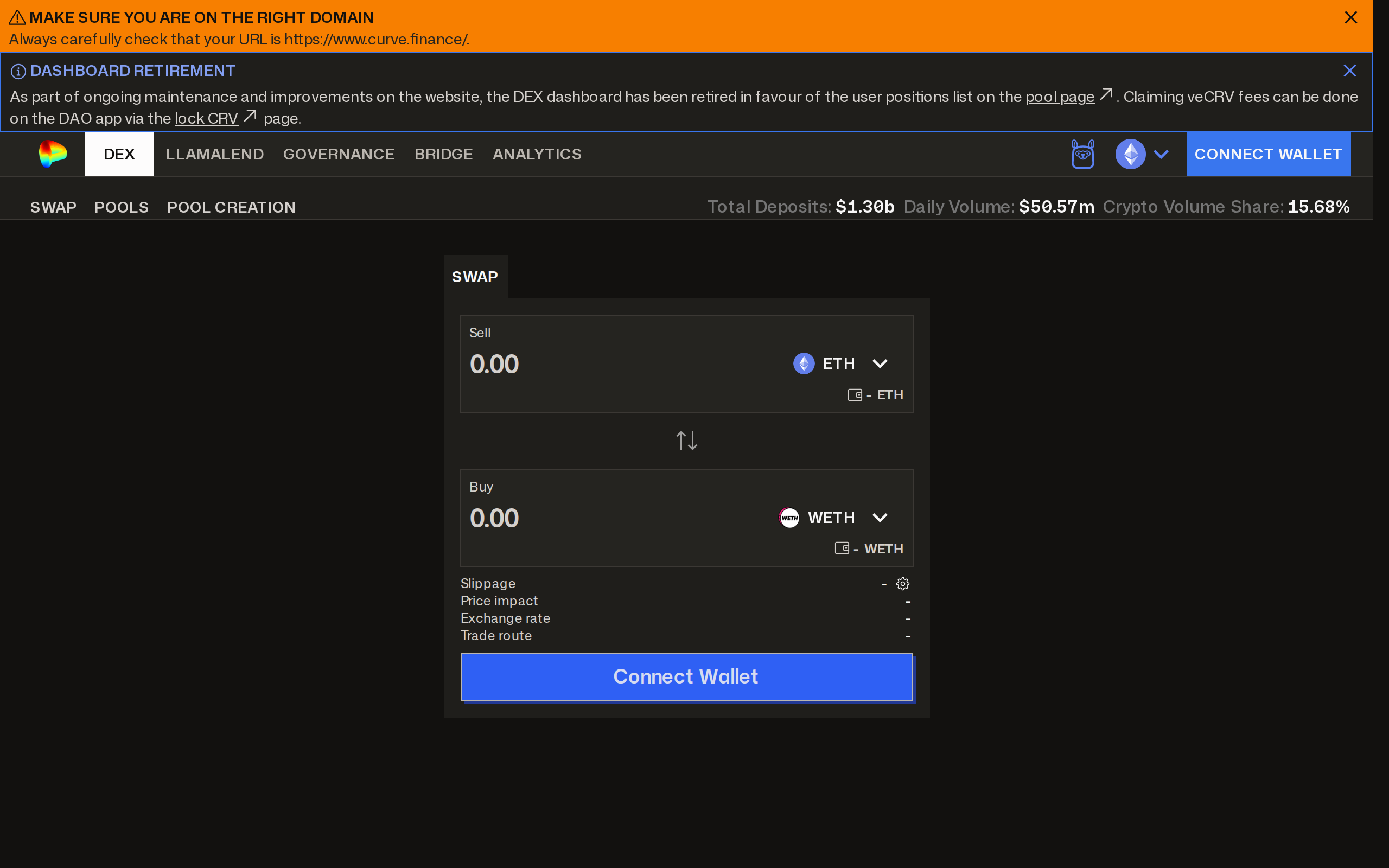
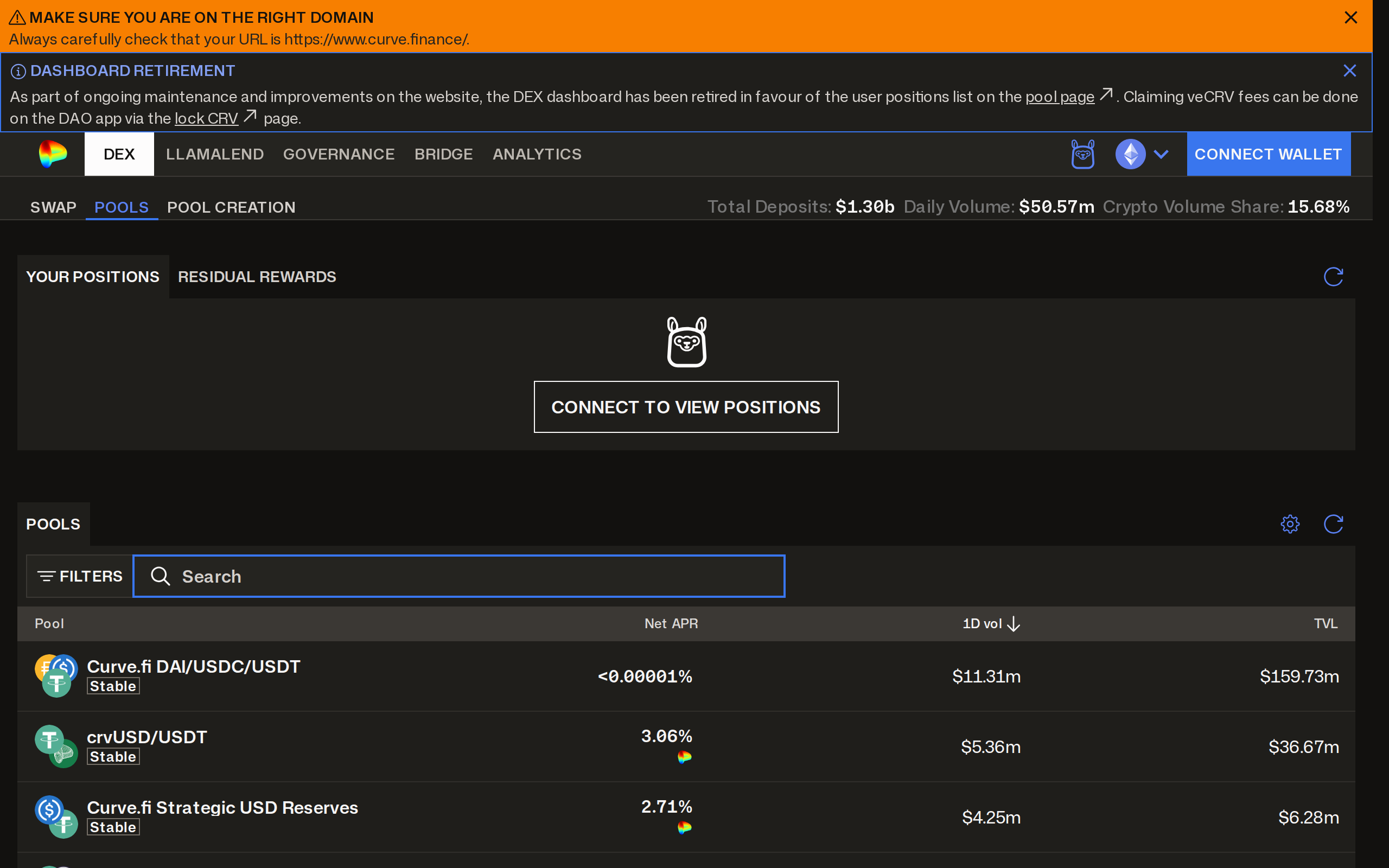
Each pool lists its tokens, its fee and its volume, and a pool page shows your position. The text on Curve's interface carries a warning to check that the URL is https://www.curve.finance/, which tells you how often people get phished here. Bookmark the real address and never reach Curve through a search ad.
Curve is not an app that explains itself. You choose a network, pick a pool, check the composition and make your own call about which stablecoins you trust. If one asset in a pool loses its peg, the pool tilts toward the bad token, and the cheap swap you wanted becomes a loss. Reading the balance of a pool before you trade is part of the job.
Size and liquidity in 2026
Liquidity has shrunk from the peak. Curve's own weekly metrics put total value locked near $1.45B in late July 2026, down from about $2.0B in mid-May, as reported in its weekly digests. Even so, the pools moved more than $1.3B in a single week of the 2026 data we read, and stablecoin demand remains the engine. For stable-to-stable swaps at size, depth is still there.
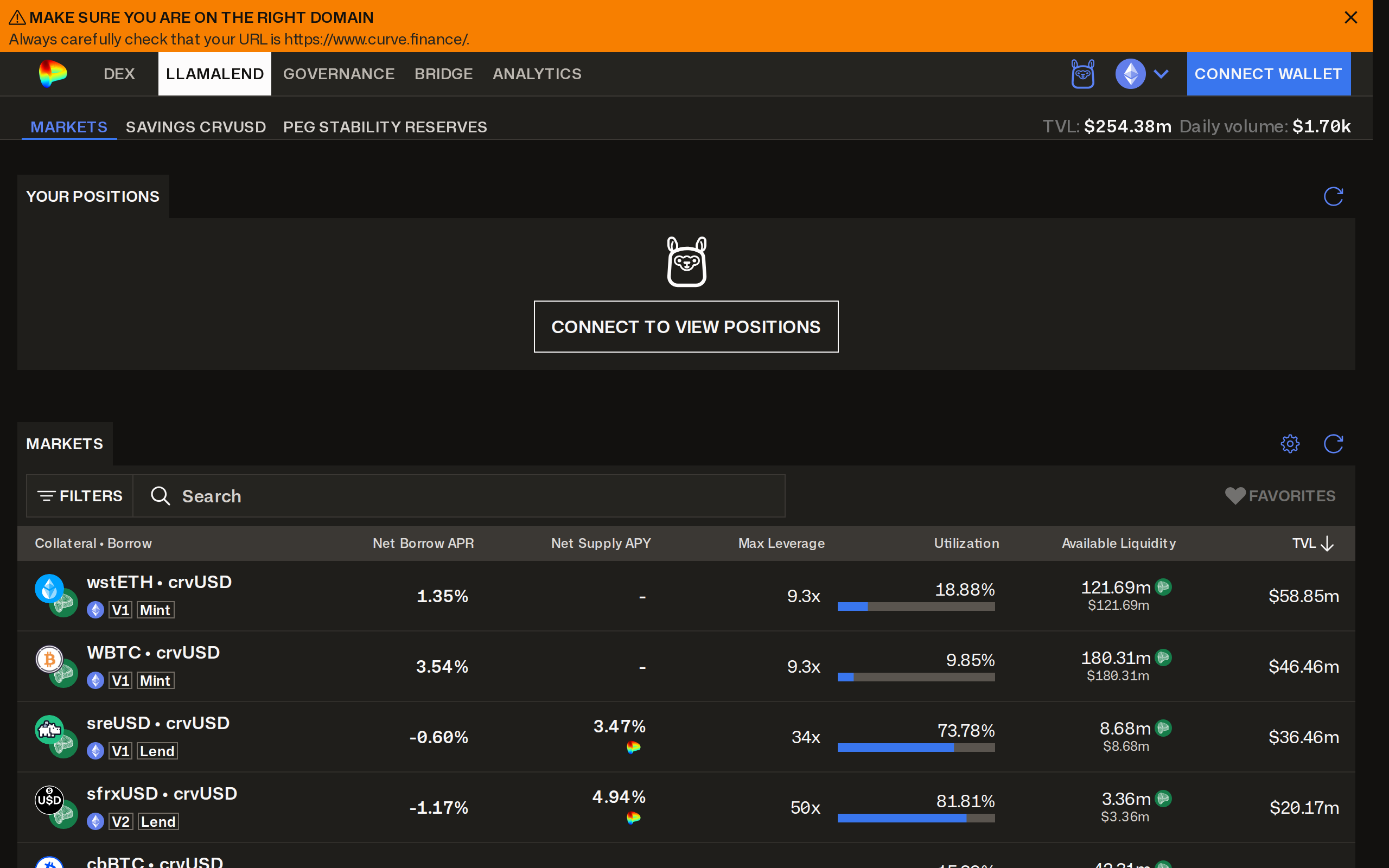
The ecosystem has moved beyond swapping. The site now carries Llamalend markets and the crvUSD stablecoin, which have their own risks and are not part of this review's score.
The risk you carry
July 30, 2023 is the date to remember. Several pools were drained, about $70M in losses, after a reentrancy flaw in certain versions of the Vyper compiler. Halborn's write-up names the affected compiler versions. Funds were partly recovered through negotiation and white-hat action, but the lesson stands: Curve's code was audited, and the bug was in the toolchain. A DEX is non-custodial, which protects you from an exchange collapsing and does nothing against a smart contract bug.
Gas is the other recurring cost. A first swap usually needs a token approval and then the swap itself, two transactions. On a busy day on Ethereum mainnet, that can wipe out the savings on a small trade. Layer 2 pools help, though their liquidity is thinner.

Curve against the aggregators
Most people never open Curve directly. Routers such as 1inch and Jupiter-style aggregators send stablecoin trades through Curve pools when those offer the best price, and you pay their route fee and gas on top. The direct route is worth it when you want to choose the pool yourself, for example to avoid a pool with a weak peg. For routine swaps, a quote comparison takes thirty seconds and can show whether Curve is actually the best path that day.
A sensible habit for any large trade is to split it: send a small test amount first, confirm the output and the received token, then send the rest. Gas for the extra transaction is small next to a mistake on a pool you misread.
Who it is for
Use Curve for large stable-to-stable swaps, for moving between a staked token and its base asset, and for anyone who wants an on-chain price without an account. Check the pool, simulate the trade and compare the quote with an aggregator before you sign.
Skip it for volatile pairs, small trades on Ethereum mainnet and first-time DeFi users who have not yet handled wallet approvals. We rate it 7.9: still the specialist, with a narrow beat. This is an assessment of the product and not advice to move funds.
Specifications
- Platform fee
- None; you pay the pool fee plus network gas
- Stable pool fee
- From about 0.01% to 0.04% (pool dependent)
- Core product
- Stableswap automated market maker
- Other products
- crvUSD stablecoin, Llamalend lending markets
- Governance
- veCRV vote-escrowed token
- Custody
- Non-custodial, connect your own wallet
- TVL, late July 2026
- About $1.45B (Curve weekly metrics)
- Past exploit
- July 30, 2023, about $70M, Vyper reentrancy bug