The short version
Blockpit is a strong pick if you file in Germany, Austria or Switzerland and want a report that matches local rules, with a clean interface and fair prices at low transaction counts. It has fewer integrations than Koinly, it charges extra for tax optimisation, and heavy DeFi users will still hand-fix labels. Outside the DACH region, compare before you pay.
Best for: German, Austrian and Swiss filers with a few thousand trades
Our score: 7.7 out of 10
Pros and cons
What works
- Portfolio tracking is free, so you can see the import quality before paying
- Report tiers start at 49 euros for up to 50 transactions in a tax year
- Tax logic is built for German and Austrian rules, which many rivals bolt on
- Expert Check and Expert Service options exist for messy histories
What does not
- No free tax report: even a tiny filer pays at least 49 euros
- Price jumps to 549 euros once a year passes 10,000 transactions
- Tax Optimizer sits in Blockpit Plus at 3.99 euros a month, billed annually
- Integration list is smaller than the biggest US-focused competitors
Most crypto tax software is designed around American forms and then stretched to fit Europe. Blockpit, founded in Linz, Austria, does it the other way round. That origin story is the whole case for it, and the whole reason to hesitate if you file somewhere else.
What you pay, and when
The pricing page has changed from what many older reviews print, so use the maker's numbers. Tracking your portfolio is free. A tax report is a one-off purchase per tax year, priced by how many transactions that year holds, not by portfolio size.
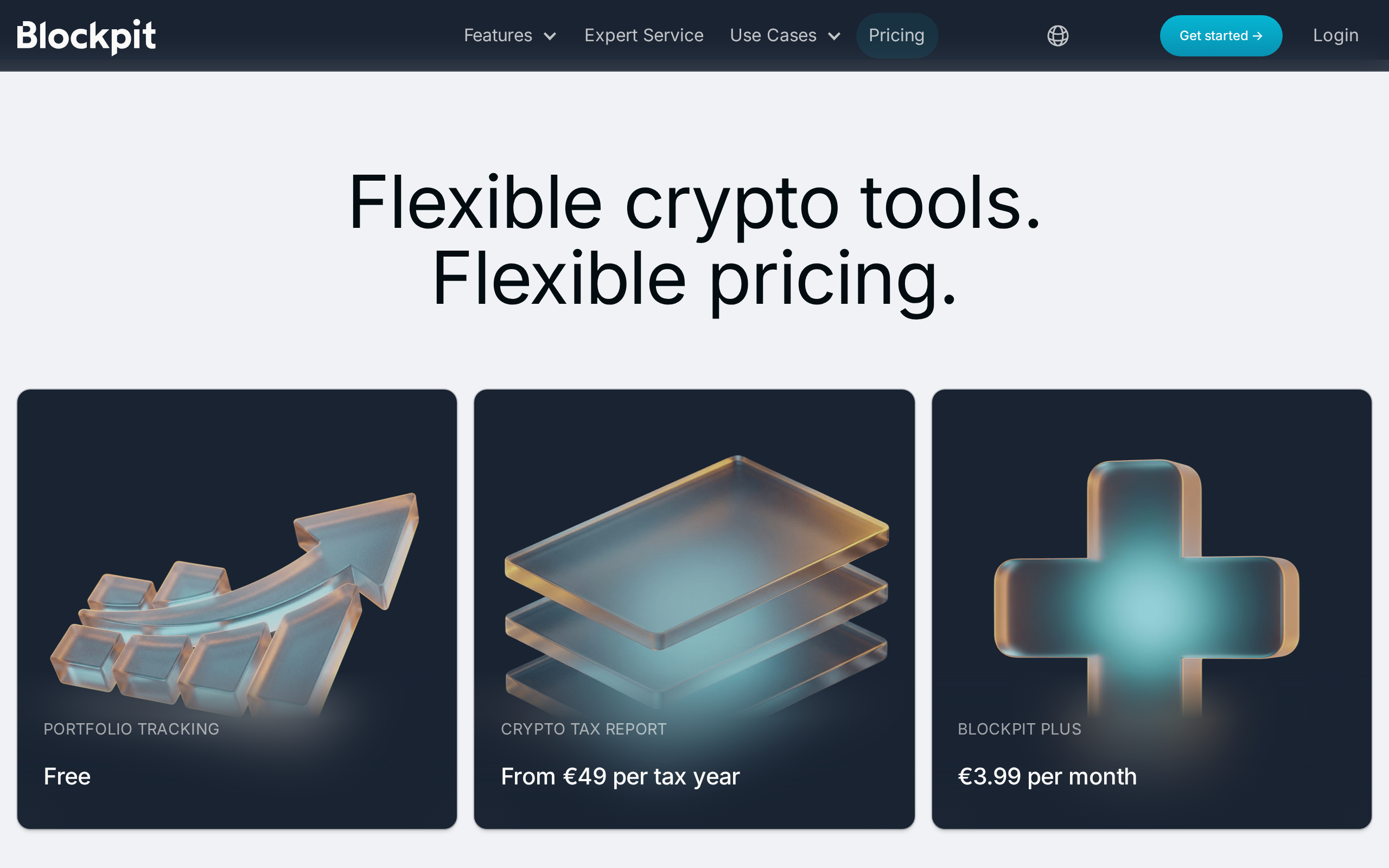
The ladder, as the pricing page lists it:
Small: 49 euros, up to 50 transactions
Medium: 99 euros, up to 1,000
Large: 149 euros, up to 3,000
X-Large: 229 euros, up to 10,000
XX-Large: 549 euros, above 10,000
Each tier includes PDF and CSV export. Blockpit Plus, the tax-optimisation layer with per-transaction cost basis and sales simulation, is 3.99 euros a month billed as an annual subscription. Two older review sites quote a Lite-to-Unlimited ladder from 49 to 299 euros; we found no sign of it on the live page, which is a reminder to check the maker before buying.
The structure favours the casual filer and the mid-size trader. A person who bought bitcoin twice and sold once pays 49 euros. A bot trader with 12,000 fills pays 549.
Free to try is the useful part
Because tracking is free, you can connect exchanges and wallets and see the import result before spending anything. Do that first. The honest test of any tax tool is whether it understands your history, and a pile of unmatched transfers tells you how much cleanup you are buying.
The integrations directory covers exchanges, wallets and blockchains through API keys, public addresses or CSV upload. An independent review at CoinPro counts around 200 and confirmed that Bitvavo and Bitpanda connected within minutes.
Around 200 is respectable but smaller than Koinly's catalogue. If you use an unusual exchange or a young chain, search this page before anything else.
Where the local logic earns its price
The same CoinPro review describes German FIFO treatment, a finished Annex SO PDF, exports for WISO and SteuerGo, and the 1,000 euro tax-free threshold. It also covers Austria's 27.5 percent capital-gains rate and Swiss wealth-tax reporting. It credits KPMG-reviewed tax logic and a TÜV Austria certification. Those are claims by the maker and a reviewer, not something we audited; we cannot verify a tax authority will accept any report, so an adviser should look at yours.
Blockpit also publishes country guides and a guide to the EU's CARF and DAC8 reporting rules, which matter because exchanges will increasingly send your data to tax offices themselves.
A bigger company than it looks
Blockpit bought its rival Accointing in November 2023, a deal The Block described as multi-million. For a user, the point is staying power: tax software is a product you need to still exist when you amend a return three years later, and a consolidating vendor is a better bet than a start-up. It does not remove the usual habit we recommend for every tool in this category: export your final report, the underlying transaction CSV and the cost-basis detail for each year, and keep them yourself.
A practical tip on cost. Because the price depends on transaction count, check whether internal transfers between your own wallets inflate the total. Cleaning those up before you buy can drop you into a cheaper tier, which is worth up to 50 euros at the lower rungs.
The weak spots
There is no free report. DeFi remains the hard part for every tool in this category, and Blockpit needs the same manual labelling as its rivals when a protocol is unrecognised. The tax-optimisation features were once bundled and now cost extra. And if your home market is not Germany, Austria or Switzerland, the local-logic advantage shrinks, so Koinly and other broad tools deserve a trial on the same data.
For paid help, Blockpit sells a 99 euro Expert Check (30 minutes) and an Expert Service from 199 euros that prepares the full report. That is useful if your history is a mess, and not cheap.
Who should pick it
Choose Blockpit if you file in the DACH region, have between 50 and 3,000 transactions a year, and prefer a modern interface to a spreadsheet. Skip it if you have a large DeFi history, an exotic exchange, or you live where its logic is not the reason to pay. This is a review of software, not tax advice.
Specifications
- Free plan
- Portfolio tracking only, no tax report
- Small report
- 49 euros, up to 50 transactions
- Medium report
- 99 euros, up to 1,000 transactions
- Large report
- 149 euros, up to 3,000 transactions
- X-Large report
- 229 euros, up to 10,000 transactions
- XX-Large report
- 549 euros, over 10,000 transactions
- Blockpit Plus
- 3.99 euros a month, billed annually
- Expert Check
- 99 euros for 30 minutes
- Home market
- Austria, Germany and Switzerland