The short version
Binance is still the cheapest place to trade spot at scale, with books deep enough that large market orders barely move the price. The cost is a compliance history that ended in a guilty plea, and access that depends on where you live. Fine for experienced traders who accept counterparty risk, wrong for anyone who wants a licensed local venue.
Best for: Experienced spot traders outside the US who want low fees
Our score: 7.4 out of 10
Pros and cons
What works
- Base spot fee of 0.100% maker and taker, 0.075% when paid in BNB
- Deepest books of any exchange, including long-tail pairs
- Fee tiers open by volume or by holding BNB, not volume alone
- One account covers spot, margin, futures, earn and bots
What does not
- Guilty plea and $4.3 billion settlement with US authorities in 2023
- Binance.com is closed to US residents, and Binance.US is a separate, smaller venue
- Interface is crowded, with dozens of products competing for attention
- Self-reported size figures are marketing, not audited volume
Most exchange reviews bury the awkward part. Here it is first: in November 2023 Binance agreed to pay $4.3 billion to settle US charges over anti-money-laundering failures and sanctions breaches, and its founder pleaded guilty and later served four months in prison. The question for an everyday spot trader is whether the product is good enough to live with that. We think, for the right person, it is.
The fee schedule is the reason people stay
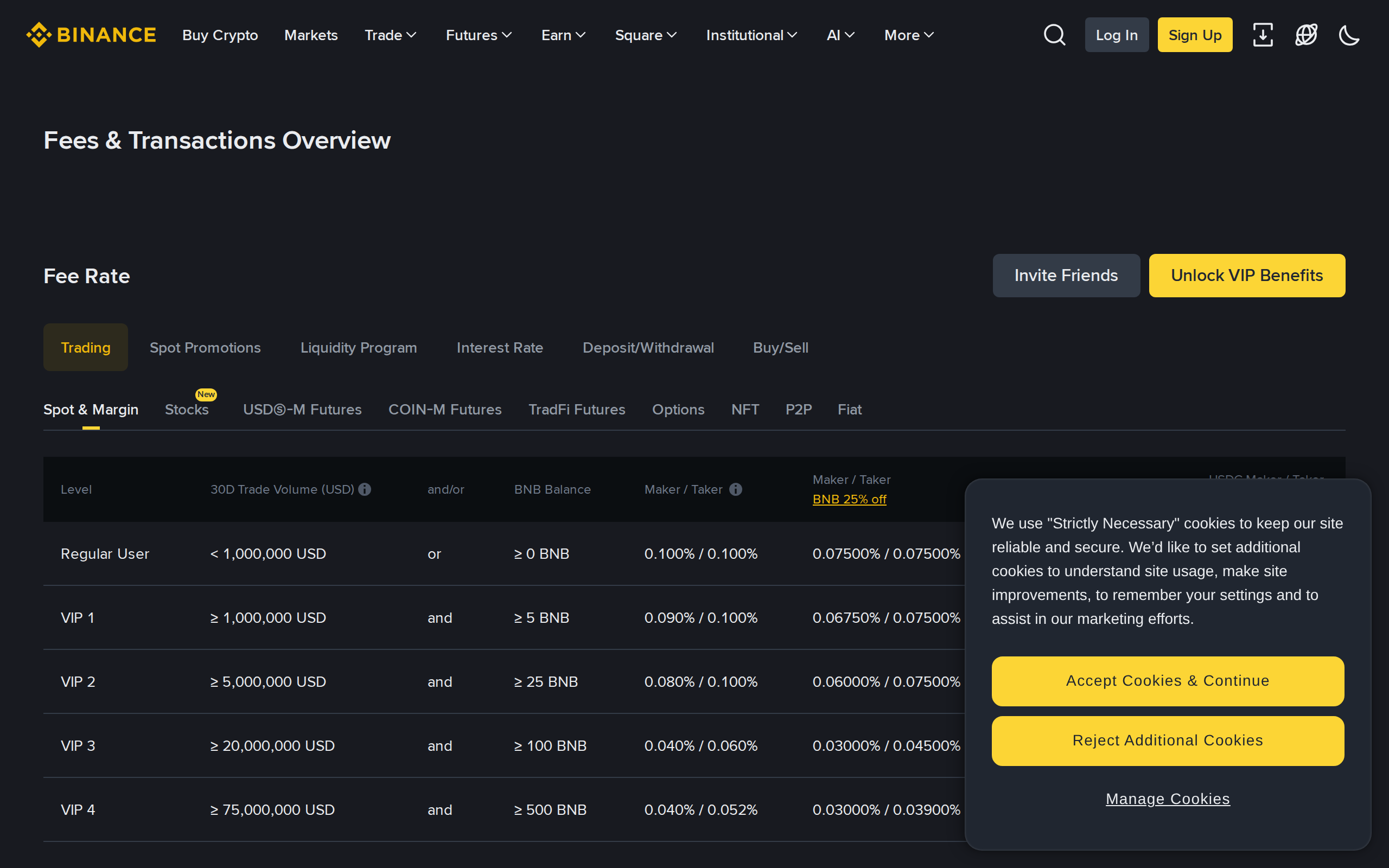
A regular account pays 0.100% maker and 0.100% taker on spot. Pay fees in BNB and the official schedule takes 25% off, which gives 0.075% each way. On a $1,000 trade that is 75 cents. Coinbase's entry Advanced tier is 0.60% taker, so the gap is roughly eight to one at small sizes.
Tiers open in two ways, and that is unusual. You reach VIP 1 with $1 million of 30-day volume or by holding 5 BNB; VIP 2 needs $5 million or 25 BNB; VIP 3 needs $20 million or 100 BNB. At the very top, VIP 9, the listed rates fall to 0.011% maker and 0.023% taker. Volume counts across spot, margin, convert, copy trading and bots, so a bot that trades a lot moves you up faster than you would expect.
One caution: holding BNB to save fees means holding a volatile token issued by the exchange. A 25% discount on 0.10% is worth 0.025 points a trade. Whether that justifies the exposure depends on how often you trade.
Liquidity and the screen you actually trade on
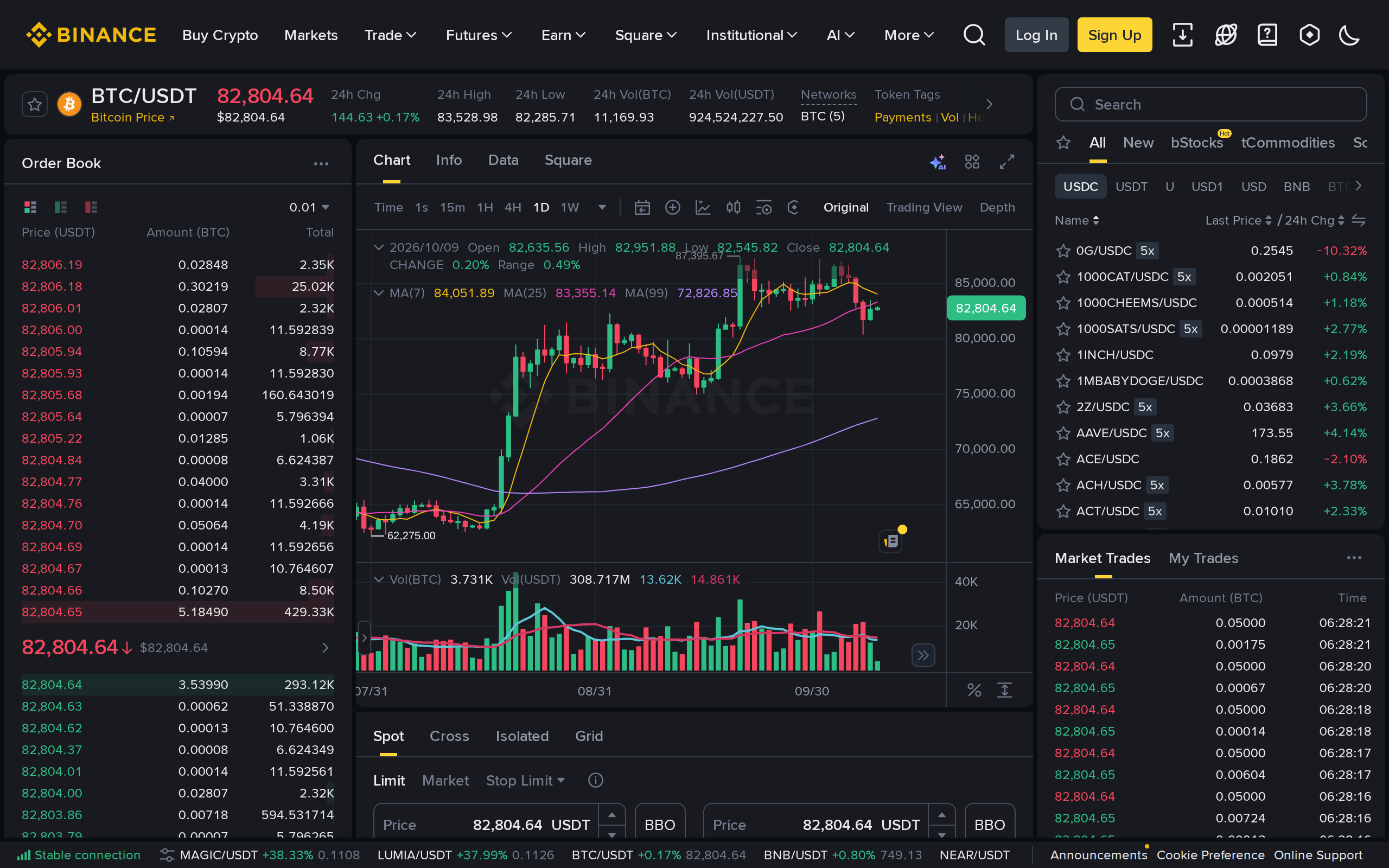
The market overview lists far more pairs than most rivals, including small tokens that other regulated venues skip. The BTC/USDT screen is the classic exchange layout: chart, order book, recent trades and order form in one view. It is dense but quick, and it is the screen you will use most.
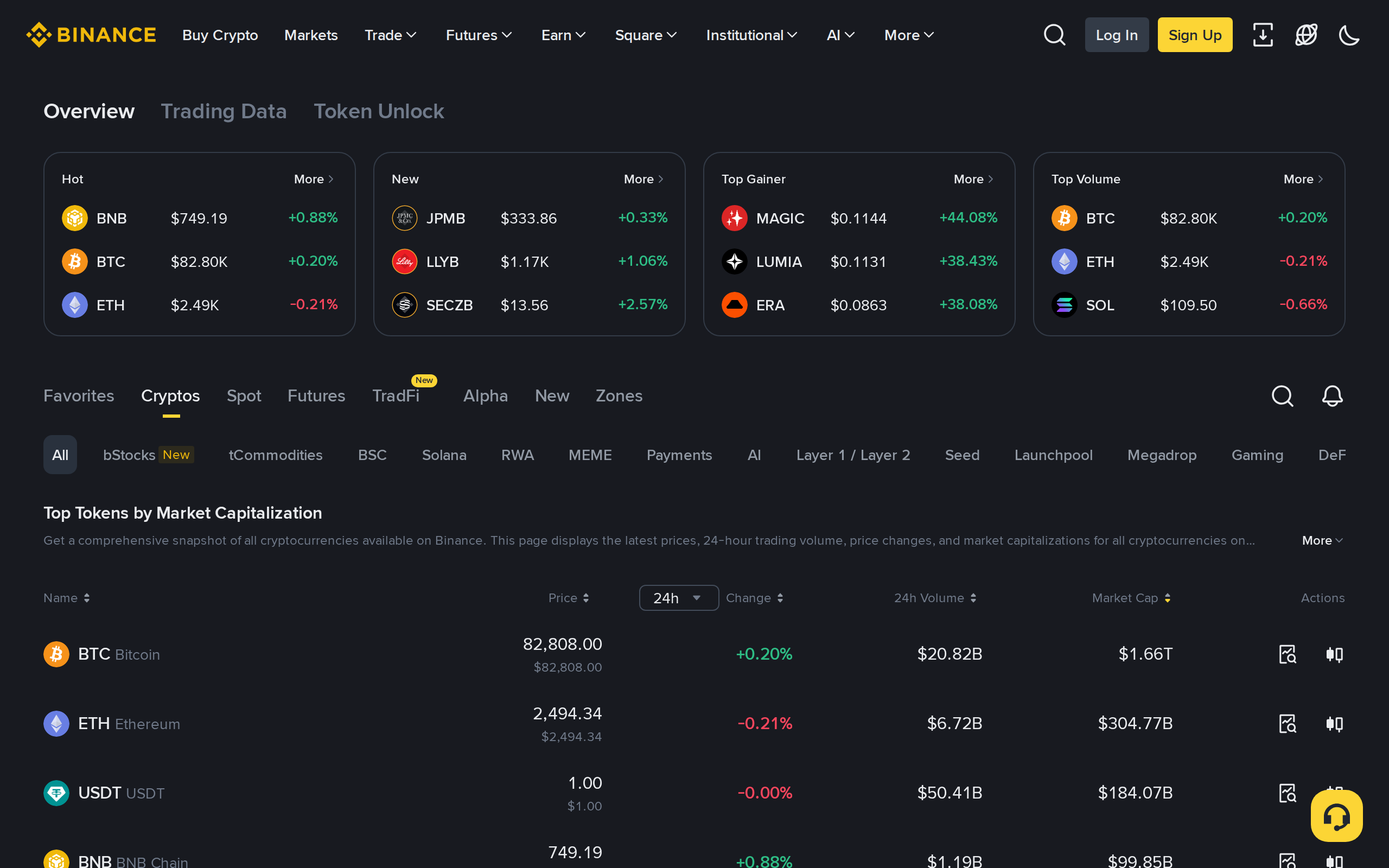
The weak spot is everything around it. Earn products, copy trading, Square, AI tools and a Convert button all sit in the same menu. A beginner can tap the wrong one. The simple Convert flow charges a spread rather than the posted fee, so use the spot screen if the 0.10% number is why you came.
What the record means in practice
The settlement came with a three-year independent compliance monitor, and reporting in 2025 described the monitor as clearing the KYC remediation while sanctions screening stayed under review. Binance has a new chief executive and publishes reserve attestations. None of that removes counterparty risk: you are trusting a company, not a custodian regulated like a bank.
Access is the other practical limit. US residents cannot use Binance.com. Binance.US is a separate operator, with a smaller market list and several states unsupported as of its June 2026 list, per a 2026 explainer. Rules differ again across Europe and Asia, so check your own country's position before depositing.
What we could not verify from public pages
Fee tables are public; fill quality is not. We read the schedule and the screens, and we did not measure slippage on large orders, so the "deep books" point rests on the pair count and on the volume rankings other trackers publish. Withdrawal limits and times also vary by coin, network and account verification level, and Binance can change them. Test a small withdrawal to your own wallet before you move real size, with any exchange.
Compared with the usual alternatives, the trade-off is simple. A regulated US-style app costs several times more per trade and gives you a tighter compliance wrapper. Binance flips that: cheaper trades, thinner protection if something goes wrong, and a rulebook that depends on your country.
Who should use it, and who should not
Use Binance if you trade spot often, live where it is permitted, understand that exchange balances are an IOU, and move long-term holdings to your own wallet. For that person the fee and depth advantage is real, and no regulated competitor matches it.
Skip it if you want a licensed local broker, if your jurisdiction restricts it, or if a past guilty plea is simply a dealbreaker for you. That is a legitimate position. Nothing here is a recommendation to trade or to hold any asset; fees and rules change, so read the current schedule before you fund an account.
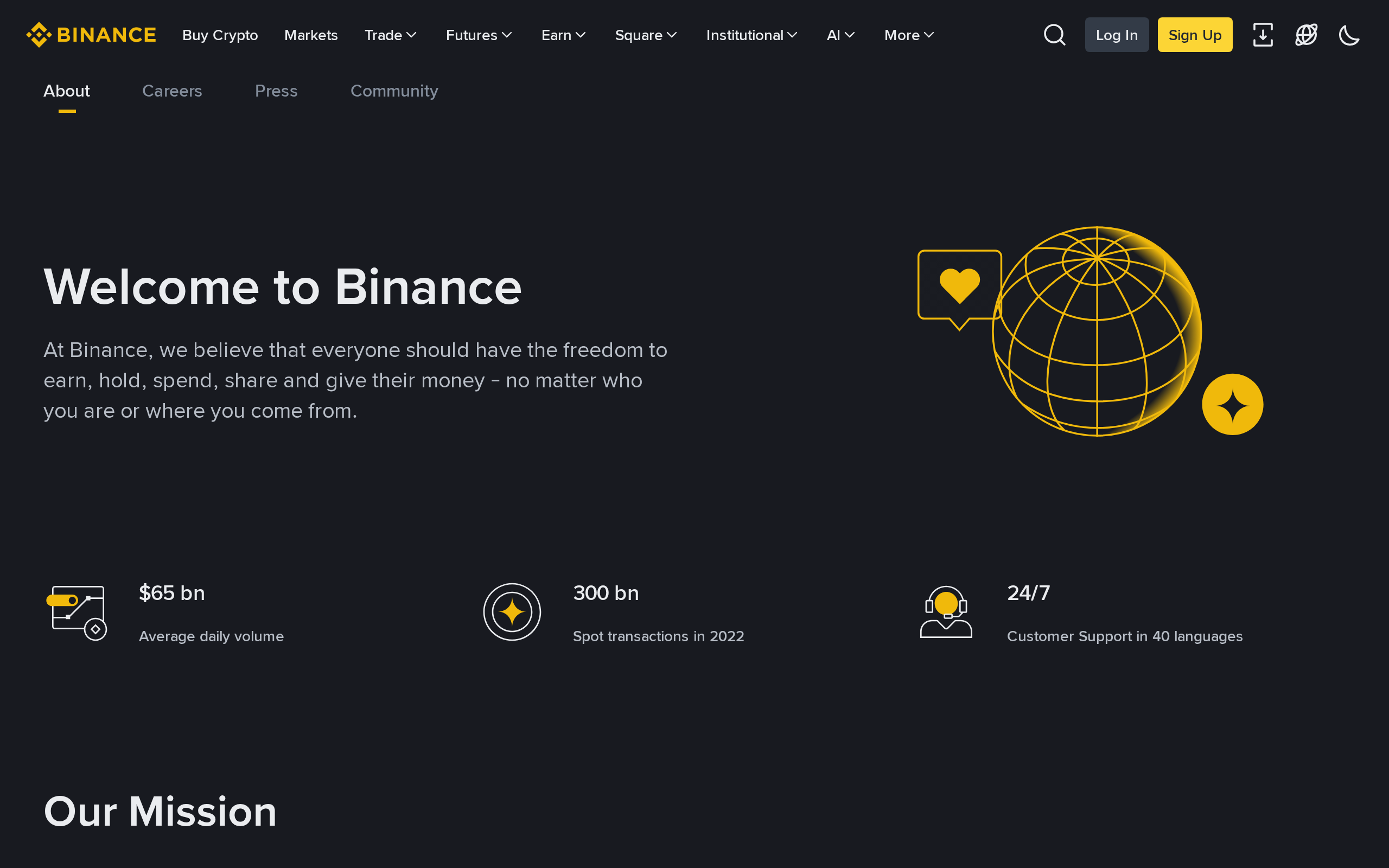
The company's own claim of roughly $65 billion in average daily volume, shown on its About page, is marketing and we treat it that way. The fee table is a hard number, and it is the strongest argument Binance has.
Specifications
- Base spot fee (VIP 0)
- 0.100% maker / 0.100% taker
- BNB fee discount
- 25% (0.075% / 0.075%)
- VIP 1 threshold
- $1M 30-day volume or 5 BNB
- Top spot tier (VIP 9)
- As low as 0.011% / 0.023%
- US access
- Not on Binance.com; Binance.US in supported states
- Products
- Spot, margin, futures, earn, convert, copy trading, bots
- Regulatory record
- 2023 DOJ resolution, $4.3B, three-year monitor