
Garmin Forerunner 970 Review: What $750 Buys a Marathon Trainer
Garmin's flagship runner adds a titanium bezel, sapphire glass, ECG, a flashlight and a brighter screen for $150 more than before. We sort out who needs it and who should buy the 570.
Best for: Serious marathon and triathlon trainers who will keep a watch for years
The best multisport watch Garmin makes below the Fenix line, with excellent GPS, a bright 1.4 inch AMOLED screen and training tools that cover a marathon or a triathlon block. It costs $750, though, and most of the training software also lives on the $450 Forerunner 570. Buy it for ECG, titanium and sapphire; for training alone, buy the 570.
$749.99from Garmingarmin.com
Garmin did not just raise the price of its top running watch. It raised it by $150, to $749.99, and asked everyone who liked the old Forerunner 965 to decide whether a flashlight and a better screen are worth that. For most runners the honest answer is no. For a smaller group, it is yes.
We read the long-form tests, the maker's own battery tables and the price lists, and we put the numbers next to each other. Where we quote a measurement, we say whose it is.
What changed from the 965
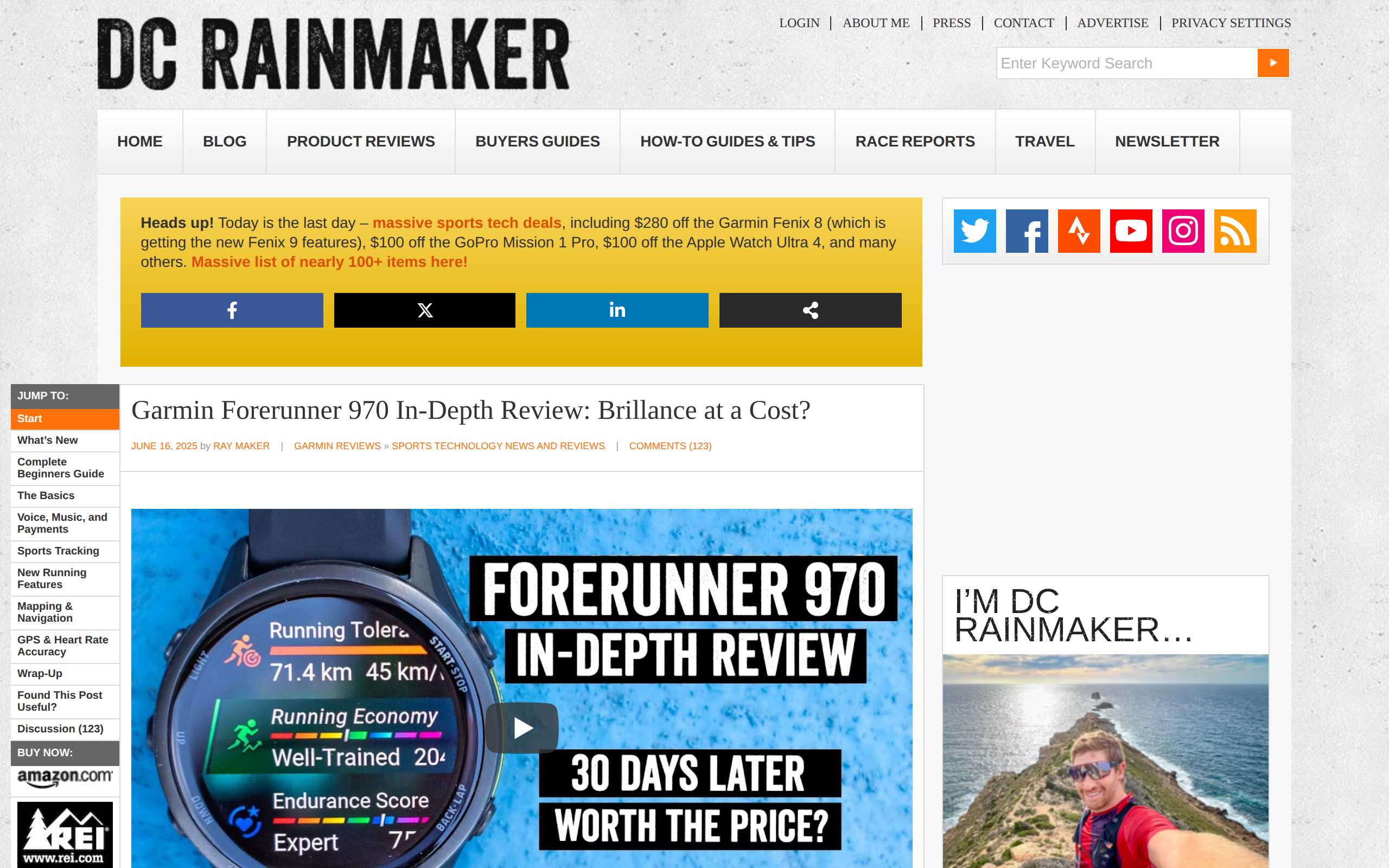
DC Rainmaker's in-depth review lists the hardware: an LED flashlight, a speaker and microphone, an ECG-capable heart rate sensor, a new GNSS chip and a brighter display. The case is a 47 mm one with a titanium bezel, the 1.4 inch AMOLED screen is the same size as before, and the cover glass moves up from Gorilla Glass to sapphire.
The ECG is the one feature that comes with a regulatory stamp. DC Rainmaker notes it is certified as a medical device by the FDA, the EU and other bodies, and that it needs the metal contact pads and titanium bezel the 570 lacks. If you want an ECG on your wrist, the 970 is the cheapest Forerunner that has one.
Battery: great on paper, easy to break
Garmin quotes up to 15 days as a smartwatch and 23 hours of SatIQ GPS. In DC Rainmaker's test, a long ride at default brightness got the full claimed 23 hours. On a 4 hour hike with brightness dropped to the lowest levels and full navigation running, he got 30 hours.
The trap is the screen. With always-on display at default brightness, he got about 2.5 days, against the 4 to 6 days he sees from other 1,000-nit Garmin watches. His fix is to run brightness at one third, which he says is still plenty bright. Android Central agrees on the broad point: 15 days is possible, but expect closer to 10 days with regular GPS runs, overnight SpO2 and calling, and about half of Garmin's eight-day always-on claim.
Our reading: set the brightness before your first run, and the watch is fine. Leave the defaults and the 970 will lose to the 965, which promised up to 23 days.
Is it worth it for a marathon or triathlon block?
Here the money question gets sharp. Android Central points out that many of the best Forerunner features, such as training load focus, daily suggested workouts and recovery time, also appear on the $450 Forerunner 570. ClimbPro and Endurance Score were already on the $600 965. So the training brain is not what you are paying $300 extra for over the 570.
What you are paying for:
Materials. Titanium and sapphire should take scratches and knocks better than aluminum and glass.
ECG and skin temperature. Useful if you care about heart rhythm checks.
Dual-band GPS with SatIQ. Android Central calls the dual-band tracking fantastic, and notes SatIQ saves a few hours of battery but can struggle under underpasses.
Multisport depth. Triathlon, brick and pool triathlon modes, plus the long sport list, are what a triathlete buys a Forerunner for.
Against the Fenix 8 47 mm, Android Central says you get a twice-as-bright display and a half-ounce lighter watch for $350 less, giving up the dive-proof metal case and the bigger battery.
The rough edges
DC Rainmaker had a couple of complaints that matter if you live in the pool or lake. His open-water swim tracks, compared against a second watch, still had mistakes he does not usually see on Garmin watches. During a photo shoot of the voice features, the watch crashed each time the microphone started, though he had no crashes in the weeks before. We would treat that as a note rather than a verdict.
Straps are a smaller trap. QuickFit bands need a special tool, and Android Central says the third-party choice is limited, with Garmin's own bands running from $50 for silicone to $300 for leather, nylon or metal.
Who should buy it
Buy the Forerunner 970 if you are training for a marathon, an Ironman or a 70.3, you want ECG, titanium and sapphire, and you expect to wear one watch for several years. Buy the Forerunner 570 at about $450 if you want the same training tools and can live with aluminum, and no ECG. Look for a discounted 965 if battery life matters more than brightness. Skip all three if you only run a few times a week, because a $750 watch will not make you faster.