
Branch Ergonomic Chair Review: How Much of a Leap Does $369 Buy?
Branch's $369 mesh chair has a seat-depth slider, 3D arms and a sliding lumbar pad, features usually found on chairs costing three to eight times more. The catch is a 275 lb limit, hard arm pads and a foam seat that tires after long days.
Best for: Home offices that sit 4 to 8 hours a day on a budget
For a home office where you sit four to eight hours a day, this is the chair to buy before spending four figures. The adjustment list matches chairs that cost three to eight times more, and Branch gives you a 30-day trial window. It is not an Aeron or Leap: the arm pads are hard, the controls need effort, the lumbar firmness is fixed and the 275 lb limit rules out heavier users. Step up to the Steelcase Leap for all-day comfort or larger frames.
$369 direct, $389 on Amazonfrom Branchbranchfurniture.com
The question hanging over every sub-$500 office chair is whether you are buying ergonomics or just the word. Branch's Ergonomic Chair is the one that most often gets the benefit of the doubt, and the reasons are mostly on its spec sheet.
What the money gets you
Branch sells the chair for $369 on its own site and it runs about $389 on Amazon. For that you get a mesh back, a high-density foam seat, a seat-depth slider that spans roughly 15.5 to 18 inches, a seat height range of 17.5 to 21.5 inches and 3D armrests that move up, in and out and pivot. The lumbar pad slides along a track. SeatedLab counts eight adjustment points and TechGearLab counts seven, so the count depends on who is tallying.
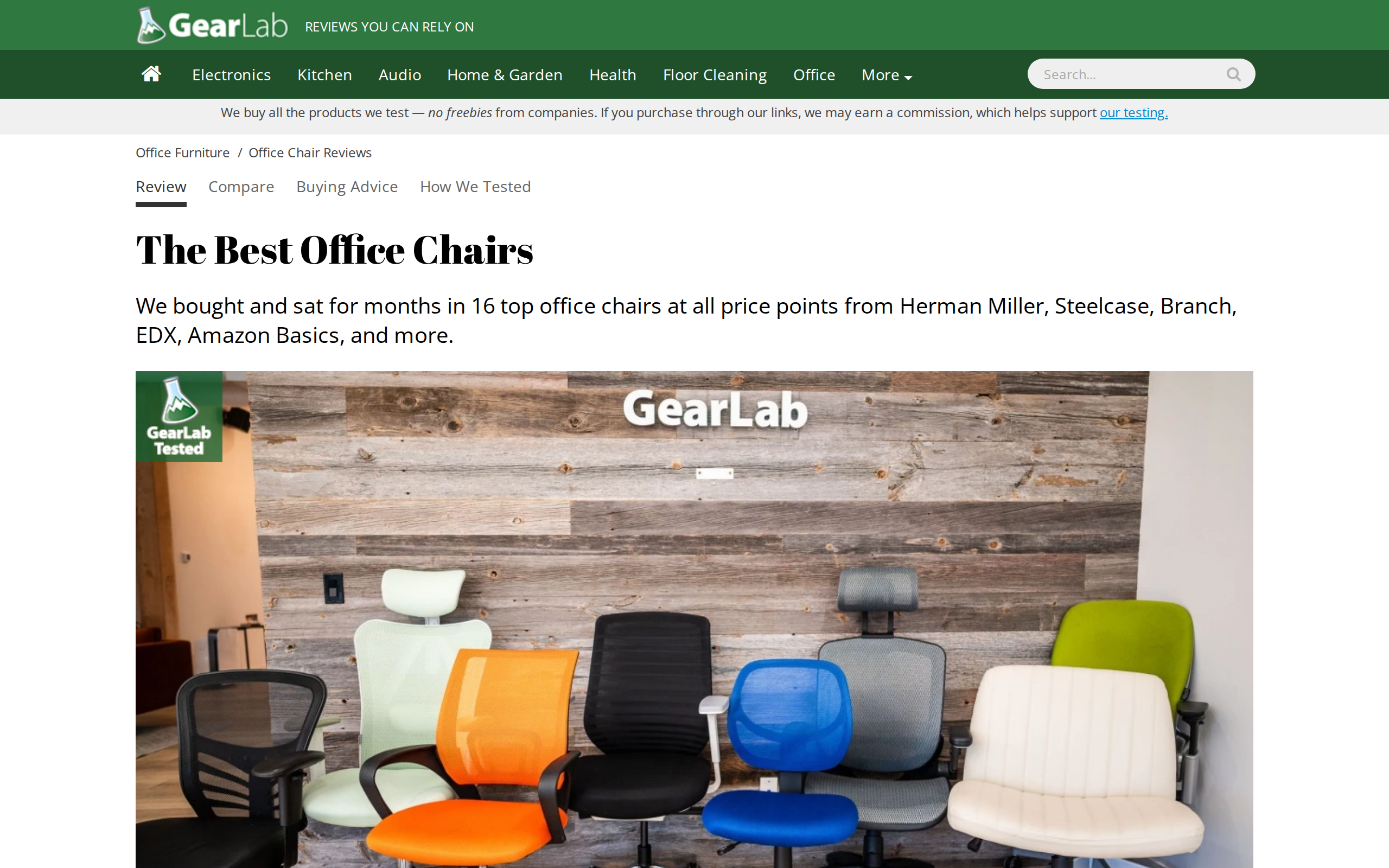
That list is why TechGearLab gave it an Editors' Choice. Its score was 77, against 73 for the Herman Miller Aeron and 89 for the Steelcase Leap in the same test. The reviewer's line is that it matches the adjustability of chairs costing three to eight times as much.
Where the price shows
The same reviewers are clear about the compromises, and they are real ones.
The arms. The pads are hard plastic. Three-way movement is rare at $369, but a pad that bites after two hours is a daily irritation.
The effort. Adjustments take force. One tester said it needed tweaking before it was "just right", while pricier chairs move smoothly.
The seat. SeatedLab reports comfort through desk sessions of four to six hours, then a drop beyond six to eight hours, when some owners find the foam flattening and the lumbar pad intrusive. The pad also has one firmness only.
The limit. 275 lb is the cap. The Leap V2 carries 400 lb.
SeatedLab also puts the recommended user at 5 ft 2 in to 6 ft 2 in, and TechGearLab mentions a narrower seat pan. If you are tall or broad, read those two lines twice.
Setting it up so it works
A chair this adjustable is only as good as the time you spend on it. Start with seat height so your feet rest flat and your knees sit at about a right angle. Then slide the seat depth until two or three fingers fit between the seat edge and the back of your knees. Raise the arms until your shoulders drop, and only then move the lumbar pad to the curve of your lower back.
Branch also sells add-ons, including a headrest, a footrest and a chair mat, according to its product page. None of them is needed to judge the chair, but a footrest helps if you are short and the seat will not go low enough. Budget for it before you decide the total is under $400.
Branch versus the chairs it gets compared to
The Leap V2 costs roughly $1,400 and, per SeatedLab, adds a LiveBack that flexes with your spine, the Natural Glide recline and a 12-year warranty, against the Branch's 7. Those extras are what you pay for when you sit ten hours or share the chair. The Aeron's mesh seat and posture support are the classic choice, but it also costs several times more.
For a home office where one person sits four to eight hours, the Branch does most of the job. Branch's 30-day return window, which SeatedLab cites, makes a first purchase less risky: you can find out whether the seat length and arm height suit you before you commit.
The Pro question
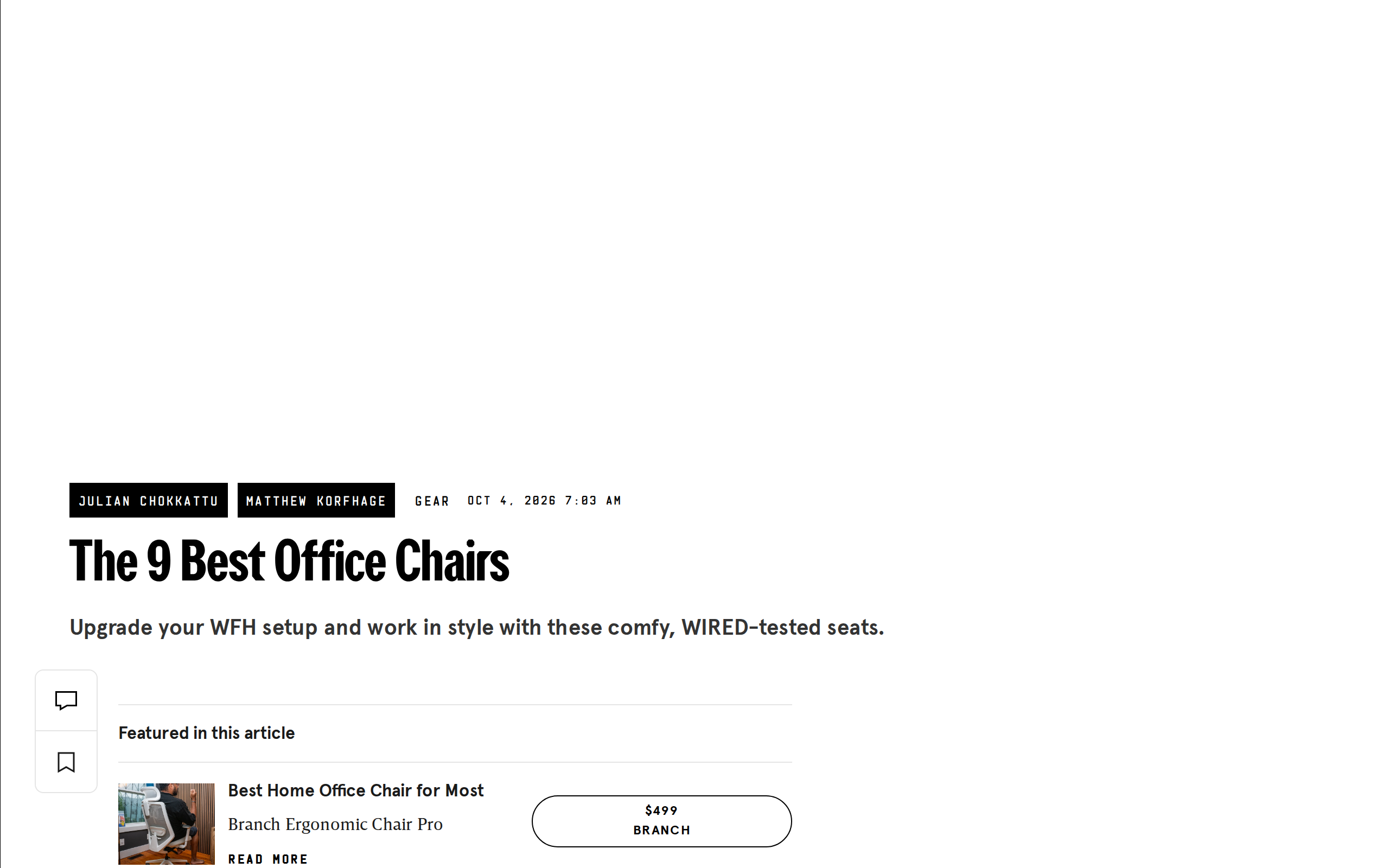
Branch also sells an Ergonomic Chair Pro. WIRED's top pick for most people is that model, not this one, partly because it keeps a reasonable price while adding comfort. If the standard chair's hard arms or seat length worry you, look at the Pro, and check the current price difference before ordering.
Who should buy it
Buy it if you work from home, weigh under 275 lb and sit under about eight hours a day. Buy it if a four-figure chair is out of reach and you want proper depth, arm and lumbar adjustment.
Skip it if you are over 6 ft 2 in, need support beyond 275 lb, or sit all day in long unbroken stretches. The Steelcase Leap is the better chair for those people, and nothing at $369 will change that.