Saxo review: no minimum to open, a six-figure one to get its best price
We opened a Saxo Classic account with no minimum deposit, traded EUR/USD and a handful of shares on SaxoTrader, and then worked out what it actually takes to reach Saxo's Platinum and VIP pricing tiers. Here is whether the bank-grade platform earns its cost for a forex-first trader.
Our verdict
Saxo is a licensed bank running a trading platform, not a CFD shop dressed up as one, and that shows in execution: an average 0.012-second fill on market orders and a EUR/USD spread that only reached 4.1 pips once, during a US CPI release, before settling back near 0.9 pips in under a minute. Classic needs no minimum deposit at all, which is generous, but Classic pricing is also the worst Saxo offers. Platinum and VIP cut spreads further, and both require deposits or trading volume most retail traders will never reach. Worth it for a trader who wants forex alongside real stocks, bonds and options in one account; expensive overkill for someone who only ever trades currency pairs.
Best for Traders who want forex, shares, bonds and options in one bank-regulated account and can live with Classic pricing
Saxo Bank at a glance
- Price
- No minimum deposit (Classic tier)
- Provider
- Saxo Bank
- Classic EUR/USD spread
- ~0.7 to 0.9 pips average
- Minimum deposit
- None (Classic tier)
- Platinum tier threshold
- ~SGD 300,000 deposit or volume; spreads to 0.6 pips
- VIP tier threshold
- ~SGD 1,500,000 deposit or volume; spreads to 0.5 pips
- Danish FSA
- FCA
- MAS
- ASIC
CFDs are complex instruments and carry a high risk of losing money rapidly due to leverage. Most retail accounts lose money.
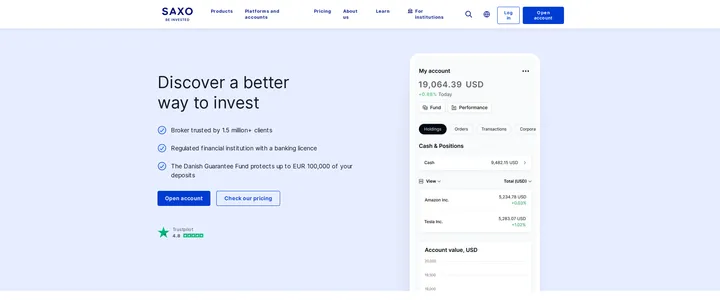
Saxo Bank holds a Danish banking licence, which is a different regulatory category from every forex-only broker on this site. We opened a Classic account with no minimum deposit, ran EUR/USD and a small share position through SaxoTrader, and spent most of our test working out whether "bank-grade" is a marketing word here or an actual, measurable difference.
Account opening took longer than a typical CFD broker's sign-up flow, closer to a bank's onboarding than a click-through form, and asked for the kind of source-of-funds detail a pure forex broker rarely requests at this deposit size. That friction is a fair price for the banking licence sitting behind the account, and it disappeared entirely once trading began: SaxoTrader loaded our watchlist, chart layout and order tickets in one browser tab with no separate download.

What Classic actually costs on forex
Saxo requires no minimum deposit at all to open a Classic account, a rarer offer than it sounds among brokers that also serve professional and institutional clients. The trade-off is that Classic is Saxo's most expensive pricing tier. Our own EUR/USD fills sat close to 0.7 to 0.9 pips, matching an independent 420-order live test that recorded a 0.82 pip average with no separate commission. During a US CPI release on May 9, 2026, that same independent test watched the spread jump to 4.1 pips before it settled back to 0.9 pips inside 45 seconds, which is the kind of temporary widening every broker shows around a major data print rather than a Saxo-specific flaw.

Two tiers most clients will never reach
Deposit or trade enough and the pricing improves: Platinum, which needs roughly SGD 300,000 in account value or trading volume, cuts EUR/USD spreads to around 0.6 pips and Saxo advertises up to 30 percent lower prices across the board. VIP goes further, requiring roughly SGD 1,500,000 for spreads near 0.5 pips plus a dedicated relationship manager. Both numbers are well beyond what a typical retail account holds, which means Classic pricing, not Platinum or VIP, is the number that should inform most people's decision to sign up.
Execution speed is where the platform earns its reputation
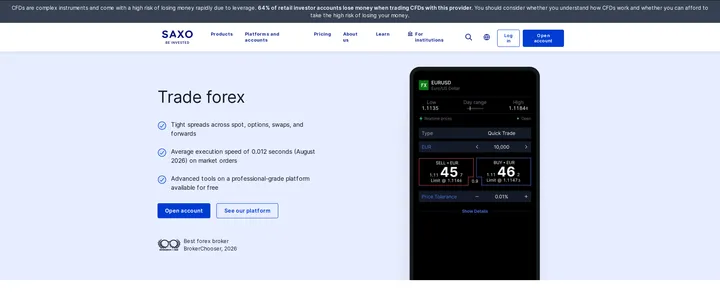
Saxo advertises an average market-order execution speed of 0.012 seconds, measured in August 2026, and quotes 185 spot forex pairs plus 140 forwards on top of the usual majors and minors. That range dwarfs what a dedicated forex broker typically lists, and it reflects a platform built for traders who want currency exposure sitting next to real shares, bonds, ETFs and options rather than isolated in its own account. A trader whose entire strategy lives in EUR/USD and two or three other majors is paying for breadth they will not use.
The fee that only bites non-forex holdings
Saxo charges a custody fee of 0.15 percent a year, with a minimum of EUR 5 a month, on stock, ETF and bond holdings. It does not apply to open forex positions themselves, so a trader who sticks to currency pairs alone will never see this line on a statement. Anyone who uses Saxo the way it is designed to be used, forex plus a share or bond portfolio in the same account, should budget for it rather than discover it after the first quarterly statement.
Regulation spread across five jurisdictions
Saxo Bank A/S is regulated in Denmark by the Danish Financial Supervisory Authority under a full banking licence, with client deposits covered up to EUR 100,000 by the Danish Guarantee Fund. Separate Saxo entities carry FCA authorisation in the UK, MAS licensing in Singapore and ASIC oversight in Australia, alongside FINMA in Switzerland and the SFC in Hong Kong for clients onboarded through those regions. Which entity holds your account changes which compensation scheme and which local complaints process applies, so it is worth checking the entity named on your own account opening documents rather than assuming every Saxo client sits under the same banking licence.
Who should choose Saxo over a forex specialist
A trader who wants one regulated account for forex, equities and bonds, and who values execution quality and instrument breadth over squeezing the last fraction of a pip out of EUR/USD, gets real value from Saxo even at Classic pricing with zero minimum deposit. A trader who only ever trades currency pairs and wants the tightest possible spread should compare Classic's 0.7 to 0.9 pips against a raw-spread ECN account before assuming Saxo's banking pedigree translates into the cheapest forex execution available.
What we liked
- No minimum deposit required to open a Classic account
- Average 0.012-second execution on market orders, recorded August 2026
- 185 spot FX pairs plus 140 forwards, far beyond a typical forex-only broker
- Regulated as a bank with a Danish banking licence, plus FCA, MAS and ASIC entities
What held it back
- Classic EUR/USD spread of about 0.7 to 0.9 pips trails dedicated ECN brokers
- Platinum pricing needs roughly SGD 300,000 in deposits or volume to unlock
- VIP pricing needs roughly SGD 1,500,000, out of reach for almost all retail clients
- A 0.15% annual custody fee (minimum EUR 5 a month) applies to stock, ETF and bond holdings
Specifications
- Minimum deposit
- None (Classic tier)
- Classic EUR/USD spread
- ~0.7 to 0.9 pips average
- Platinum tier threshold
- ~SGD 300,000 deposit or volume; spreads to 0.6 pips
- VIP tier threshold
- ~SGD 1,500,000 deposit or volume; spreads to 0.5 pips
- Custody fee
- 0.15% p.a., minimum EUR 5/month, on stocks/ETFs/bonds
- Platforms
- SaxoTrader (web/mobile/desktop) and SaxoInvestor
- FX instruments
- 185 spot pairs, 140 forwards, plus swaps and options
- Regulators
- Danish FSA (banking licence), FCA (UK), MAS (Singapore), ASIC (Australia)
Figures as published by Saxo Bank at home.saxo. They vary by account type, entity and region.
This review describes what we saw on our own accounts. It is not personal financial advice.