Crypto ExchangesReview
Robinhood Crypto Review: Withdrawals Arrived, But So Did a Florida Subpoena
We opened a Robinhood Crypto account, compared its default market-maker spread against the disclosed exchange-routing fee tier, checked the crypto transfer and self-custody wallet options, and read through the Florida Attorney General's July 2025 probe into the company's lowest-cost marketing claims.
Our verdict
Robinhood Crypto now lets you send coins in and out freely, closing the biggest gap it used to have against a real exchange, and its exchange-routing option discloses a fee that drops from 0.85% to 0.03% as your 30-day volume climbs. The catch is the default: app orders route to a market maker that pays Robinhood roughly $0.95 per $100 of volume, a cost folded into the spread rather than shown as a line item. Florida's Attorney General is already asking Robinhood to justify its lowest cost marketing under subpoena. Traders who switch on exchange routing get a fair deal; anyone on the default screen pays more than the slogan promises.
Best for: Existing Robinhood brokerage users who will switch on exchange routing and watch their fee tier
- Price
- Commission-free; spreads apply
- Made by
- Robinhood
What we liked
- No deposit or withdrawal fees; you can send crypto to and from external wallets
- Exchange routing discloses a clear 0.03% to 0.85% fee tier tied to 30-day volume
- Optional self-custody wallet lets you hold keys outside the exchange
- Staking is available with partner fees capped at 2.75% of earnings
What held it back
- Market maker routing is the app default and folds an undisclosed spread into the price
- Florida's Attorney General subpoenaed Robinhood in July 2025 over its lowest-cost claims
- Trustpilot rating sits at 1.2 out of 5, with withdrawal and support complaints
- Market maker rebate of about $0.95 per $100 of volume is not shown at the point of trade
Robinhood built its crypto business on a simple pitch: no commissions, no withdrawal lockout, and a headline claim to be the lowest-cost place to trade. We opened an account, priced a Bitcoin buy through both of its routing options, and checked what Robinhood is being asked to explain to a state regulator.
The default screen isn't the cheap one
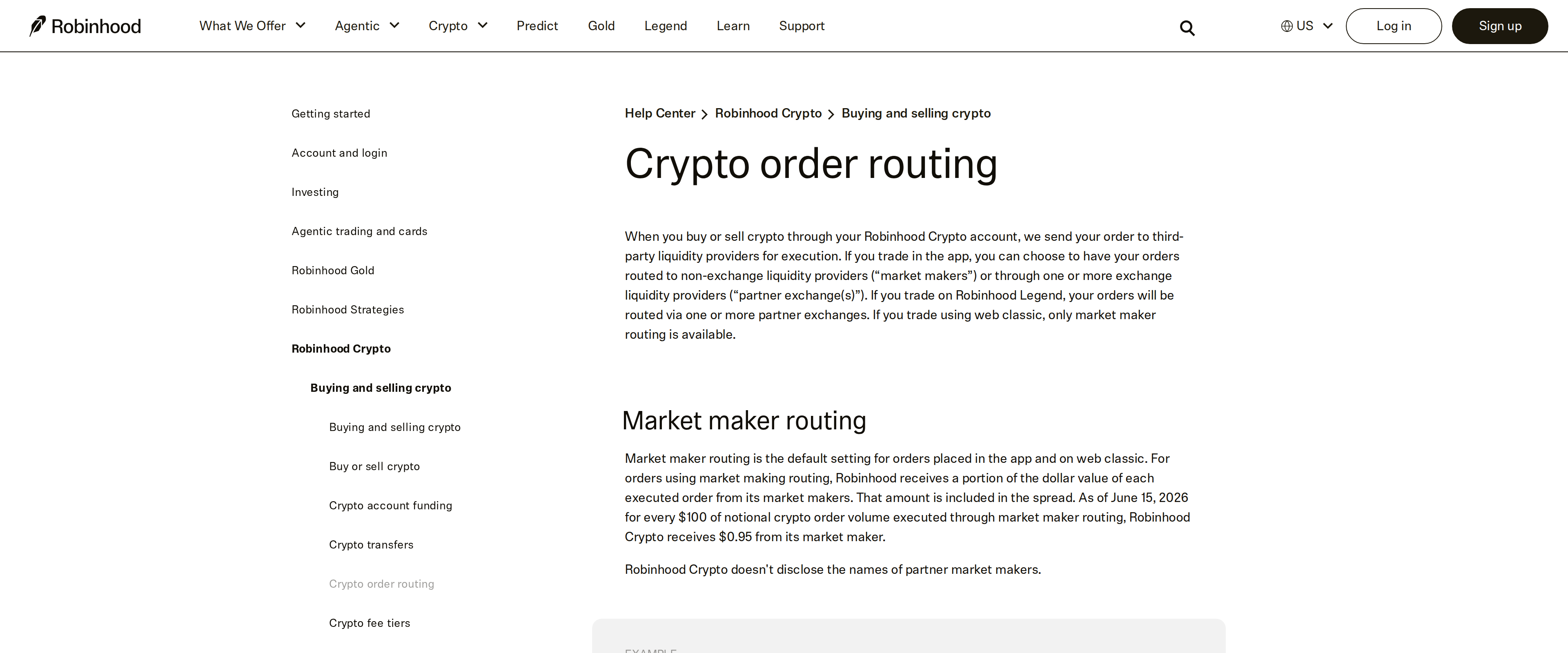
Open the app and place a market order, and Robinhood sends it to a market maker by default. That maker pays Robinhood about $0.95 for every $100 of volume it fills, a figure Robinhood discloses in its support pages but not on the order ticket itself. The cost to you shows up as a wider spread rather than a line-item fee, and independent estimates put that spread between 0.35% and 0.85% on Bitcoin and Ethereum. On a $95,000 Bitcoin buy, that range works out to roughly $330 to $800 of hidden markup before a single dollar of stated commission appears anywhere on the screen.
Switching to exchange routing actually saves money
Robinhood's alternative, exchange routing, sends your order to a partner exchange instead of a market maker and charges a disclosed fee between 0.03% and 0.85%, scaled to your trailing 30-day volume. Robinhood's own support article confirms it keeps no rebate from that route, so the incentive to hide cost in a spread disappears once you flip the toggle. The fee tier only helps if you remember to check it; the app does not warn you which routing option is active before you tap confirm.
Reading the tier before you trade
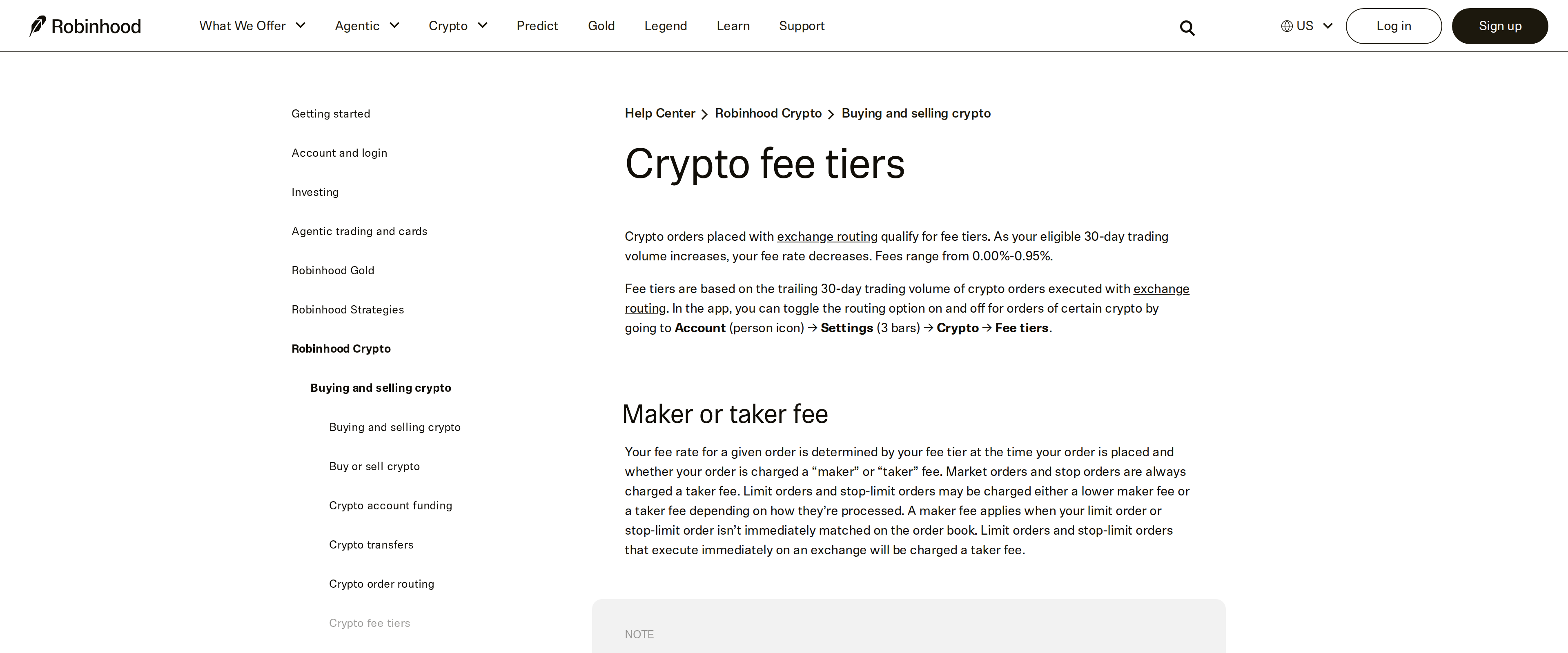
Robinhood's fee tier page lays out the exact math: your rate depends on your trailing 30-day exchange-routed volume, and whether a given order fills as a maker or a taker changes the number again. A trader doing a few hundred dollars a month sits at the top of the range near 0.85%, while someone running six-figure monthly volume drops toward 0.03%. That's a real, disclosed number you can plan around, which is more than most competitors publish for their own spread-based pricing.
Withdrawals, staking and the self-custody option
The bigger structural change is that Robinhood now lets you send crypto out to an external wallet and receive it back in, with no Robinhood-side fee beyond the network's own gas cost. That alone used to be a reason to avoid Robinhood for anyone who wanted real custody of their coins. Robinhood also offers an optional self-custody wallet and crypto staking, where partner fees run as high as 2.75% of whatever the stake earns, a cap worth checking against a dedicated staking provider before you commit a large balance.
Specifications
- Standard commission
- $0, paid through spread instead
- Market maker rebate
- ~$0.95 per $100 notional volume (June 2026 rate)
- Exchange routing fee
- 0.03% to 0.85%, tiered by 30-day volume
- Typical major-coin spread
- 0.35% to 0.85% of trade value
- Withdrawal fee
- $0 from Robinhood; network fee only
- Staking partner fee
- Up to 2.75% of staking earnings
- Trustpilot rating
- 1.2 / 5
- Regulatory note
- Florida AG subpoena issued July 2025 over marketing claims