Software WalletsReview
Rabby Wallet review: a security engine that actually reads the transaction
We moved our daily DeFi habit from MetaMask to Rabby for six weeks to see if its pre-sign risk checks catch what MetaMask misses. They did, twice, and the wallet's own swap fee undercuts MetaMask's by more than half.
Our verdict
Rabby earns its reputation as the more careful of the two default EVM wallets. Its pre-sign security engine simulates the exact balance change and flags risky approvals before you click confirm, something MetaMask only partially does, and its built-in swap fee of 0.25 percent stays well under MetaMask's 0.875 percent. It is not a hardware wallet replacement and its mobile app is younger than the extension, but for anyone signing DeFi transactions daily, it is the safer default.
Best for: Daily DeFi users who sign contracts often and want the transaction previewed before they approve it
- Price
- Free
- Made by
- DeBank
What we liked
- Pre-sign simulation shows the exact token balance change before you approve anything
- Batch-revoke lets you clear out old risky approvals in one action instead of one by one
- Built-in swap fee of 0.25 percent undercuts MetaMask's 0.875 percent on the same trade
- Gas Account covers fees on any of its 100+ chains from one deposit, no bridging native tokens first
- Supports Ledger, Trezor, Keystone and BitBox02 for anyone who wants to sign with cold storage
What held it back
- The mobile app launched only in late 2025 and still lags the browser extension in polish
- Rabby Swap still takes a cut on non-exempt pairs, it is cheaper than rivals, not free
- No built-in card or fiat off-ramp, so spending still routes through a separate exchange
We run a MetaMask wallet for testing every review that touches DeFi, so switching our daily driver to Rabby for six weeks meant giving up muscle memory to see whether DeBank's safety pitch holds up against real contracts, not demo ones. Rabby is built by the team behind DeBank, the DeFi portfolio tracker many of us already used to check balances across chains, and the wallet inherits that same multi-chain habit rather than treating Ethereum as the only network that matters.
What the security engine actually catches
Rabby's pitch is that it simulates a transaction before you sign it, showing the real token balance change rather than a raw hex string. In practice that meant two moments during our test where a swap on an unfamiliar router would have drained more of a token than the interface suggested, and Rabby's preview flagged the mismatch before we clicked confirm. MetaMask's own preview caught one of the two. Neither wallet is magic: both rely on simulating the call against current chain state, and a contract designed to behave differently only when it detects a simulation could still slip past either one. Rabby's batch-revoke tool also let us clear nine stale token approvals from a defunct NFT mint in a single action, instead of hunting through Etherscan one contract at a time.
The Gas Account is the feature we didn't expect to use
Every EVM wallet has the same annoyance: you cannot pay a chain's gas fee without first holding that chain's native token, so bridging ten dollars of ETH to a new L2 just to try one dapp is common and wasteful. Rabby's Gas Account lets you deposit funds once and draw on that balance to cover fees across its supported chains, so a transaction on a network you have never touched still goes through. It is a small convenience with an outsized effect on how often we actually explored new chains during testing, rather than avoiding them because setup felt expensive.
The swap fee comparison that made the difference
Rabby introduced a 0.25 percent fee on its built-in swap aggregator in 2024, after years of running the feature for free, and DeBank has been upfront that the fee funds ongoing development. That is still less than a third of MetaMask's advertised 0.875 percent, which itself often compounds with routing costs once slippage is added. Over the swaps we ran during testing, Rabby's total cost stayed noticeably below MetaMask's on the same trade pairs. Neither fee applies if you route a swap directly through a DEX front end like Uniswap instead of the wallet's own aggregator, so the saving matters most to people who take the convenience of an in-wallet swap over shopping the trade manually.
Specifications
- Price
- Free
- Maker
- DeBank
- Platforms
- Chrome extension, desktop app, iOS, Android
- Chains supported
- 100+ EVM-compatible networks
- Swap fee
- 0.25% on the built-in aggregator
- Security model
- Pre-sign transaction simulation and risk scoring
- Hardware wallet support
- Ledger, Trezor, Keystone, BitBox02, GridPlus
- Chrome Web Store rating
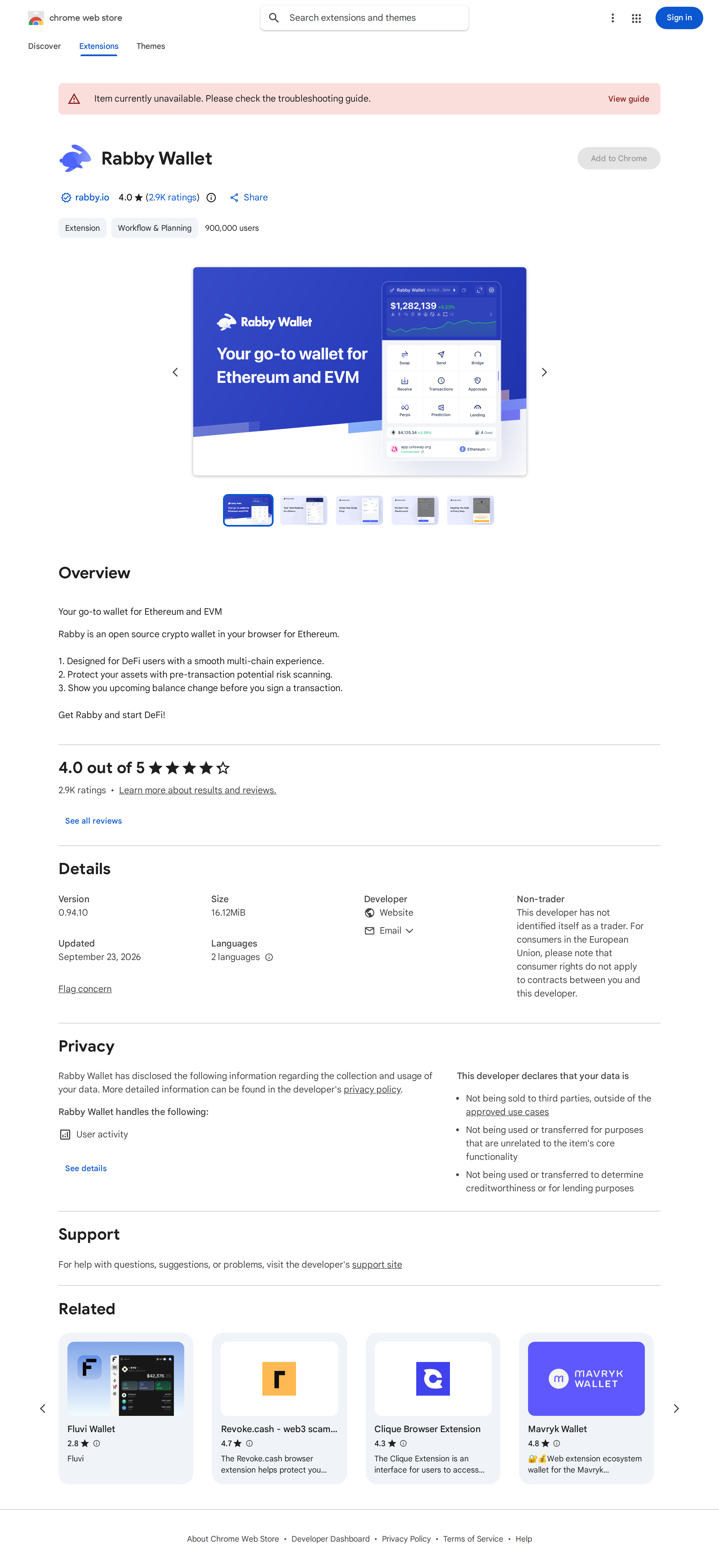
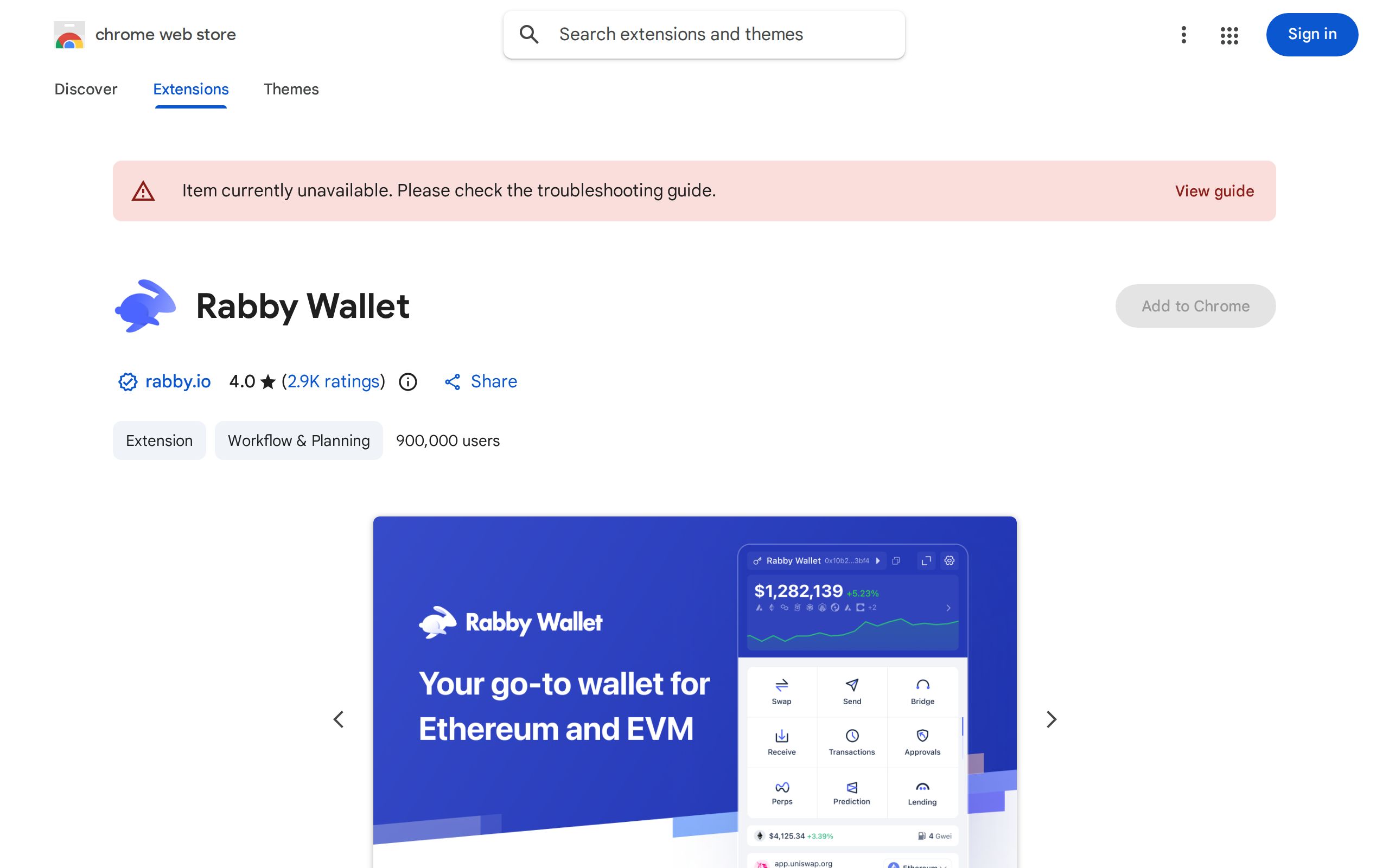
- 4.0 out of 5 from 2.9K ratings