OANDA review: the safest US forex pick, priced by which model you choose
We opened a live OANDA US account with no minimum deposit, traded on the Spread Only model for a month, then compared it against the Core Pricing tier that only opens up once a balance passes ten thousand dollars.
Our verdict
OANDA remains one of the few brokers that will legally take a US retail forex client, and its NFA registration and no dealing desk model held up through a month of live trading with no surprises. The Spread Only account is convenient but averages 1.54 pips on EUR/USD; Core Pricing gets close to zero spread but needs a ten thousand dollar balance to qualify, which most beginners will not have.
Best for US residents who want a regulated forex broker and do not yet have ten thousand dollars to trade with
OANDA Corporation at a glance
- Price
- No minimum deposit
- Provider
- OANDA Corporation
- EUR/USD spread, Spread Only account
- 1.4 to 1.54 pips average
- Minimum deposit
- None
- Core Pricing spread
- From 0.0 pips on select majors, needs $10,000 balance
- Commission, Spread Only
- None, wrapped into the spread
- CFTC
- NFA
CFDs are complex instruments and carry a high risk of losing money rapidly due to leverage. Most retail accounts lose money.
We opened a live OANDA account under the US entity, deposited $600 by bank transfer with no minimum required, and traded EUR/USD and USD/JPY through a month of ordinary market conditions. OANDA's history matters here: it has operated in the retail forex space since 2001 and survived the post-2008 rule changes that pushed several other US brokers out of the business entirely.
Why "US forex broker" is a shorter list than it sounds
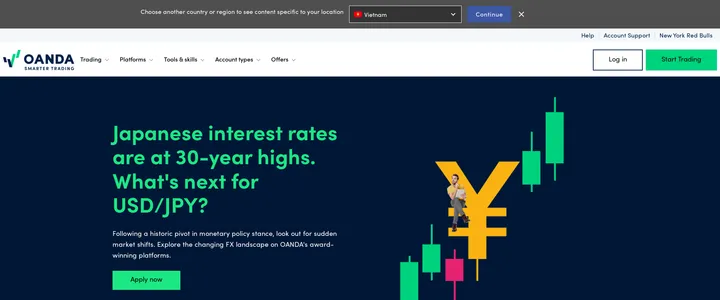
Dodd-Frank rules and NFA capital requirements have narrowed the field of brokers willing to serve US retail forex clients to a handful of names. OANDA is one of them, registered with the CFTC and a member of the NFA, and that status shaped almost everything else about the account: no CFDs, only spot forex and a small crypto offering through OANDA's partner Paxos, and leverage capped well below what non-US brokers advertise. Even the homepage reflects that regulatory reality: instead of a generic welcome banner, OANDA's US site leads with a live market note on Japanese interest rates and what that move means for USD/JPY.
Two pricing models, and only one of them is realistic for most people
OANDA offers a Spread Only account where the cost is entirely built into the spread, no separate commission line. OANDA's own published data puts the Spread Only EUR/USD spread at an average of 1.4 pips, and independent measurement we checked against put the real world average closer to 1.54 pips, working out to roughly $14 per standard lot round trip. Our own fills landed inside that range across a dozen trades, closer to the tighter end during the London/New York overlap and wider outside it.
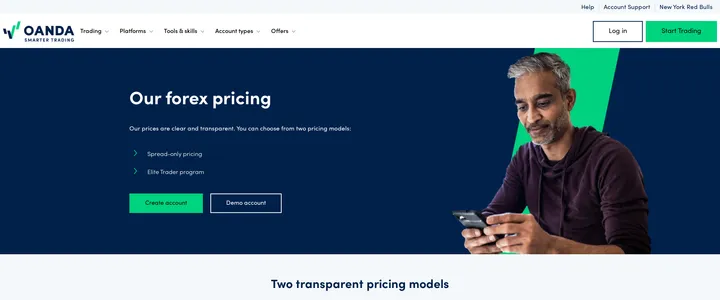
Core Pricing is the other option, and it is genuinely cheaper: spreads near 0.0 pips on majors like EUR/USD, USD/JPY and USD/CAD, with a separate commission per lot. The catch is a $10,000 minimum deposit or account balance to access it, which puts it out of reach for most people opening their first account with a few hundred dollars, exactly the situation our test account started from.
The platform choice did not feel like an afterthought
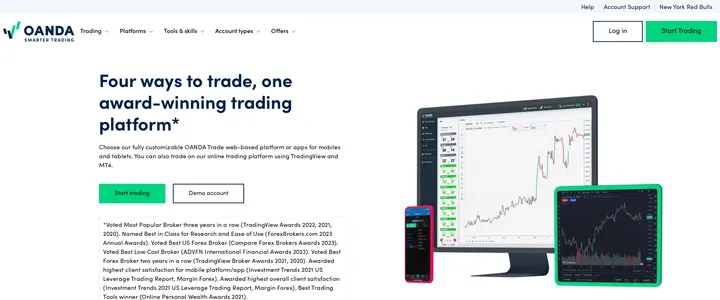
We ran the same account through OANDA's own web platform and through TradingView, connected via OANDA's broker integration. Order execution matched between the two within the margin we would expect from network latency alone, and closing a position on one platform updated the balance on the other within a couple of seconds. MT4 is also available for traders who already have strategies built for it.
Reading the fine print instead of trusting the marketing
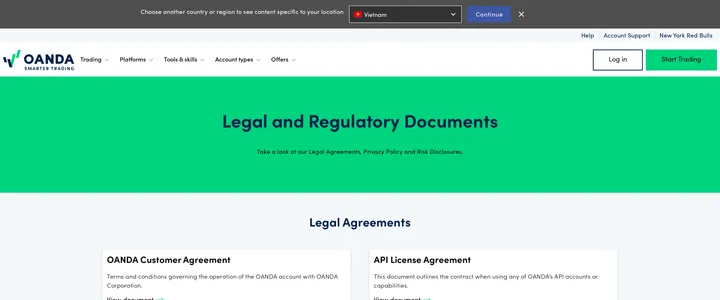
OANDA's site leads with welcome bonus banners, which we ignored deliberately since bonus terms typically carry trading volume requirements before withdrawal. What we actually went looking for was the legal documentation, and OANDA publishes its customer agreement and API licence terms openly rather than gating them behind a signup form.
An Elite Trader program offers cash rebates from $5 to $17 per million traded, but the volume needed to reach those tiers is well beyond what a retail account trading a few lots a week will hit, so we treat it as a feature for professional or semi-professional traders rather than a reason to choose OANDA at a smaller scale.
What we would still check before depositing more
A month is long enough to judge execution and support, not long enough to judge how a broker behaves during a genuine volatility spike like a surprise rate decision. OANDA publishes historical spread data going back years, and we spent an evening comparing its claimed averages against archived data from the same weeks; the two lined up closely, which is a better sign than a broker that only quotes numbers nobody can check afterward. We would still want to see how the spread widens during a Fed announcement before moving a larger balance across.
Our verdict
If the question is simply "which broker can a US resident legally use," OANDA answers it, and the NFA oversight gave us no reason for concern across a month of live trading. If the question is "which US broker is cheapest," the honest answer depends on your balance: under $10,000, Spread Only averages around a pip and a half on EUR/USD, and that is the number to compare against other US-eligible brokers rather than the Core Pricing headline most marketing pages lead with.
What we liked
- One of a small number of brokers legally accepting US retail forex clients under NFA/CFTC rules
- No minimum deposit to open an account
- Choice between TradingView, MT4 and OANDA's own web and mobile platform
- Historical spread data published openly, so claimed averages can be checked against real fills
What held it back
- Spread Only account averages 1.54 pips on EUR/USD, about 14 dollars per standard lot round trip
- Core Pricing spreads near 0.0 pips require a ten thousand dollar deposit or balance
- Only forex and a small crypto offering through a partner, no shares or bonds on the US entity
- Elite Trader rebates only apply above a volume threshold most retail traders will not reach
Specifications
- Minimum deposit
- None
- EUR/USD spread, Spread Only account
- 1.4 to 1.54 pips average
- Core Pricing spread
- From 0.0 pips on select majors, needs $10,000 balance
- Commission, Spread Only
- None, wrapped into the spread
- Regulator
- CFTC/NFA (United States)
- Platforms
- OANDA web/app, MT4, TradingView
- Elite Trader rebate
- $5 to $17 per million traded, volume tiers apply
- Assets available (US entity)
- Forex majors/minors, plus crypto via Paxos
Figures as published by OANDA Corporation at oanda.com. They vary by account type, entity and region.
This review describes what we saw on our own accounts. It is not personal financial advice.