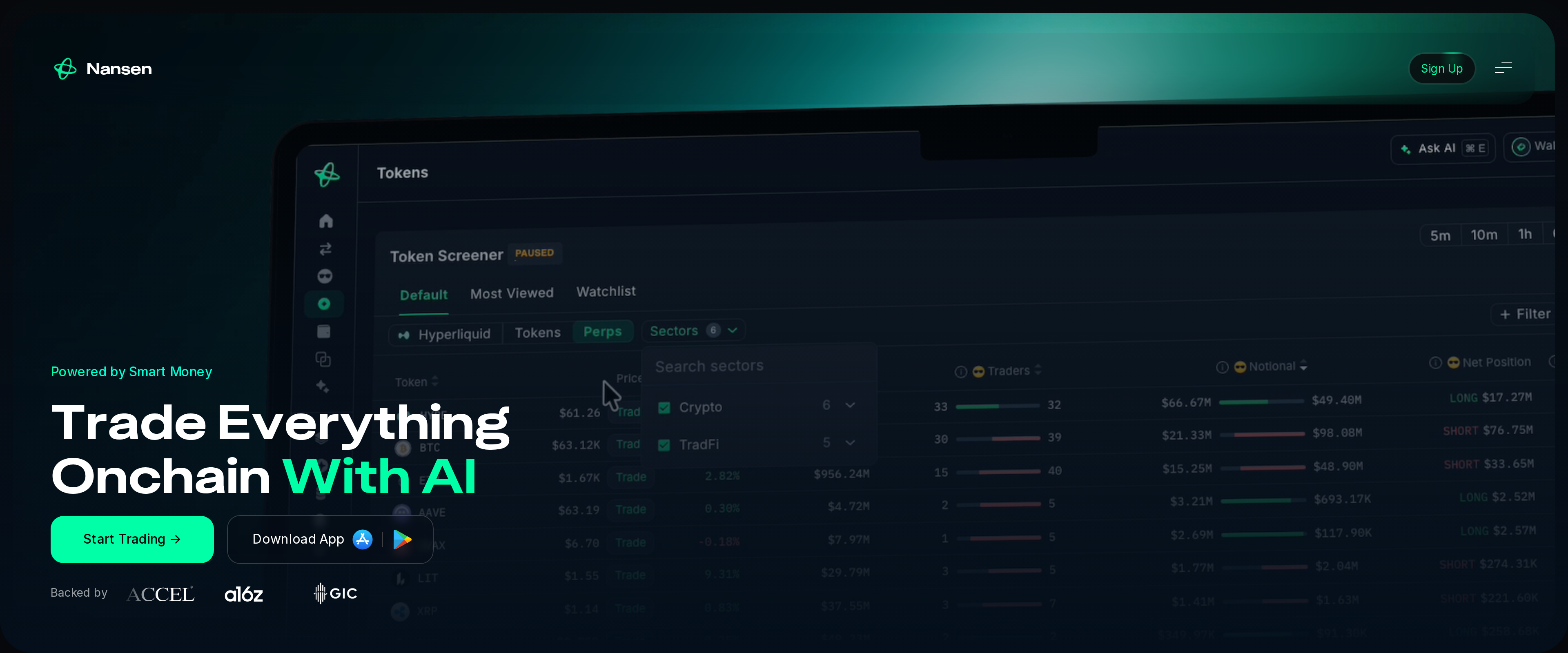
Nansen labels over 500 million wallet addresses and tags a curated set as Smart Money, then sells a $49-a-month Pro plan to see what those wallets are doing in real time. We tested the labels, the Hyperliquid and Solana tools, and asked whether following them beats a retail trader's own research.
A tool that tells you what a profitable wallet just bought sounds like a shortcut to profit. Nansen's own marketing leans into that: "surface the signal" is the literal headline on its homepage. We spent two weeks watching its labels move, followed a handful of tagged wallets through a Hyperliquid position and a Solana rotation, and tried to separate what the labels actually prove from what a reader hopes they prove.
What a label is, mechanically
Nansen has attached identity to roughly 500 million wallet addresses across more than 35 chains, according to the figures on its own API page. Most of those labels are mundane: exchange hot wallets, known funds, market makers. A smaller, curated subset earns the "Smart Money" tag, built from rule-based criteria such as historical profit and loss and holding patterns, and that subset numbers in the dozens of categories rather than thousands of individual traders. Watching what that group buys is watching a pattern, not a person, and the pattern updates only as fast as the underlying wallets trade.
The price actually got simpler, which matters more than it sounds
Nansen spent years running a confusing tier structure: a Pioneer plan around $99 a month, a Professional plan north of $999. That changed in September 2025, when the company collapsed everything into one Pro plan at $49 a month billed annually, or $69 a month billed monthly, with no feature gating above that. Older reviews comparing Nansen's cost against tools like Dune or Arkham are now describing a product that no longer exists at that price. For a reader deciding whether to subscribe today, the honest comparison is $49 against a free tier that limits depth enough to make serious tracking impractical.