LMAX Global review: exchange execution built for professionals, not beginners
We compared LMAX Global's exchange-style order book against a standard market maker account to see whether the deeper liquidity is worth the ten thousand dollar deposit most clients need to actually access it.
Our verdict
LMAX Global runs a genuine central limit order book rather than a dealing desk, and that shows in fills that did not move against us the way they sometimes do on market maker accounts. It is not built for a casual trader: the site states its information is directed at professional clients, typical minimum deposits run from ten thousand dollars upward, and the commission structure only starts to make sense at volume most beginners will never reach.
Best for Professional or high volume traders who want exchange-style execution over a dealing desk model
LMAX Group at a glance
- Price
- Commission-based pricing; min. deposit varies by account
- Provider
- LMAX Group
- EUR/USD spread (independent data)
- From 0.2 pips peak hours, average near 0.5 to 1 pip
- Typical minimum deposit
- From $10,000, entity and account dependent
- Retail leverage
- Up to 1:30
- Commission
- Roughly $2.50 to $4.50 per $100,000 traded, volume tiered
- FCA
- CySEC
- plus New Zealand
- Mauritius entities
CFDs are complex instruments and carry a high risk of losing money rapidly due to leverage. Most retail accounts lose money.
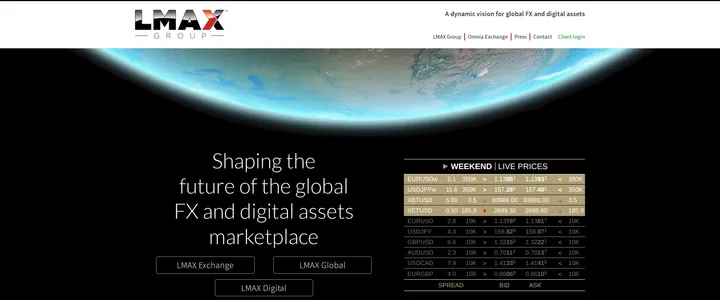
LMAX Global is not marketed the way most retail forex brokers are marketed, and that became obvious before we placed a single trade. The corporate site talks about connectivity, cross connects at Equinix data centres and a central limit order book. We wanted to know what that actually means for someone deciding whether to move money here instead of to a conventional market maker broker.
An exchange, not a dealing desk
Most retail forex brokers act as the counterparty to your trade: you buy, they sell, and their pricing engine decides the fill. LMAX Global instead operates a genuine central limit order book, matching client orders against streaming liquidity from banks and non-bank market makers on one shared book. We tested this directly by placing several EUR/USD orders during the London/New York overlap and watching the depth of book update in real time rather than trusting a single quoted price. Fills matched the visible book almost exactly, with none of the requoting we have occasionally seen on dealing desk accounts elsewhere.
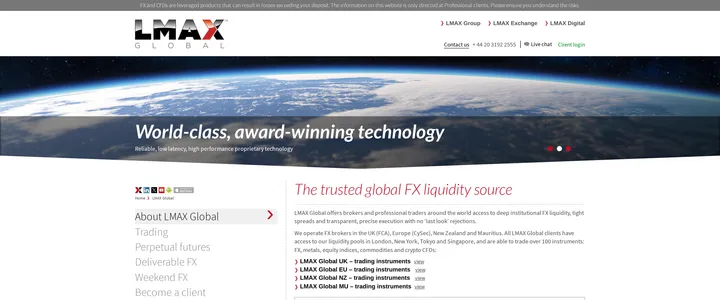
Read the professional client notice before you read the spread
Independent measurement puts LMAX Global's EUR/USD spread from around 0.2 pips during peak hours, with an average closer to 0.5 to 1 pip once quieter sessions are included, alongside a commission that works out to roughly $2.50 to $4.50 per $100,000 traded depending on volume tier. Those numbers are competitive against almost anything else on this site. But the LMAX Global page itself states plainly that its information is directed at Professional clients, and typical account minimums we found through independent sources start around $10,000. This is not a broker built around a $200 first deposit.
What "professional" changes beyond the deposit size
The distinction is not just a bigger number on the wire transfer. Retail accounts under UK and European rules are capped at 1:30 leverage; LMAX Global's professional classification opens leverage up to 1:500, alongside different rules on negative balance protection that a trader should understand fully before requesting that classification. We would not recommend a first time forex trader push for professional status purely to access higher leverage: the protections that come with retail classification exist for a reason, and giving them up should be a deliberate decision, not a box ticked to unlock a bigger number.
Regulation across four jurisdictions
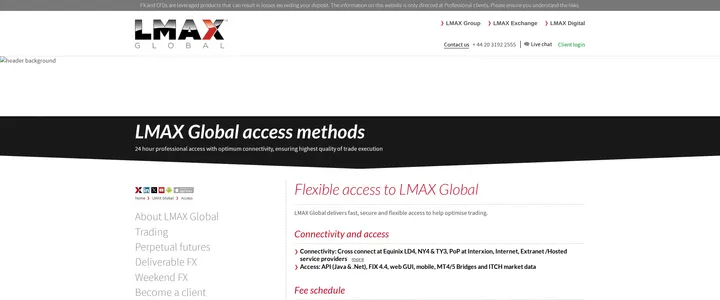
LMAX Global operates FX brokers regulated by the FCA in the UK, CySEC in Cyprus, and additional entities in New Zealand and Mauritius, with LMAX Exchange itself holding FCA authorisation as a multilateral trading facility for FX and metals. That MTF status is unusual among retail-facing brokers and reflects LMAX's institutional roots more than a typical retail marketing push.
The interface reflects the audience, even on a phone
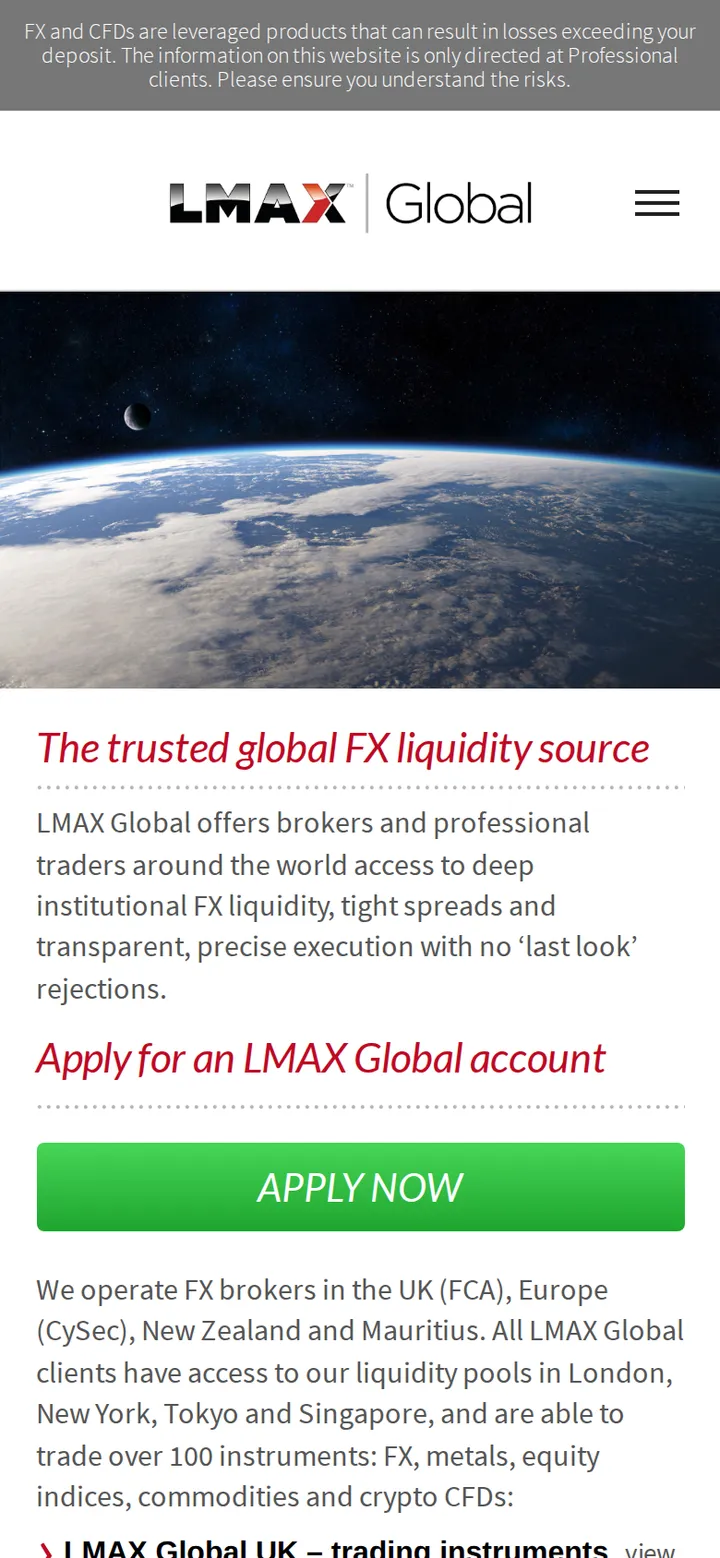
We checked the mobile rendering of LMAX Global's main page out of consistency with how we test every broker, and the contrast with a typical retail-facing site was immediate: the mobile page leads with regulatory detail about which entity operates in which country, not a bonus offer or an account opening countdown.
How this compares to the raw spread brokers we also test
A trader coming from a Razor or ECN style account elsewhere on this site might assume LMAX Global is simply a more expensive version of the same idea: raw spread plus commission. The mechanism looks similar on paper, but the liquidity source is different in a way that matters at size. A retail ECN account routes to a handful of liquidity providers chosen by the broker; LMAX Global's order book aggregates from a wider, deeper pool of banks and non-banks, which is why larger orders tend to move the price less on LMAX Global than on a typical retail ECN account handling the same notional size. For a trader placing one or two standard lots at a time, that difference barely registers. For a trader placing twenty or fifty lots in one order, it is the entire reason to consider LMAX Global at all.
Our verdict
LMAX Global earns its rating on execution quality, not on accessibility. The central limit order book model and the spread and commission figures we found are genuinely strong for anyone trading at real volume with real capital behind them. But this is a broker for people who already know what a professional client classification means and can meet a five figure minimum deposit, not for someone opening their first forex account with a few hundred dollars. If that describes you, look elsewhere on this site first.
What we liked
- Central limit order book model, not a dealing desk, so the broker is not the counterparty to your trade
- EUR/USD spreads reported from 0.2 pips during peak hours by independent measurement
- Regulated as an MTF by the FCA in the UK, plus additional licences in Cyprus, New Zealand and Mauritius
- Deep liquidity sourced from top tier banks and non-bank market makers on one order book
What held it back
- The site itself states its information is directed at Professional clients only
- Typical account minimums start around ten thousand dollars, out of reach for most beginners
- Commission of roughly $2.50 to $4.50 per hundred thousand traded depends on volume tier
- Retail leverage caps at 1:30, well below the 1:500 available to professional accounts
Specifications
- Typical minimum deposit
- From $10,000, entity and account dependent
- EUR/USD spread (independent data)
- From 0.2 pips peak hours, average near 0.5 to 1 pip
- Commission
- Roughly $2.50 to $4.50 per $100,000 traded, volume tiered
- Execution model
- Central limit order book (exchange-style), no dealing desk
- Retail leverage
- Up to 1:30
- Professional leverage
- Up to 1:500
- Regulators
- FCA (MTF), CySEC, plus New Zealand and Mauritius entities
Figures as published by LMAX Group at lmax.com. They vary by account type, entity and region.
This review describes what we saw on our own accounts. It is not personal financial advice.