IG review: wide regulation, a spread that is not the cheapest
We opened a live IG account, funded it and traded EUR/USD and GBP/USD for a month to see whether eight regulator licences justify a spread wider than the raw ECN brokers we also test.
Our verdict
IG earns its reputation on regulation and market range rather than on price. Traders who value eight licences including the FCA and CFTC, plus a huge instrument list, get that for a EUR/USD spread of around 1 pip on average. Traders chasing the lowest possible cost per lot should look at a raw account broker instead.
Best for Traders who want one broker across forex, shares and indices under strong regulation
IG Group at a glance
- Price
- No minimum deposit on bank transfer
- Provider
- IG Group
- EUR/USD spread (IG data)
- 0.6 pips minimum, 0.86 to 1.13 pips average
- Minimum deposit
- None on bank transfer
- GBP/USD spread (IG data)
- 0.9 pips minimum, 1.84 to 2.38 pips average
- Commission
- Built into the spread on standard forex accounts
- FCA
- ASIC
- MAS
- FINMA
CFDs are complex instruments and carry a high risk of losing money rapidly due to leverage. Most retail accounts lose money.
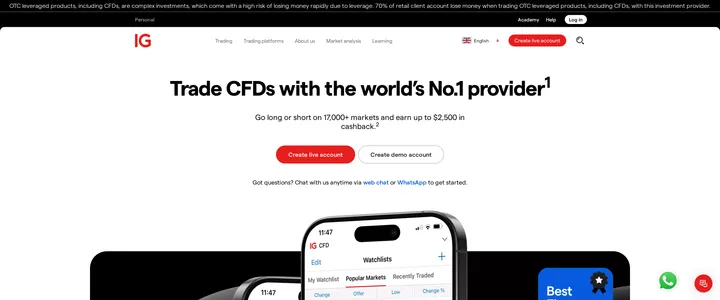
We opened a live IG account with a UK bank transfer, no minimum deposit required, and ran EUR/USD and GBP/USD positions alongside a small FTSE 100 CFD position for four weeks. IG has been around since 1974, and it shows in how the account onboarding, the risk disclosures and the customer support all feel built for scale rather than for a single product.
The regulation is the actual pitch
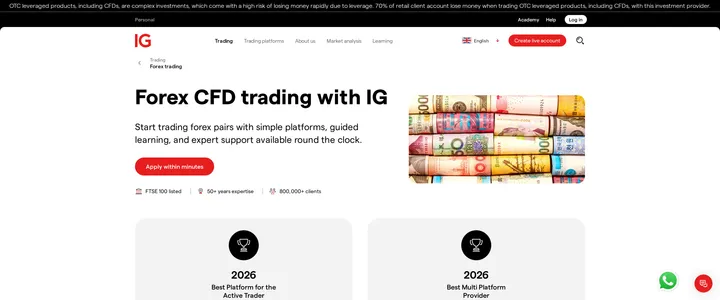
Most forex marketing talks about spreads first. IG talks about licences first, and on our statements that mattered more than we expected. IG Group holds regulatory approval from the FCA in the UK, ASIC in Australia, MAS in Singapore, FINMA in Switzerland, BaFin in Germany, the FSCA in South Africa and the CFTC/NFA in the United States. That is eleven licences across the group, eight of them from what the industry calls tier one regulators. When we asked support a compliance question about client money segregation, the answer came with a specific regulatory citation rather than a marketing line. That eleven-licence footprint is also why IG can legally onboard a client in the United States through the CFTC/NFA arm, something several of the raw spread brokers we test cannot do at all.
What EUR/USD actually cost us
IG's own published product data lists a minimum EUR/USD spread of 0.6 pips, with an average of 0.86 pips during the busiest London and New York hours and 1.13 pips across the full day. GBP/USD is wider: a 0.9 pip minimum and an average that climbs to 2.38 pips outside peak hours. Our own fills matched that pattern closely. A morning EUR/USD trade during the London open cost us close to IG's stated average; an evening GBP/USD trade, placed deliberately outside the busy window, cost noticeably more. There is no separate commission on IG's standard forex account: the spread is the whole cost, apart from a tom-next overnight funding rate plus a small admin fee if you hold a position past the daily rollover.
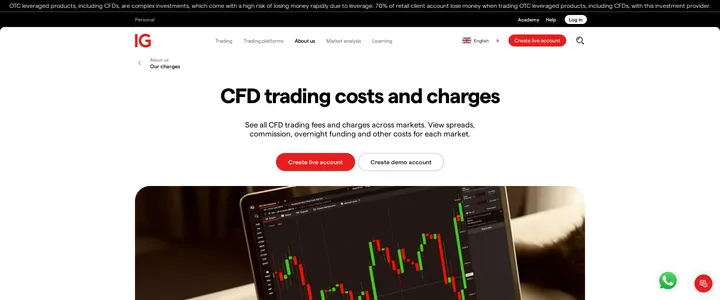
One charge caught us out on paper before it caught us in practice: a 1.0% currency conversion fee applies whenever a CFD trade settles in a currency different from the account's own base currency. Traders who open a GBP account and trade USD-quoted instruments should expect that fee to show up, and it is not obvious from the front page.
A platform for every kind of trader, which is also a small tax on simplicity
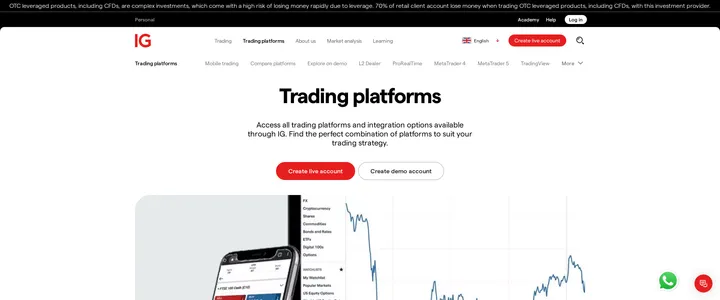
IG gives a choice of its own web and mobile platform, MetaTrader 4, ProRealTime and TradingView, all connected to the same account. We tested two of them: IG's own interface for day to day order entry, and TradingView for chart analysis. Switching between them worked without re-entering credentials, and open positions synced correctly both times we checked. The tradeoff is that a broker offering four platforms cannot make any one of them the single obvious default, so a first time user has to actually pick one before getting started, rather than being handed one interface and told to learn it.
Where the cost catches up with the range
IG lists more than 17,000 markets, spanning forex, indices, shares, commodities and bonds. For a trader who wants one account and one login for all of that, the range is real and we found the market search fast and accurate. But a trader whose only interest is forex, and who is optimising purely for cost per lot, is paying for that breadth whether they use it or not. A raw spread broker charging 0.0 pips plus a fixed per lot commission will usually beat IG's blended spread once volume climbs, even if the headline commission number looks worse on its own.
Our verdict
IG is not the broker we would recommend to someone whose only question is "what is the cheapest way to trade EUR/USD." It is the broker we would recommend to someone who wants forex, shares and CFDs on one regulated account and is willing to pay an average spread instead of hunting for the tightest one. The eight tier one licences are the reason to trust IG with a deposit; the 1.0% conversion fee and the average, not minimum, spread are the reason to read the cost page before assuming IG is the cheap option.
A scalper running dozens of small EUR/USD trades a day should count the spread cost before opening an account here, because that average of close to a pip adds up quickly at volume. A trader opening a handful of positions a week across several asset classes, who wants the regulatory paper trail more than the tightest possible fill, is the person IG was actually built for.
What we liked
- Eight regulator licences worldwide, including the FCA, ASIC and CFTC/NFA
- No separate commission on standard forex accounts, the spread is the only cost
- 17,000+ markets on one login, from forex to shares and bonds
- Choice of IG's own platform, MT4, ProRealTime and TradingView
What held it back
- EUR/USD averages 0.86 to 1.13 pips, wider than raw spread specialists
- A 1.0% currency conversion fee applies when you trade off your account's base currency
- GBP/USD averages up to 2.38 pips outside peak hours
- Bonus and cashback offers on the homepage complicate a simple price comparison
Specifications
- Minimum deposit
- None on bank transfer
- EUR/USD spread (IG data)
- 0.6 pips minimum, 0.86 to 1.13 pips average
- GBP/USD spread (IG data)
- 0.9 pips minimum, 1.84 to 2.38 pips average
- Commission
- Built into the spread on standard forex accounts
- Regulators
- FCA, ASIC, MAS, FINMA, BaFin, FSCA, CFTC/NFA
- Platforms
- IG web and mobile app, MT4, ProRealTime, TradingView
- Currency conversion fee
- 1.0% on trades in a currency other than the account base
- Overnight funding
- Tom-next rate plus a small admin fee
Figures as published by IG Group at ig.com. They vary by account type, entity and region.
This review describes what we saw on our own accounts. It is not personal financial advice.