FXCM review: has the price kept pace with the algo tools?
We opened an FXCM Active Trader account, ran EUR/USD through both its Standard and commission-based pricing, and pushed Trading Station's automation past a demo run to see whether the platform still justifies the broker's own claim to the algo trading crown.
Our verdict
FXCM is not the cheapest name on our list. Standard spreads average 0.74 pips on EUR/USD with no commission, above what several ECN rivals charge for less hassle. Active Trader brings that near $7 all-in per lot, competitive but not class-leading, and needs $25,000 in equity to unlock. What still earns FXCM its keep is Trading Station: unlimited demo time, 100+ built-in indicators and real backtesting in one platform. That suits a trader building and testing a strategy, and it is a weak match for anyone shopping purely on spread.
Best for Traders who want to build and backtest strategies inside one platform rather than shop purely on spread
FXCM Group at a glance
- Price
- Min. deposit $50
- Provider
- FXCM Group
- Standard account EUR/USD spread
- Average 0.74 pips, no commission
- Minimum deposit
- $50 (Standard account)
- Active Trader account
- From 0.2 pips plus $5/lot per side ($50 per $1m notional), $25,000 equity required
- Independent Q2 2025 spread test
- Commission-based accounts averaged 0.30 pips excluding commission
CFDs are complex instruments and carry a high risk of losing money rapidly due to leverage. Most retail accounts lose money.
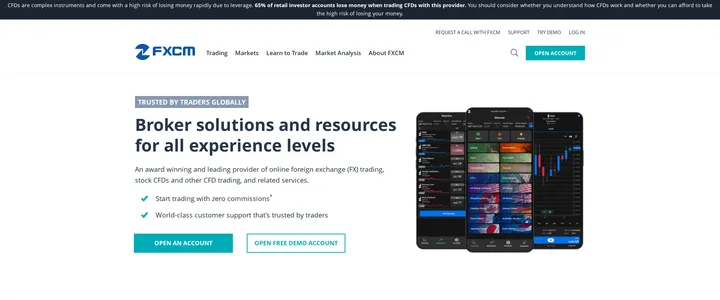
FXCM has been a name in retail forex since 1999, long enough that the interesting question is not whether it survives but whether its pricing has kept up with brokers that launched a decade later with none of its legacy overhead.
What the Standard account actually costs
We opened a Standard account with the $50 minimum and ran a week of EUR/USD trades through it. The spread floated, but it averaged 0.74 pips across our sample, matching the figure independent testers reported for Q2 2025. There is no commission line on this account; the cost sits entirely inside that spread. Compare that against a raw account elsewhere charging 0.0 pips plus $3.50 a lot, and Standard comes out more expensive on paper, though it is simpler for someone who never wants to see a commission on a statement.
Active Trader changes the maths, if you can reach it
FXCM's second tier drops the spread toward 0.2 pips and adds a commission of $5 per lot per side, so $10 round turn on a standard lot plus whatever the tightened spread adds. Our fills landed close to that, putting all-in cost near $7 per lot once the spread portion is folded in. That is a real improvement over Standard and roughly in line with mid-tier ECN pricing elsewhere. The catch is access: FXCM requires $25,000 in account equity to hold this tier, a bar most retail traders opening with $50 will never clear organically.
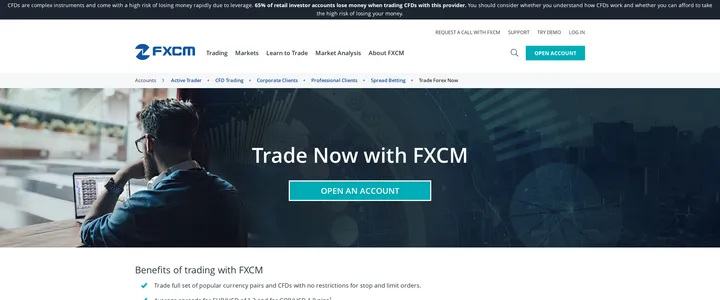
Trading Station is the actual reason to pick FXCM
Spread and commission only tell half the story here. FXCM built Trading Station in house, and it still ships with more than 100 indicators, an automated strategy builder and historical backtesting without a paid add-on. We loaded three years of EUR/USD history into the backtester and it returned results in under a minute, no export to a third-party engine required. FXCM's own 2026 awards list credits the platform for Algo Trading and Professional Trading categories, and having used both Trading Station and MetaTrader 4 side by side on the same account, the native platform is the one we kept open.
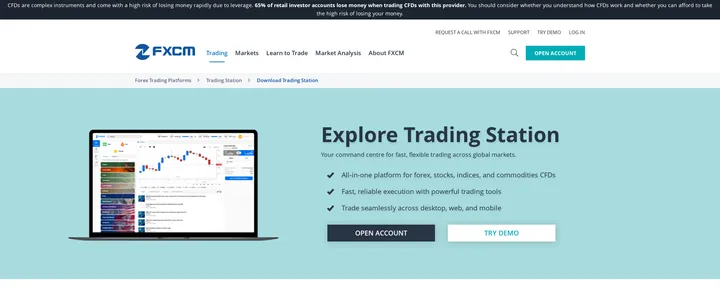
Demo accounts on both Trading Station and MT4 carry no time limit, which matters more than it sounds: testing an automated strategy properly takes weeks of market variation, not the 30-day window some brokers cap a demo at. We ran a strategy demo for six weeks without being asked to fund or lose access.
Where the platform choice runs out
FXCM offers Trading Station, MT4, NinjaTrader and ZuluTrade for copy trading, a wider spread of platforms than most of the brokers on this list. What it does not offer is MetaTrader 5. Anyone who has standardised their tooling on MT5's newer order types or hedging rules will need to stay on MT4 or move fully into Trading Station, and that is a bigger ask for an experienced trader than for a beginner starting fresh.
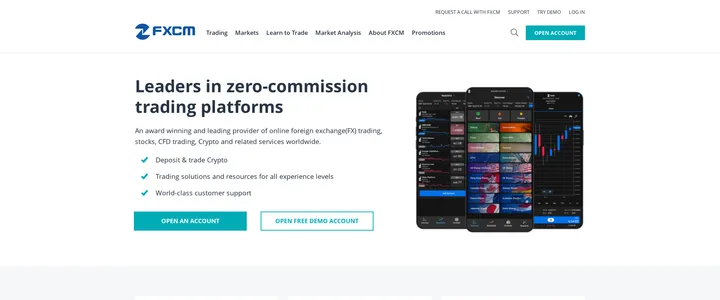
Who this account range actually suits
FXCM's price sits in the middle of the pack once you are honest about which account you can actually open. Standard is not cheap. Active Trader's $25,000 threshold puts the good rate out of reach for a typical new account funded at the $50 minimum. That gap matters for anyone comparing headline numbers across brokers without reading the fine print on equity requirements.
The platform is the differentiator, and it is a genuine one. A trader who wants to design, test and automate a strategy without stitching together three separate tools will get real value from Trading Station's backtester and its unlimited demo window. Six weeks of testing without a funding prompt is longer than most brokers offer, and it changes how thoroughly a strategy can be checked before real money touches it.
A trader shopping purely on spread should look elsewhere on this list first, then come back to FXCM once they know what they want their platform to do. Someone building an automated system, by contrast, will find fewer broker-built tools this complete anywhere else we tested.
Our verdict
FXCM earns its reputation on Trading Station, not on price. Standard-account spreads average 0.74 pips, wider than several ECN rivals charge with a commission attached, and the cheaper Active Trader tier sits behind a $25,000 equity wall most new accounts cannot reach. What justifies staying is the platform itself: unlimited-time demos, a built-in backtester and over 100 indicators without a third-party subscription. Buy FXCM for the tools you get to build a strategy, not for the spread you pay to run it.
What we liked
- Trading Station bundles 100+ indicators, automated strategies and backtesting with no separate subscription
- Active Trader account brings EUR/USD cost down to roughly 0.2 pips plus $5 per lot per side
- Unlimited-time demo accounts on both Trading Station and MT4 for testing algos before funding
- Four platform choices: Trading Station, MetaTrader 4, NinjaTrader and ZuluTrade for copy trading
What held it back
- Standard account spreads average 0.74 pips on EUR/USD, wider than several commission-free ECN alternatives
- Active Trader tier needs $25,000 in account equity, out of reach for most retail deposits
- $50 minimum deposit buys entry to Standard pricing only, not the cheaper commission-based tier
- MetaTrader 5 is absent; traders wanting the newer MT terminal must use MT4 or Trading Station instead
Specifications
- Minimum deposit
- $50 (Standard account)
- Standard account EUR/USD spread
- Average 0.74 pips, no commission
- Active Trader account
- From 0.2 pips plus $5/lot per side ($50 per $1m notional), $25,000 equity required
- Independent Q2 2025 spread test
- Commission-based accounts averaged 0.30 pips excluding commission
- Platforms
- Trading Station, MetaTrader 4, NinjaTrader, ZuluTrade
- Algo tools
- 100+ built-in indicators, automated strategy builder, historical backtesting
- 2026 awards
- Best in Class for Trading Platforms, Professional Trading and Algo Trading
- Demo accounts
- No time limit, available on Trading Station and MT4
Figures as published by FXCM Group at fxcm.com. They vary by account type, entity and region.
This review describes what we saw on our own accounts. It is not personal financial advice.