Dukascopy review: is learning JForex worth it for a Swiss bank account?
Dukascopy runs its own SWFX marketplace and its own Java-based JForex platform instead of leaning on MetaTrader like most rivals. We funded a live account, worked through JForex's learning curve and priced its volume-based commission against a flat-fee MT4 broker to see whether the Swiss bank wrapper earns its keep.
Our verdict
Dukascopy's SWFX marketplace is genuinely institutional-grade, and being regulated as an actual Swiss bank under FINMA carries weight that a standard CFD broker licence does not. JForex takes real time to learn next to a MetaTrader interface most traders already know, and the commission structure rewards size: a small account pays more per lot than a trader with a six-figure balance, which makes Dukascopy a better fit for a trader planning to grow into that discount than one testing the water at $100.
Best for Traders who want genuine Swiss bank custody and are willing to learn JForex rather than default to MetaTrader
Dukascopy Bank at a glance
- Price
- Min. deposit $100 (live account)
- Provider
- Dukascopy Bank
- Spread (EUR/USD)
- From 0.1 pips on SWFX during liquid sessions
- Minimum deposit (live account)
- $100
- Leverage
- Up to 1:200, jurisdiction dependent
- Minimum deposit (Dukascopy Bank SA)
- $5,000
- FINMA
- JFSA
CFDs are complex instruments and carry a high risk of losing money rapidly due to leverage. Most retail accounts lose money.
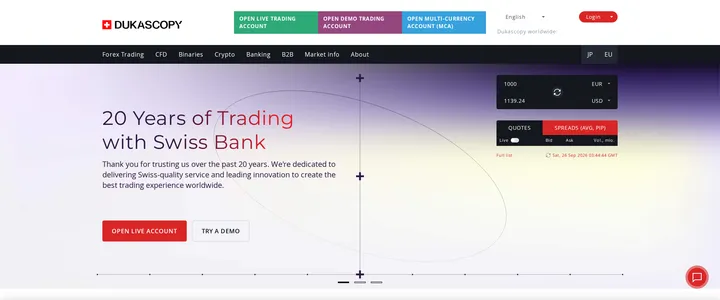
Most retail forex brokers are companies licensed to offer CFDs. Dukascopy is a bank, supervised by FINMA the same way a Swiss savings institution would be, and that distinction shapes almost everything else about how it operates. It also runs its own trading platform, JForex, instead of defaulting to MetaTrader like nearly every broker we cover in this category. We opened a live account, spent real time inside JForex and worked out whether the Swiss bank wrapper and the unfamiliar platform are worth the adjustment.
A twentieth anniversary and a claim that is unusually literal
"Swiss Bank" on Dukascopy's homepage is not a marketing flourish; the entity is licensed and supervised by FINMA as an actual bank, a materially higher regulatory bar than the CFD-broker licences most competitors hold. That status brings genuine advantages in custody and counterparty risk, along with the more conservative culture that comes with banking regulation, including the inactivity fee and documentation requirements a pure CFD broker would be less likely to impose.
SWFX: an ECN marketplace, not a dealing desk
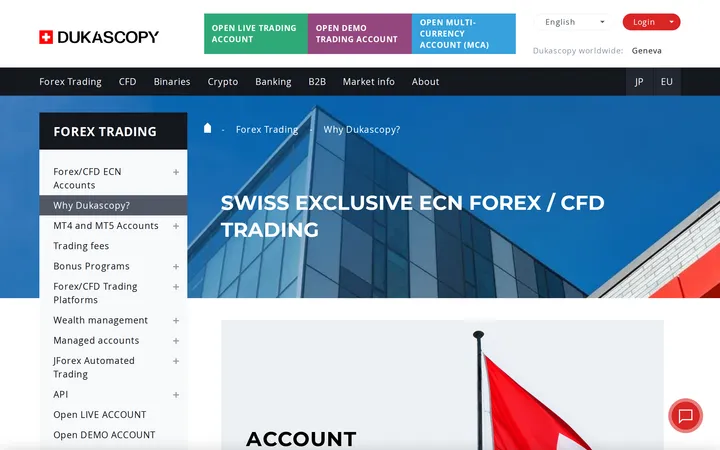
SWFX pools pricing from multiple banks and liquidity providers into one order book, and our EUR/USD fills during liquid sessions landed close to the advertised 0.1-pip floor. The commission sits on top of that spread and is where Dukascopy's pricing gets more complicated than a flat per-lot fee: the rate depends on net deposit, equity and 30-day volume, with the lowest of the three applied. A smaller account starting out pays closer to $7 round turn per lot, while an account with substantial equity or volume can work that down meaningfully. That structure rewards a trader planning to grow into a larger balance more than one testing a $100 deposit for a month.
JForex: powerful, and not something you already know
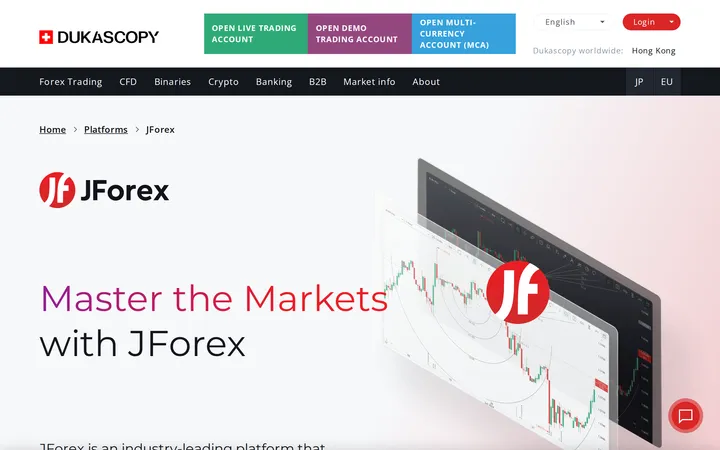
JForex is a genuinely capable platform, with over 250 built-in indicators, native Java-based algorithmic strategy support and separate net-position and hedging modes that MetaTrader does not offer in the same form. It is also unfamiliar to almost every trader arriving from another broker, since MT4 and MT5 dominate the industry and most traders' existing expert advisors and custom indicators are built for those platforms specifically. Dukascopy does support MT4 and MT5 as an alternative, but running MetaTrader here adds a $5-per-million surcharge on top of the standard commission, so the platform that showcases Dukascopy's actual strength is also the more expensive one to avoid learning.
The fee schedule rewards reading it closely
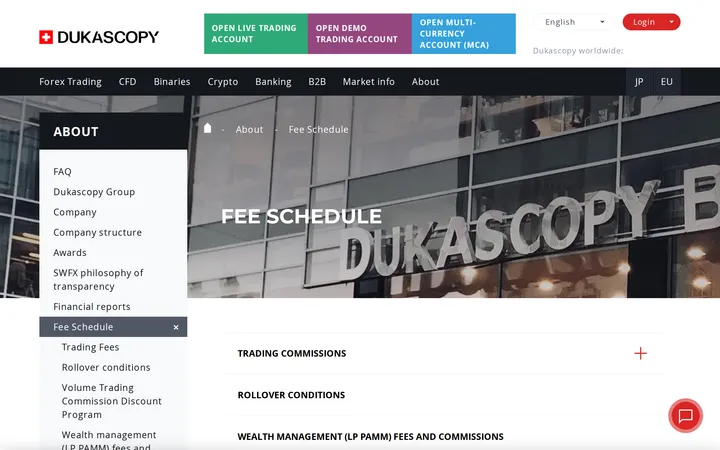
Beyond trading commission, Dukascopy charges an inactivity fee of up to CHF 100 after 180 consecutive days without a trade, a policy more common among banks than CFD brokers and one that can catch an occasional trader off guard if they open an account and step away for a season. Withdrawal fees also vary by method, and bank wire withdrawals carry a noticeably higher cost than an e-wallet payout. None of this is hidden, Dukascopy publishes the fee schedule openly, but it takes more reading than a broker with a single flat commission number.
Opening the account felt like opening a bank account
Verification asked for more documentation than a typical CFD broker, including proof of address dated within three months and a clearer source-of-funds declaration for larger deposits, consistent with the banking-level compliance FINMA requires. That process took longer than the same step at a standard offshore broker, closer to two business days than the same-day approval we have seen elsewhere. Once approved, funding by bank transfer reflected in the account within a day, and a subsequent withdrawal request back to the same bank followed the published timeline without any unexplained delay.
Who should actually open this account
A trader moving meaningful capital who wants the counterparty protection of an actual bank, and who is willing to invest a few sessions learning JForex properly, gets real value from Dukascopy that a standard CFD broker cannot match on the regulatory side alone. A trader who wants to deposit $100, trade casually through familiar MetaTrader charts and withdraw a few weeks later will find the inactivity fee, the MT4 surcharge and the higher smaller-account commission working against exactly that use case. Dukascopy rewards commitment more than it rewards curiosity.
Our verdict
Dukascopy earns its Swiss bank framing rather than borrowing the phrase for marketing, and SWFX delivers genuinely tight, transparent pricing once a trader has enough volume or equity to benefit from the lower commission tiers. JForex is worth learning for the strategy and analysis tools it offers, but a trader who only wants familiar MetaTrader charts will pay a small surcharge for that comfort. This broker suits someone planning to hold a meaningful balance here for the long term more than someone opening $100 to try it for a month.
What we liked
- Regulated by FINMA as an actual Swiss bank, not just a CFD broker licence
- SWFX ECN marketplace aggregates pricing from multiple banks and liquidity providers
- JForex includes over 250 built-in indicators and native algorithmic strategy support
- Commission scales down as net deposit, equity or volume rises, rewarding larger accounts
What held it back
- JForex has a steeper learning curve than MT4 or MT5 for a trader switching from those platforms
- Commission starts near $7 round turn per lot for smaller accounts before volume discounts apply
- Inactivity fee up to CHF 100 applies after 180 days without a trade
- MT4 trading carries an extra $5-per-million surcharge on top of standard commission
Specifications
- Minimum deposit (live account)
- $100
- Minimum deposit (Dukascopy Bank SA)
- $5,000
- Spread (EUR/USD)
- From 0.1 pips on SWFX during liquid sessions
- Commission
- Volume-based, roughly $5-25 per $1 million traded, scaling with net deposit/equity
- Platforms
- JForex 4 (desktop, web, mobile), MT4, MT5
- Regulator
- FINMA (Switzerland), JFSA (Japan)
- Leverage
- Up to 1:200, jurisdiction dependent
- Inactivity fee
- Up to CHF 100 after 180 days without a trade
Figures as published by Dukascopy Bank at dukascopy.com. They vary by account type, entity and region.
This review describes what we saw on our own accounts. It is not personal financial advice.