Darwinex review: a fairer split than copy trading, at a real cost
We funded a Darwinex trading account with $500, ran EUR/USD to see the raw pricing, then traced exactly where a DARWIN investor's money goes: the 20% performance fee, the 1.2% management fee, and the $11.3 million Darwinex says it has already paid out to strategy providers.
Our verdict
Darwinex solves the part of copy trading that always felt lopsided: a DARWIN provider earns 15% of the profit their strategy makes for investors, with only 5% going to Darwinex, rather than a copy-trading platform quietly taking a spread markup nobody sees. Investors still pay real money for it, a 20% high-water-mark performance fee plus a 1.2% annual management fee on invested equity, and $569.80 million in third-party capital says enough people accept that price. The FX account underneath is competitively priced on its own; the DARWIN layer on top is where this broker actually earns its reputation.
Best for Verified traders wanting fair pay, and investors wanting audited strategy exposure
Tradeslide Trading Tech at a glance
- Price
- Min. deposit $500; $2.50/lot per side on FX
- Provider
- Tradeslide Trading Tech
- FX spread and commission
- From 0.0 pips + ~$2.50/lot per side
- Minimum deposit (trading account)
- $500, then $100 minimum
- DARWIN performance fee
- 20% total (15% provider, 5% Darwinex), high-water mark
- DARWIN management fee
- 1.2% per year on invested equity
- FCA
- CNMV
- FSA
CFDs are complex instruments and carry a high risk of losing money rapidly due to leverage. Most retail accounts lose money.
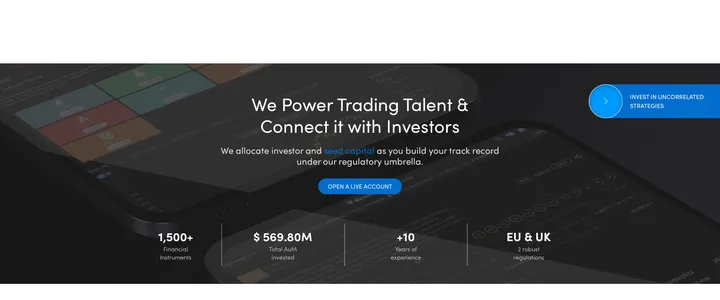
Copy trading has an arithmetic problem most platforms never explain: the person whose strategy actually makes the money often earns less from a follower's profit than the platform hosting the feed does. Darwinex was built to fix that specific imbalance, and we spent our test tracing whether the fix holds up once real fees are attached to it.
Opening the trading account underneath it all
Before any DARWIN exists, a trader needs a funded Darwinex trading account, $500 to open and $100 for anything after that. We ran EUR/USD through it and saw pricing from 0.0 pips plus a commission close to $2.50 per lot per side, in line with what Darwinex advertises and competitive with other ECN-style accounts on this site. This account is also what generates the verified track record that later becomes a DARWIN, so the quality of fills here is not incidental. It is the data every future investor will judge the strategy on.
How a DARWIN turns a track record into an asset
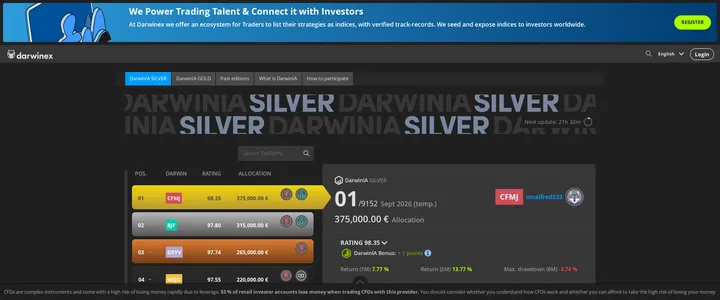
Once a trader has built enough history, Darwinex converts the strategy into a DARWIN, a risk-normalized index that investors can buy into directly, separate from the trader's own account and balance. DarwinIA, Darwinex's seeding programme, ranks these strategies and allocates the company's own capital to the strongest ones based on metrics like drawdown rather than raw return; one DARWIN we looked at showed a six-month maximum drawdown of just 3.74%, a number investors can check before committing rather than take on faith.
Where the money actually goes
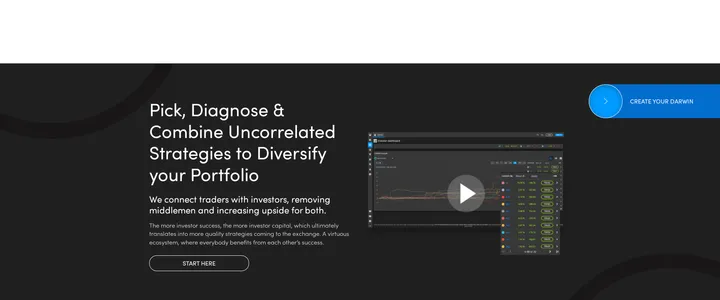
This is the part most copy-trading platforms bury. Darwinex charges investors a 20% performance fee on profit, calculated quarterly on a high-water-mark basis so a trader cannot get paid twice for the same gain after a drawdown. Of that 20%, 15 percentage points go to the DARWIN provider and 5 to Darwinex itself, a three-to-one split in the trader's favor that is the opposite of how most copy-trading arrangements are structured. Investors also pay a 1.2% annual management fee on invested equity, charged in small daily increments rather than as one lump sum. Minimum investment per DARWIN sits at 200 units of the investor's wallet currency, low enough to test a strategy with a genuinely small stake before scaling up.
Proof the split actually pays out
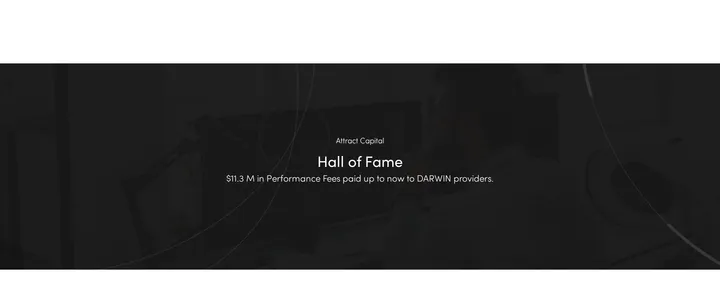
Darwinex publishes a running total of what it has paid DARWIN providers, and at the time of our test that figure stood at $11.3 million. That number is worth more than any marketing claim about fairness, because it is a historical payout figure a prospective strategy provider can check rather than a projection. Total assets under management across all DARWINs sat at $569.80 million in the same snapshot, concentrated, as with most platforms like this, in a relatively small number of top-ranked strategies rather than spread evenly across the whole roster.
Regulation and where it gets thinner
Darwinex Ltd is authorised by the FCA in the UK, with a MiFID passport covering the EU through additional CNMV registration in Spain, and UK clients get FSCS protection up to £85,000 on top of segregated funds. A separate Seychelles entity, regulated by the FSA, serves clients outside those regions under a materially lighter rulebook. Anyone signing up should confirm which entity their own account sits under before assuming the FCA protections apply.
What a DARWIN cannot promise
Risk normalization smooths a strategy's volatility so investors can compare very different trading styles on similar terms, but it also means the DARWIN an investor buys is a mathematical transformation of the trader's real account, not a mirror of it. A trader who suddenly changes position sizing on their live account, deliberately or in a moment of panic, can produce a DARWIN track record that behaves differently from what earlier investors signed up for. Darwinex publishes the metrics that let an investor watch for that shift, drawdown, correlation, leverage used, but reading them is the investor's job, not something the platform does automatically on their behalf.
Who this actually suits
A trader with a genuine, provable track record gets paid more fairly here than on almost any copy-trading platform we have tested, and the DARWIN structure turns that record into something a stranger can invest in without ever seeing the trader's raw account. An investor gets a transparent fee, not a hidden spread markup, but 20% of profit plus 1.2% of equity every year is a real cost that only pays off if the DARWIN they pick keeps performing.
What we liked
- DARWIN providers keep 15% of investor profit, versus 5% to Darwinex
- $11.3 million paid out to DARWIN providers to date, a public, auditable figure
- FX account prices from 0.0 pips plus roughly $2.50 per lot per side
- FCA (UK) and CNMV (Spain) oversight with FSCS protection up to £85,000
What held it back
- Investors pay a 20% high-water-mark performance fee on top of a 1.2% annual management fee
- $569.80 million in assets under management is concentrated in a small number of top DARWINs
- Some clients are onboarded under the Seychelles entity with materially less protection
- A DARWIN's risk-normalized track record can still diverge from the provider's live account
Specifications
- Minimum deposit (trading account)
- $500, then $100 minimum
- FX spread and commission
- From 0.0 pips + ~$2.50/lot per side
- DARWIN performance fee
- 20% total (15% provider, 5% Darwinex), high-water mark
- DARWIN management fee
- 1.2% per year on invested equity
- Minimum DARWIN investment
- 200 units of wallet currency (max 100,000)
- Assets under management
- $569.80 million (September 2026)
- Paid to DARWIN providers to date
- $11.3 million
- Regulators
- FCA (UK), CNMV (Spain), FSA (Seychelles)
Figures as published by Tradeslide Trading Tech at darwinex.com. They vary by account type, entity and region.
This review describes what we saw on our own accounts. It is not personal financial advice.