Crypto ExchangesReview
Bybit Review: A $1.5 Billion Hack Later, Is It Still Safe to Trade?
North Korea's Lazarus Group stole $1.5 billion from a Bybit cold wallet in February 2025, the largest crypto theft on record. Bybit covered every dollar itself. We checked its fees and its proof-of-reserves audits to see if that trust is earned.
Our verdict
Bybit lost $1.5 billion to a wallet-signing exploit in February 2025 and made every affected user whole within days, funded by bridge loans and its own balance sheet rather than user funds. Its monthly Hacken-audited proof of reserves has stayed at or above 100 percent since. That record, plus 0.1 percent spot fees and 0.055 percent taker fees on USDT perpetuals, makes it a defensible pick for derivatives trading, but the hack itself is a reminder that even a top-three exchange by volume can lose a cold wallet to a convincingly faked signing screen.
Best for: Active derivatives traders who want deep USDT perpetual liquidity and accept centralized custody risk
- Price
- Free account; trading fees apply
- Made by
- Bybit
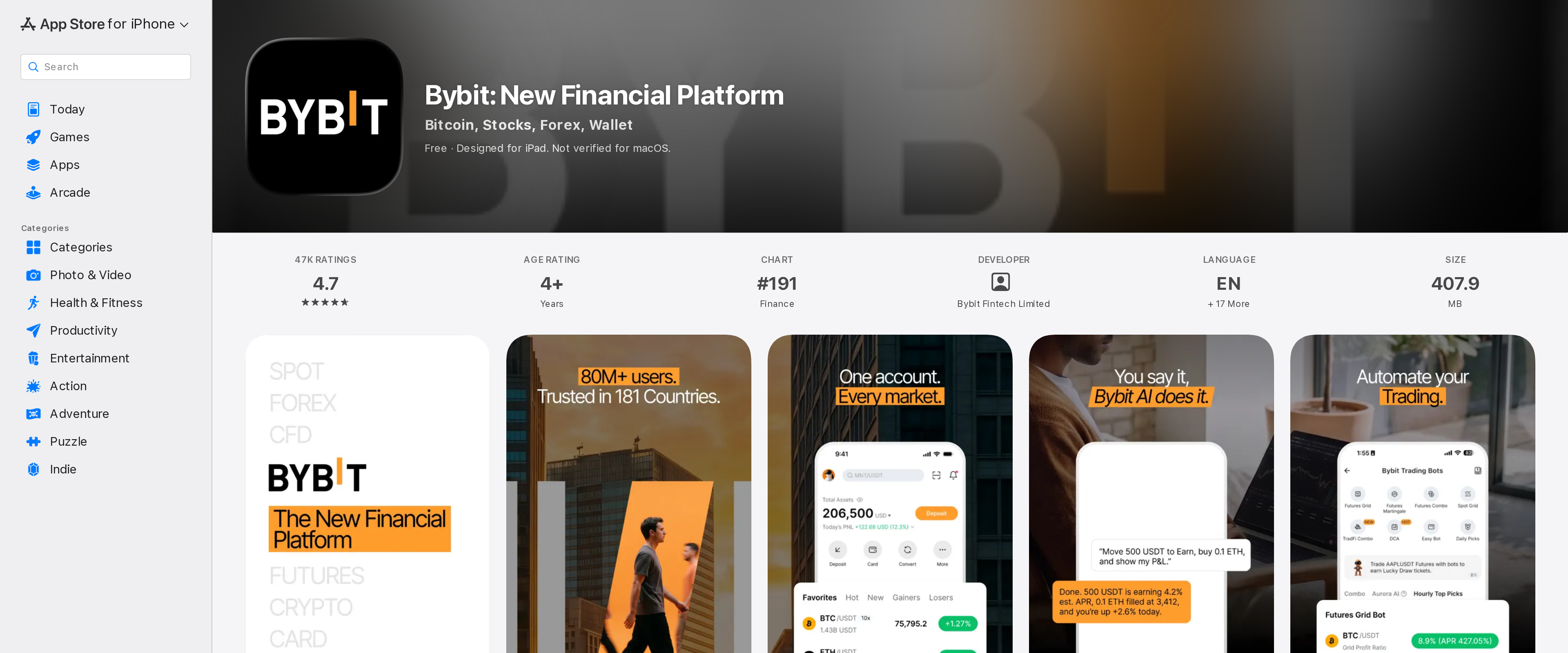
What we liked
- Covered the entire $1.5 billion February 2025 loss itself; no user lost funds
- Monthly proof-of-reserves audits from Hacken have shown 100%+ coverage since
- Spot fees of 0.1% and derivatives taker fees of 0.055% undercut several rivals
- Deep liquidity across USDT perpetuals, USDC perpetuals, inverse contracts and options
What held it back
- The 2025 hack happened because signers approved a spoofed transaction interface, a process risk, not just a code bug
- $400M+ insurance fund covers derivatives liquidations, not a repeat custody breach
- Crypto-to-fiat pairs carry a separate, higher fee schedule up to 0.20% taker
- Not licensed to serve US customers directly
Bybit is the exchange that lost $1.5 billion in a single transaction and kept its doors open the same week. That fact alone should shape how anyone reads the rest of this review: the fees are competitive and the liquidity is real, but the story starts with the largest crypto theft ever recorded, and what Bybit did next is most of why it is still worth discussing here.
What actually happened in February 2025
Attackers linked to North Korea's Lazarus Group compromised a developer's machine connected to the Gnosis Safe multisig wallet Bybit used for cold storage. They injected malicious code into the signing interface itself, so when Bybit's own signers approved what looked like a routine transfer, the screen showed one destination while the underlying transaction sent roughly $1.5 billion in ETH somewhere else entirely. Nothing about Bybit's servers or hot wallets was breached directly; the exploit targeted the human approval step at the exact moment it should have been safest.
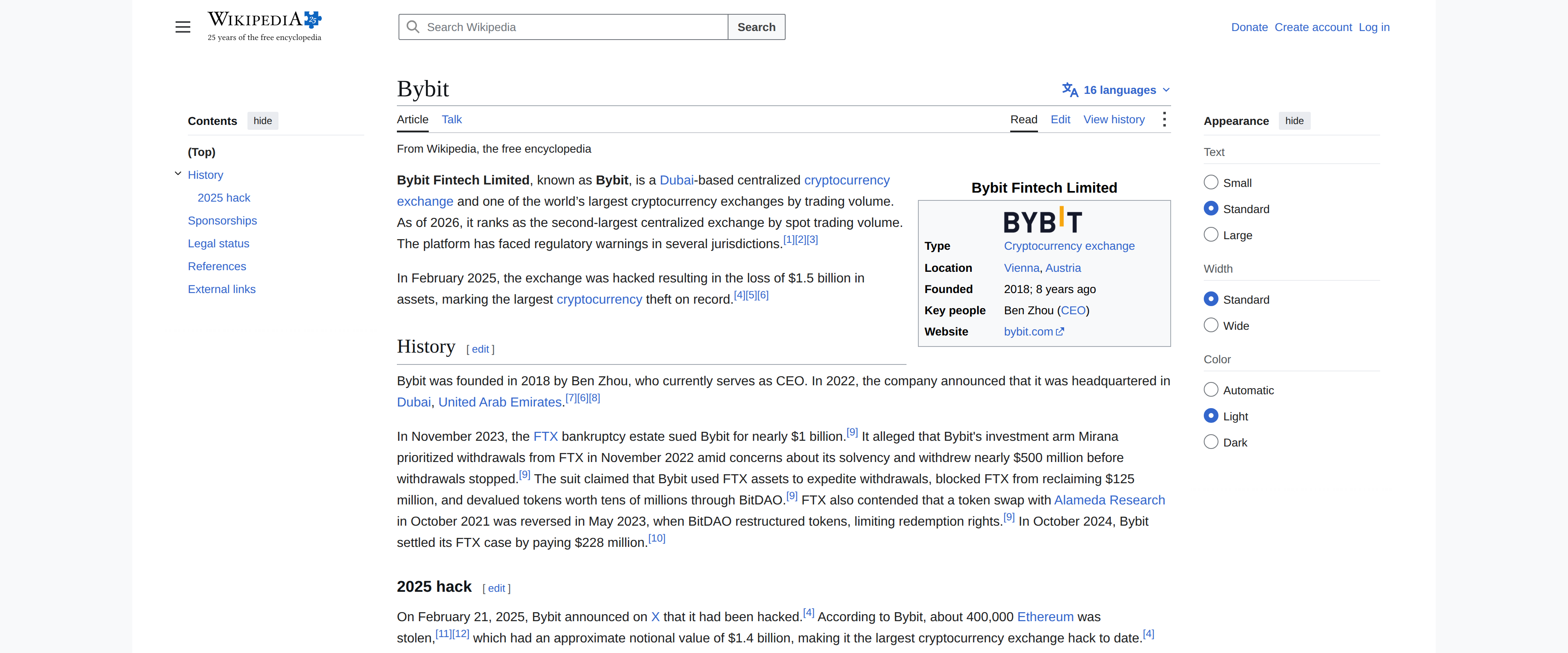
Making users whole, fast
Within 72 hours, Bybit had closed the entire ETH shortfall through bridge loans, OTC purchases and support from partners including Galaxy Digital, FalconX and Wintermute, according to reporting at the time. Deposits, withdrawals and trading kept running throughout, and no customer lost funds because Bybit absorbed the loss on its own balance sheet rather than passing it on. A recovery bounty program offering up to 10 percent of any traced funds has since helped investigators follow the stolen assets through mixers and cross-chain bridges.
Checking the receipts instead of taking their word for it
Every exchange says it holds enough in reserve. Bybit has published monthly proof-of-reserves reports audited by Hacken since mid-2024, and its 31st snapshot in February 2026 reported reserve ratios at or above 100 percent across its major tracked assets. CoinMarketCap's own exchange page pulls the same figures directly.
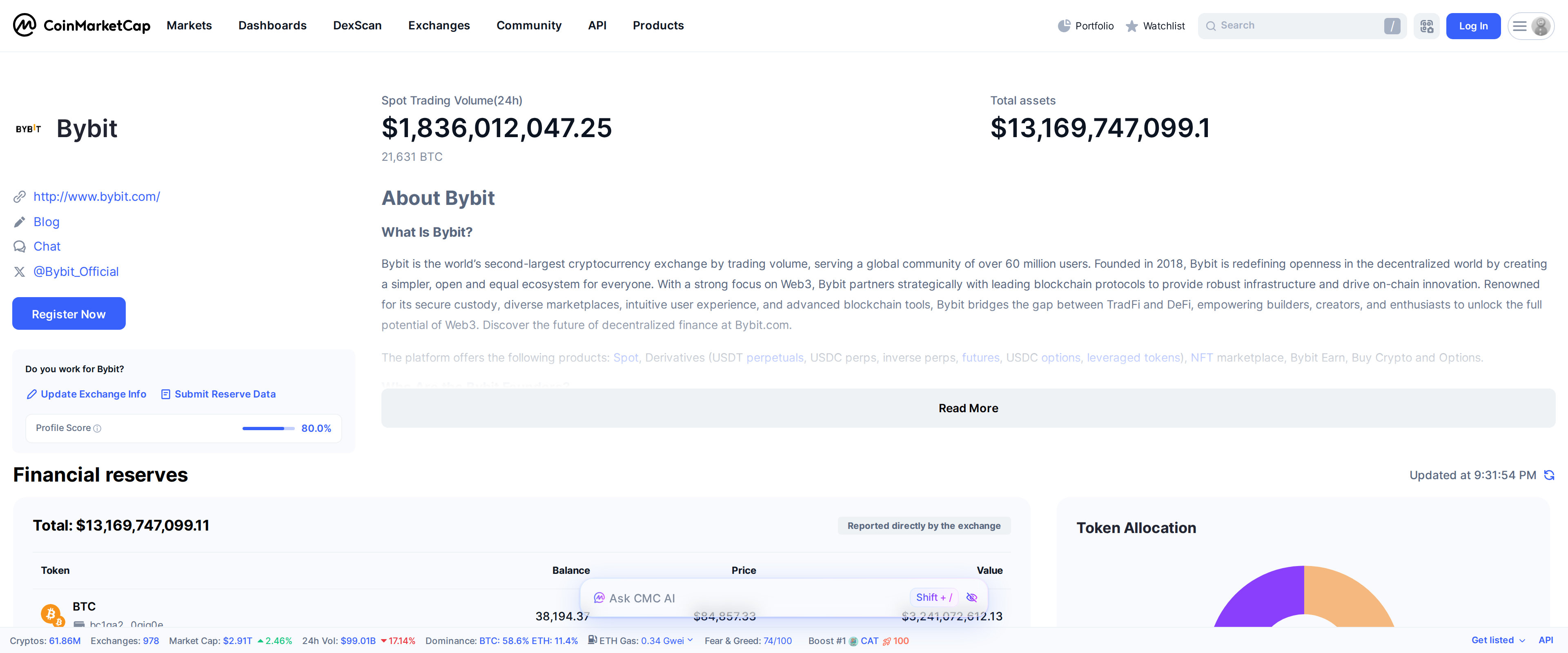
Users can run their own Merkle-tree check against their account balance rather than trust a PDF, which is a meaningfully stronger claim than most exchanges make. None of that undoes the hack, but it is the kind of transparency an exchange only adopts once it has had to.
Specifications
- Founded
- 2018, headquartered in Dubai
- Users
- Over 60 million reported globally
- Spot fee
- 0.1% maker / 0.1% taker (crypto pairs)
- USDT perpetual fee
- 0.02% maker / 0.055% taker
- Options fee
- 0.02% maker / 0.03% taker
- February 2025 loss
- $1.5 billion from a cold wallet, fully covered by Bybit
- Proof of reserves
- Monthly audits by Hacken, Merkle-tree verifiable by users
- Insurance fund
- $400M+, covers derivatives liquidation shortfalls
- Products
- Spot, derivatives, options, NFT marketplace, Earn, Bybit Card