Market Data and ResearchReview
Arkham review: free whale tracking that beats paid alternatives
We spent a week following the wallets behind crypto headlines through Arkham's entity labels and alerts, at no cost, to see whether a free tool can really replace what Nansen and Arkham's own paid rivals charge a monthly fee for.
Our verdict
Arkham's entity labeling turns anonymous wallet addresses into names we recognized within minutes, and it costs nothing to use, but the labels are crowdsourced and occasionally wrong, so treat every claim as a lead to verify, not a fact.
Best for: Readers who want to check the wallet behind a crypto headline without paying for data
- Price
- Free
- Made by
- Arkham
What we liked
- Core entity tracking, alerts and portfolio views cost nothing to use
- Labels turned raw addresses into names like exchanges and funds faster than manually searching a block explorer
- Covers multiple chains at once instead of one explorer per network
- The Intel Exchange lets the community submit and reward new address labels, so coverage keeps growing
What held it back
- Entity labels are crowdsourced and Arkham itself warns some are unverified or wrong
- Deanonymizing wallets raises real privacy objections that Arkham does not fully address on its site
- No published paid tier means power users cannot buy priority support or higher API limits the way Nansen offers
- Alerts and deeper portfolio tools require creating an account rather than being available anonymously
A tweet about a wallet moving 40,000 ETH is only useful if you can find out whose wallet it is. We spent a week testing whether Arkham's free entity tracking answers that question well enough to skip a paid data terminal entirely.
Turning addresses into names
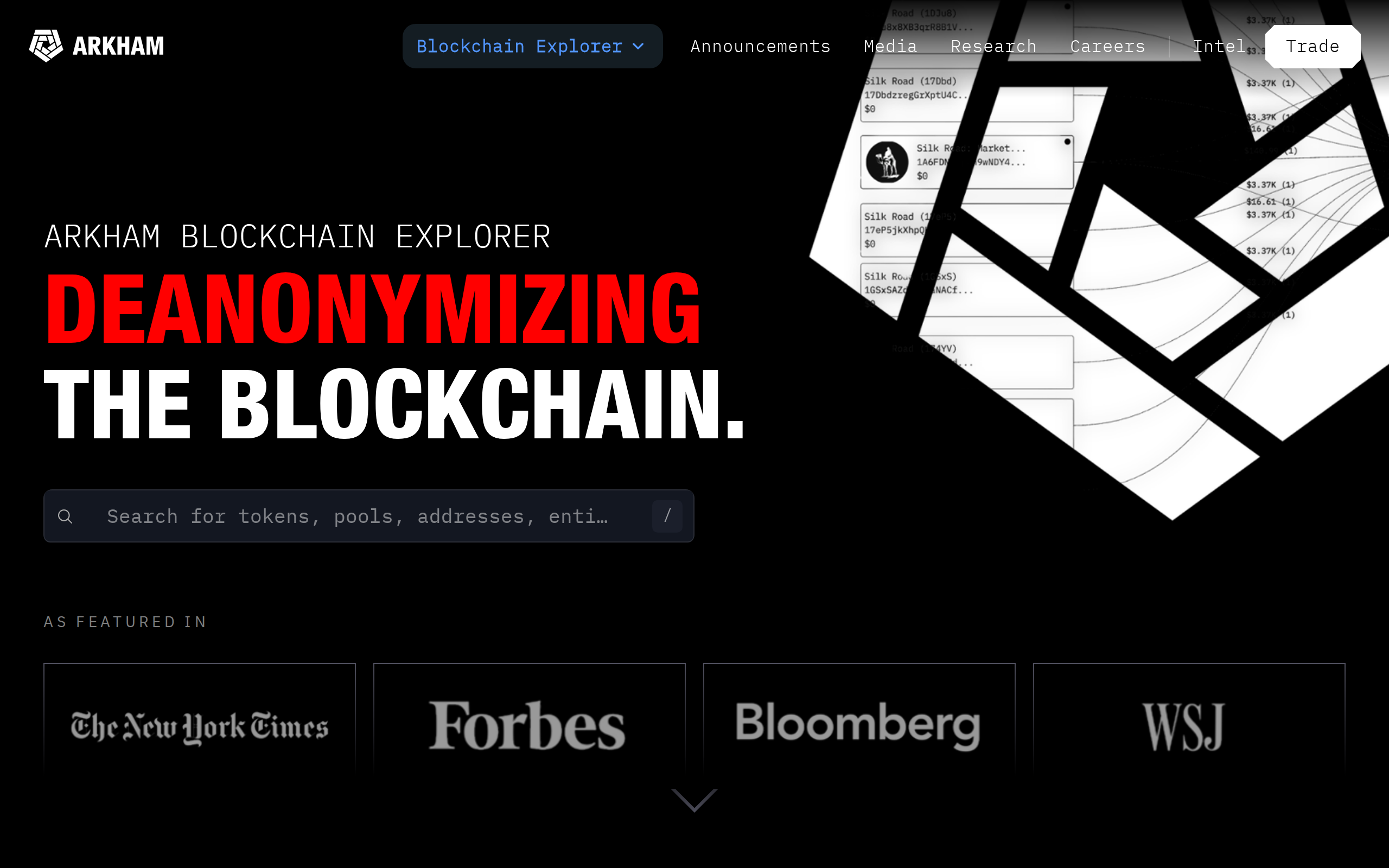
Arkham's whole pitch sits on one idea: raw blockchain addresses are useless to a normal reader, so the platform attaches human names, exchanges, funds, founders, to as many wallets as it can. It builds these labels through a mix of automated pattern matching, an in-house research team, and a public bounty system called the Intel Exchange, where anyone can submit evidence tying an address to an identity and earn ARKM tokens for labels the community verifies.
We tested this against three wallets we already knew the owners of from public disclosures. Arkham correctly named two of them within its interface, and left the third unlabeled rather than guessing, which we counted as a point in its favor: a wrong label dressed up as fact is worse than no label at all.
Following a fund without paying for the privilege
Once you follow an entity, Arkham surfaces its holdings, transaction history and connections to other labeled wallets, and pushes an alert when that entity moves funds. We set an alert on a mid-size trading firm's labeled wallet and got notified of a transfer within roughly two minutes of it landing on-chain, fast enough to matter if you are trading around the news rather than reading about it the next morning.
None of this requires a subscription. Compare that to Nansen, which gates its wallet labeling and alert features behind a monthly plan, and the gap in access is the story here: Arkham gives away, for free, the category of tool that used to be a paywalled analyst product.
The catch: crowdsourced means sometimes wrong
Arkham is upfront that not every label on its platform is verified, and the Intel Exchange model means anyone can submit a claim before it gets confirmed. We found one label during testing that had already been flagged as disputed by other users in the platform's own comment thread, which is a reasonable safeguard but still means a reader skimming quickly could take an unverified claim at face value.
There's a separate, harder question the site does not really engage with: deanonymizing wallets is exactly what it sounds like, and some crypto users who value pseudonymity will reasonably object to a platform whose entire business model is stripping that away, even when the underlying data is public. We are not going to settle that debate here, but anyone using Arkham should know it exists.
Specifications
- Price
- Free
- Core product
- Multi-chain blockchain explorer with entity labels
- Coverage
- Wallets, exchanges, funds and individuals across multiple chains
- Labeling method
- AI plus in-house research plus community-submitted intel via the Intel Exchange
- Alerts
- Real-time notifications on tracked wallet activity
- Native token
- ARKM, used to reward verified intelligence submissions
- Founded
- 2020
- Backers
- Investors include Bedrock, Draper Associates and Binance Labs