Tuta Mail Review 2026: Encrypted Email vs Proton Mail | Cipherwell
Tuta Mail Review: A Stricter, Cheaper Encrypted Alternative to Proton?
Tuta encrypts subject lines, calendars and contacts as well as message bodies, from German servers, starting at free. We read the plans and security pages to see what you give up compared with Proton Mail.
7.9 out of 10
Best for Privacy-first users who will live inside Tuta's own apps and never need IMAP
By The Cipherwell Test Desk
tuta.com
The verdict
Tuta encrypts more than Proton Mail does by default, including subject lines, calendar and contacts, and it does so from Germany with open-source apps and post-quantum keys. Revolutionary costs 3 euros a month. The price of that strictness is no IMAP, no POP3 or SMTP and no PGP, so Outlook and Thunderbird are out and you live inside Tuta's own apps.
What we liked
Encrypts subject lines, bodies, attachments, calendar and contacts
Free plan includes encryption, a calendar and 1 GB of storage
Revolutionary is 3 euros a month for 20 GB and 3 custom domains
Open-source clients and quantum-safe key exchange (x25519 with Kyber-1024)
No IP address logging by default, hosted in Germany
What held it back
No IMAP, POP3 or SMTP, so desktop mail clients are off the table
No PGP support, so external mail is only encrypted by password
Sender and recipient addresses are not encrypted
Lacks Proton's business extras such as retention and group addresses
Free plan is limited to 1 GB, one calendar and 3 labels
Proton Mail is the name people reach for when they want private email. Tuta is the quieter German alternative that is cheaper, stricter about what it encrypts and a good deal less compatible. The question we asked is simple: are the extra encryption and the lower price worth giving up your mail client?
For some people, yes. For many, no. The deciding factor is a single missing feature.
What Tuta encrypts that others leave open
tuta.com
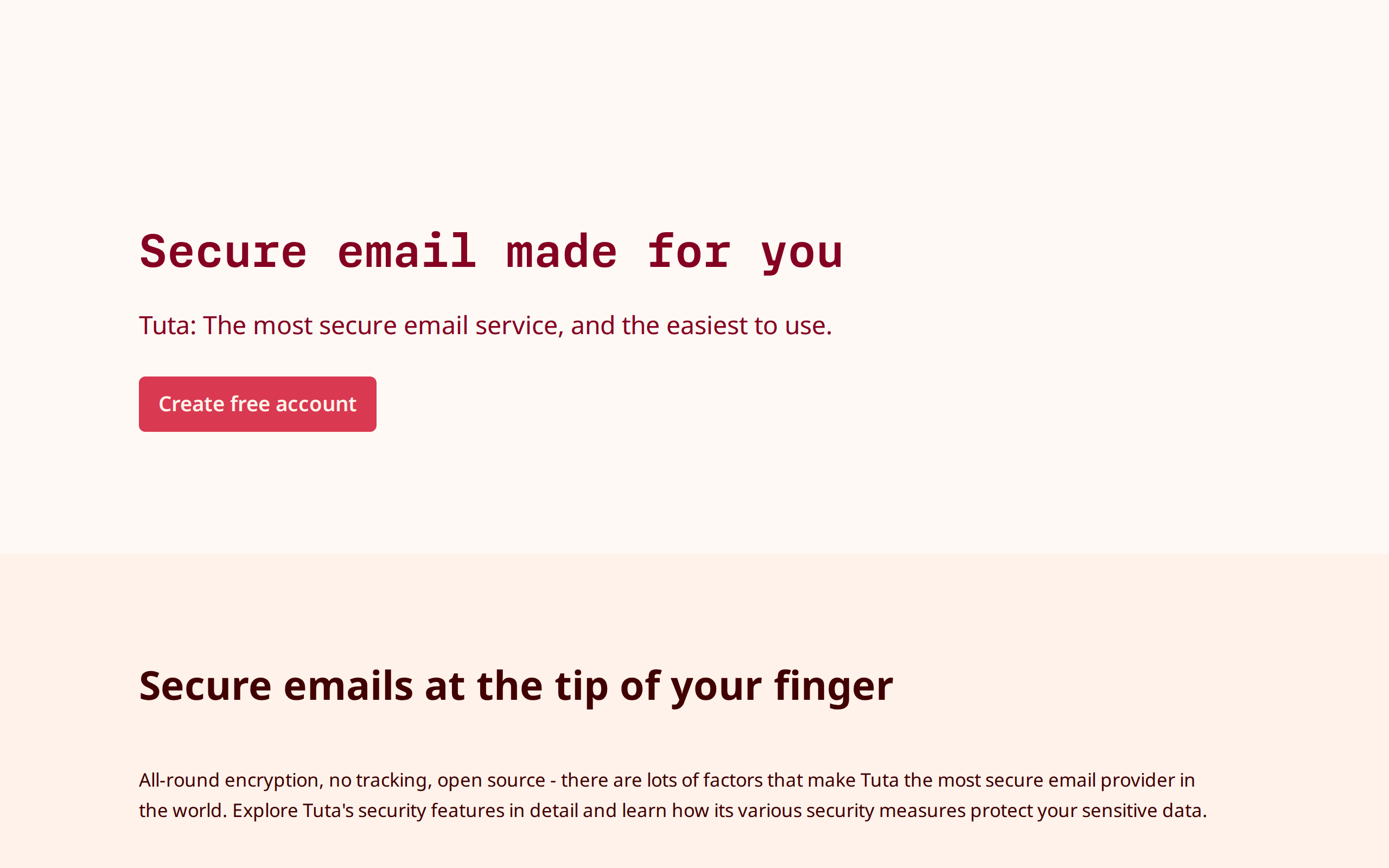
The security page, which calls Tuta the most secure email provider and explains its encryption.
The security page says email, calendars and contacts are end-to-end encrypted by default, and that includes subject lines. In ordinary email the subject is readable by the provider, and in standard PGP-encrypted mail it stays visible too. Reminders in the calendar are encrypted too.
The list of what is not encrypted is short and unavoidable: sender and recipient addresses, which the network needs for delivery. Headers are stripped from outgoing mail and Tuta says it does not log IP addresses by default.
The cryptography is up to date. Tuta replaced RSA with x25519 combined with Kyber-1024, a design meant to hold up if quantum computers ever break today's key exchange. The web client and the desktop and mobile apps are open source on GitHub, so the claims can be checked. Passwords are hashed with Argon2 before leaving your device, and two-factor works with TOTP or U2F hardware keys. All data sits in German data centres certified to ISO 27001.
That is a stricter default than a PGP-based service gives you, which is the comparison to keep in mind next to our Proton Mail review.
The price of the strictness
Tuta does not offer IMAP, POP3 or SMTP. There is no Bridge equivalent that plugs into Outlook, Apple Mail or Thunderbird. You read and write mail in Tuta's web app, its desktop apps for Windows, macOS and Linux, or its phone apps. If you live in a desktop client, that is a deal-breaker, and no pricing makes up for it.
There is also no PGP. Mail to an outside address is not end-to-end encrypted unless you set a shared password for the recipient, which is also how Proton handles non-users. Proton's own comparison page adds that Tuta lacks business-oriented features such as retention policies, group addresses and SMTP relay. It is a rival's page, so weigh it accordingly, but it matches what Tuta's plan list shows.
Plans in euros, and what each tier is for
tuta.com
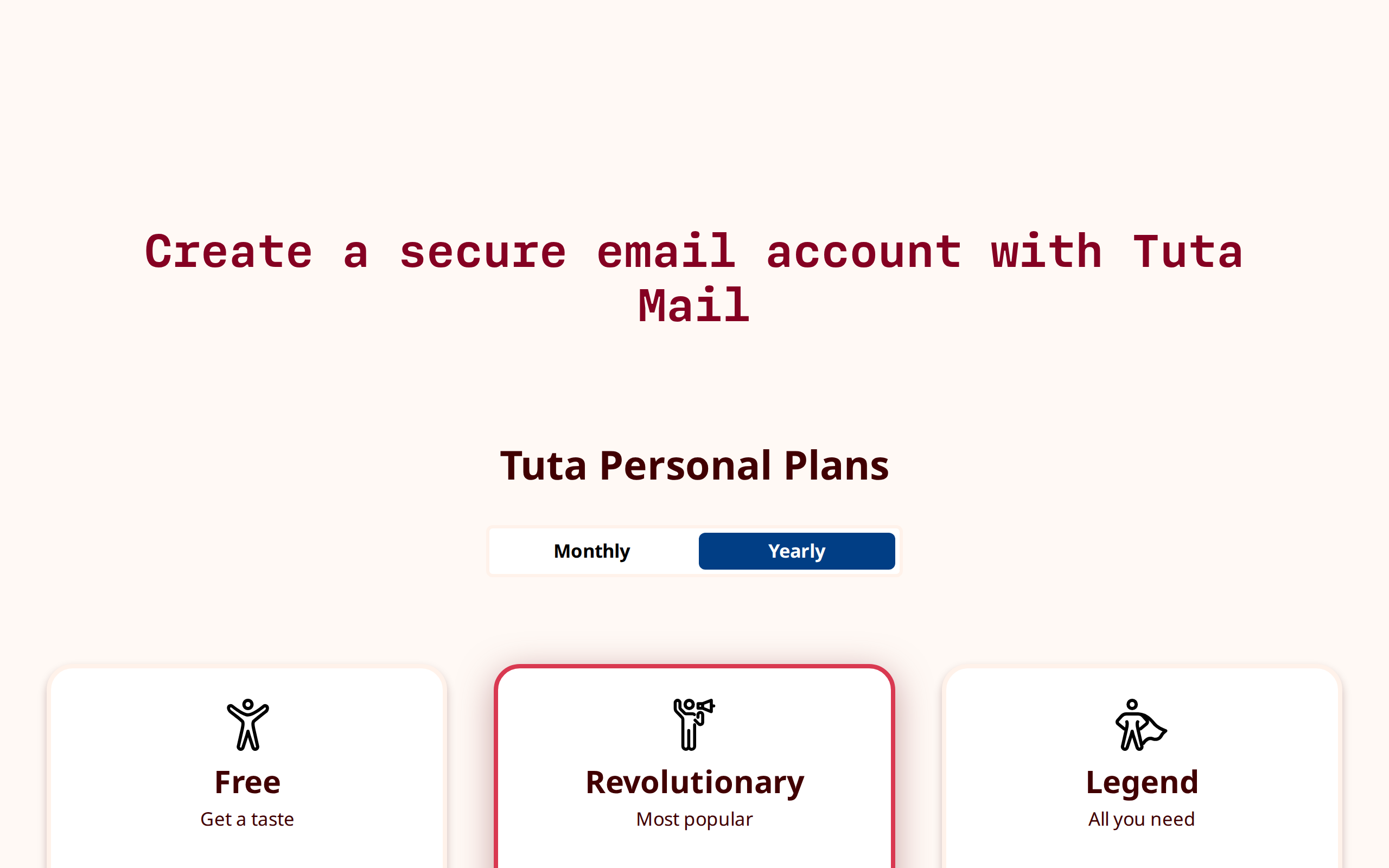
The pricing page: Free at 0 euros, Revolutionary at 3 euros and Legend at 8 euros a month.
Free: 1 GB, one calendar, 3 labels, no custom domain. It has full encryption, which most free tiers skimp on.
Revolutionary, €3 a month: 20 GB, unlimited calendars and labels, 15 aliases and 3 custom domains.
Legend, €8 a month: 500 GB and 10 custom domains.
Prices include taxes and are quoted for yearly payment, with a monthly option. After the first period the plan becomes a rolling contract that you can cancel at any time, which is a plain renewal term.
For a household, a Revolutionary plan with a custom domain is a respectable setup. Family use is set up by contacting support: each member gets a mailbox with 20 GB and 15 aliases for €3 per user a month.
The calendar is a real selling point
tuta.com
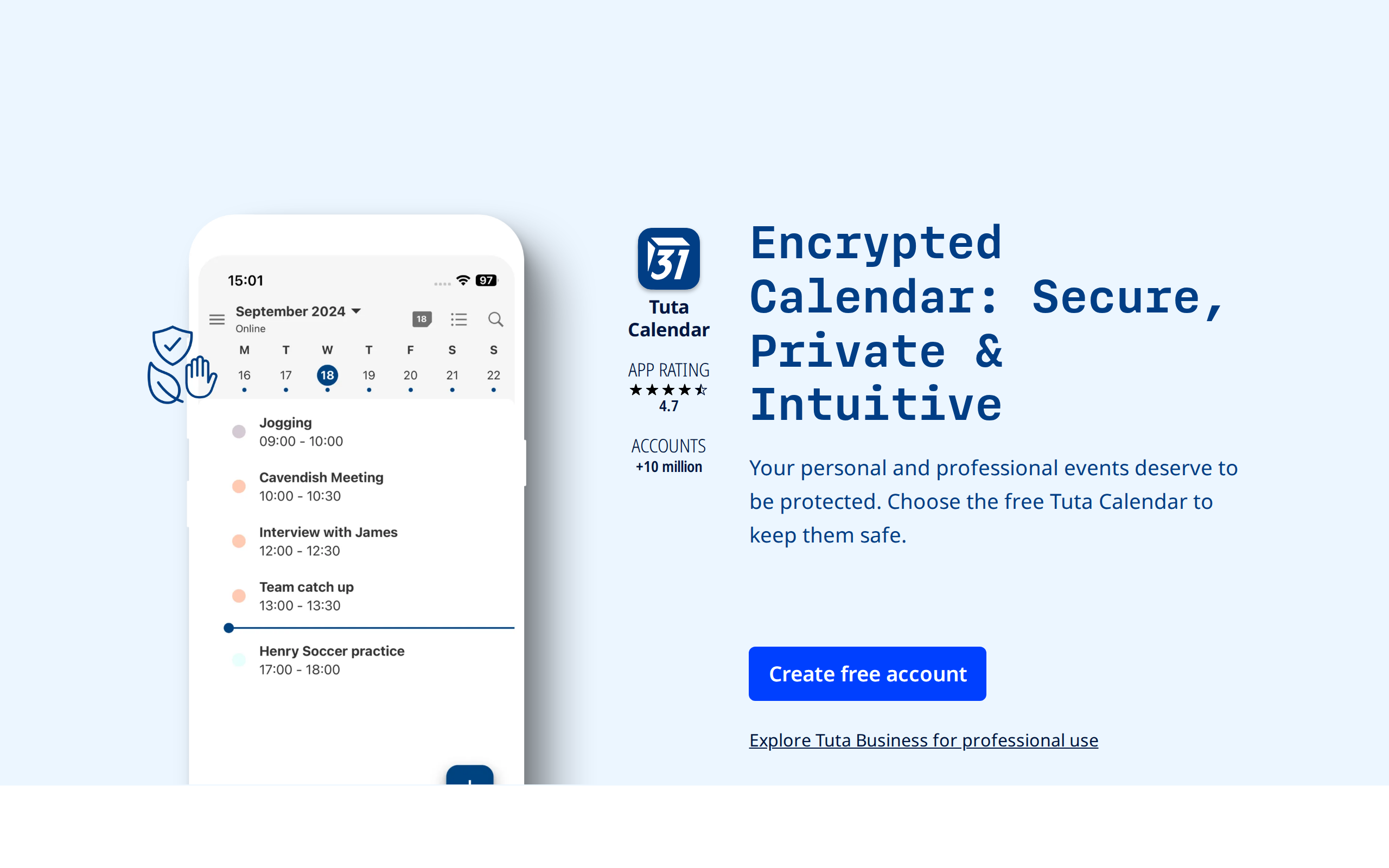
The calendar page, promoting the free encrypted calendar and showing it on a phone.
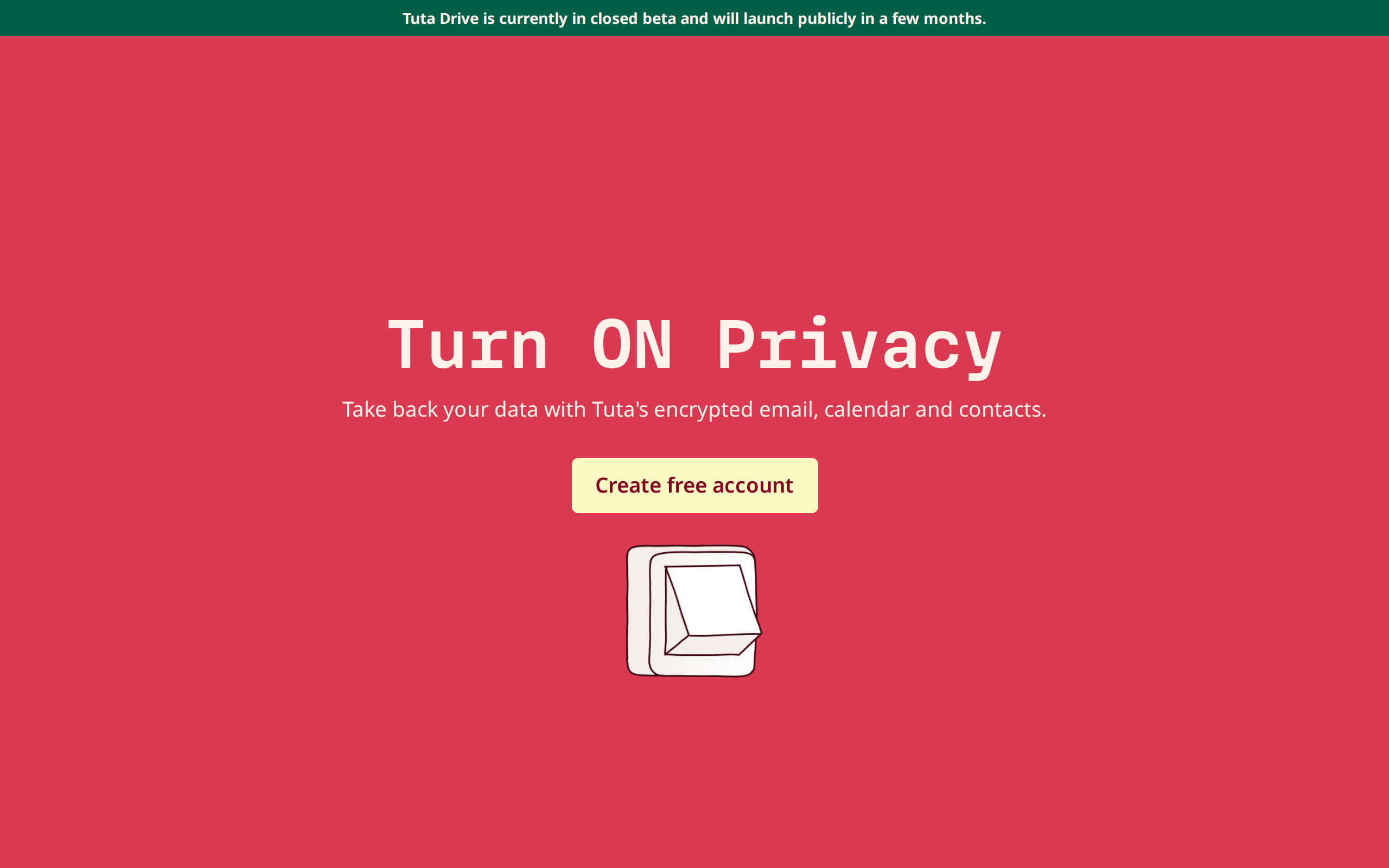
Tuta bundles an encrypted calendar into the free tier. That matters because a calendar is a map of your life: where you are, who you meet and when. Most privacy-minded email plans treat it as an afterthought. Tuta also lists encrypted contacts, and a Drive product is in closed beta, with a public launch promised in a few months.
Living with it day to day
Without IMAP, migration is the first chore. You cannot point a desktop client at the mailbox, so moving years of mail in means importing it or forwarding from the old account. Search is the second. Because the server cannot read your mail, searching is done on your own device against data it has downloaded, which is the honest trade of zero-knowledge storage.
Custom domains start at Revolutionary, with 3 domains and 15 aliases, and the free plan has none. If you want an address on your own domain with a tidy set of aliases, the 3 euros a month is where Tuta stops being a trial and becomes a product.
Who should choose it
Pick Tuta if you want strong default encryption, accept web and app access only, and care more about price and metadata than compatibility. The free plan is a strong way to test it.
Skip it if you rely on IMAP, PGP or a shared company inbox. For those cases Proton Mail remains the more flexible tool. Our 7.9 reflects excellent privacy design, held back by the missing standards that make email email.