Proton Mail Review: Can It Replace Gmail for Everyday Use?
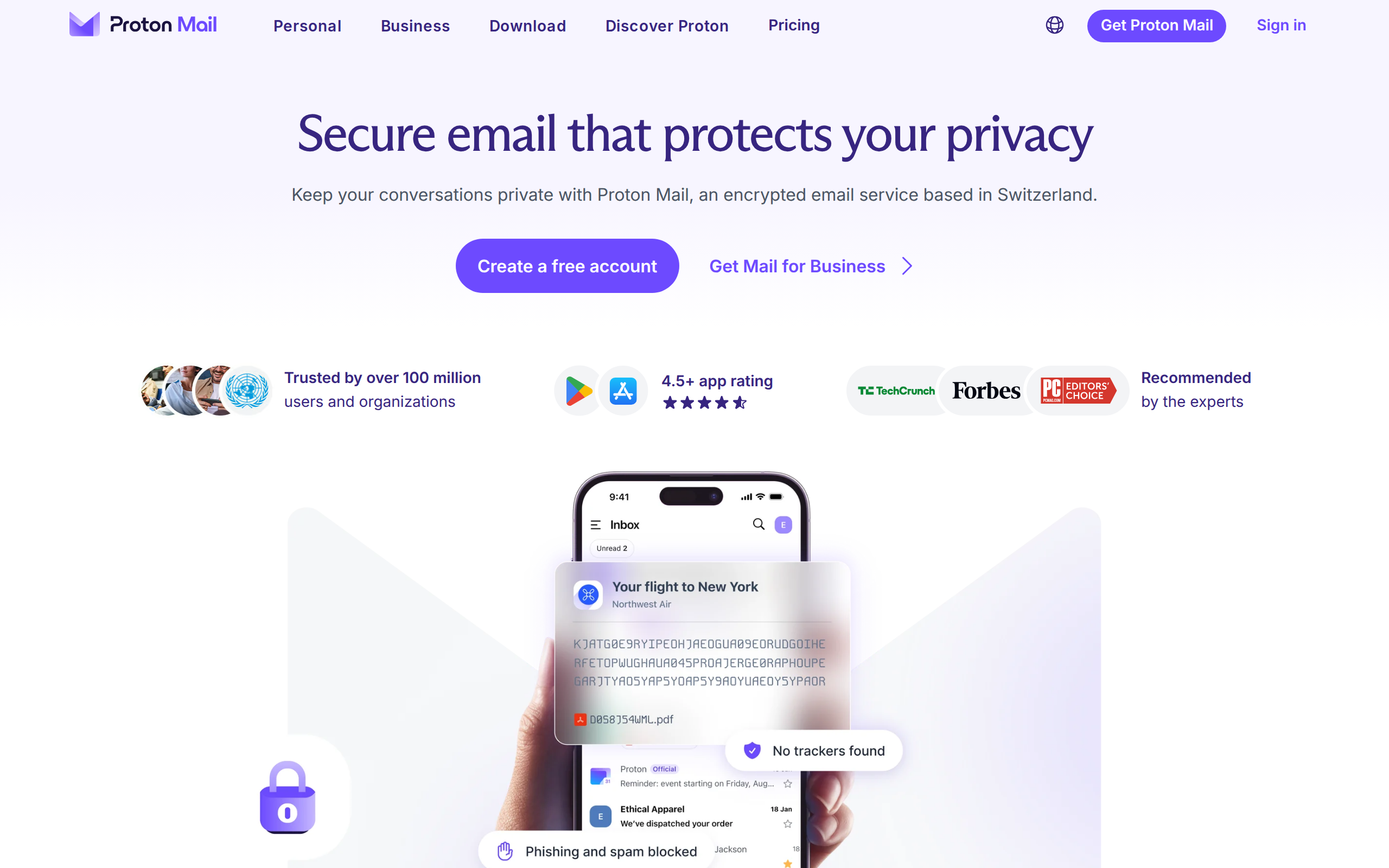
Proton Mail swaps Gmail's ads and 15 GB for zero-access encryption and a Swiss base. We looked at the free limits, Mail Plus at $3.99 a month, Bridge and where it still falls short.
8.2 out of 10
Best for Privacy-minded people ready to leave Gmail and pay a little
Proton Mail can replace Gmail for most people, provided you accept three costs. The free plan is 1 GB with a 150-message daily send cap, search of message bodies is slower than Google's, and Bridge for desktop clients needs a paid plan. Paying for Mail Plus fixes most of it.
What we liked
Zero-access encryption protects stored mail from Proton itself
Mail Plus at $3.99 a month gives 15 GB and unlimited sending
Bridge adds encryption to Outlook, Thunderbird and Apple Mail
Swiss jurisdiction and a business funded by subscribers
Paid plans bundle calendar, Drive and, on Unlimited, a VPN
What held it back
Free plan caps storage at 1 GB and sends at 150 a day
Encrypted body search is slower than Gmail's search
Bridge and desktop client access need a paid plan
Mail to non-Proton contacts is not end-to-end encrypted by default
Switching email address is a bigger decision than switching VPN or password manager. Your bank, your landlord and every old shopping account know you by that address. So the question about Proton Mail is not "is it private?" It is "will I regret moving?"
Our answer is: probably not, if you plan the move and pay for the right tier.
What you give up on the free plan
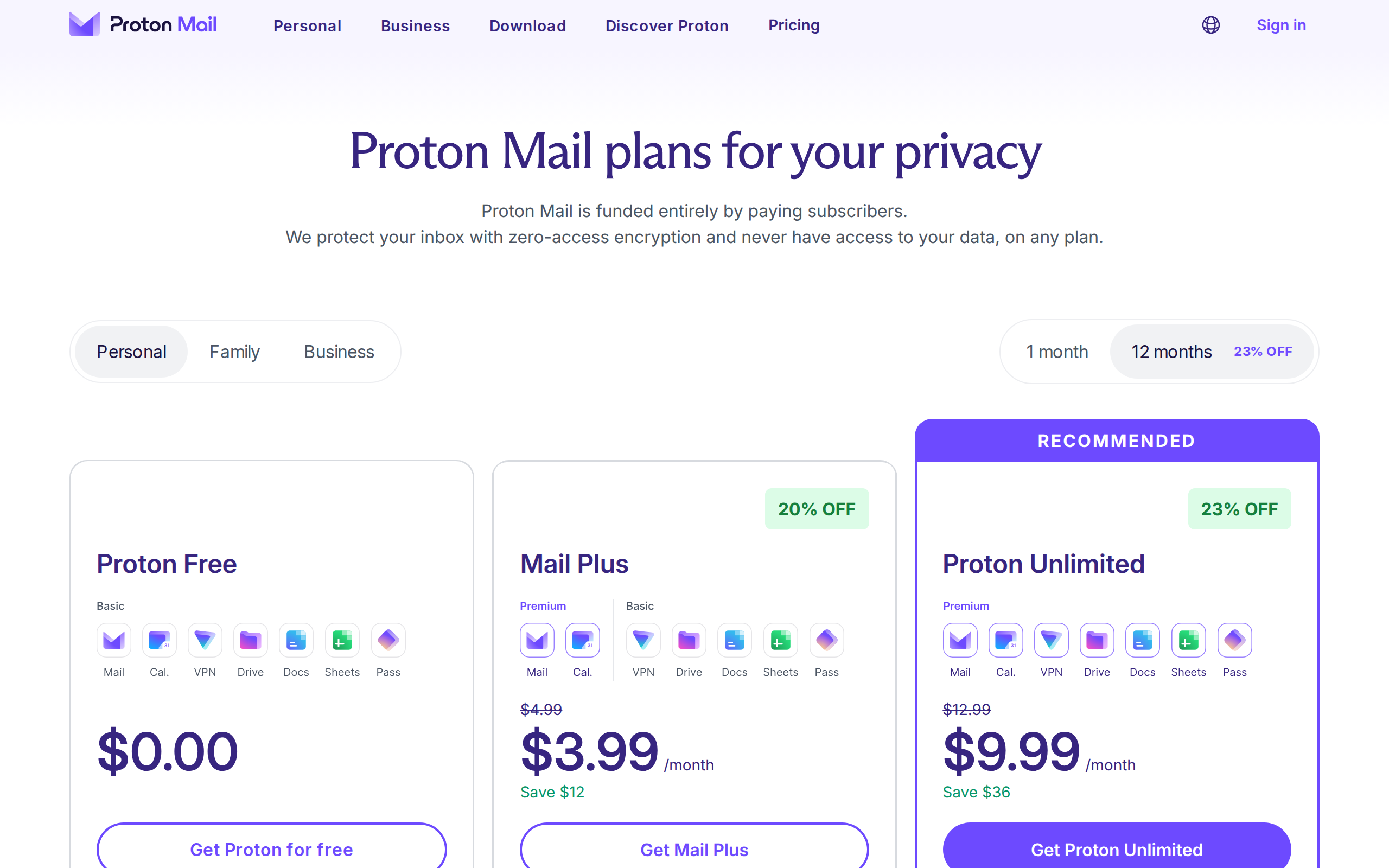
The free plan is real and usable, but it is small. According to the pricing page, it gives you 1 GB of storage, one address, three folders and three labels, and 150 messages a day.
proton.me
Proton Unlimited, Mail Plus and Proton Free are compared on the plans page
Gmail offers 15 GB. If you keep years of attachments, 1 GB will fill up quickly, and three folders is tight for anyone who sorts mail seriously. The send cap rarely matters for personal use, but it does for a small business or a newsletter habit.
Mail Plus removes those limits for $3.99 a month, or $47.88 a year on the annual price shown. That buys 15 GB, ten addresses, unlimited folders and labels, unlimited sending and 25 calendars. For most people this is the plan to start on, and the free tier is best seen as a long trial.
Proton Unlimited is for people who want the suite
Proton Unlimited costs $9.99 a month on the annual price shown ($119.88 a year). It brings 500 GB of storage, 15 addresses, three custom domains and a VPN for ten devices. That is a good deal if you will use Drive and the VPN. If you only want email, it is more than you need.
Using it with the apps you already know
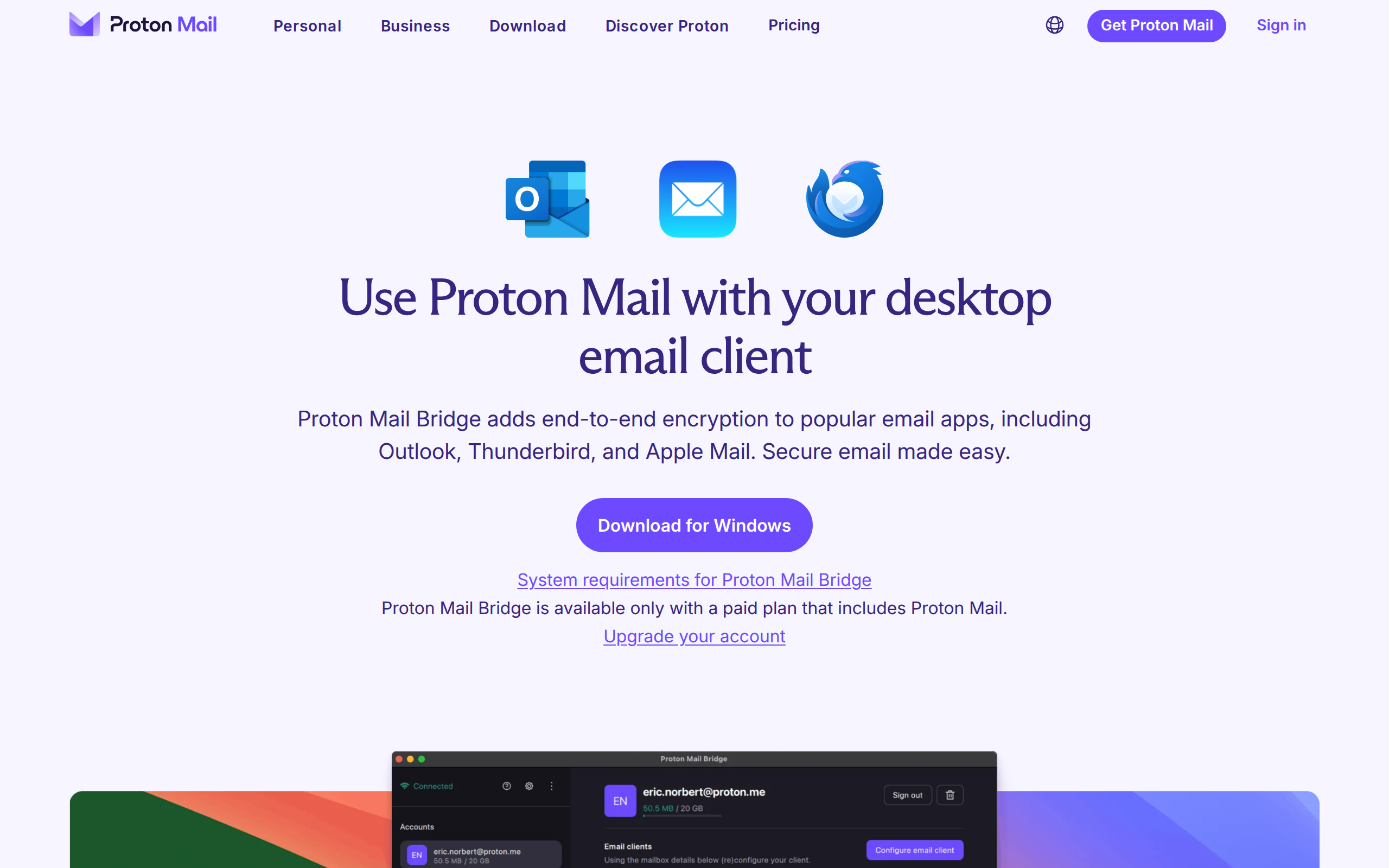
The big practical worry is whether you must live in Proton's own web and mobile apps. Not entirely. Proton Mail Bridge adds end-to-end encryption to desktop clients such as Outlook, Thunderbird and Apple Mail.
proton.me
Specifications
Free plan
1 GB, 1 address, 3 folders and labels, 150 sends a day
Bridge connects Proton Mail to Outlook, Thunderbird and Apple Mail
The page states plainly that Bridge is available only with a paid plan that includes Proton Mail. That is a design consequence: a server that cannot read your mail cannot hand plaintext to a standard IMAP client, so a local program does the decryption on your computer. We think the cost is fair, but free users should know before they build a workflow around Thunderbird.
Search, the daily friction
Encrypted mail makes search harder. Independent reviews, including Cloudwards, report that full-text search runs more slowly than Gmail's, because message bodies are searched locally against an index on your device rather than on Google's servers. If you search your inbox forty times a day, you will notice. If you mostly look for a sender or a subject, you will not.
This is the honest trade at the heart of the product. You get privacy that does not depend on trusting the provider's staff. You lose the instant, server-side search that Google built by reading everything.
The part encryption cannot fix
Mail between two Proton users is end-to-end encrypted. Mail to your friend on Gmail or Outlook is not, unless you use password-protected messages, which add a step for the recipient. Most of your correspondents are not on Proton, so most of your mail will travel the way ordinary email always has, with Proton protecting only what it stores for you.
That is still a gain, but it is a narrower one than the marketing suggests. Proton also publishes how-to guides for newer protections, such as post-quantum options.
proton.me
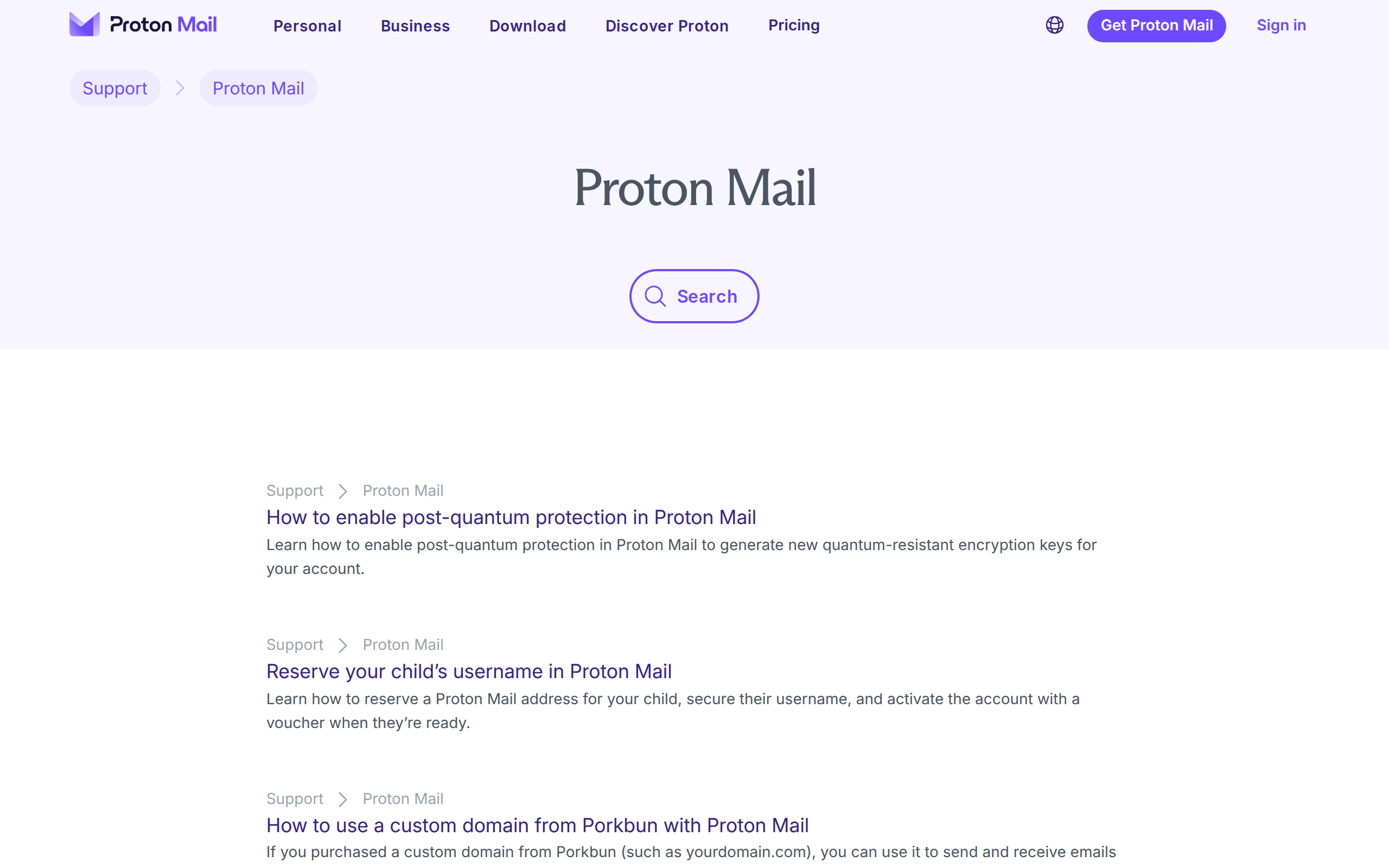
The support section covers post-quantum protection, custom domains and account setup
Money, and who pays for the servers
Proton's pricing page says the service is funded entirely by paying subscribers. For a privacy product, that matters more than any feature. A free mailbox paid for by advertising has an incentive to look at your mail, and a mailbox paid for by subscribers has an incentive to keep you. The catch is that the free tier exists to turn into a paid one, so expect upgrade prompts when you hit the limits.
Should you switch?
Switch if you want your inbox out of an advertising company's hands, you will pay for Mail Plus, and you can tolerate slower search. Move gradually: forward old mail, update your key accounts one by one, and keep the old address for six months.
Stay put if you rely on Google Workspace integrations, shared documents tied to your Gmail identity, or very fast mailbox search.
Verdict
Proton Mail is the most complete mainstream answer to "I want out of Gmail." It loses ground on search and on the small free tier, not on trust. We rate it 8.2 out of 10.