Mailbox.org Review: Private Email With Your Own Domain and Plain IMAP
Mailbox.org is a German mail host that works with any IMAP client and supports custom domains from 3 euros a month. We read its plans and security pages to see what the low price leaves out.
8.0 out of 10
Best for People who want a custom domain, standard IMAP and a calendar at a low price
By The Cipherwell Test Desk
mailbox.org
The verdict
Mailbox.org is the right pick if you want a private, ad-free inbox that works in Thunderbird, Apple Mail or any other IMAP client, with your own domain from 3 euros a month. It is not zero-access: Guard encrypts on the server, so the company can in principle read unencrypted mail. For a threat model that includes your mail host, choose Proton Mail or Tuta. For everyone else, it is good value.
What we liked
Standard IMAP, POP3 and SMTP work with any desktop or phone mail client
Custom domains with aliases and catch-all from the 3 euro Standard plan
30-day free trial of every plan, with a migration service for old mail
ISO 27001 and BSI C5 certified, with data centres in Berlin
Mail, calendar, contacts, tasks, drive and video calls in one login
What held it back
Guard encrypts on the server, so it is not true end-to-end encryption
Light at 1 euro has 2 GB of mail and no custom domain
Monthly billing is much dearer: Standard is 4 euros, Premium is 12 euros
No free plan, and the webmail looks dated next to Proton and Tuta
Most private email services ask you to give something up: your mail client, your own domain, or a tolerable price. Mailbox.org asks for less. It is a conventional mail host in Berlin that happens to take privacy seriously, and that makes it the easiest encrypted-adjacent service to move a household or a small business onto.
We should be exact about the word "encrypted". Mailbox.org does not promise that it cannot read your mail. It promises that it will not, and it backs that with certifications and a tidy privacy posture. If that distinction matters to you, read the section on Guard before anything else.
Three plans, and the one that matters
mailbox.org
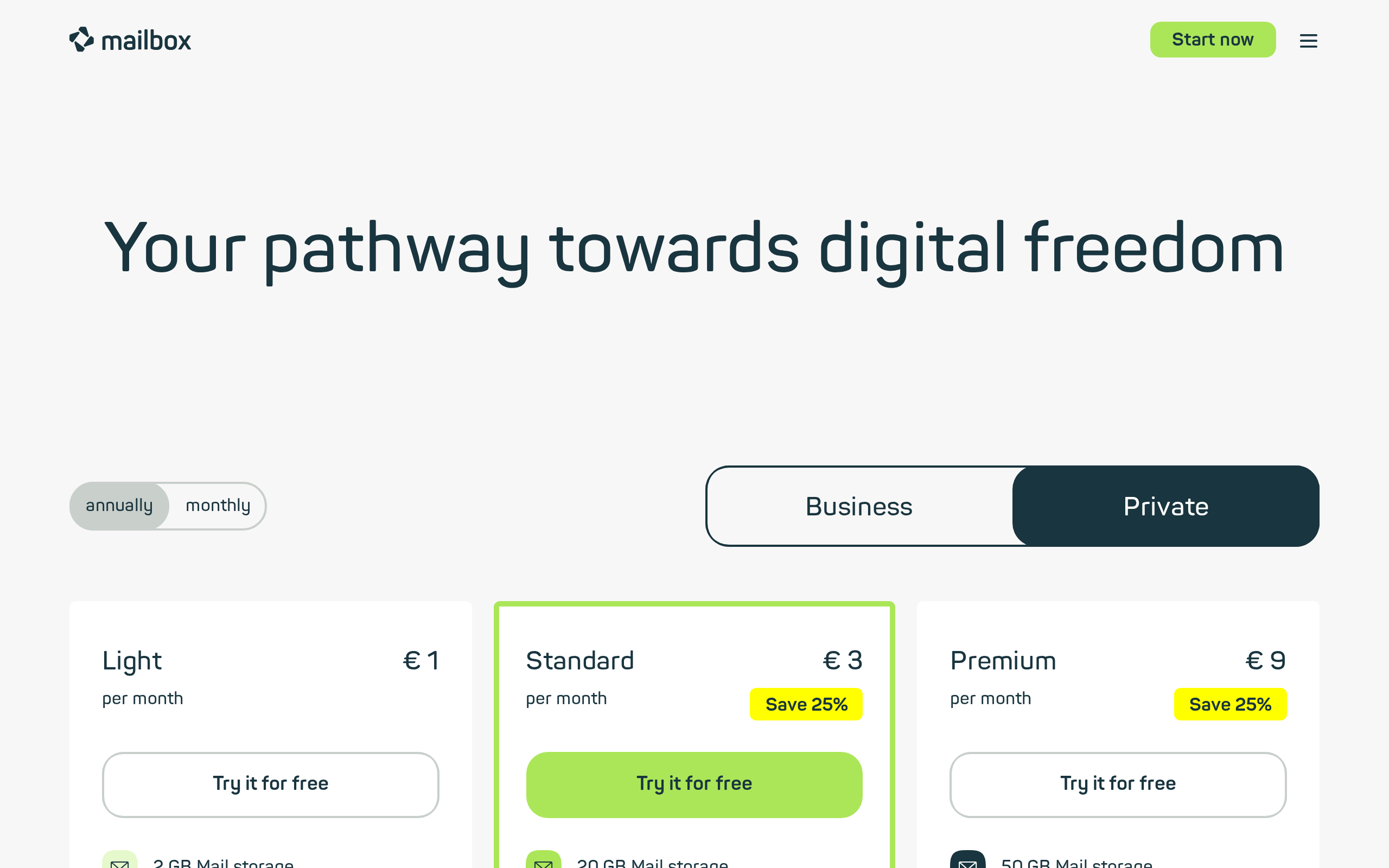
The prices page: Light is 1 euro a month, Standard 3 euros and Premium 9 euros when paid annually.
The prices page lists three personal tiers. Light is 1 euro a month with 2 GB of mail storage. Standard is 3 euros a month on an annual contract (4 euros if you pay monthly) and brings 20 GB of mail plus 10 GB of drive space. Premium is 9 euros annually (12 monthly) with 50 GB of mail and 100 GB of drive.
Light is a trap for anyone who wants their own address. The site says custom domains are available only on Standard and Premium, so Light gets you a name at mailbox.org and nothing more. Standard allows 50 domain aliases and Premium 250, plus a catch-all address, which is plenty for a freelancer or a family domain.
Billing is where you should read twice. The annual price is a real discount, and the monthly price is not far off what mainstream rivals charge. We would commit to a year only after using the free 30-day trial, which unlocks every feature.
Why standard IMAP is the real selling point
Proton Mail and Tuta lock you into their own apps or a bridge. Mailbox.org does not. It speaks plain IMAP, POP3 and SMTP, with CalDAV and CardDAV for calendars and contacts, and the site says the whole set works with the stock iOS and Android apps.
That means Thunderbird, Apple Mail, Outlook and K-9 all work without a helper program. Search, filters and rules are the ones your client already has. If you ever leave, you export through the same protocol you came in on.
For a team with an existing domain, the private plans page points to a migration service that copies mail, contacts and calendar data from Gmail, Microsoft 365 or another host. Family accounts allow up to 10 full mailboxes, each billed at the normal rate, so four people on Standard pay 12 euros a month on an annual contract.
mailbox.org
The private plans page, headed Privacy meets security, with the Privacy Made in Germany section.
Guard: useful, but know what it is
The security page describes TLS on every connection, DNSSEC and DANE/TLSA on its own domains, MTA-STS, and a TLS checker inside webmail that tells you whether a message will travel encrypted before you send it. There are also "secure aliases" at secure.mailbox.org that refuse delivery unless the sending server uses TLS. These are things most hosts skip.
mailbox.org
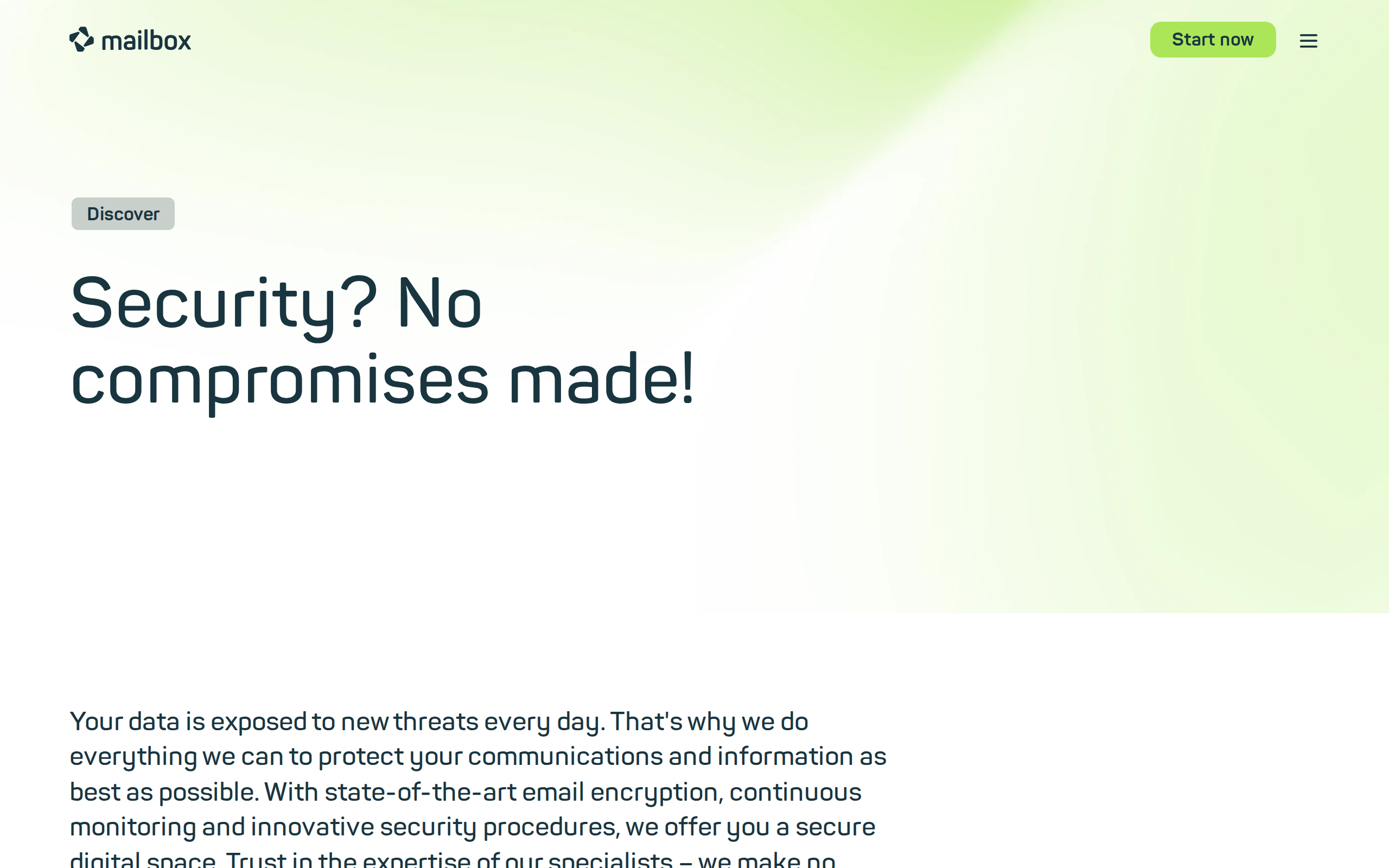
The security page, headed Security? No compromises made!, covering encryption, certifications and two-factor login.
Guard handles PGP and S/MIME inside webmail. It is convenient, and it is also where the limit sits. Encryption and decryption happen on the server, and community discussion on Privacy Guides notes that zero-access protection only applies if you upload your own private key and protect it with a Guard password. Regular incoming mail is stored readable on the server like at any other host.
If you want real end-to-end encryption, keep your PGP key in Thunderbird or a mail client and use Mailbox.org as plain transport. That works, because IMAP is standard, but it is work that Proton does for you.
Two-factor login and per-app passwords are offered, which limits the damage if a mail client's password leaks. The company is certified to ISO 27001 and BSI C5, and Stiftung Warentest gave the Light plan a 1.8 (good) rating in 2026, according to the maker's own pages. Treat that as the maker reporting a test result, not as something we verified.
Who should buy it, and who should skip it
Buy it if you run mail on your own domain, use a desktop client, and want an inbox that is not mined for advertising. Buy it for a family or a three-person business that needs shared calendars and a drive without paying for a full office suite. The 4-euro monthly price, a year's commitment at 3 euros, and a real person to ask through the forum and support make it hard to beat.
Skip it if your threat model includes the mail host itself, or if you want a polished mobile app and an aliasing feature built in. The webmail is functional rather than pleasant, and there is no free tier to try beyond the 30-day trial.
Next to Proton Mail it is less private by design and far more compatible. Next to Tuta it offers IMAP and PGP, which Tuta refuses to provide. That compatibility is the whole case for Mailbox.org, and for the people who need it, it is a strong one.