LifeLock Review: Is the Identity Theft Cover Worth the Monthly Fee?
LifeLock sells monitoring, insurance and a restoration specialist for $10 to $35 a month. We read the plan pages, the reimbursement limits and the restoration guarantee to see what the cover buys and what you can do free.
6.8 out of 10
Best for US adults with savings or investments who want a restoration specialist on call
By The Cipherwell Test Desk
lifelock.norton.com
The verdict
LifeLock is a service you pay for the insurance and the human restoration help, not the alerts, which free tools mostly match. Core starts at $12.49 a month and Total reaches $34.99, with reimbursement from $25,000 in stolen funds up to $1 million. Worth it if you hold real assets or hate paperwork. Skip it if you will freeze your credit yourself.
What we liked
A named US-based restoration specialist handles an identity theft case from start to finish
Total raises stolen funds reimbursement to $1M and adds 401(k) and home title fraud alerts
Annual plans carry a 60-day money-back guarantee, renewals included
Every plan includes up to $1M for lawyers and experts
Advanced and Total monitor all three credit bureaus and add scam reimbursement
What held it back
Core pays only $25,000 in stolen funds and watches two credit bureaus
Monthly billing costs 20 percent more than the annual rate on every tier
Insurance is issued by a third party, and the maker says it is not a licensed insurer
Scam cover is excluded for residents of New York and pays only $5K or $10K
A credit freeze, which you can place for free, blocks the most common fraud
Most identity theft products sell fear and call it protection. LifeLock sells two things that are real: an insurance policy, and a person who will spend weeks on the phone with creditors when your Social Security number has been used to open a loan. Whether that is worth $12.49 to $34.99 a month depends on how much you could lose and how much of the legwork you would do yourself.
Reading the plan page before the ad copy
lifelock.norton.com
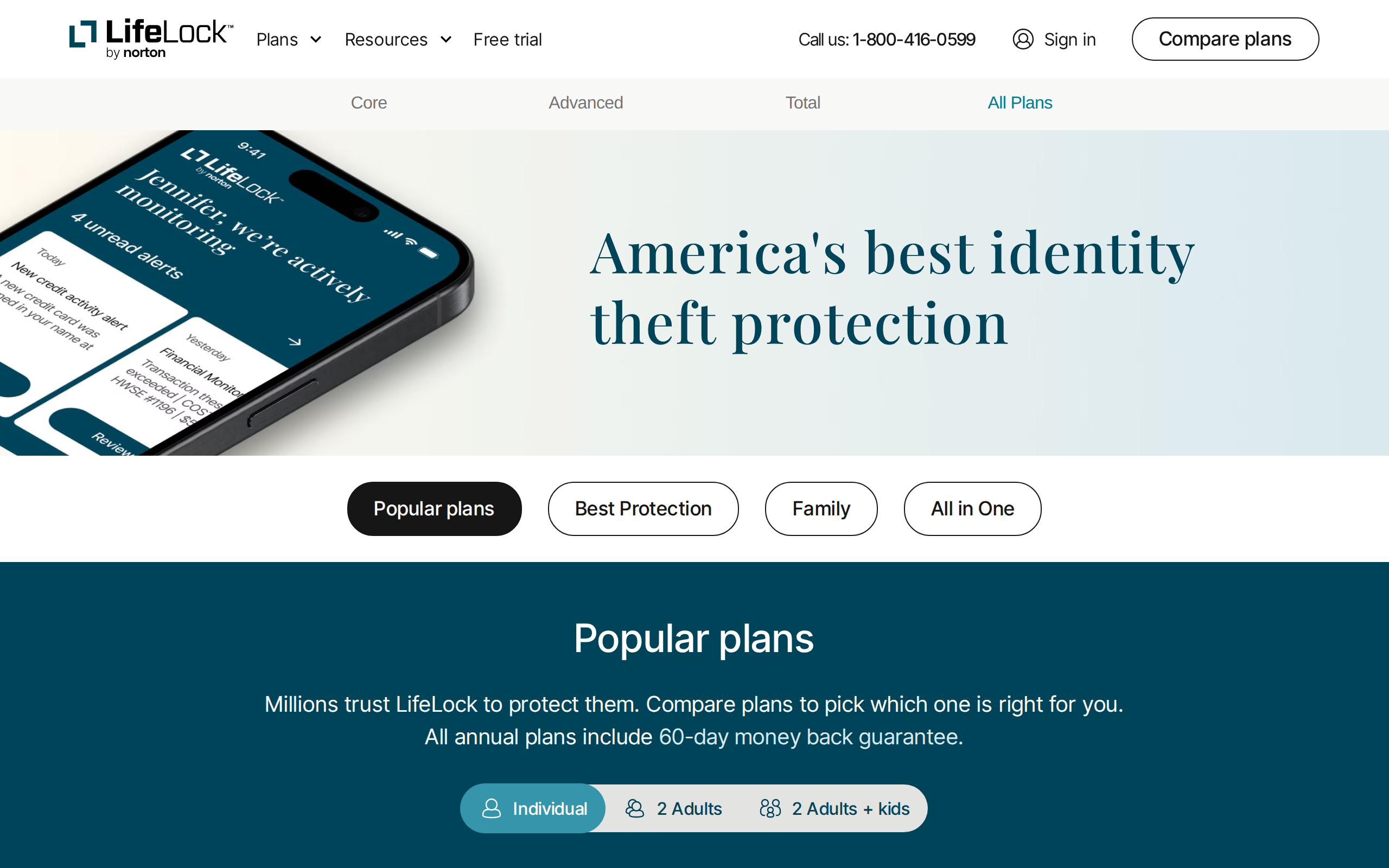
The plans page opens with the Popular plans table: Core, Advanced and Total, with individual and family columns.
LifeLock is sold by Gen Digital, the company behind Norton. The page lists three plans for one adult, and each also has two-adult and family versions.
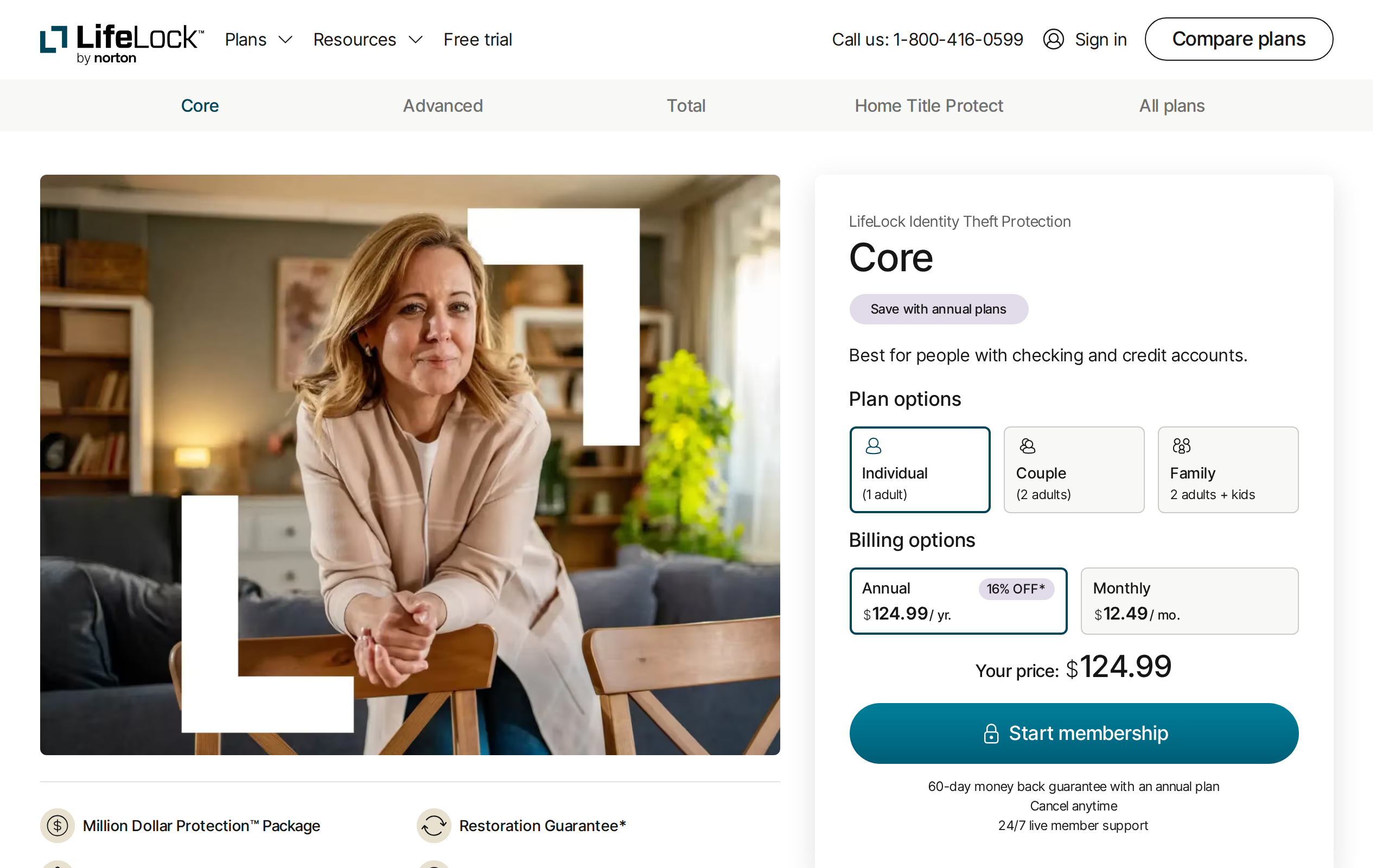
Core: $12.49 a month, or $124.99 a year. Watches two credit bureaus. Pays up to $1.05M for identity theft, of which only $25,000 is stolen funds.
Advanced: $19.99 a month, or $16.67 a month on an annual term. Three bureaus, $1.2M total reimbursement, $100,000 for stolen funds and $5,000 of scam reimbursement.
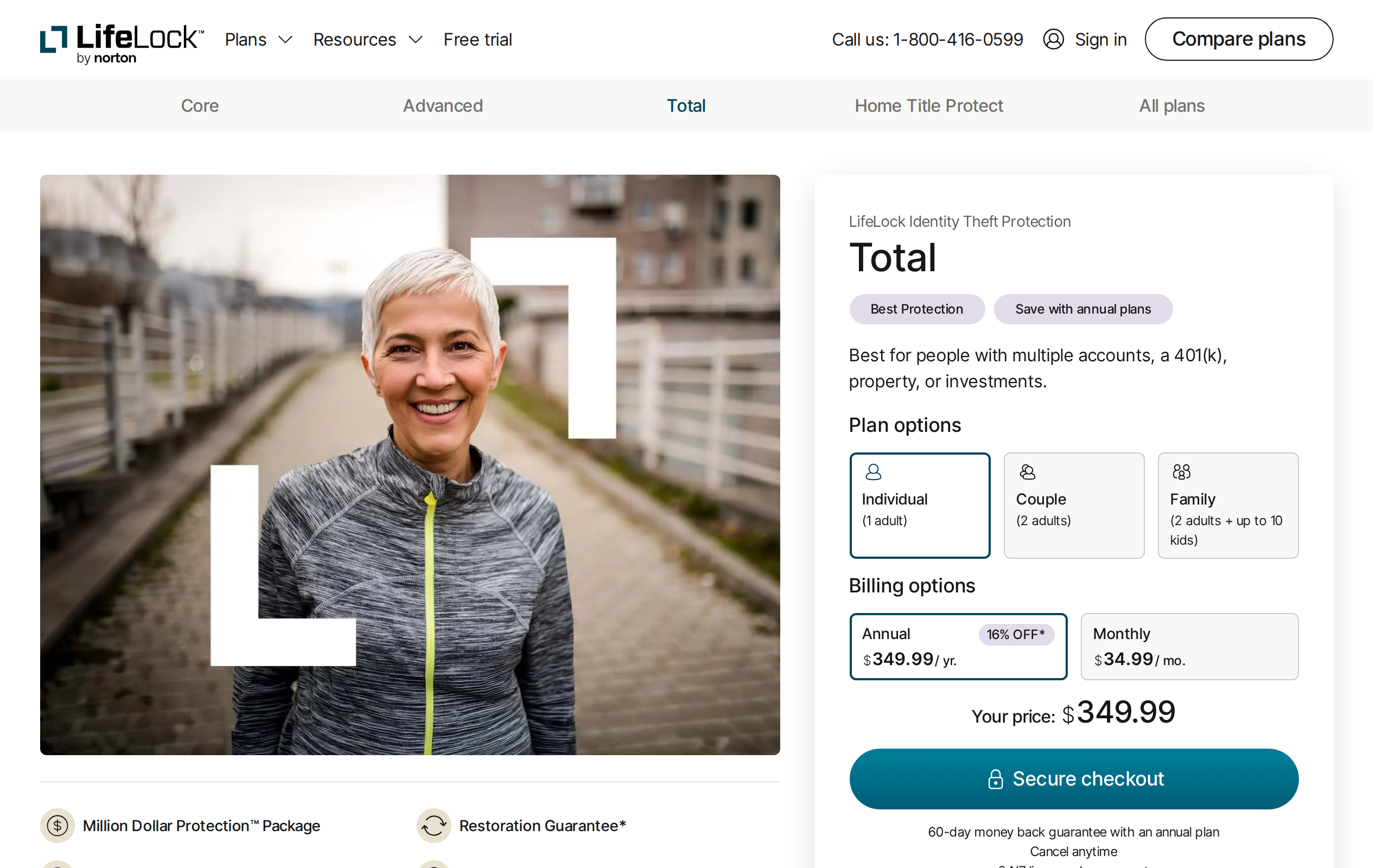
Total: $34.99 a month, or $29.17 a month annually. Three bureaus, up to $3M, $1M of stolen funds and $10,000 of scam cover.
The headline on every tier is "up to $1 million for lawyers and experts". Read the footnote: reimbursement varies by plan, and benefits are issued by a third party. Gen Digital says outright that it is not a licensed insurance producer, and the policy is underwritten by HSB Specialty Insurance Company. Scam cover is unavailable to residents of New York. None of that is hidden, but none of it is in the big type either.
Why Core is the weak spot
lifelock.norton.com
The Core page pairs plan options with billing options and the Million Dollar Protection Package badge.
The cheapest plan carries the biggest number, $1.05M, and the smallest useful one. If someone drains your checking account, Core returns at most $25,000. Our read is that Core is the plan to avoid unless the price is the only thing you can afford. For the same money you could place a free credit freeze at each bureau and still have cash left for a password manager.
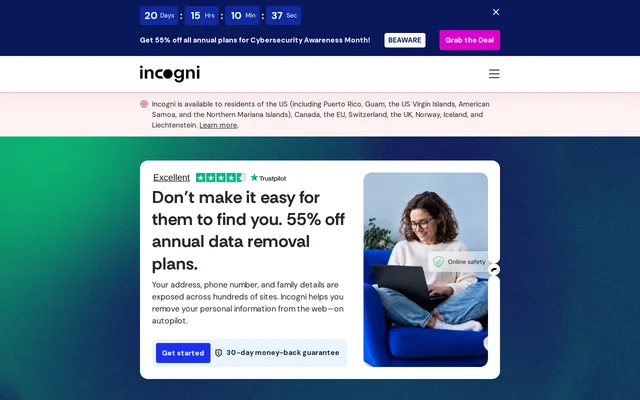
Core does give you dark web and breach alerts, and the restoration specialist. Independent reviewers, including Incogni's write-up, reach the same view: the alerts are the part you can copy for free.
What Total adds, and who it is for
lifelock.norton.com
Total is pitched at people with a 401(k), property or investments, and covers two adults and up to ten children.
Total is the plan where LifeLock stops overlapping with free tools. Its alerts cover bank account takeover, 401(k) and investment fraud, home title fraud and SIM swap attempts, and it removes the cap on monitored bank accounts. Stolen funds reimbursement rises to $1M. If you have a mortgage, a brokerage account and a retirement plan, that reimbursement is the product.
At $34.99 a month the bill reaches about $420 a year on monthly billing, or $350 on the annual rate. It is a lot to pay for an event that most customers will never claim on. We treat it as insurance, with the usual insurance trade-off.
The restoration help, tested on paper
lifelock.norton.com
The Restoration Guarantee page explains the money-back promise if an identity cannot be restored.
The service we would pay for is the case manager. LifeLock assigns a US-based restoration specialist who owns a case from first report to resolution. The Restoration Guarantee says that if the identity cannot be restored to good standing, you get up to twelve months of subscription fees back. That is a modest remedy. It is not a promise that the thief goes away, and it never covers losses.
We did not stage a theft to test response times, and we would not trust any review that claims to. What we could check is the paper: who is named on the policy, which events are covered, what is capped. That is where the value or the disappointment sits.
Free alternatives, and what they miss
You can freeze your credit at Equifax, Experian and TransUnion for free, and a freeze blocks new accounts opened in your name. LifeLock itself says its locks cannot prevent every account takeover. Breach lookups, bank alerts and a password manager cover much of the rest. What the free route does not give you is a paid specialist to make the calls, or money back for legal fees.
If your main worry is your name sitting on data broker sites, a removal service such as the ones we review in this category does that job directly, for less. The pricing pattern matters too: promotional rates run about 16 percent under monthly billing, and the 60-day annual refund is the cheapest way to try the service.
Verdict
LifeLock is a competent, honestly priced insurance product with a monitoring dashboard attached. Advanced is the sensible middle for most households, and Total is for people with assets that justify a $1M stolen funds limit. Core is the plan we would skip. This is a review of a product, not personal financial advice: check the policy terms for your own situation.
Specifications
Core
$12.49/mo, or $124.99/yr; $25K stolen funds, 2 bureaus
Advanced
$19.99/mo, or $16.67/mo billed yearly; $100K stolen funds
Total
$34.99/mo, or $29.17/mo billed yearly; $1M stolen funds
Total reimbursement
Up to $3M for identity theft
Scam reimbursement
$5K on Advanced, $10K on Total
Lawyers and experts
Up to $1M on every plan
Credit monitoring
2 bureaus on Core, 3 on Advanced and Total
Refund window
60 days on annual plans
Restoration guarantee
Up to 12 months of fees back if unresolved
Insurer
HSB Specialty Insurance Company, under a master policy