Dewscope
Sunscreen3 min read
Biore UV Aqua Rich SPF 50 Review: The US Version Compared
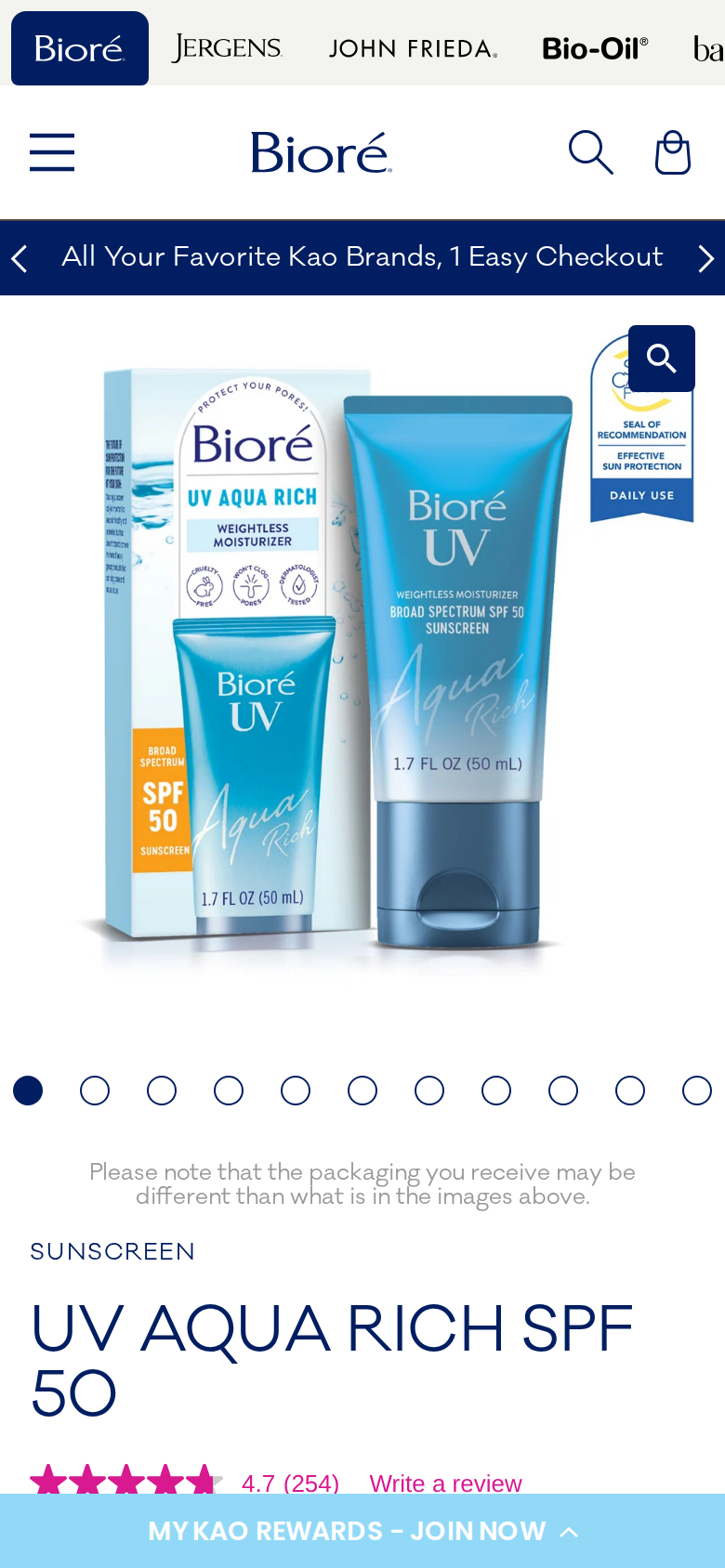
The US take on Japan's cult watery sunscreen uses four chemical filters and alcohol, costs $15.99 for 1.7 fl oz, and reportedly feels richer than the original.
Our verdict
A reasonably priced, invisible-feeling SPF 50 that suits normal to dry skin and wears well under makeup. The US formula is not the Japanese original, it uses alcohol and four chemical filters, and it is not water resistant.
Best forDaily commuters wanting a clear SPF 50 under makeup
What we liked
- Price of $15.99 for 1.7 fl oz is modest for a facial SPF 50
- Brand says no white cast on all skin tones
- Hydrating base with hyaluronic acid suits normal to dry skin
- Chemical filters leave no chalky film under makeup
What held it back
- Reviewers say the US version feels oilier than the Japanese original
- Alcohol denat is the first inactive after water, which can sting some skin
- Not labelled water resistant, so not for swimming or heavy sweat
The famous Japanese Biore sunscreen has an American cousin, and the two are not the same tube with a different label. The US version is a "hydrating facial moisturizer" with broad spectrum SPF 50, and it is sold in the States as a revamp of the cult original. Buyers who loved the Japanese watery essence should hear this first: the US formula is a reformulation, and reviewers who have tried both say it is not quite as light.
What the US label tells you
Biore's US page describes a sunscreen that "absorbs instantly on all skin tones with no white cast or greasy feel", with hyaluronic acid and what it calls micro gel capsules that cover the skin evenly. It lists the size as 1.7 fl oz at $15.99, and a higher $35 price also appears on the page. The brand says it is dermatologist tested, will not clog pores, works under makeup and suits sensitive skin.
The detail that matters most is in the drug facts. The active ingredients are four chemical filters:
Avobenzone 3%
Homosalate 10%
Octisalate 5%
Octocrylene 5%
There is no mineral filter in the formula. That is how it manages the invisible finish, because chemical filters absorb into skin and do not leave the chalky film that zinc oxide can. It also means it is not the pick if you react to chemical filters or want a mineral-only routine.