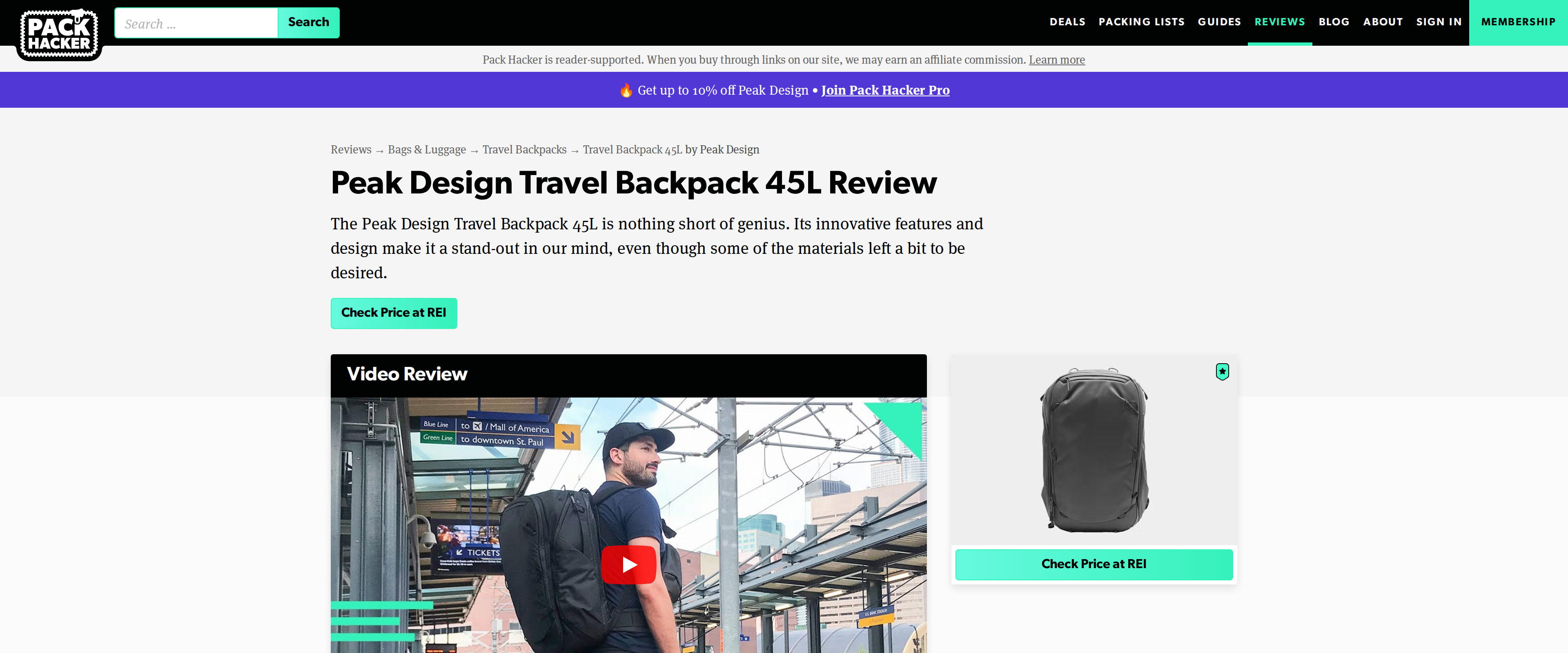
Peak Design Travel Backpack 45L Review: Worth the Hardware Premium?
The Travel Backpack 45L is the rare pack where the gimmicks actually work. MagLatch closes one-handed in a security line, the FlexFold dividers turn a top-loader into a real clamshell in seconds, and the lifetime warranty removes the usual risk of paying this much for a bag. It is heavier than a simple duffel-style pack and the hip belt does not adjust to different torso lengths, so a tall or short traveler should try one on first. We would buy this one again, but only in the 45L size: the tighter 30L compression this pack starts from makes the extra 15 liters worth carrying.
What works
- MagLatch buckle closes and cinches one-handed, faster than any clip-and-strap system we tested
- FlexFold dividers convert the main compartment between a duffel layout and full organization in under a minute
- 100% recycled 400D nylon shell shrugs off rain and shipped with a lifetime warranty
- Expands from a 30L carry-on-safe size to 45L for longer trips without a separate bag
What does not
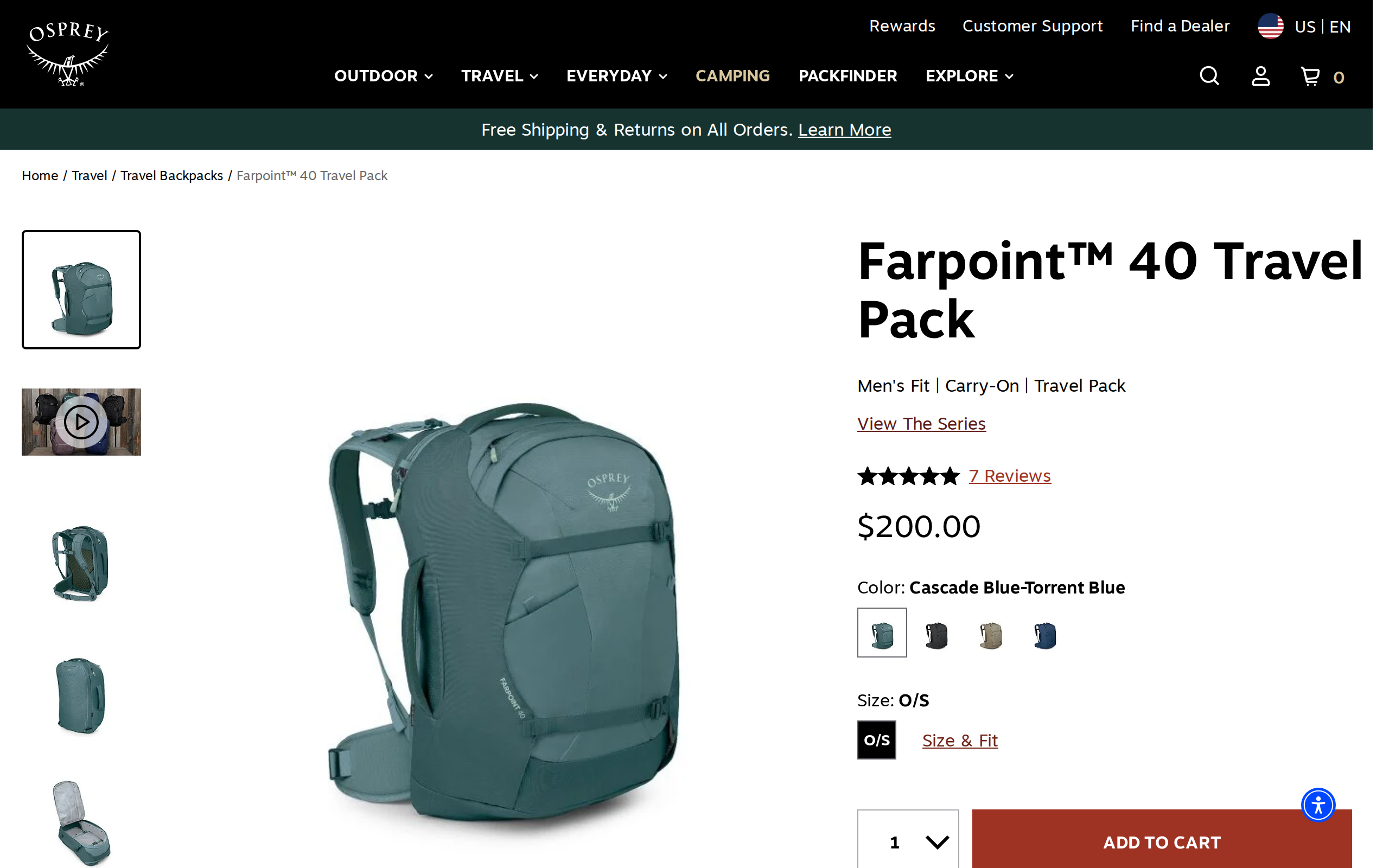
- At 4.5 lb (2.05 kg) empty, it is noticeably heavier than simpler packs like the Osprey Farpoint 40
- Hip belt has no torso adjustment, so fit is closer to one-size-fits-most than tailored
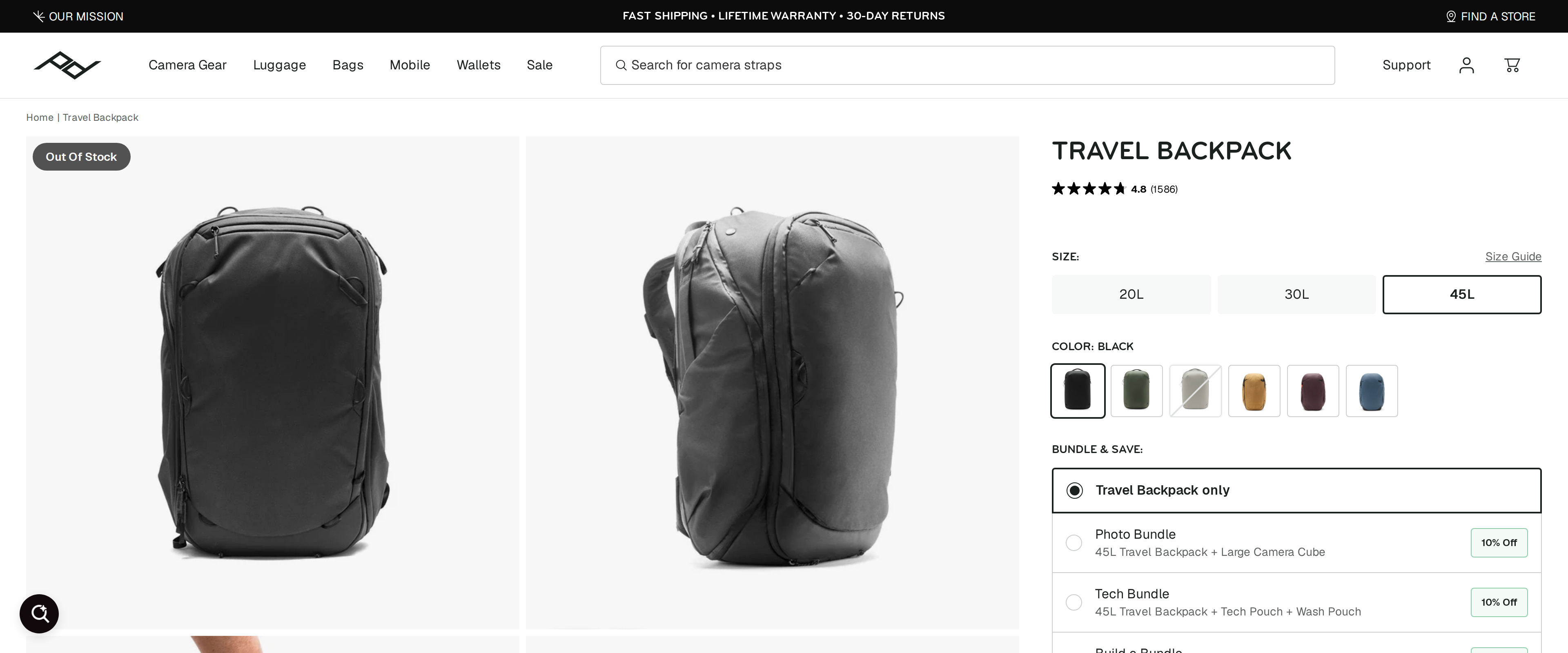
- $299.95 sits well above most 40 to 45 liter travel packs without built-in organization
- Once camera cubes go in, there is little room left for more than a few days of clothing
Peak Design built its name on camera straps and clips, then turned that hardware obsession loose on a travel backpack. The result costs $299.95, more than an Osprey Farpoint 40 or an Aer Travel Pack 3, and it wants you to pay for a magnetic buckle called MagLatch instead of a plain side-release clip. We carried the 45L version through a photo trip to Portugal and a string of short domestic flights to find out whether that buckle, and the rest of the hardware around it, is worth the jump.
The buckle that actually changes how you pack
MagLatch sounds like a marketing name until you use it at a security checkpoint with one hand full of a boarding pass. Pull the top strap and it cinches the main compartment closed and locks in place with a magnet-assisted click, no threading a strap through a frame buckle. It sounds small. After three weeks it was the one feature we missed on every other bag we own.
The FlexFold dividers do a similar trick for what is otherwise a top-loading shape. Fold them one way and the main compartment behaves like a duffel, one open space for a jacket and a pair of boots. Fold them the other way and you get a structured, three-section clamshell for shirts, a dop kit and a laptop sleeve. Switching takes under a minute and does not require removing anything from the bag first.
Size, weight and what 45L actually means
Peak Design sells one shell that compresses to 30L, sits at 35L in normal use, and expands to 45L when a second zipper is opened. That range is the whole pitch: pack it small for a carry-on-strict airline, expand it for a longer trip, and never own two bags. The tradeoff is weight. Empty, it comes in at 4.5 lb (2.05 kg), noticeably more than a simple soft-sided pack, because the shell, the buckles and the internal frame are all built to survive the same abuse Peak Design's camera bags are rated for.
The 100 percent recycled 400D nylon shell held up to a rain shower in Lisbon without a cover, and the weatherproof zips on all five access points (top, front, rear and both sides) never caught or stuck the way cheaper zips do after a few weeks of daily use.
Where the fit falls short
The hip belt does not adjust for torso length. Peak Design sells the pack in one size, and while the strap lengths flex, a traveler under 5'4" or over 6'2" should try it on before buying rather than trust the product photos. It is also not a pack for someone who plans to fill it with camera gear and still pack for a week: once a Camera Cube goes in the main compartment, what is left fits three or four days of clothing at most, not the "travel or everyday carry" range the marketing implies.
What the warranty is worth
Peak Design backs the bag with a lifetime warranty against manufacturing defects, matched by Osprey's guarantee but ahead of most competitors at this price, who cap coverage at one or two years. Combined with 30-day returns, the warranty removes most of the risk of spending $299.95 sight unseen. It does not cover the discomfort of a fixed hip belt on the wrong body, which no warranty fixes.
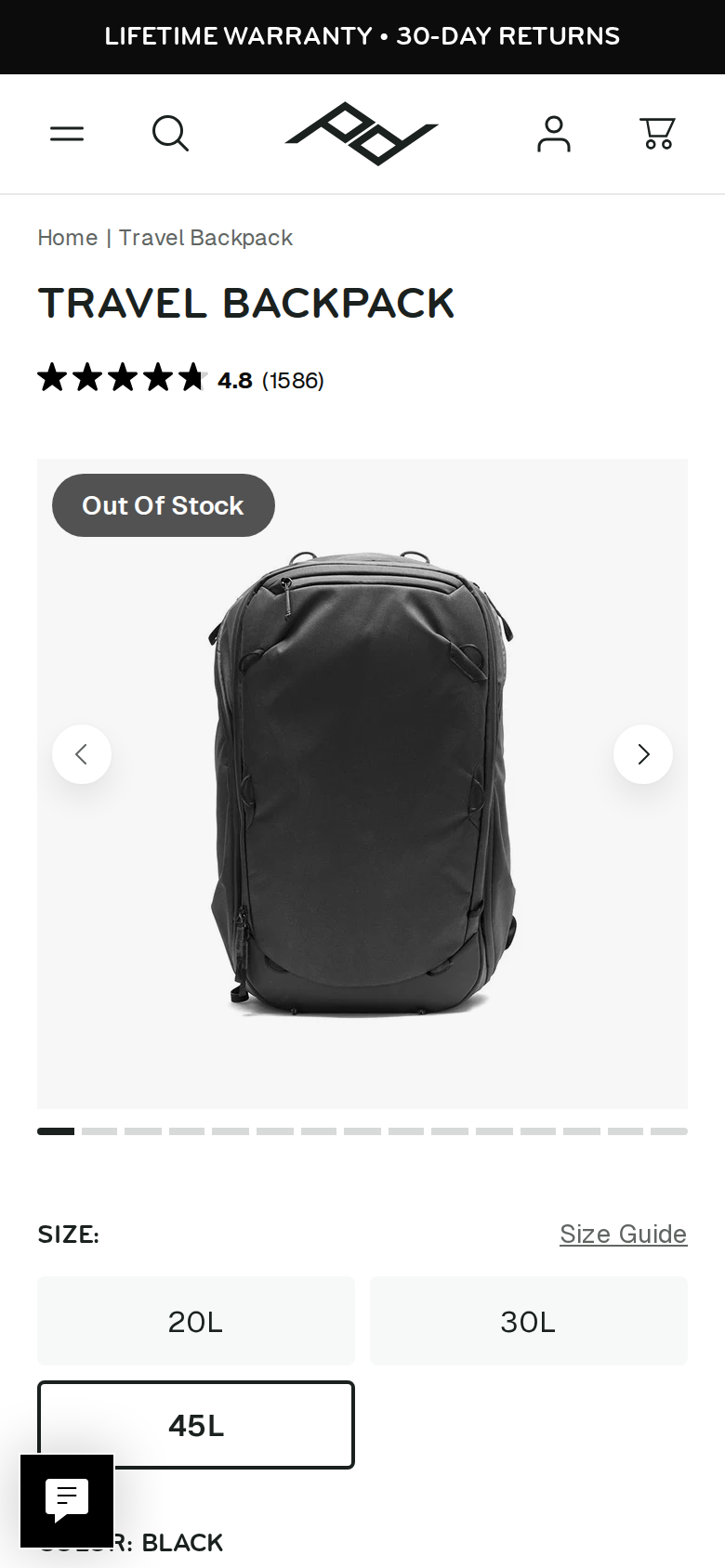
How it stacks up against the cheaper option
An Osprey Farpoint 40 costs roughly $100 less and weighs about a pound less too, so the comparison is not close on paper. What the Farpoint lacks is the side access panels, the tool-free FlexFold reconfiguration and the magnetic buckle, all of which matter more on a trip with ten border crossings than on one week at a beach resort. Buyers who travel two or three times a year will likely find the Farpoint's simplicity and lower price the smarter pick. Buyers who travel monthly, or who already own Peak Design camera bags and want the accessories to click into a matching system, get more use out of what the extra money buys here.
Would we buy it again
Yes, but only in the 45L size. The 20L and 30L versions compete with plain daypacks that cost half as much and do not need MagLatch to prove their worth. At 45L, the modularity, the weatherproof build and the warranty justify the premium over a Farpoint 40 for anyone who travels often enough to feel a zipper fail on a cheaper bag. Anyone who wants the lightest possible pack, or needs hip belt adjustment for a smaller frame, should look elsewhere first.
The specifications
- Capacity
- 30L compressed, 35L standard, 45L expanded
- Weight
- 4.5 lb (2.05 kg)
- Dimensions (standard)
- 22 x 13 x 9.5 in (56 x 33 x 24 cm)
- Dimensions (expanded)
- 22 x 13 x 11 in (56 x 33 x 29 cm)
- Material
- 100% recycled 400D nylon Versa Shell, weatherproof
- Laptop sleeve
- Padded, fits up to 16 inches, plus a separate tablet slot
- Access points
- Top, front, rear and both side panels via weatherproof zips
- Warranty
- Lifetime warranty against manufacturing defects