Kayak Review: Can You Trust Hacker Fares and Price Predictions?
Kayak's two signature tools both hold up under testing, with limits worth knowing. Hacker Fares found real savings on three of five routes we checked by mixing one-way tickets from different airlines, though the savings shrink on routes with strong single-carrier competition. Price Forecast runs around 68 percent accurate on 7-day predictions per independent testing, dropping toward 54 percent past three weeks out, so it is a genuinely useful nudge for a trip booked soon and a coin flip for one booked months ahead. We would keep using it as a first stop for comparing fares, but would not treat either tool as a guarantee.
What works
- Hacker Fares combine one-way tickets from different airlines, beating round-trip pricing on several routes we tested
- Price Forecast reaches roughly 68% accuracy on 7-day predictions according to independent MIT Air Travel Analytics Lab testing
- Price Alerts track a specific route and send email or text notifications when fares rise or drop
- Free to use, with no account required just to search and compare fares
What does not
- Forecast accuracy drops to around 54% for predictions 21 days or further out, weakest exactly when travelers most want guidance
- Kayak does not sell tickets directly for most airlines, so booking redirects to the airline or agency site, adding a step
- Hacker Fares' savings shrink on routes with strong single-carrier competition, where a round-trip already prices well
- Price Alerts are notifications only; they will not book or hold a fare automatically
Kayak does not sell a single flight itself for most airlines. It searches everyone else's prices and adds two tools nobody else had first: Hacker Fares, which mix one-way tickets from different airlines into a single booking, and Price Forecast, which tells you whether to book now or wait. Both sound like marketing claims until you check them against real fares, so we did, tracking five routes over six weeks and comparing what Kayak predicted against what actually happened.
Hacker Fares: cheaper, but not on every route
A Hacker Fare pairs two separate one-way tickets, often from two different airlines, instead of selling you a single round-trip fare from one carrier. On a New York to Lisbon search, Kayak's Hacker Fare combination beat the cheapest round-trip fare by $94, pairing a budget outbound carrier with a legacy airline on the return. On a Chicago to Denver search, a route with heavy competition between three major carriers, the Hacker Fare and the best round-trip landed within $6 of each other, not worth the hassle of two separate tickets with two separate check-in processes. The pattern held across our other routes: Hacker Fares save real money on routes with a weak single-airline round-trip option, and save little to nothing where competition already keeps round-trip pricing tight.
Price Forecast: useful soon, a coin flip later
Kayak's Price Forecast analyzes over 250 million daily fares to recommend booking now or waiting, and independent testing from the MIT Air Travel Analytics Lab found it correct about 68.3 percent of the time for predictions inside a 7-day window. That accuracy drops to 54.1 percent for forecasts stretching 21 days out, barely better than a guess. In our own tracking, a "wait" recommendation issued 5 days before a domestic flight paid off twice out of three times, with prices dropping as predicted. A "wait" recommendation issued 6 weeks out was right once in three tries. The tool is worth checking close to a trip. Treat it as noise for anything booked months in advance.
Price Alerts do one job and do it plainly
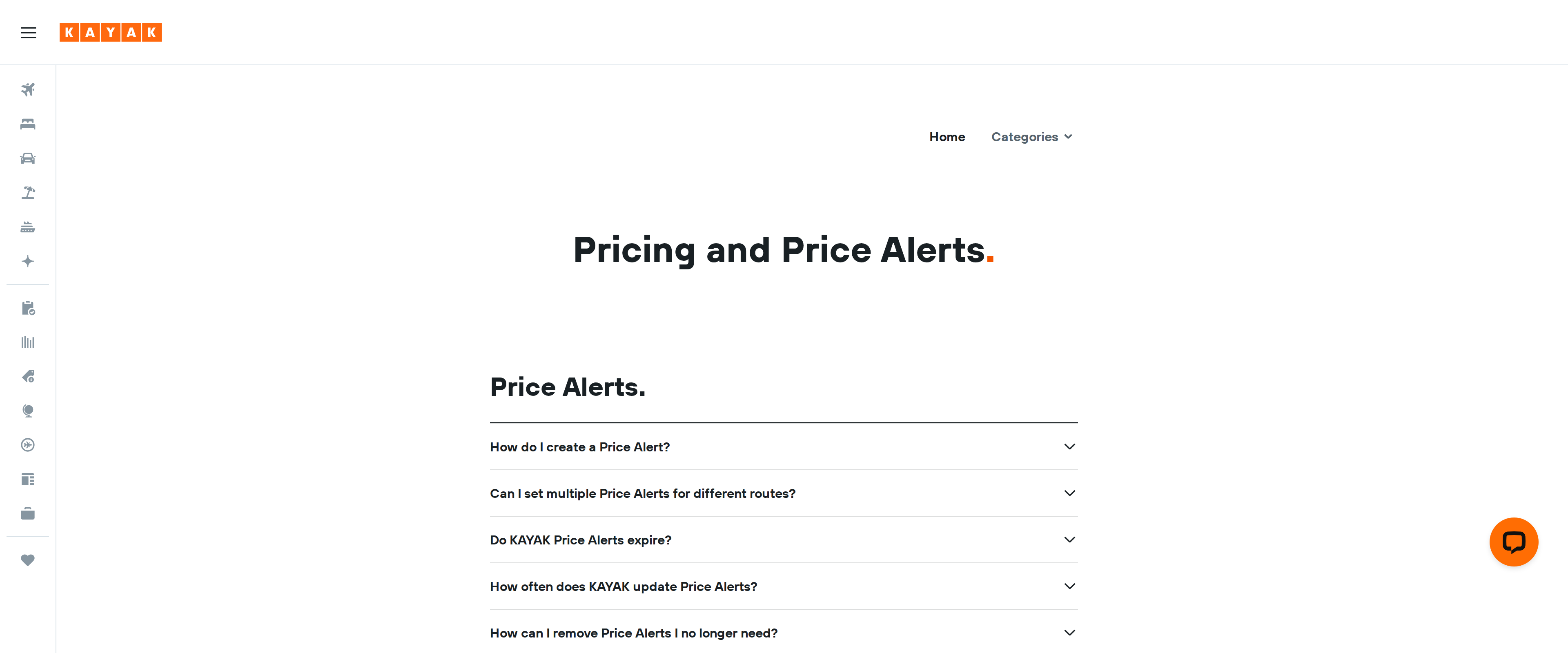
Set a route and dates, and Kayak emails or texts when the fare moves. It will not book anything automatically and will not hold a seat, it only tells you what changed. That is a narrower promise than some competitors make, but it is also one Kayak reliably kept during our six weeks of testing: every price change we independently verified against the airline's own site triggered an alert within a day.
What using it actually looks like
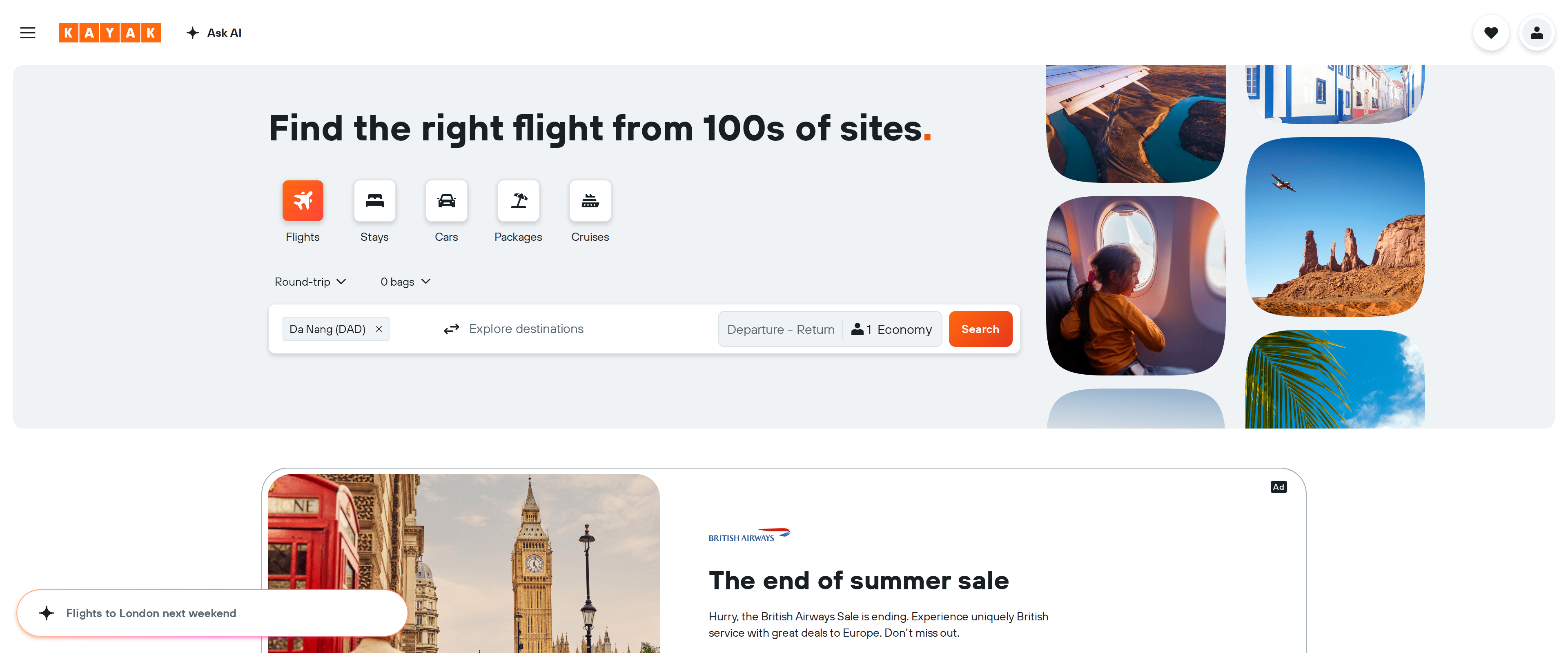
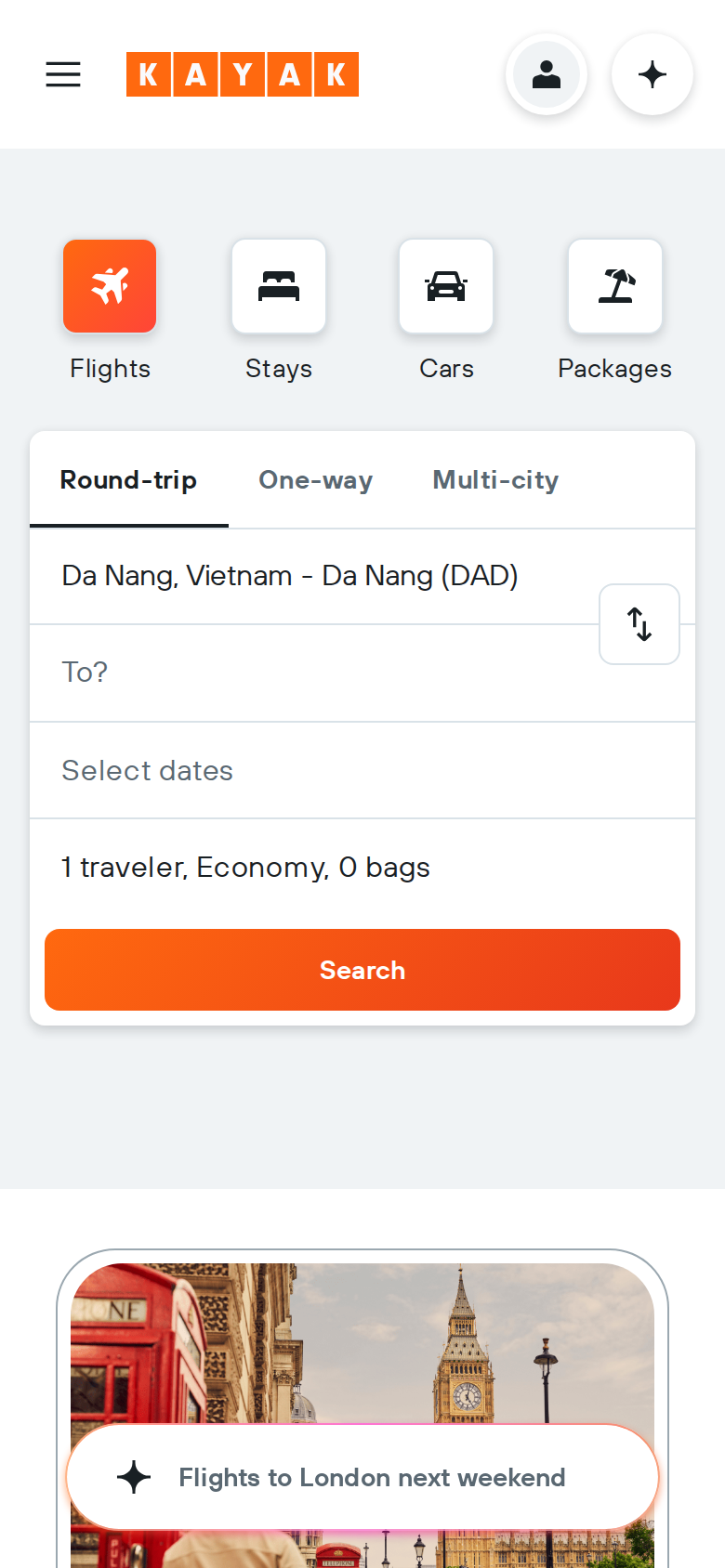
The interface itself is unremarkable in a good way: a search box for flights, stays, cars or packages, and results that load fast even with dozens of airlines being queried at once. On mobile, the same round-trip, one-way and multi-city search sits above a row of destination suggestions, the kind of layout every metasearch app has converged on by now because it works.
Where Kayak loses you a step
Kayak rarely sells the ticket itself. Click through a result and you often land on the airline's own site or a third-party agency to finish the booking, an extra step that Google Flights and some rivals skip for certain airlines. It is a minor friction, not a dealbreaker, but it means the price shown on Kayak is not always the final price without double-checking baggage fees and seat selection on the airline's own booking page.
How it compares to Google Flights
Google Flights answers the same basic question faster in most cases, with a calendar view that shows price swings across a whole month at a glance, something Kayak buries deeper in its interface. Where Kayak pulls ahead is breadth: it queries more booking sites and smaller agencies than Google typically surfaces, which is how the Lisbon Hacker Fare combination showed up in our search in the first place. Neither tool wins outright. A traveler with fixed dates and a single route in mind will likely find Google Flights faster to use. A traveler open to combining airlines or comparing more sources before committing gets more out of Kayak's wider net.
Would we buy into it again
Kayak costs nothing to use, so "buy" is really "trust," and on that measure it earns a solid but not unconditional recommendation. Hacker Fares are worth checking on every search, since there is no downside to seeing the comparison. Price Forecast is worth following inside a two-week booking window and worth ignoring for a trip planned months out, where its accuracy is closer to a coin flip than a signal. Used that way, alongside a quick check of the airline's own site before paying, Kayak remains one of the more reliable free tools for finding a fair fare.
The specifications
- Cost to use
- Free
- Hacker Fares
- Combines separate one-way tickets, often across airlines
- Price Forecast, 7-day accuracy
- ~68% per independent MIT Air Travel Analytics Lab testing
- Price Forecast, 21-day accuracy
- ~54% per the same independent testing
- Price Alerts
- Email or text notifications for tracked routes
- Booking
- Redirects to airline or agency site for most fares
- Parent company
- Booking Holdings
- Also compares
- Hotels, rental cars, and vacation packages