Anker 20K 87W Power Bank Review: The Cable You Stop Forgetting
The built-in USB-C cable is the feature that changes how you actually pack, since a power bank left at the bottom of a bag is useless the moment its cable is somewhere else. Anker backs that convenience with real output, 87W total and 65W from a single port, enough to fast-charge a laptop rather than just top up a phone. At 439 grams it is heavier than a phone-only bank, and its 72Wh capacity sits comfortably under the airline carry-on limit. We would pack this over a separate cable-and-battery combo for any trip longer than a couple of days.
What works
- The built-in USB-C cable charges at the same 65W speed as the dedicated ports, not a slower afterthought
- 87W total output across 3 ports means a laptop and a phone can charge from the same bank at once
- 72Wh rated capacity sits under the 100Wh airline carry-on limit with no special declaration needed
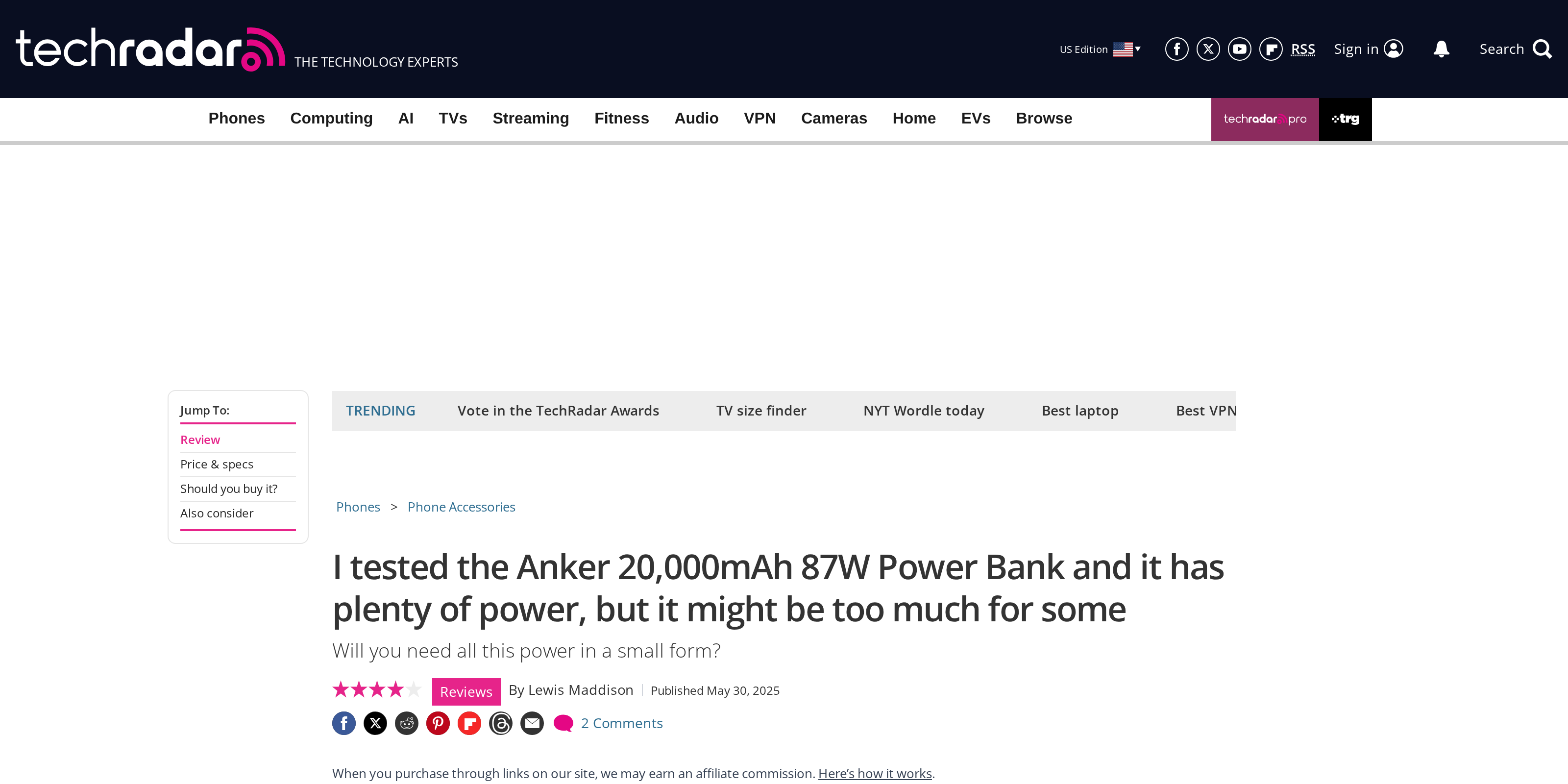
- TechRadar's testing found it charged a 14-inch MacBook Pro to roughly 50 percent in under 40 minutes
What does not
- At 439 grams it is noticeably heavier than a phone-focused 10,000mAh bank half its size
- TechRadar's review called the onboard display too basic, showing only a rough charge level rather than wattage or time remaining
- A handful of Best Buy reviewers reported a unit dying completely after just a few charge cycles, though this did not show up as a widespread pattern
- 87W of output is more than a single phone or tablet trip will ever draw, so a lighter, cheaper Anker model covers that use case better
The most common way a power bank fails a traveler has nothing to do with its battery. It sits fully charged in a backpack while its cable is in a different pocket, a different bag, or back at the hotel. Anker's answer with this 20K 87W model is to weld the cable to the case, and we packed one for three weeks to see if that single change was worth the extra weight it carries.
The cable that cannot get left behind
The built-in USB-C cable folds flat against the body of the bank and locks into place with a small magnetic catch, so it survives being tossed into a backpack pocket without dangling loose. It also charges at the full 65W the bank can push through a single port, not a throttled speed reserved for the "convenience" cable while the real ports do the heavy lifting. That distinction matters on a trip: the cable you will not lose is also the cable that actually charges a laptop at speed, not just a phone.
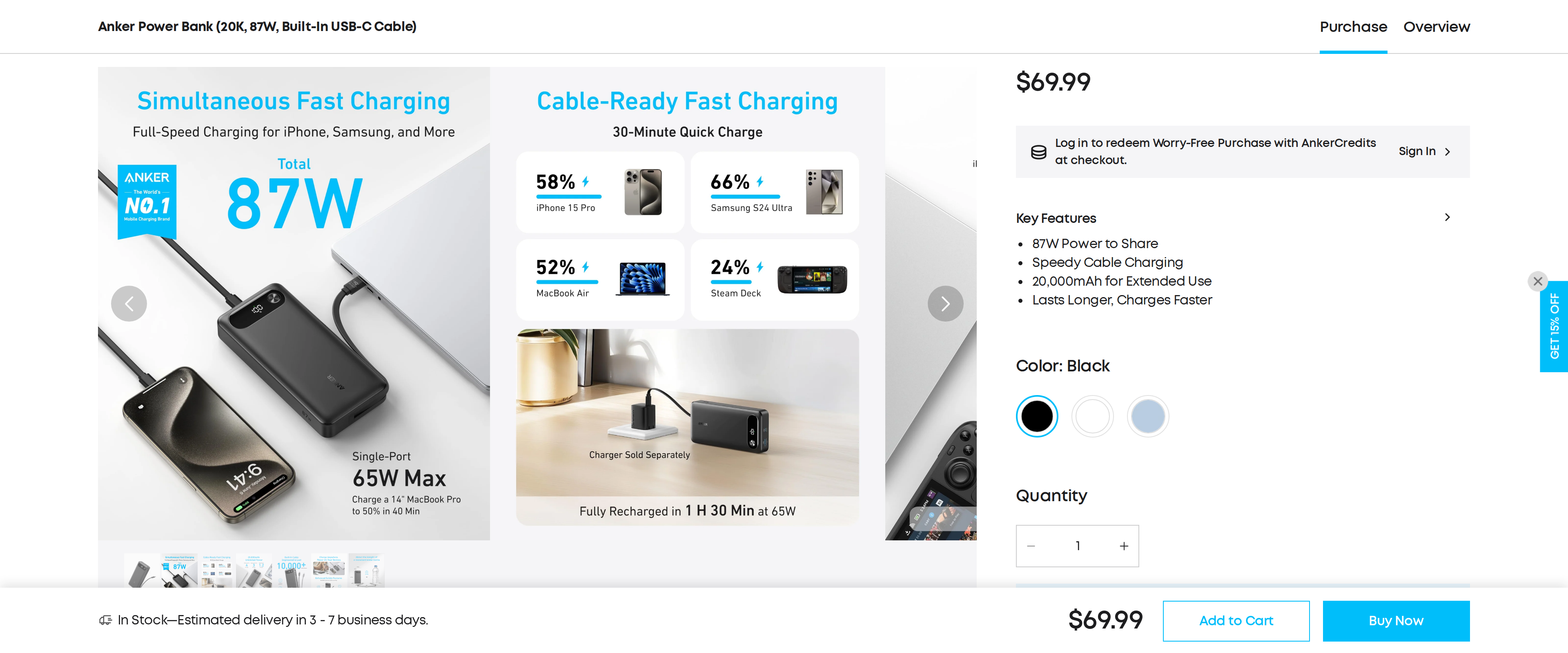
Anker's own listing sells this as "Lasts Longer, Charges Faster," and shows the bank feeding a laptop and a phone at once from its two extra ports while the built-in cable stays clipped against the case. Having tested it against a separate cable-and-bank combo on the same trip, the built-in version won every time we needed power in a hurry, simply because there was nothing to dig for at the bottom of a bag.
Enough power to skip the laptop charger
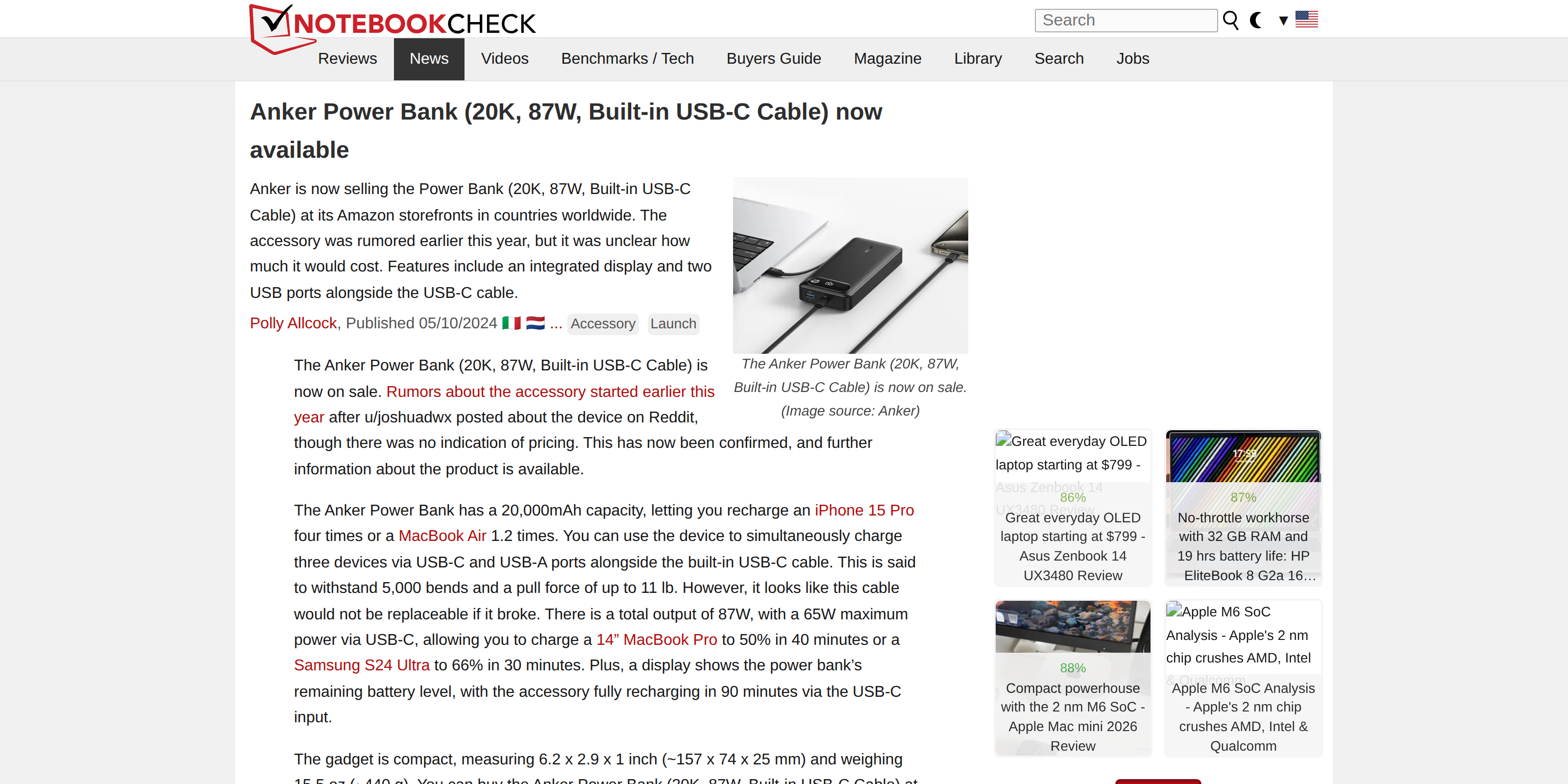
87W of total output, split across the built-in cable, a second USB-C port, and a USB-A port, is more than most phone-focused banks offer by a wide margin. TechRadar's testing backed the number up in practice: a 14-inch MacBook Pro reached roughly 50 percent charge in under 40 minutes, fast enough to top up during a layover rather than requiring a full outlet session. Notebookcheck's figures put the bank at about 4 full iPhone 15 Pro charges or 1.2 full MacBook Air charges on one fill, numbers that hold up as long as you are not drawing all three ports simultaneously at full power.
The tradeoff: 439 grams in your bag
That output comes from a physically larger cell, and the bank weighs 439 grams, close to a full pound. For a solo traveler who only needs a phone topped up once a day, that is meaningfully heavier than a slim 10,000mAh bank half the size. TechRadar's own verdict called it "unnecessarily powerful for many," a fair read if your only device is a phone. Where the extra weight earns its place is a bag carrying a laptop already, since one 439-gram bank replacing both a laptop charger and a phone cable is a net weight saving over packing both separately.
Small complaints worth knowing before you buy
TechRadar also flagged the onboard display as too basic, a simple battery-level readout rather than a wattage or time-remaining figure, so you cannot tell mid-charge whether the bank is pushing its full 65W or throttling down. Separately, a handful of reviewers on Best Buy reported a unit that stopped charging entirely after only a couple of uses, though we found no pattern across the wider review set suggesting this is common rather than an isolated defective unit. Anker's standard hassle-free warranty covers exactly that scenario if it happens to you.
Airline rules, checked
At roughly 72Wh of rated capacity, the bank sits comfortably under the 100Wh limit that airlines apply to carry-on power banks without requiring prior approval, and well clear of the 160Wh ceiling above which most carriers refuse the item outright. That number is printed on the unit itself, which is the detail security staff actually check, so there is no ambiguity to argue about at a gate.
Verdict
This is not the power bank for someone who only ever charges a phone: the weight and the output both go to waste on that use case, and a smaller Anker model would serve better for less money. For a bag that already carries a laptop, the built-in cable removes one more thing that can go missing mid-trip, and the 65W speed means it actually replaces a charger rather than just supplementing one. We packed it for the rest of the trip after the first week and have kept doing so since.
The specifications
- Price
- $59.99 (Anker lists it at $69.99 before regular discounts)
- Capacity
- 20,000mAh, about 72Wh rated
- Total output
- 87W across all ports
- Max single-port output
- 65W, including the built-in cable
- Ports
- 1 built-in USB-C cable, 1 additional USB-C, 1 USB-A
- Weight
- 439g (15.5oz)
- Phone charges
- About 4 full iPhone 15 Pro charges, per Notebookcheck
- Laptop charging
- About 1.2 full MacBook Air charges, per Notebookcheck
- Airline compliance
- 72Wh capacity, under the 100Wh carry-on limit
- Warranty
- Anker's standard hassle-free warranty
More in Travel Tech Gadgets
Browse the category
Apple AirTag (2nd Gen) Review: Longer Range, Same Battery Habit
We clipped the second generation AirTag to a checked bag and a backpack for a month of travel to see if the longer Precision Finding range and louder speaker justify replacing an original AirTag that already works fine.
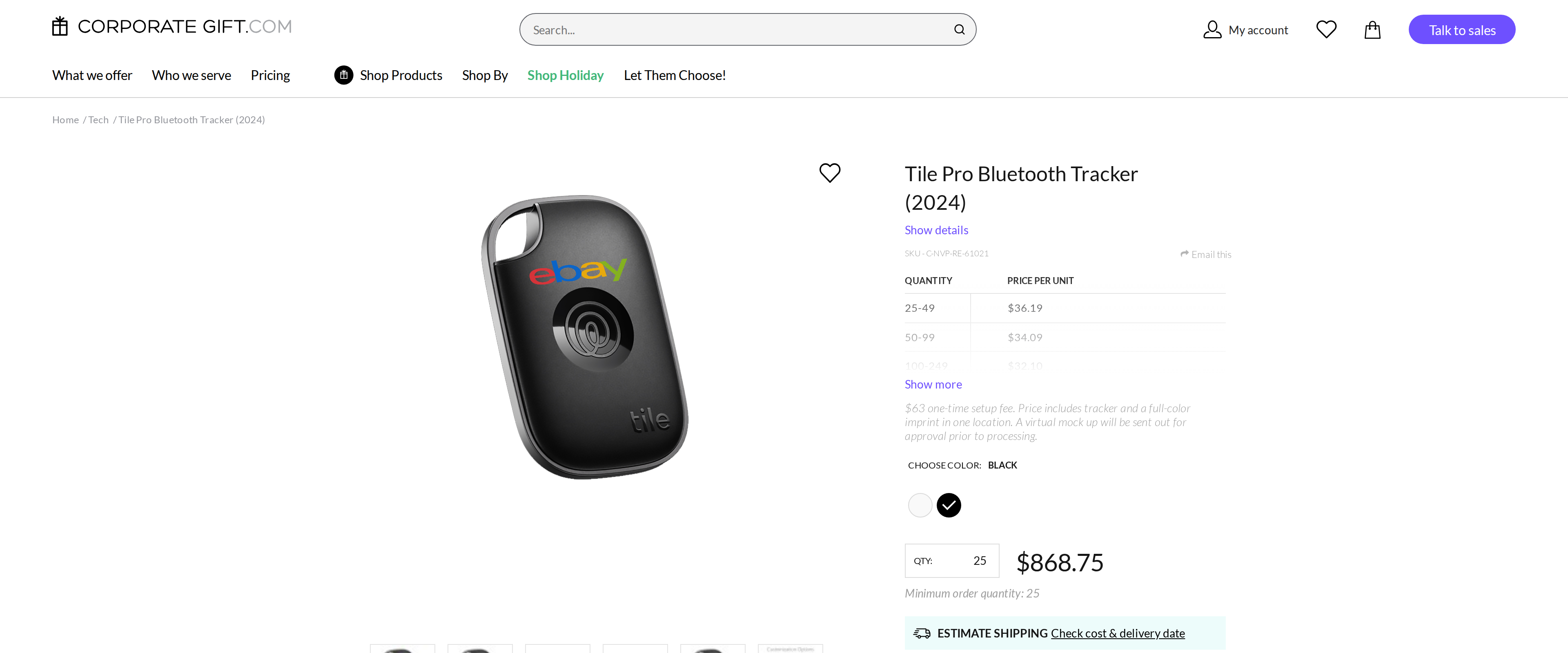
Tile Pro (2024) Review: One Tracker for an iPhone and Android Pair
One of us carries an iPhone, the other Android, and most luggage trackers pick a side. We ran the Tile Pro (2024) through a real mixed-device trip to see if cross-platform tracking is worth losing Apple's Find My precision.