The verdict
The Water Cream is a very good silicone-and-rice-ferment gel with colloidal gold at position eleven and a real fragrance load. Buy it for the texture and buy the refill second time round, buy the Rice Polish, and ignore everything above $110.
What works
- Full ingredient lists published for every product, which is rarer at this price than it should be
- The Water Cream's gel-to-water break is genuinely hard to formulate and easy to recognise
- Refill pods now cover three jar moisturisers, which is a commitment rather than a gesture
- Beautiful Faces, Beautiful Futures has funded over ten million days of school with Room to Read since 2014
What does not
- Colloidal gold sits eleventh in the Water Cream with no demonstrated function whatsoever
- Parfum, alcohol, limonene, linalool and citral in a range recommended for sensitive skin
- Hadasei-3 carries untestable claims: no concentration and no clinical work on the complex is published
- Nothing above about $110 buys more skincare than the product below it — Ageless is a positioning price
Tatcha is a San Francisco company that sells Japanese skincare. Both halves of that sentence are true, and the space between them is most of this review. Vicky Tsai founded it in 2009 after a trip to Kyoto and a 200-year-old beauty manual; Unilever bought it in 2019 in a deal widely reported at around $500 million; the products are made to a standard a lot of prestige skincare does not reach.
We spent our time on the two products that carry the brand — The Water Cream and The Dewy Skin Cream, both $74 for 50 ml — and on the ingredient lists Tatcha publishes in full. Publishing them at all is to its credit, and rarer at this price than it should be. What they say is more complicated.
What is actually in The Water Cream
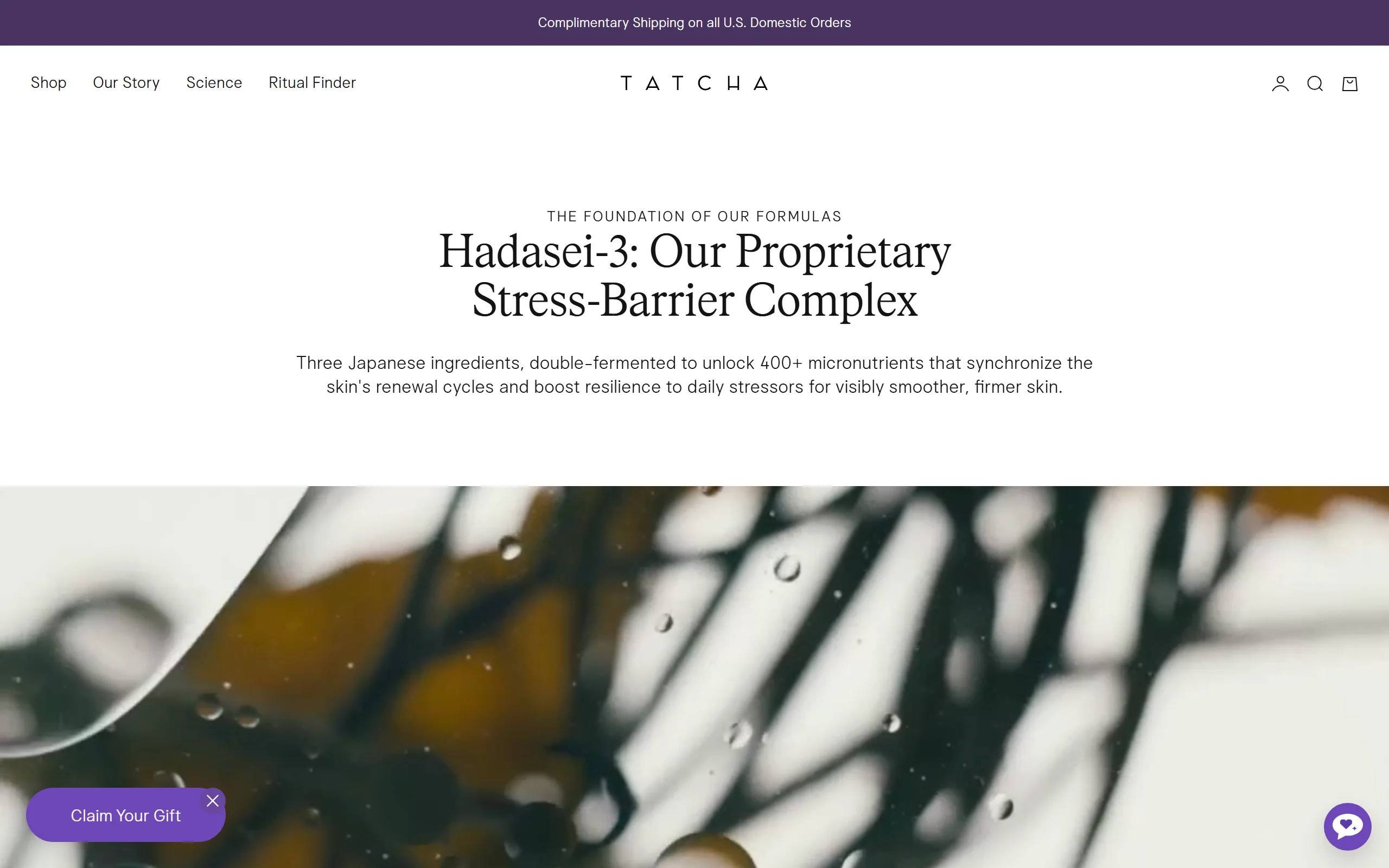
The Water Cream is the best seller: 50 ml for $74, 4.5 stars across 5,442 reviews on Tatcha's own site, $66.60 on subscription. It is sold as a pore-refining moisturiser for oily and combination skin, and on that narrow brief it is genuinely good. The texture is the reason people repurchase — it breaks from a firm gel to water under a fingertip and leaves no film at all, which is a hard thing to formulate and an easy thing to recognise.
The list opens: water, Saccharomyces/rice ferment filtrate, dimethicone, propanediol, glycerin, diglycerin, diphenylsiloxy phenyl trimethicone. That is a silicone-and-humectant gel built on a rice ferment. It is a respectable way to make a light moisturiser and it is broadly what you would find in a well-made Japanese gel cream at a third of the price.
Two things further down deserve naming. The eleventh ingredient is gold — colloidal gold, in a face cream, with no demonstrated function whatsoever. And the tail of the list reads parfum, alcohol, limonene, linalool, citral: a real fragrance load in a product the brand recommends for sensitive and reactive skin. Tatcha is not unusual in any of this. It is unusual in charging $74 for it.
Hadasei-3, and the 400 micronutrients
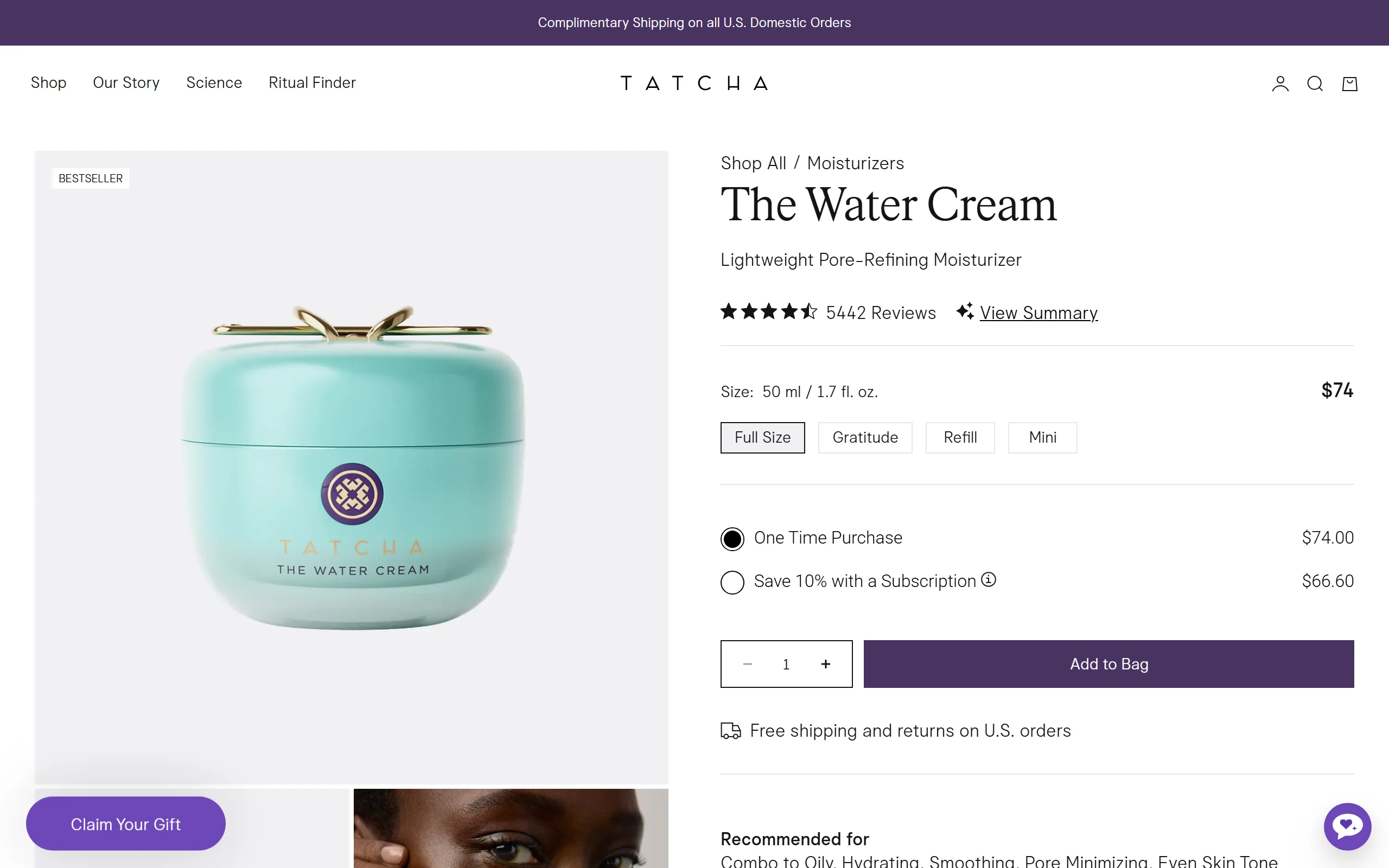
Every Tatcha face product carries Hadasei-3, which the brand's own explainer page describes as three Japanese ingredients "double-fermented to unlock 400+ micronutrients that synchronize the skin's renewal cycles." The three are green tea, rice and Okinawa algae: Camellia sinensis leaf extract, the Saccharomyces/rice ferment filtrate, and Cladosiphon okamuranus extract. You can find all three in the Water Cream list, at positions two, eight and nine.
So the complex exists and it is high in the formula, which is more than most trademarked complexes manage. The trouble is the sentence wrapped around it. "Synchronize the skin's renewal cycles" is not a claim anybody can test. "400+ micronutrients" is a count of compounds detectable in a ferment, not a measure of anything reaching skin. Tatcha publishes no concentration for Hadasei-3 in any product and no clinical work on the complex itself.
Fermented rice filtrates are not nonsense. They are humectant, mildly antioxidant, and the reason Japanese essences work as well as they do. They are also the backbone of products costing under $20. What the premium buys here is the trademark, the jar and the copywriting.
The range, and where it stops making sense
The bottom of the range is the sane part. The Rice Wash soft cream cleanser is $40, the Matcha Foam Cleanse the same, the Indigo Cleansing Balm $39 and the Camellia Cleansing Oil $50. The Rice Polish: Classic, a foaming enzyme powder, is $69 and is the product we would actually recommend to someone curious about the brand — powder exfoliants are hard to buy well and this is one of the good ones.
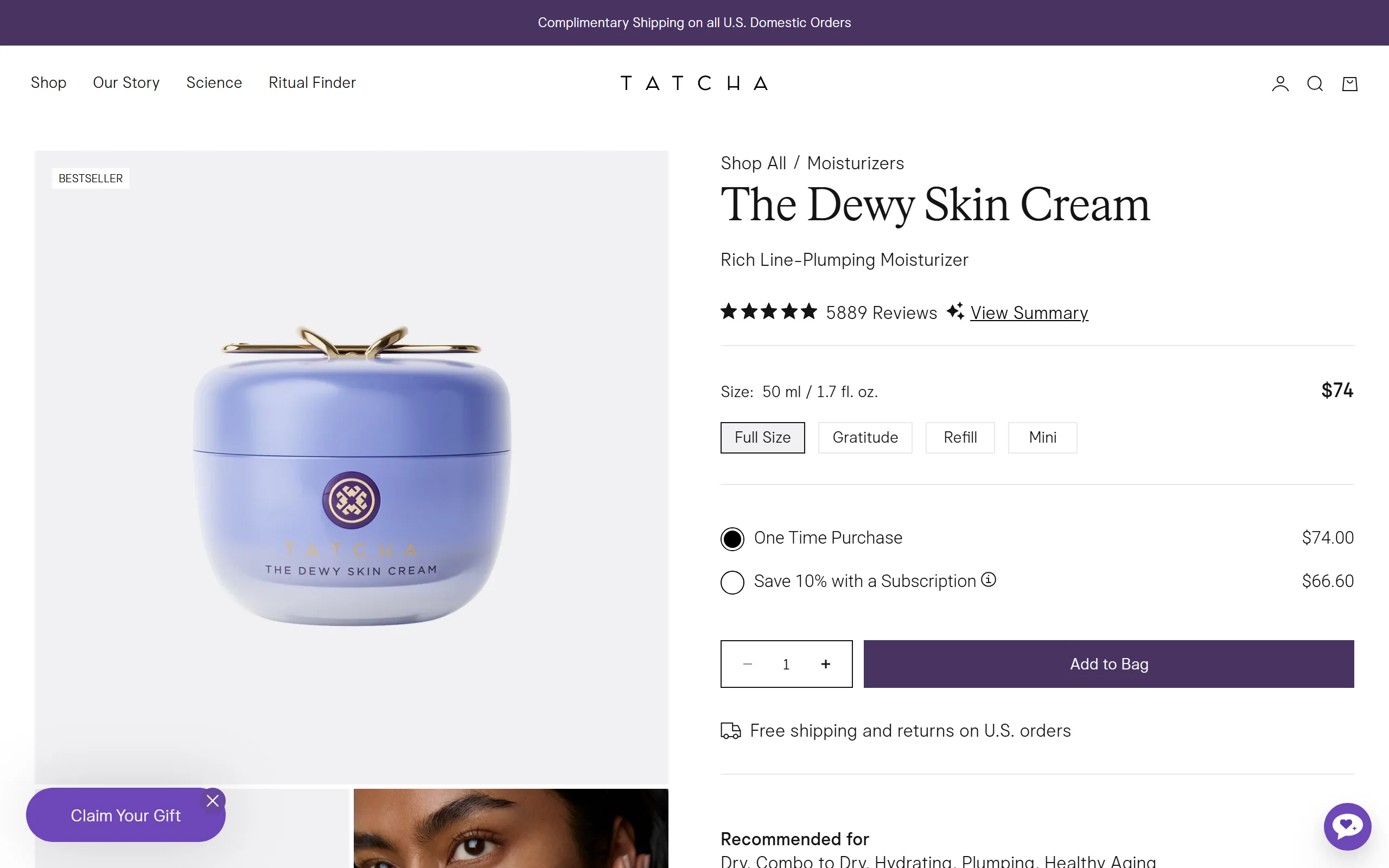
The middle holds together too. The Dewy Skin Cream is $74 for the same 50 ml as the Water Cream, with 5,889 reviews and a much richer, plumper finish; The Dewy Serum is $89, The Silk Serum $99, The Essence $110. Around there the logic changes. The Silk Cream is $125. Ageless Revitalizing Eye Cream is $144. Ageless Enriching Renewal Cream is $198 — which is not a skincare price, it is a positioning price, set against La Mer and Sisley rather than against anything in the formula.
Our position: nothing above about $110 in this range is buying more skincare than the thing below it.
The refills are the best decision the brand has made
A lot of what $74 buys is the container: a weighted jar with a gold clasp that is unmistakably the point of the purchase for a good number of customers. Tatcha now sells refill pods for the three jar moisturisers — the Water Cream, the Dewy Skin Cream and the Longevity Memory Cream — so the jar is bought once and refilled after that.
Refills are easy to announce and hard to sustain, and most brands that launch them quietly limit the programme to one hero product. Three is a commitment. It is also the single change that most improves the value case here, and it has had a fraction of the marketing that Hadasei-3 gets.
Room to Read
Beautiful Faces, Beautiful Futures has run with Room to Read since 2014 and has funded, by the two organisations' own reporting, more than ten million days of school for girls. Tsai sits on Room to Read's board and has stayed with the programme through the Unilever acquisition.
We are habitually unkind about beauty philanthropy because most of it is a line on an about page with no number attached. This one is twelve years old, tied to a named partner, and reported in units that can be checked. It is the most substantive thing the brand does that is not a product, and it survived a change of owner, which is the real test.

The verdict
Buy The Water Cream if the texture is what you want, and buy the refill the second time. Buy the Rice Polish. Try the Rice Wash at $40 before anything else in the range, because it is the cheapest honest introduction to how the brand actually formulates.
Do not buy the Ageless range. And do not buy anything here on the strength of Hadasei-3, because the brand has never published a number that would let you judge it. What Tatcha genuinely sells is texture, restraint and a very well-made jar — which is a real thing to sell, and a more defensible one than the science it puts on the front of the box.
Prices, formulas and ownership were checked against the brand's own site on September 18, 2026 and change without notice. Screenshots in this review were captured by Shelfproof from public pages. Cosmetic ingredients affect people differently — this is consumer research, not medical, dermatological or legal advice.