The verdict
Genuinely different chemistry with genuinely mixed outcomes. The Full and No Frizz lines do something no silicone-based product does, which is worth the premium if that is your problem. Everything else is priced as though it were equally novel, and it is not.
What works
- Silicone-free formulations that do not weigh fine hair down over repeated washes
- OFPMA in the No Frizz range is a genuine humidity shield rather than a coating
- Full Dry Volume Blast is one of very few volumisers that does not leave hair crunchy
- Perfect hair Day Dry Shampoo absorbs well without heavy white cast
What does not
- Coarse, thick or very curly hair frequently gets nothing from the silicone-free approach
- $32 for shampoo when the differentiating chemistry is in the styling products
- Restore line for damaged hair is unremarkable against Olaplex and K18
- Heavy fragrance across the range with no fragrance-free option
Most haircare works by putting silicone on your hair. Silicones are excellent: they smooth the cuticle, add shine, reduce friction and make hair easier to comb. They also build up, and on fine hair that build-up is the difference between hair with body and hair that hangs.
Living Proof was founded in 2005 by a group that included MIT chemists and the biotech investor Robert Langer, and its founding argument was that you could get the benefits of silicone from molecules designed for the job rather than borrowed from the lubricant industry. That argument is the brand, and it holds up in exactly two places.
Where it works: No Frizz
The No Frizz line uses OFPMA — a healthy-hair-molecule the company developed — which forms a thin, non-occlusive barrier that repels humidity rather than sealing the hair shaft. The practical difference is that hair treated with it stays smooth in humidity without feeling coated, and the effect does not compound into greasiness over a week.
For fine-to-medium hair that frizzes, this is a genuinely better answer than a silicone serum. For thick, coarse or tightly curled hair, silicone is frequently the better answer and No Frizz will underdeliver.
Where it works: Full
The Full line uses a patented thickening molecule that increases the apparent diameter of each strand rather than gluing strands together with polymer. Full Dry Volume Blast is the standout — a dry texture spray that adds body without the crunch and grit that most volumising sprays leave behind. At around $32 it is expensive and there is not a close substitute.
Where it is ordinary
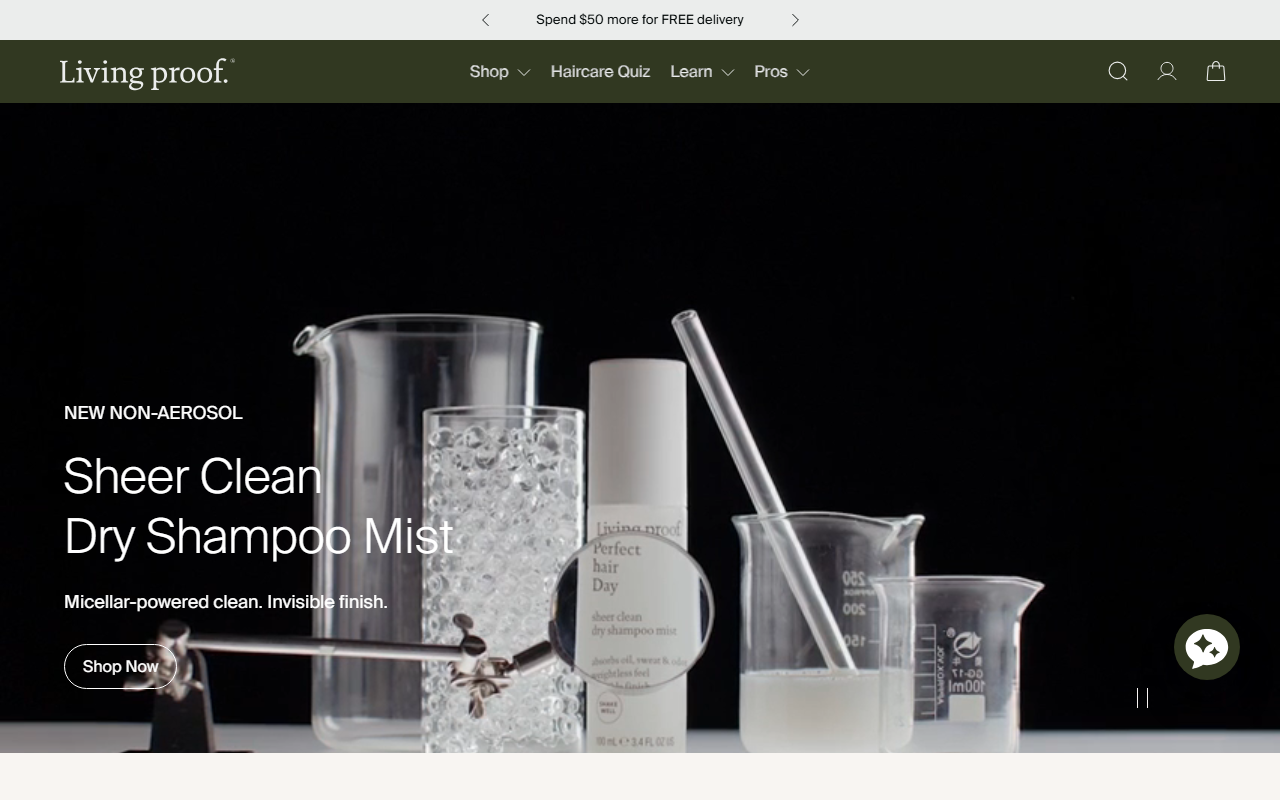
Perfect hair Day (PhD) is the brand's bestseller and the line we are least convinced by. The 5-in-1 Styling Treatment and the shampoo are perfectly good, unremarkable products at a meaningful premium. The dry shampoo is the exception and is genuinely one of the better ones — it absorbs oil properly and leaves less cast than most.
Restore, the damage-repair line, is the weakest. Against Olaplex's bond chemistry and K18's peptide, a conventional repair conditioner priced at $36 does not make an argument. If your hair is actually damaged, this is not where to spend.
Curl is decent and clearly a secondary priority for the brand.
Transparency
Reasonable. Living Proof names its proprietary molecules, explains the mechanism, and is clear about the silicone-free positioning and why it took that route. What it does not do is publish concentrations, and it does not flag fragrance prominently despite using a lot of it — there is no fragrance-free option anywhere in the range, which for a brand positioned on scientific rigour is an odd gap.
Ownership
Unilever acquired Living Proof in 2016. The formulas do not appear to have been cheapened, and distribution has widened. Standard conglomerate ownership, disclosed, no particular concerns.
The silicone argument, fairly stated
Living Proof's founding premise deserves examining rather than accepting, because a lot of haircare marketing has since borrowed it badly.
Silicones are not harmful. Dimethicone is inert, non-irritating and extremely good at reducing friction between hair fibres, which is why it appears in almost every conditioner on earth. The genuine objection is narrower: heavier silicones are not water-soluble, so they accumulate over repeated washes unless you clarify, and accumulated silicone on fine hair reads as limpness.
That is a real problem for a specific group of people — fine hair, low porosity, washing with a sulphate-free shampoo that will not strip build-up. For everyone else, the solution is a clarifying wash every couple of weeks, not a whole silicone-free regimen.
Living Proof is worth the premium if you are in that group. It is not worth it because silicones are bad, and the brand's marketing does sometimes drift toward implying they are. A science-led company should be the one drawing that distinction most carefully.
Price
$26 to $48. The value score is the lowest thing here, and the reason is structural: the differentiating chemistry lives in three or four styling products, but the whole range is priced as though all of it were equally novel. A $32 shampoo has to be doing something unusual, and most of these are not.
The verdict
If you have fine hair that goes flat, buy Full Dry Volume Blast. If you have fine-to-medium hair that frizzes in humidity, buy No Frizz. If you have coarse or curly hair, or damaged hair, buy something else — the silicone-free premise that makes this brand useful to one group makes it actively less useful to others.
It is a science brand whose science applies narrowly. That is not a criticism of the science.
Prices, formulas and ownership were checked against the brand's own site on June 4, 2026 and change without notice. Screenshots in this review were captured by Shelfproof from public pages. Cosmetic ingredients affect people differently — this is consumer research, not medical, dermatological or legal advice.