The verdict
The most consistently excellent sensitive-skin range on the mass market, held back in the United States by a sunscreen filter list that has nothing to do with the brand. If you can shop the European catalogue, La Roche-Posay is close to unimprovable at the price.
What works
- Anthelios UVMune 400 with Mexoryl 400 is genuinely best-in-class UVA protection where it is sold
- Cicaplast Baume B5 is the rare 'do everything' balm that actually does
- Full ingredient lists, allergen declarations and tolerance testing published as standard
- Effaclar Duo+ and the adapalene gel cover acne properly rather than gesturing at it
What does not
- The US line-up is a materially weaker product than the European one under the same names
- Thermal spring water is doing more marketing work than dermatological work
- Prices have crept upward faster than formula changes justify
- Packaging is medical to the point of being unpleasant to use daily
There is a version of this review that gives La Roche-Posay a nine and stops. It is the version written by someone who buys their sunscreen in a French pharmacy.
The brand takes its name from a spa town in central France whose thermal water it still puts in most of its products. The water is the marketing. The reason dermatologists recommend the brand has almost nothing to do with it and almost everything to do with the fact that La Roche-Posay has spent forty years building formulas around tolerance — short ingredient lists, no unnecessary fragrance, allergen declarations printed where you can find them, and clinical tolerance testing on genuinely compromised skin rather than on a panel of people with perfect faces.
Anthelios, and the filter problem
Anthelios is the reason to care about this brand. The UVMune 400 formulas use Mexoryl 400, a filter L'Oréal developed specifically to close a gap in long-UVA coverage that almost every other sunscreen leaves open. Combined with Tinosorb S and Uvinul A Plus, it produces protection across the UVA1 range that American sunscreens simply cannot match.
Americans cannot buy it. The FDA's approved filter list has been effectively frozen since 1999, so the US Anthelios products are built from avobenzone, homosalate and octisalate — an older, less photostable, less broadly protective set. The bottle says Anthelios. The contents are a different product.
This is the single biggest thing to understand before you spend money here. La Roche-Posay's sun care is outstanding in the EU, the UK, Canada, Korea and Australia. In the US it is merely competent, and the price premium it commands is much harder to justify.
Cicaplast and the rest of the range
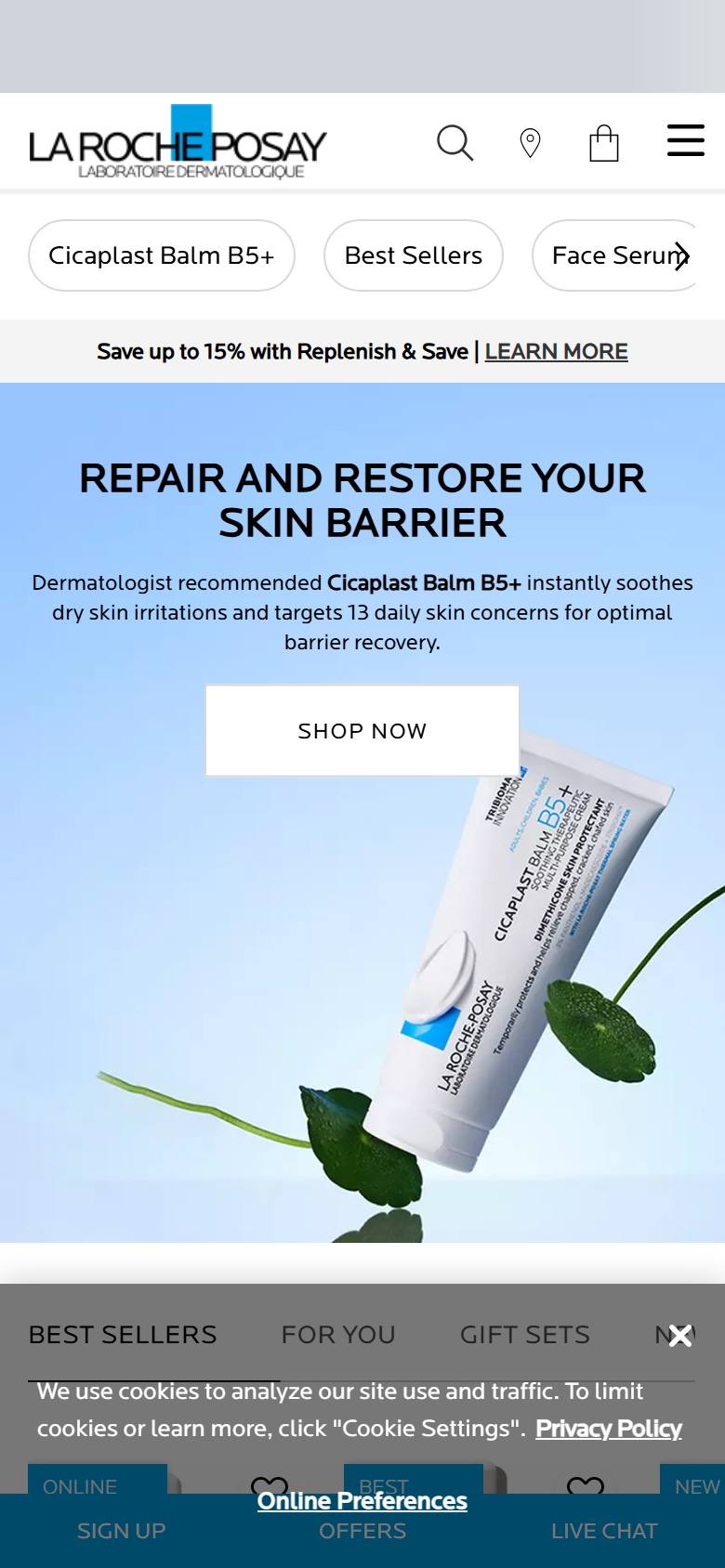
Cicaplast Baume B5 is the product people quietly reorder forever. It is a panthenol, shea and madecassoside balm designed for post-procedure and compromised skin, and it is the most useful single tube in the catalogue — good on retinoid flaking, on windburn, on a toddler's cheeks, on the patch of eczema that appears every February. At around $20 for 40 ml it is not cheap, but you use very little.
Effaclar covers acne with more seriousness than most brands manage. Effaclar Duo+ M is a niacinamide and salicylic treatment that does real work on congestion, and the brand sells adapalene gel 0.1% over the counter in several markets — a genuine retinoid at a supermarket price.
Toleriane is the sensitive-skin core: the Purifying Foaming Cleanser and the Double Repair Face Moisturizer are the two to know, both fragrance-free, both unexciting in the best sense.
Where the range weakens is in actives. The 10% Pure Vitamin C serum is adequate and unstable; the Retinol B3 serum is fine. Neither would win against a dedicated specialist. La Roche-Posay is a tolerance brand, not a potency brand, and the launches that try to be both are the ones that convince least.
What it tells you, and what it does not
Transparency is a strength. Full INCI lists, named allergens, a published position on fragrance, and clear labelling of which products are for which skin state. Where the brand is coy is in efficacy framing: "dermatologist tested" and "suitable for sensitive skin" are doing a lot of quiet work on packs that otherwise stick to the facts.
It is a L'Oréal brand, and has been since 1989. That ownership is visible in the good ways — Mexoryl exists because a conglomerate could fund a twenty-year filter programme — and in the ordinary ways, including a launch cadence that has accelerated well past the pace of actual innovation.
Price
Between roughly $15 and $45 in the US, meaningfully cheaper in European pharmacies where it is a mass-market brand rather than an imported one. Anthelios in France costs about half what the weaker US version costs in an American drugstore, which is an uncomfortable fact for anyone arguing that the premium buys the formula.
The verdict
For sensitive, reactive, post-procedure or acne-prone skin, this is the strongest mass-market range available, and Cicaplast alone would keep it on a recommended list. Buy the sun care abroad if you possibly can. Buy Cicaplast anywhere.
Prices, formulas and ownership were checked against the brand's own site on August 19, 2026 and change without notice. Screenshots in this review were captured by Shelfproof from public pages. Cosmetic ingredients affect people differently — this is consumer research, not medical, dermatological or legal advice.