The verdict
A masterclass in formulation restraint. The Gokujyun lotion does one thing — hydrate — with a handful of ingredients, no fragrance, no colour and no alcohol, and it costs about $14. Very few products in this review are as easy to recommend.
What works
- Gokujyun Hyaluronic Acid Lotion uses four hyaluronic acid molecular weights and almost nothing else
- Fragrance-free, colourant-free, alcohol-free and mineral-oil-free across the core range
- Ingredient lists short enough to evaluate in seconds
- Around $14 for 170 ml — among the cheapest genuinely good products in skincare
What does not
- The US Hada Labo Tokyo range is reformulated and not identical to the Japanese original
- Slightly tacky texture that needs a moment to absorb and puts some people off
- No sun care in the Western range, which is a significant gap for a Japanese brand
- Packaging and marketing are so plain that the products are easy to overlook
The Gokujyun Hyaluronic Acid Lotion has been among the best-selling skincare products in Japan for roughly two decades. Its ingredient list, in the Japanese formulation, runs to around eight items. There is no fragrance, no colourant, no alcohol, no essential oil and no botanical extract included for the sake of appearing on the box.
That restraint is the entire product and it is worth taking seriously, because almost every expensive skincare failure in this review comes from the opposite instinct.
What "lotion" means here
A translation note that trips up a lot of Western buyers. In Japanese skincare, a "lotion" is not a moisturiser — it is a watery hydrating step applied after cleansing and before serum or cream, roughly equivalent to what Korean routines call an essence or a toner. Hada Labo's lotion is a slightly viscous, clear liquid you pat into damp skin.
If you buy this expecting a moisturiser you will be disappointed. Buy it as the hydration layer under your moisturiser and it is excellent.
The formula
The lotion uses four molecular weights of hyaluronic acid: a super-hyaluronic acid, a nano-hyaluronic acid, a standard sodium hyaluronate and a hydrolysed form. The reasoning is straightforward — different molecular sizes sit at different depths in the stratum corneum, so a blend hydrates more evenly than a single weight.
Around it: butylene glycol and glycerin as humectants, a minimal preservative system, and a pH adjuster. That is close to all of it.
The texture is slightly tacky on application and takes fifteen or twenty seconds to settle. That is the one legitimate complaint and it is the trade-off for the humectant load. Applying to damp skin and patting rather than rubbing largely solves it.
At around $14 for 170 ml, the per-use cost is negligible, which matters because a hydrating lotion is a product you should use generously.
The Japanese versus Western question
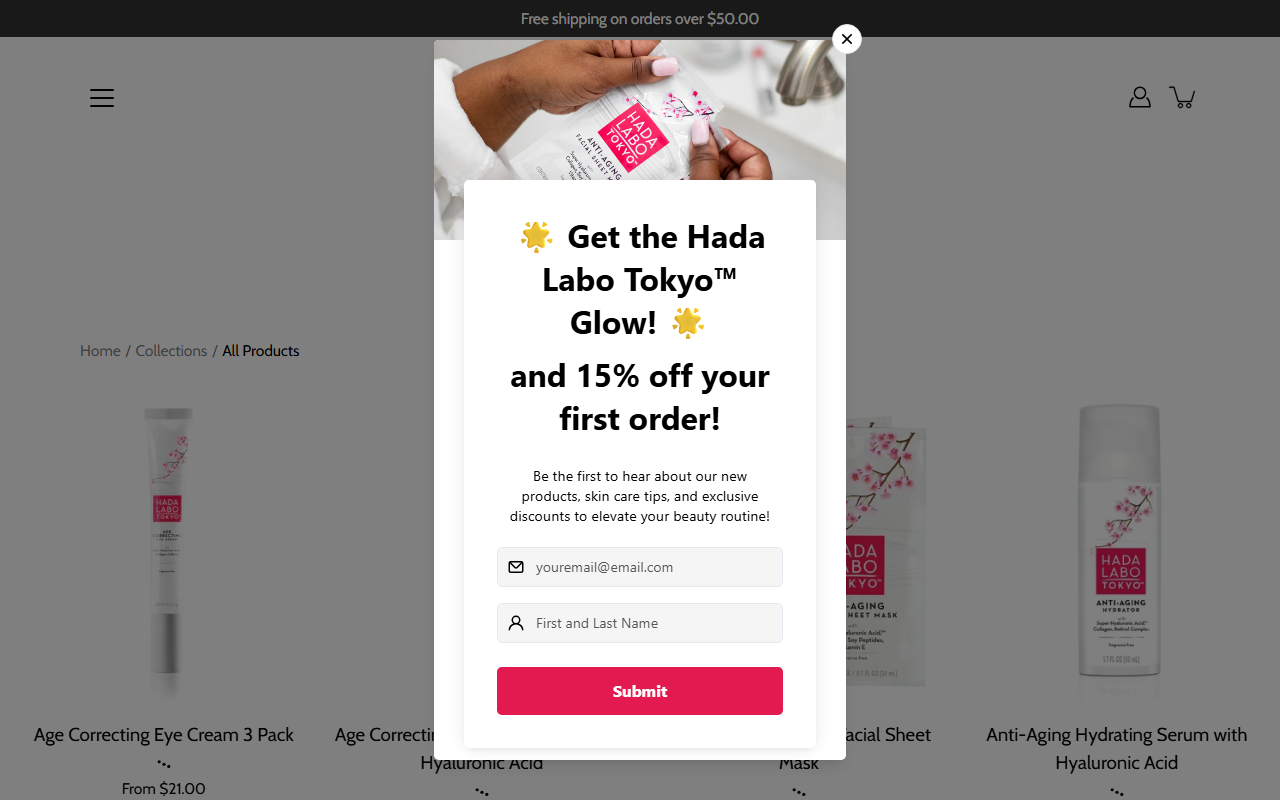
Hada Labo Tokyo, the range sold in the United States, is a reformulation rather than the Japanese original. Rohto adjusted the formulas for the US market, and the ingredient lists differ — the US Hydrating Lotion is still good and still fragrance-free, but it is not the same product that has topped the Japanese charts.
The Japanese Gokujyun line, available through Japanese-import retailers, is the one long-term users mean when they recommend the brand. It is worth knowing which one you are buying.
Within the Japanese range there are variants worth understanding: Gokujyun (the standard hyaluronic lotion), Gokujyun Premium (richer, more hyaluronic weights), Shirojyun (with arbutin for tone), and Gokujyun Alpha (with retinol and collagen). The standard and the Premium are the two to start with.
Transparency
Good. Ingredient lists are short and complete, the free-from claims are specific — no fragrance, no colourant, no alcohol, no mineral oil — and the brand does not make efficacy claims it cannot support. It is a pharmaceutical company's cosmetic brand and it behaves like one.
The gap is the reformulation question: Rohto does not clearly explain that the US range differs from the Japanese one, and a shopper comparing reviews will be reading about two different products.
The case for short ingredient lists
Hada Labo is the clearest illustration of an argument worth making explicitly, because it cuts against most of the marketing in this review.
Every additional ingredient in a formula is another chance to react to something. Botanical extracts, essential oils, fragrance and colourants are all added for reasons that have nothing to do with efficacy — they make a product smell nice, look appealing, or list impressively on a box — and every one of them is a potential sensitiser.
A formula with eight ingredients, all of which are there to do a job, is not a cheap formula. It is a disciplined one, and it is considerably harder to sell, because there is nothing on the label to build a story around.
This is why brands with long botanical lists are often worse for reactive skin than brands with short ones, and why the most expensive product in a category is frequently not the gentlest. Hada Labo's whole proposition is that restraint, and it is the reason a $14 lotion outperforms a great many $80 ones on the only measure that matters for sensitive skin: whether you can use it every day without incident.
What is missing
Sun care. Rohto makes Skin Aqua, one of the best-regarded Japanese sunscreen ranges, and it is not part of the Hada Labo line. For a brand this good at gentle, fragrance-free basics, the absence of a sunscreen in the Western range is the biggest hole in the proposition.
The verdict
Buy the Gokujyun Hyaluronic Acid Lotion — the Japanese version if you can get it, the Tokyo version if you cannot. Pat it into damp skin, follow with a moisturiser, and spend the money you saved on a good sunscreen.
It is one of the most quietly sensible products in this entire review.
Prices, formulas and ownership were checked against the brand's own site on July 31, 2026 and change without notice. Screenshots in this review were captured by Shelfproof from public pages. Cosmetic ingredients affect people differently — this is consumer research, not medical, dermatological or legal advice.