The verdict
A sixty-year-old house with a genuinely deep back catalogue and a candle business that justifies its reputation on burn quality rather than branding. Philosykos and Do Son are two of the best things in accessible niche fragrance.
What works
- Philosykos remains the definitive fig composition — leaf, fruit and wood, not a fruit accord
- Candles burn evenly with a proper scent throw, which most luxury candles do not
- Deep, coherent back catalogue rather than a launch-driven range
- Refillable candle vessels and a repair-and-reuse programme with real uptake
What does not
- $40 for a 70 g candle and $78 for the 190 g is a steep entry
- Some newer launches are noticeably more commercial than the historic range
- Longevity on the eaux de toilette is moderate and not always flagged
- Retail presentation now leans harder on luxury signalling than it used to
Diptyque was opened in 1961 on Boulevard Saint-Germain by three friends — a painter, a set designer and an interior designer — selling fabrics and objects. The candles came in 1963, the first fragrance in 1968. It is one of the few genuinely old niche houses and the back catalogue shows it.
Philosykos
If this review recommends one thing, it is Philosykos. Composed by Olivia Giacobetti in 1996, it is a fig fragrance that renders the entire tree: the green bitterness of the leaf, the milky sweetness of the fruit, and the dry white wood underneath. Most fig fragrances are a sweet fruit accord with a green note over the top. This one is a place.
It exists as eau de toilette and eau de parfum. The EDT is the original and the more transparent; the EDP is heavier on the wood and lasts longer. Around $150 for 75 ml of EDT.
The rest of the fragrance range
Do Son is a tuberose built with a lightness that tuberose almost never gets — white floral without the heaviness that makes most tuberose unwearable in summer. Eau Rose is a clean, uncomplicated rose. Tam Dao is a sandalwood that has been quietly excellent since 2003. L'Ombre dans l'Eau is blackcurrant leaf and rose, green and slightly strange and very good.
The newer launches — the Eaux de Parfum collection in particular — are more conventional and more commercial. They are competently made and they are not the reason to shop here.
The candles, assessed properly
Luxury candles are mostly a con. The typical failure modes are tunnelling — the wick burns straight down, leaving a ring of unused wax — and a scent throw so weak the room never smells of anything.
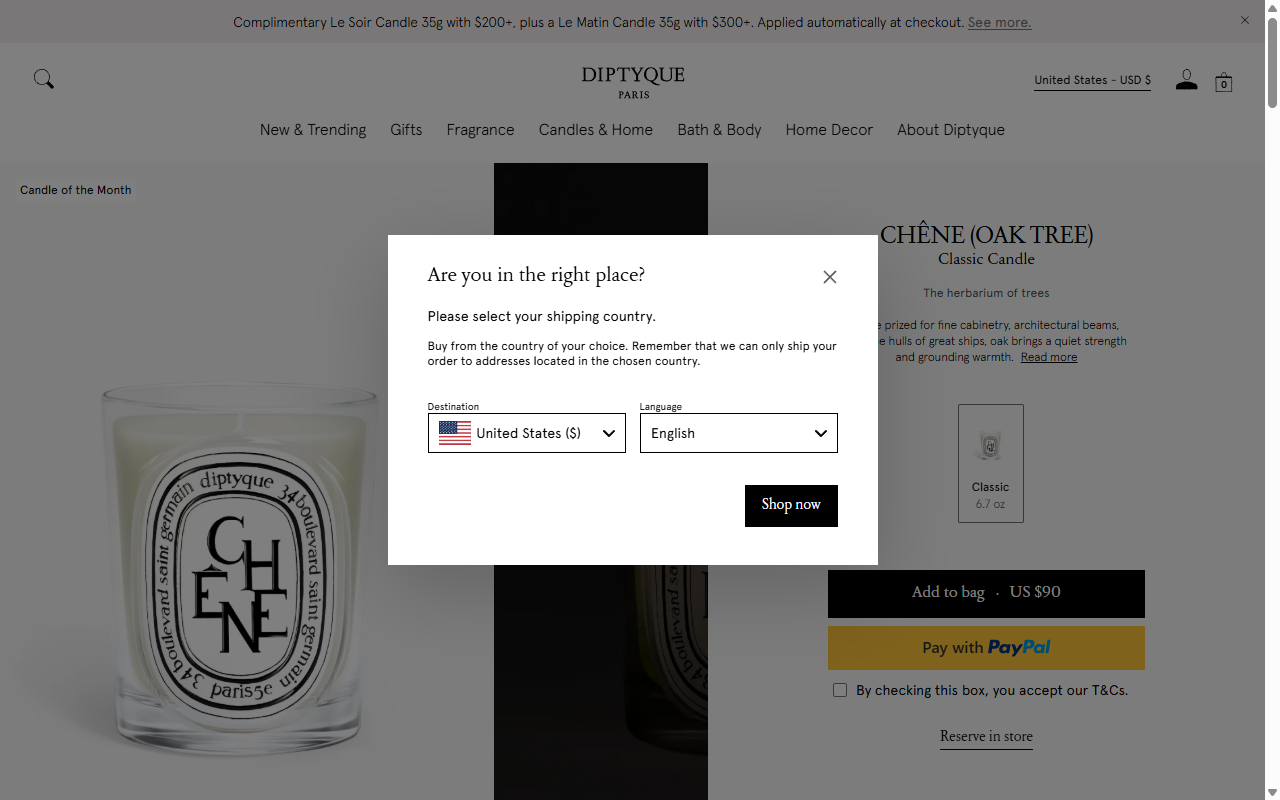
Diptyque's candles do not do this, and the reason is unglamorous: correct wick sizing for the vessel diameter, and a wax blend that melts to the edge. A 190 g Baies will burn evenly to the glass and will scent a medium room within twenty minutes. That is what you are actually paying for, and it is the difference between a $78 candle and a $12 one that tunnels.
Baies — blackcurrant leaf and rose — is the famous one and deserves it. Figuier is Philosykos in candle form. Feu de Bois is a woodsmoke that smells like an actual fire rather than a fire-scented product.
The vessels are reusable and Diptyque runs a programme for refilling and repurposing them, which is more than a gesture given how many of these glasses exist in the world.
Transparency
Reasonable for the category. Diptyque credits its perfumers — Giacobetti, Fabrice Pellegrin and others — publishes note pyramids, and is clear about the difference between its EDT and EDP concentrations. It does not publish material lists in detail, which no commercial house does.
Getting your money's worth from the candles
If you are going to spend $78 on a candle, two habits determine whether you get what you paid for.
First burn: leave it lit until the melt pool reaches the edge of the glass, which takes two to three hours for the 190 g. Wax has memory. If the first burn only melts the centre, every subsequent burn will tunnel down that channel and you will lose a third of the candle to a hard ring of unused wax around the sides.
Every burn after: trim the wick to about 5 mm before lighting. An untrimmed wick mushrooms, produces soot, blackens the glass and burns the fragrance off faster than it can disperse. Do not burn for more than about four hours at a stretch — past that the wax overheats and the scent throw actually drops.
Done properly a 190 g will give roughly sixty hours. Done badly it will give thirty-five and leave a ruined glass. That is a $40 difference in something entirely within your control, and it is the single most useful thing anyone can tell you about luxury candles.
Ownership and price
Diptyque is owned by Manzanita Capital, a London investment firm, which has held it since 2005 and has left the house's direction largely alone — a noticeably lighter touch than the conglomerate acquisitions elsewhere in this category.
Prices: $40 for a 70 g candle, $78 for 190 g, $150 to $250 for most fragrances, up to $320 for the largest formats. The 70 g candles and the 20 ml travel fragrances are the sensible way in.
The verdict
Buy Philosykos. Buy a Baies candle if you are going to buy a candle at all, because it is one of very few in this price bracket where the product justifies the number.
Sixty-five years in, Diptyque is still making things properly, which is the highest compliment available in a category this full of marketing.
Prices, formulas and ownership were checked against the brand's own site on August 22, 2026 and change without notice. Screenshots in this review were captured by Shelfproof from public pages. Cosmetic ingredients affect people differently — this is consumer research, not medical, dermatological or legal advice.