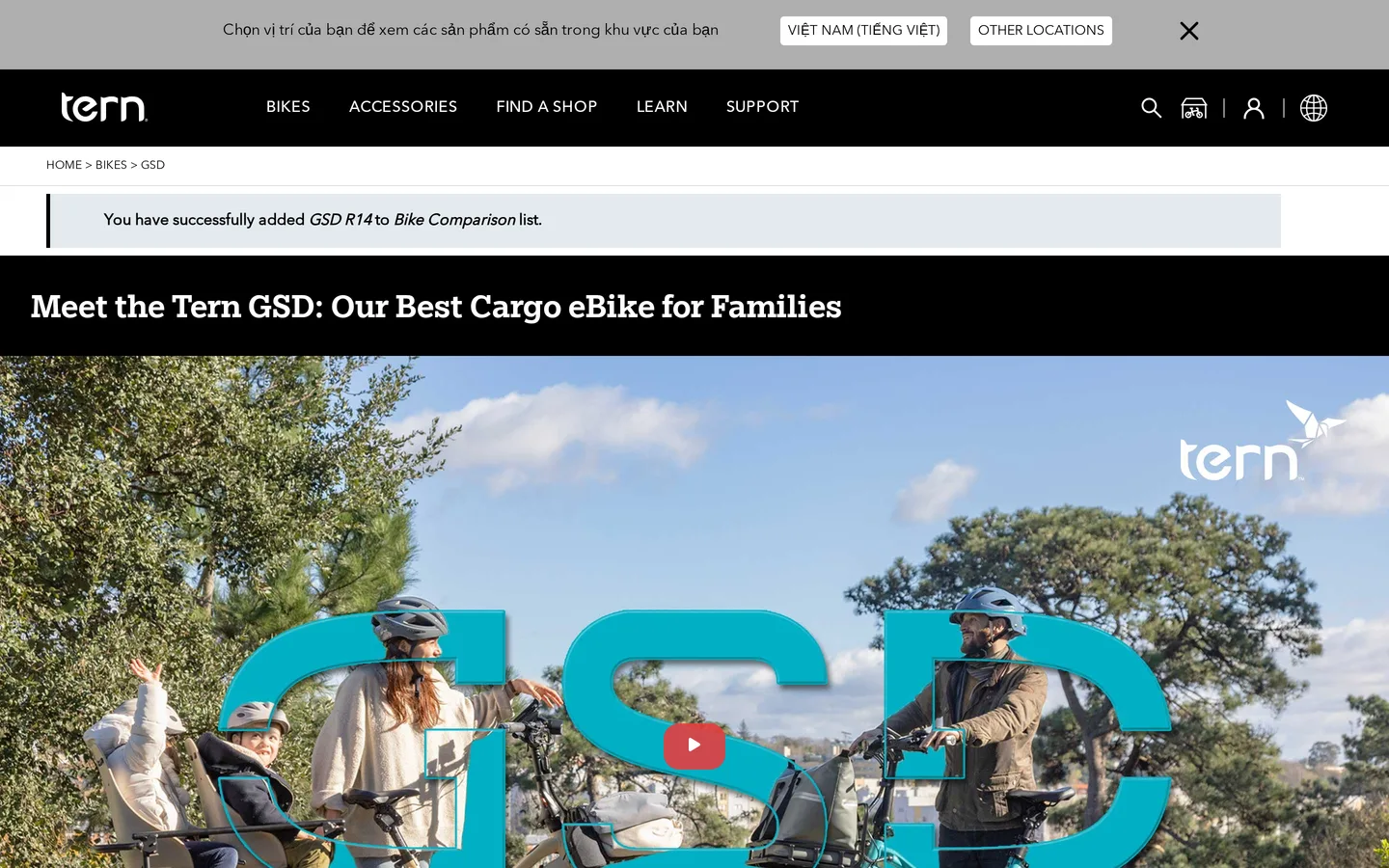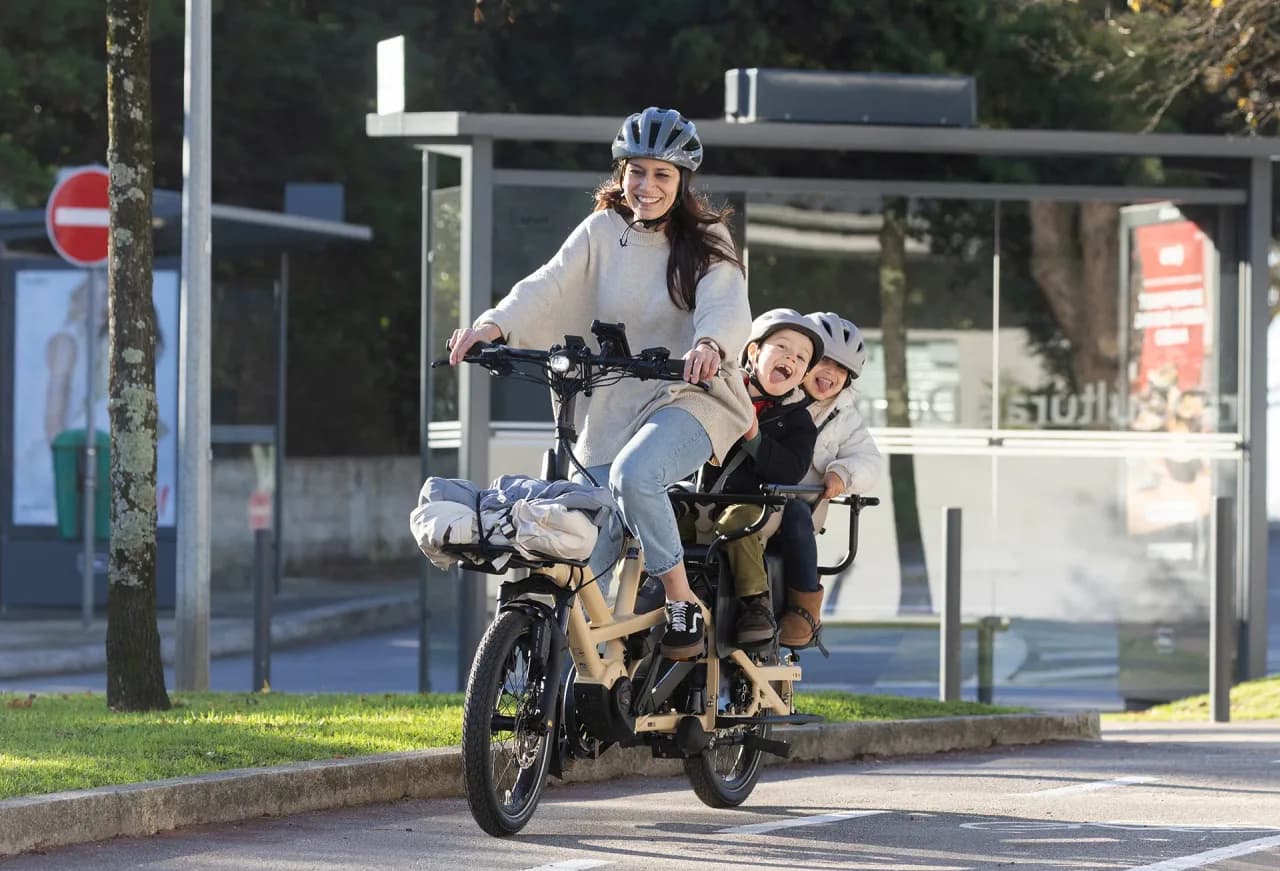
On Tern's bike range page there is a filter no other bicycle brand offers: filter by passenger count. You pick “+1 passenger” or “+2 passengers” and the list narrows.
That filter tells you what problem Tern thinks its customers are solving.
210 kg: the most important number, and the least discussed
Tern states that the GSD Gen 3 has a gross vehicle weight of 210 kg — 463 pounds.
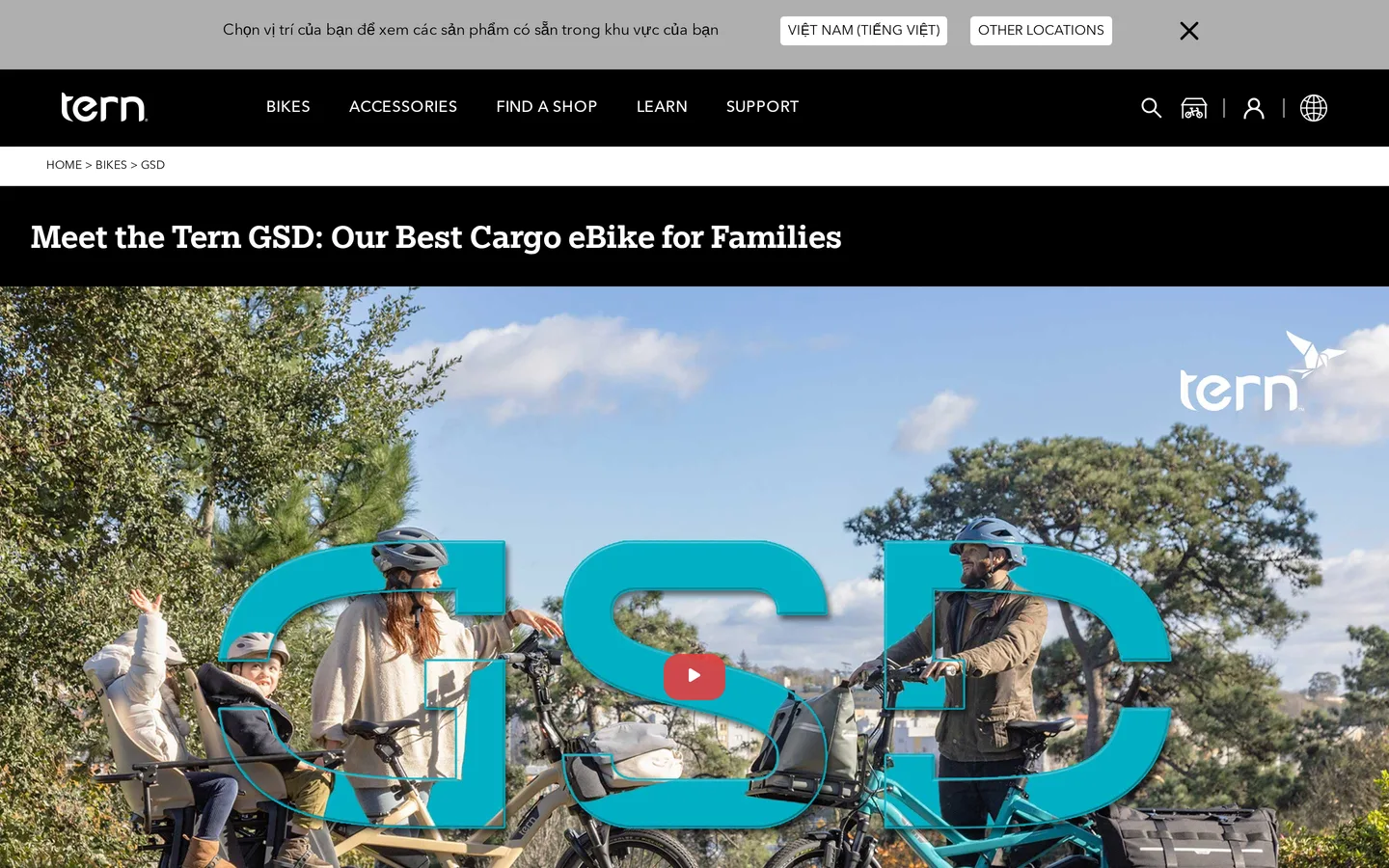
That is the total: the bike's own weight, plus rider, plus passengers, plus cargo. It is not additional payload.
Work through an ordinary school morning:
The bike: about 35 kg.
Adult riding: 65 kg.
Two children on the rear seat: 22 kg and 28 kg.
Rucksacks, school bags, shopping: 12 kg.
Total: 162 kg. That leaves 48 kg spare. This is a bike engineered with a real margin, not with a number just big enough to print on a flyer.
When comparing cargo bikes, always ask: is this figure additional payload or gross vehicle weight? The two differ by exactly the weight of the bike — usually 30 to 40 kg.
Short, and why that changes everything
Traditional cargo bikes come in two shapes: longtails, stretched at the back, and bakfiets with a box at the front. Both are considerably longer than an ordinary bicycle.
Length is a real problem: the bike does not fit in a lift, cannot turn in an alley, does not fit the bike store at a block of flats, and will not go on many car racks.
The GSD keeps its overall length to about that of a normal bike while still carrying two passengers. That comes from using small wheels and designing the frame around exactly this problem.
It sounds like an engineering detail. In daily life it is the difference between a bike you use every day and a bike you find annoying.
Gen 3: a redesigned frame
Tern describes the new GSD as having a frame redesigned to carry the 210 kg gross weight, stronger and smarter than the previous generation.
On a bike carrying two children, upgrading the frame rather than only the motor is the right signal. The frame is what holds everything together, and on a cargo bike it takes bending moments an ordinary bicycle never sees.
The price
The GSD sits in the most expensive group in this series. Tern does not list a single global price because it sells through dealers in each market.
The calculation worth doing is not GSD against another e-bike. Compare it with the cost of keeping a second car: purchase, parking, servicing, fuel. In many European cities, families buy a GSD precisely to get rid of a car — and from that angle, the price is a saving.
If you are not replacing a car, the maths is different: a moped-class electric scooter that carries two people costs far less. The GSD does not compete with that on cost; it competes on whether you want to pedal.
Carrying children: four things that are mandatory, not optional
If you plan to carry a child on any e-bike, GSD or otherwise, this is the minimum checklist.
Enclosed footrests. A child's foot pulled into the spokes is the most common injury when carrying children by bike, and the injuries are severe.
A rear spoke guard. A second layer of protection against the same problem. Do not skip it just because there are footrests.
A handrail or a surrounding frame. Children fall asleep on bikes. With nothing holding them, they fall off.
A double kickstand, not a side stand. You need the bike to stand steady while you lift a child on, and a side stand cannot do that with a load aboard.
The GSD has all four as part of its design. On other models, check each one — and if a bike is sold as “child-friendly” without a double stand, start asking questions about the rest of it.
And the availability question
Tern localises its site for a long list of markets, which is more than most brands here manage. But in many countries the dealer network is still thin, and the GSD is a bike that wants assembling and servicing by someone who understands it.
We score it 8.9 — the highest in this whole series. It is the only bike we looked at where we could not find a corner cut in the wrong place.
Nhìn tận mắt