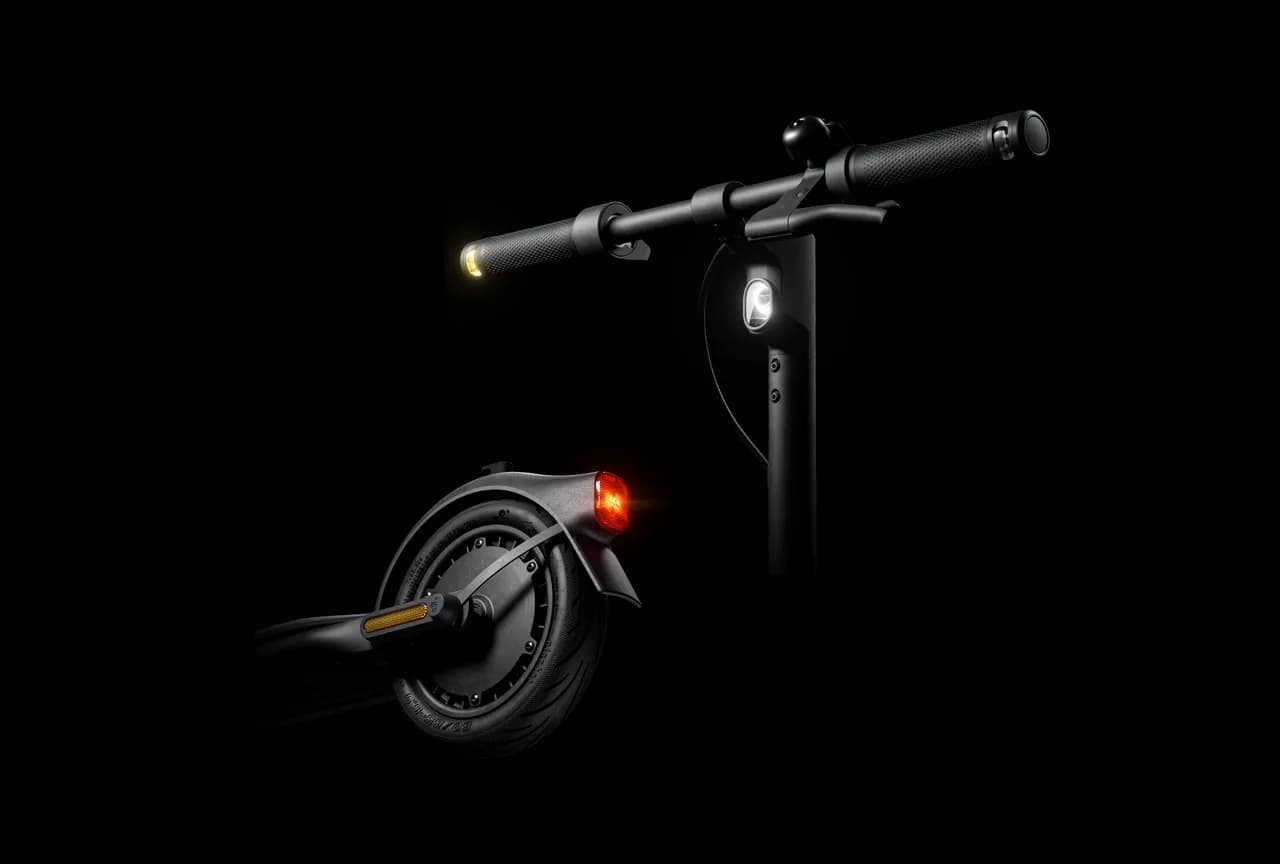
Ask anyone who has ridden an electric scooter for a year what went wrong. The most common answer is not the battery, not the motor, not the brakes.
It is a puncture.
Self-sealing tyres: why they are worth more than they look
Scooter wheels are small, run at high pressure, and travel close to the road where the glass, screws and metal fragments are. The puncture rate is far higher than on a bicycle.
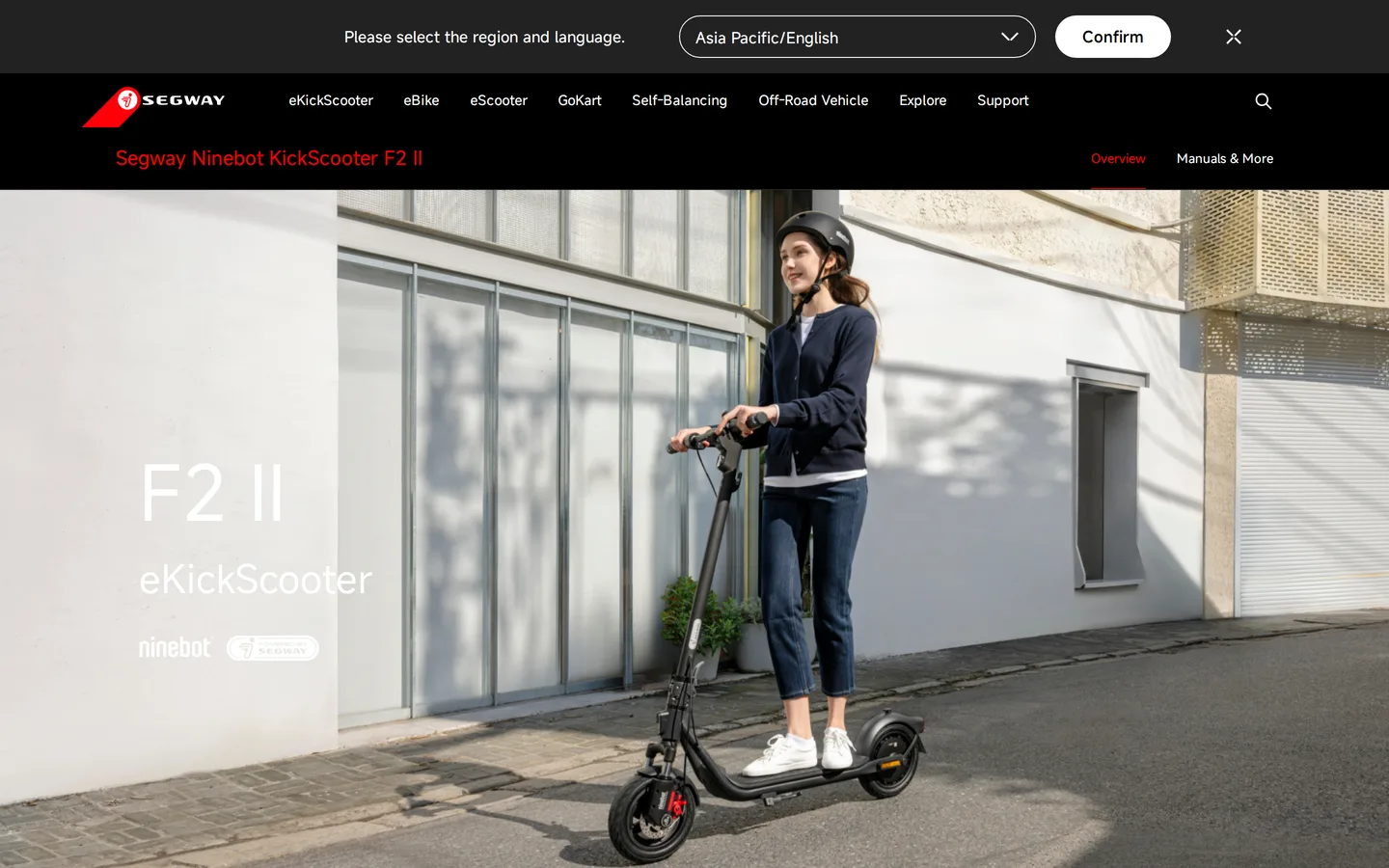
And repairing a scooter puncture is considerably harder than repairing a bicycle one: the rear wheel usually contains the motor, so removing it means disconnecting the motor wiring. Many owners have to take the machine to a shop, and many shops will not touch it.
A self-sealing tyre contains a layer of sealant inside. When something sharp punctures it, the sealant floods the hole and sets. Small punctures are closed before you notice them.
It is not a fix for everything — sealant cannot cope with a long cut. But it removes most real-world punctures, and those are most of the reason a scooter ends up parked.
Of all the features on an electric scooter, self-sealing tyres are the one you will be most grateful for and never actually see working.
Segway publishes two range figures — and that deserves credit
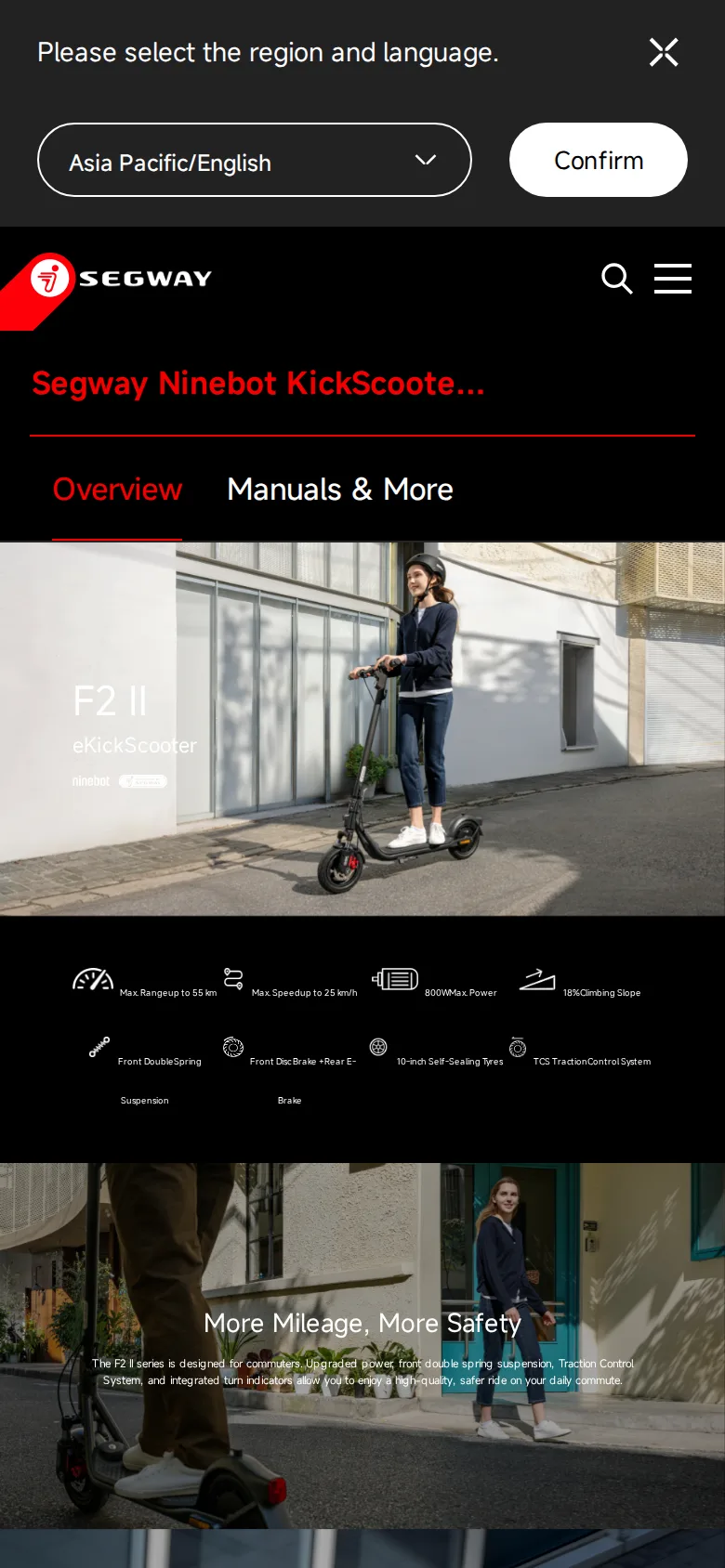
The spec table states plainly: 55 km in Eco and 40 km in Sport, each with its own footnote.
Most brands publish only the larger number and let you discover it was measured in the slowest mode. Putting both on the table is the honest approach, and it gives you a real range to plan within.
The battery capacity of 367 Wh is also stated. That lets you cross-check: 367 Wh over 55 km is about 6.7 Wh per km — a reasonable figure for a 17.3 kg scooter in economy mode.
TCS: traction control on a scooter
The TCS system detects the driven wheel losing grip and cuts power until it bites again.
On city streets after rain — painted road markings, cast-iron manhole covers, glazed pavement tiles — this happens for real. A scooter's rear wheel carries little weight, and when you open the throttle on a slick surface, it spins.
TCS at this price is above expectations. Together with the twin front springs, the F2 II has a more serious chassis than people usually get here.
One point to note about the brakes
Segway states: front disc brake, rear electronic brake.
An electronic brake uses the motor itself to slow the machine. It is smooth, it does not wear, and it costs nothing to maintain. But it is weaker than a mechanical brake in an emergency stop, and it does nothing if the electrical system faults.
At 25 km/h with a front disc to back it up, that configuration is acceptable. But build the habit of using both brakes together, and do not rely on the rear lever alone.
An 18% gradient: what that means on real roads
Segway states that the F2 II climbs 18% — a rise of 18 metres for every 100 metres travelled horizontally.
For a sense of scale: the ramp up a city flyover is usually between 6 and 10%. The ramp down into an underground car park can reach 15 to 20%. A mountain road rarely exceeds 12%.
So 18% covers almost anything you meet in a city, including a car park ramp — the situation where plenty of weaker scooters make their rider get off and push.
Note the test conditions: that figure goes with the standard load the maker used in testing. If you are heavier than that, or carrying a full rucksack, the real climbing ability is lower. And a long climb is not a short one — 18% for ten metres is very different from 18% for two hundred, because the motor heats up.
17.3 kg: the price of solidity
The F2 II weighs 17.3 kg, nearly 6 kg more than the NIU KQi Air.
That weight sits in the suspension, the thicker tyres and the stiffer frame. The trade is clear: the F2 II is the better scooter to ride, the KQi Air is the better scooter to carry.
If your journey runs from your door to your office with no stairs in between, take the F2 II. If you have to carry it through a station every morning, take the KQi Air.
We score it 8.5.
Nhìn tận mắt