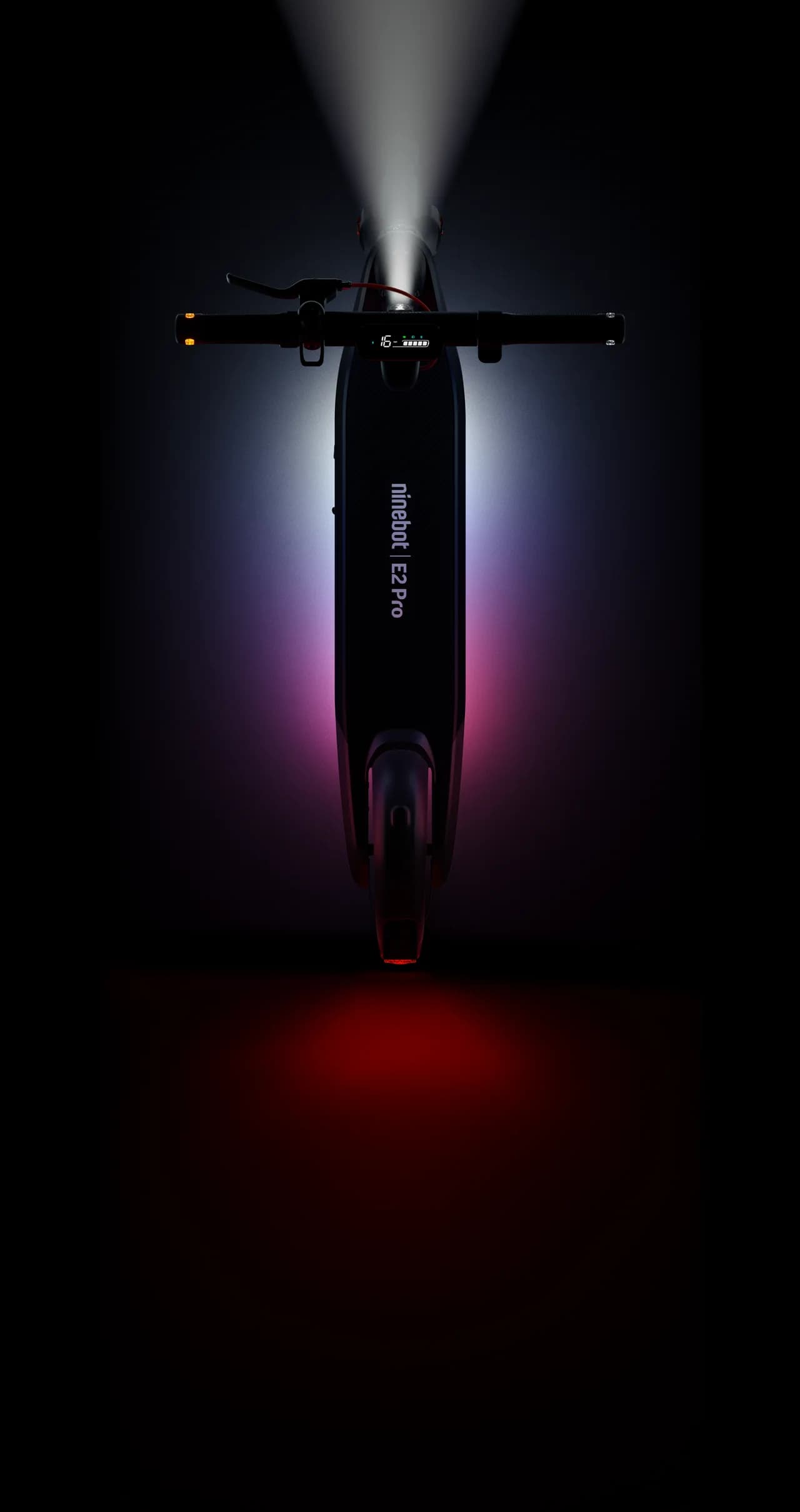
Almost every scooter brand publishes one range figure. Segway publishes three, and states the test conditions for each:
27 km at the 25 km/h top speed.
35 km in mode D, at 20 km/h.
40 km in mode E, at 15 km/h.
With a footnote: measured with a full battery, a 75 kg rider, at 25 °C, on average road surface.
This is how a brand you can trust publishes a specification.
Why one number is never enough
Range on any electric vehicle depends heavily on speed, because air resistance rises with the square of velocity. The difference between 15 km/h and 25 km/h on the E2 Pro is 48% of the range — from 40 km down to 27 km.
When a brand publishes only “40 km”, it is publishing the figure from the slowest mode and letting you discover that after you have bought. Not technically wrong, but it sets the wrong expectation.
When you read a range figure, hunt for the test conditions. If you cannot find them, knock thirty percent off and plan around that.
Segway also states the rider weight used in the test: 75 kg. That matters: if you weigh 90 kg, your real range will be below even the published figure.
275 Wh: a small battery, and what that means
A battery capacity of 275 Wh is modest. Segway's own F2 II carries 367 Wh, a third more.
A small battery has two consequences. First, less range — visible in that 27 km figure. Second, and less often considered: you charge more often, which means the pack goes through more cycles for the same total distance.
A lithium battery's life is counted in cycles. A small-battery scooter covering the same annual distance ages faster than a big-battery one.
The upside: a small battery means a lighter scooter and a faster charge. For a 3 km hop each way, 275 Wh is plenty and you get the weight benefit.
Three safety details worth praising
An IPX6 battery
Segway states that the pack meets IPX6 — it withstands powerful water jets from any direction. On a device ridden in the rain and sprayed by its own wheels, that is the right rating to quote.
BMS
The battery management system is named right in the headline spec block, not buried at the bottom of the page. The BMS is what watches temperature and per-cell voltage and cuts out when something is wrong.
TCS
Traction control, for stability. On slick surfaces — painted lines, manhole covers, wet paving — this is a feature that genuinely does something.
A 120 kg payload: high for the class
Maximum payload is 120 kg. Plenty of mass-market scooters stop at 100 kg, and for a 95 kg rider with a backpack that is a real limit.
Exceeding the payload on a scooter is not only a warranty question. It cuts range, raises the temperature of motor and controller, and loads the deck beyond what it was designed for.
Three ride modes, and how to actually use them
The E2 Pro has three modes matching three speeds: 15, 20 and 25 km/h. The common habit is to select the fastest and leave it there. There is a better way.
Mode E (15 km/h): for shared pavement with pedestrians, inside a campus or a hospital site, and for your first two weeks while you learn the machine. Good for 40 km.
Mode D (20 km/h): the sensible default for most journeys. Fast enough not to lose patience, slow enough to stop in time. Good for 35 km.
The fastest mode (25 km/h): for open stretches with good tarmac. Good for 27 km.
The habit worth building: change mode with the road surface, not with your mood. After rain, with wet paint and manhole covers about, drop into mode D. Five km/h is nothing against stopping distance on a slippery surface.
An 18% gradient
Segway claims a climbing ability of 18% — a rise of 18 metres over 100 metres of road. That is a steep gradient, comparable with the ramp up a large flyover.
With 750 W of peak power, the figure is plausible. It is achieved with a 75 kg load; if you are heavier, plan for less.
The verdict
We score it 8.2. Not because the E2 Pro has the strongest numbers — it does not — but because this is a scooter where every figure is published with its conditions, and every design decision is consistent with what the thing is for.
Nhìn tận mắt